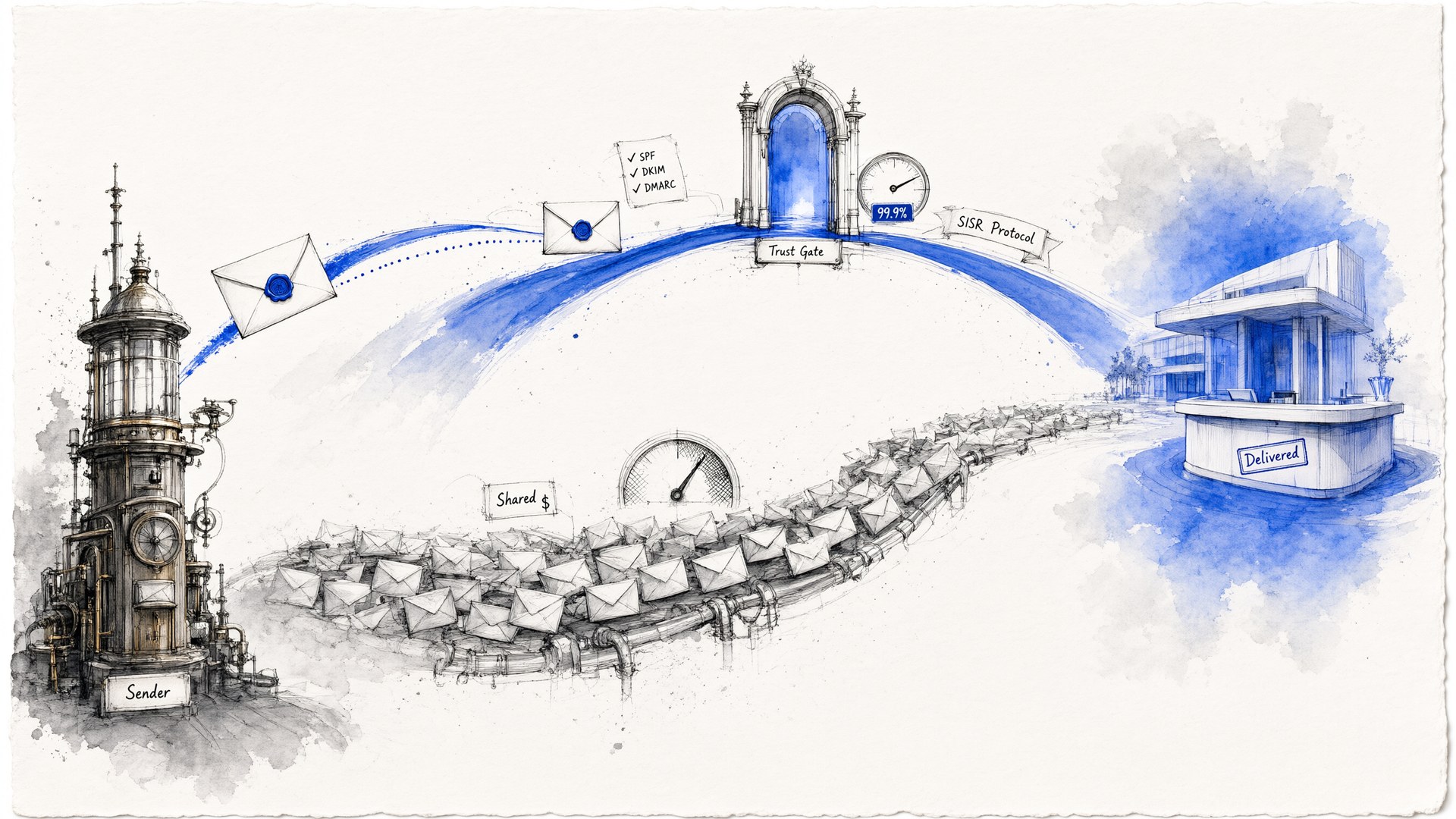
Compare dedicated vs. shared IP pools in 2026. See benchmarks, costs, and the SendroAI SISR protocol for stable cold email deliverability at scale.
Why IP Pool Architecture Determines 2026 Cold Email Success Rates
In 2026, the debate between dedicated and shared IP pools has evolved from a technical configuration choice to a strategic determinant of revenue. For B2B organizations, the architecture of your sending infrastructure dictates not just whether emails land in the inbox, but how consistently they do so under varying load conditions. Mailbox providers (MBPs) like Google and Microsoft have tightened their algorithms to prioritize sender reputation stability over raw volume. Consequently, the decision to isolate your reputation via dedicated IPs or leverage pooled trust through shared environments must be driven by specific operational thresholds rather than generic best practices.
The Reputation Isolation Imperative
Reputation isolation is the primary advantage of dedicated IP pools. When you utilize a dedicated pool, every email sent contributes exclusively to your unique sender score. This creates a clean feedback loop where high engagement rates directly improve deliverability, and conversely, issues can be diagnosed without noise from other senders. In contrast, shared IP pools distribute reputation across hundreds or thousands of accounts. While this offers immediate access to pre-warmed trust, it introduces inherent volatility; a single neighbor engaging in spam-like behavior can negatively impact your placement rates, regardless of your own hygiene.
- Exclusive control over sender reputation metrics and troubleshooting signals
- Ability to segment cold outreach, marketing, and transactional streams onto distinct subdomains
- Predictable scaling once warmup phases are completed successfully
- Direct correlation between list quality and inbox placement stability
Never mix cold outreach with transactional or marketing traffic on the same IP pool. The engagement patterns differ significantly: transactional emails receive near-100% opens, while cold outreach may see 5-15%. MBPs use these variance patterns to assess intent. Segregating streams ensures that a temporary dip in cold reply rates does not poison the reputation of your critical system notifications.
| Dimension | Dedicated IP Pools | Shared IP Pools |
|---|---|---|
| Reputation Control | Exclusive to your organization's sending behavior | Shared across multiple unrelated senders, introducing external risk |
| Warmup Requirement | Requires gradual ramp-up over several weeks to establish trust | Typically pre-warmed, allowing immediate high-volume sending |
| Volume Stability | Highly stable after warmup; absorbs large consistent loads | Subject to rate limits and potential fluctuation from neighbors |
| Cost Structure | Higher fixed costs plus potential infrastructure management fees | Lower entry cost, often included in standard SaaS tiers |
The threshold for switching to dedicated IPs is no longer just about volume; it is about consistency. If your monthly sending volume exceeds 50,000 emails and remains relatively steady, dedicated IPs become cost-effective because the overhead of warmup is amortized over time. For teams below this threshold, shared pools remain viable provided that strict authentication protocols—SPF, DKIM, and DMARC—are implemented correctly. However, as you scale towards enterprise-level outreach, the risk of shared pool contamination outweighs the convenience. According to recent industry data, organizations using dedicated pools report up to 40% fewer false-positive spam flags during peak campaign periods compared to those relying on shared infrastructure.
Illustrative Example: A B2B SaaS company scales from 10,000 to 200,000 monthly sends. Initially, they use shared IPs for rapid testing. As they move to dedicated IPs, they observe a 15% increase in primary inbox placement within four weeks of completing warmup, attributed to the elimination of 'noisy neighbor' effects.
Result: Stabilized deliverability at scale allows for predictable pipeline generation without reactive firefighting.
Managing dedicated IP pools requires rigorous discipline. Unlike shared environments where the provider manages reputation health, dedicated pool owners are solely responsible for maintaining low bounce rates and complaint levels. A hard bounce rate exceeding 1% or a complaint rate above 0.3% can trigger immediate throttling or blacklisting by major providers. Therefore, the transition to dedicated IPs must be accompanied by enhanced list verification processes and automated monitoring tools. Teams should implement weekly seed tests to monitor placement across Gmail, Outlook, and Yahoo before initiating any significant volume increases.
Decision Rules for IP Architecture
- Use shared IPs only if monthly volume is under 50k and consistency is sporadic
- Migrate to dedicated IPs when volume exceeds 50k/month and remains steady
- Always segment cold outreach from transactional traffic using separate subdomains
- Implement automated seed testing weekly to detect reputation drift early
Ultimately, the choice between dedicated and shared IP pools hinges on your organization's maturity in cold outreach. Early-stage teams validating their Ideal Customer Profile (ICP) should leverage shared IPs to minimize setup friction and cost. However, as you optimize for long-term ROI and brand protection, dedicated pools offer the necessary isolation to safeguard your domain reputation. For a deeper understanding of how IP architecture impacts overall deliverability, review our comprehensive analysis on 2026 B2B Cold Email Benchmarks: Open & Reply Rates.
Shared IP Pools: The Low-Friction Entry Point for Early-Stage Teams
For early-stage B2B teams and startups, shared IP pools represent the most logical entry point for cold outreach infrastructure. In 2026, the friction of acquiring, authenticating, and warming a dedicated IP block often outweighs the marginal deliverability gains for low-volume senders. Shared pools leverage pre-established sender reputation managed by the ESP or platform provider, allowing teams to bypass the traditional 4-6 week warmup period required for new IPs. This immediate availability is critical for validating ICP (Ideal Customer Profile) fit and messaging resonance before committing significant capital to infrastructure. By utilizing shared resources, early teams can focus budget on data quality and creative strategy rather than technical deliverability maintenance.
The Mechanics of Shared Reputation
Shared IP pools operate on a multi-tenant model where your sending volume is aggregated with other users on the same infrastructure. Mailbox providers like Google and Yahoo evaluate the aggregate behavior of the IP address rather than individual sender metrics in isolation. For early-stage teams, this provides a "trust buffer"; if one user in the pool spikes aggressively, the collective reputation absorbs the shock better than a single dedicated IP would. However, this model introduces the risk of "neighbor contamination," where poor practices by other senders can temporarily depress placement rates for everyone on the pool. To mitigate this, SendroAI and similar platforms enforce strict governance, capping per-inbox sends at 30 emails per day during ramp phases and requiring verified contact lists to keep hard bounce rates below 1%.
Shared IP Pool Tradeoffs for Early Teams
- Immediate deployment without warmup delays
- Lower upfront cost included in standard plans
- Reduced technical overhead for authentication setup
- Resilience against minor volume fluctuations
- Exposure to neighbor reputation volatility
- Limited granular control over IP-level analytics
- Potential throttling during high-demand periods
- Inability to isolate specific campaign failures
Despite these limitations, shared IPs remain highly effective for teams sending under 5,000 emails per month. The key constraint is discipline: you must maintain consistent sending patterns and avoid sudden spikes that trigger provider filters. If your team is still refining its value proposition, the flexibility of a shared pool allows for rapid iteration on subject lines and body copy without the penalty of damaging a dedicated IP's long-term reputation. For more complex setups involving multiple brands or high-volume enterprise scaling, consider reviewing our guide on The 2026 Cold Email Deliverability Audit to understand when to transition away from shared infrastructure.
Illustrative Example: A Series A SaaS startup launches its first cold email campaign targeting mid-market CTOs. They have a clean list of 2,000 contacts and plan to send 50 emails per day across 5 inboxes. They choose a shared IP pool through their outreach software.
Result: The team achieves an initial open rate of 45% within the first week because the shared IP already has established trust with major ISPs. They avoid the 3-week warmup period, allowing them to validate their messaging hypothesis immediately. When they decide to scale to 20 inboxes next month, they retain the ability to migrate to dedicated IPs later without losing domain authority.
Choosing a shared IP pool also aligns with the lean operational model favored by many modern B2B teams. It eliminates the need for dedicated DevOps support to manage SPF, DKIM, and DMARC configurations for multiple IP blocks, although basic domain authentication remains mandatory. This reduction in technical debt allows sales development representatives (SDRs) to focus on outbound activities rather than inbox troubleshooting. As your volume grows and becomes consistent, you can reassess your needs using tools like Top Cold Email Software for B2B Teams in 2026 to identify features that support seamless migration to dedicated pools when ready.
Dedicated IP Pools: Reputation Isolation and Scale Control
In the high-stakes environment of 2026 B2B outreach, a dedicated IP pool is not merely a technical configuration; it is an asset class that requires active management. By definition, a dedicated IP pool consists of sending addresses used exclusively by your organization, ensuring that every email sent contributes solely to your unique sender reputation. This isolation creates a closed feedback loop between your sending practices and mailbox provider (MP) algorithms. When your data hygiene is rigorous and engagement rates are healthy, this exclusivity allows you to build a trust score that is immune to the erratic behavior of other senders. However, this benefit comes with a significant prerequisite: you must own the risk entirely. Unlike shared environments where reputation is averaged across thousands of users, a dedicated IP starts at zero. If your initial campaigns trigger spam filters due to poor list quality or aggressive pacing, the penalty falls directly on your infrastructure, potentially resulting in immediate blacklisting without the buffer of a pre-warmed community reputation.
The Economics of Isolation and Scale
Transitioning to dedicated IPs is often driven by volume thresholds and the need for granular control over multi-stream operations. For agencies managing multiple clients or enterprises running distinct product lines, mixing cold outreach with transactional or marketing emails on a shared pool is a recipe for catastrophic deliverability failure. A dedicated pool allows you to segment these streams logically, ensuring that a spike in newsletter opens does not dilute the reputation of your primary sales sequences. The financial reality involves upfront costs for IP acquisition and warmup capacity, but the ROI becomes clear when you factor in the cost of lost deals due to inbox placement volatility. To visualize the operational differences, consider how these pools handle key deliverability dimensions:
| Dimension | Dedicated IP Pool | Shared IP Pool |
|---|---|---|
| Reputation Source | Exclusive to your sending history | Averaged across all pool members |
| Volume Control | Unlimited after warmup completion | Strictly rate-limited by provider safety |
| Troubleshooting | Direct attribution to your campaigns | Noisy; hard to isolate specific issues |
| Warmup Requirement | Mandatory gradual ramp (weeks) | Pre-warmed; immediate sending possible |
The decision to adopt dedicated IPs should be grounded in your ability to maintain consistent sending patterns. Mailbox providers reward predictability. If your team sends 5,000 emails one day and zero the next, a dedicated IP will struggle to establish a stable baseline. Conversely, if you can sustain a steady daily volume, the algorithm begins to categorize your traffic as "high-intent" rather than "bulk." This distinction is critical for bypassing aggressive spam filters that rely on behavioral heuristics. Furthermore, dedicated pools enable advanced segmentation strategies, such as using different subdomains for different verticals. For example, you might route healthcare outreach through health.yourdomain.com on IP Set A, while tech startups go through tech.yourdomain.com on IP Set B. This level of granularity protects your root domain's reputation even if one specific vertical experiences temporary engagement drops.
For organizations ready to scale beyond the early stages, dedicated IP pools offer the stability required for enterprise-grade outreach. However, they demand discipline. You must treat your IP reputation as a fragile asset that requires constant monitoring. If you find yourself struggling with the complexities of IP management, consider leveraging platforms like SendroAI that automate these workflows. Our approach integrates dedicated IP handling with advanced data hygiene protocols to ensure your reputation remains pristine as you scale. Learn more about our comprehensive strategy in our guide on The 2026 Multi-Account Deliverability Protocol: Scaling B2B Outreach Without Reputation Risk.
Never mix cold outreach with transactional emails on the same dedicated IP. Transactional mail has different engagement patterns and higher volumes, which can skew your reputation metrics and confuse mailbox providers. Always use separate IP sets for transactional vs. promotional/outbound traffic.
The 2026 Benchmark: When to Switch from Shared to Dedicated
The decision to transition from a shared IP pool to a dedicated infrastructure is not merely a technical upgrade; it is a strategic pivot that defines your sender reputation architecture. In 2026, as mailbox providers like Google and Yahoo enforce stricter bulk sender guidelines, the margin for error on shared networks has effectively vanished. While shared IPs offer a low-friction entry point for early-stage validation, they introduce an uncontrollable variable: your deliverability is inextricably linked to the aggregate behavior of every other sender on that pool. If a neighbor engages in spammy practices or suffers a sudden volume spike, your inbox placement can degrade regardless of your own hygiene. The verdict is clear: you must switch to dedicated IP pools when your sending volume becomes consistent enough to sustain a warmup period, yet high enough that reputation isolation is required to protect business-critical revenue streams.
The Volume Thresholds and Timing Signals
Timing your migration correctly prevents the common pitfall of dedicating an IP before it has earned sufficient trust. Mailbox providers require a sustained history of positive engagement signals to reward a dedicated IP with stable primary inbox placement. Moving too early results in a "cold start" penalty where the IP struggles to gain traction against established shared pools. Conversely, waiting too long exposes your brand to the volatility of pooled reputation risks. The benchmark for switching hinges on three concrete metrics: consistent daily volume, verified list quality, and multi-stream segmentation needs. If you are sending sporadically or below steady thresholds, the cost and complexity of managing a dedicated IP outweigh the benefits. However, once you cross into predictable, high-volume territory, the stability offered by isolation becomes non-negotiable for scaling outreach programs.
- Consistent Daily Volume: You send a steady, predictable number of emails daily, allowing the dedicated IP to maintain a stable reputation score without volatile dips.
- Reputation Isolation Needs: You manage multiple email streams (e.g., cold outreach, marketing newsletters) that require separate reputational lanes to prevent cross-contamination.
- High-Value Campaigns: Your average deal size justifies the investment in premium infrastructure, making inbox placement stability critical for ROI.
- Multi-Client Management: As an agency or SDR team, you need to segment reputations by client or vertical to ensure one underperforming campaign does not poison the well for others.
The 2026 Switch Benchmark
Switch to dedicated IP pools when you have validated your ICP and messaging on shared infrastructure, achieved a clean verification rate above 98%, and are ready to scale volume beyond the safety limits of shared pools. Use this transition to lock in reputation gains and enable granular control over subdomain strategies.
Implementing this switch requires more than just acquiring new IP addresses; it demands a disciplined approach to warmup and governance. Once you move to dedicated infrastructure, you assume full responsibility for the IP's reputation. This means enforcing strict caps on daily sends per inbox—typically capping at 30 emails during the ramp phase—and maintaining hard bounce rates below 1%. Furthermore, you must leverage subdomains to create distinct reputational silos. For instance, route cold outreach through a dedicated IP on a specific subdomain while keeping transactional emails on a separate infrastructure. This segmentation ensures that even if one stream encounters issues, your core domain health remains intact. By combining dedicated IPs with automated monitoring tools, you can detect placement drops early and adjust cadence before minor issues escalate into major deliverability crises.
| Metric | Shared IP Pool | Dedicated IP Pool |
|---|---|---|
| Reputation Control | Pooled across many senders; unpredictable | Exclusive to your organization; fully controllable |
| Warmup Requirement | Usually pre-warmed; immediate sending | Requires gradual warming over several weeks |
| Deliverability Stability | Fluctuates based on neighbor activity | Stable if volume and engagement are consistent |
| Volume Scalability | Rate-limited for safety; lower throughput | Higher capacity after successful warmup phase |
| Cost Structure | Included in standard plans; lower upfront cost | Additional monthly fees; higher total cost of ownership |
Subdomain Sharding and Stream Segmentation Strategies
Subdomain sharding and stream segmentation are not merely organizational preferences; they are critical architectural decisions that determine the longevity of your sending infrastructure. In 2026, mailbox providers like Google and Microsoft utilize sophisticated reputation models that evaluate domain authority alongside IP health. If you send cold outreach, marketing newsletters, and transactional receipts from the same subdomain or IP pool, a single complaint spike in one stream can poison the well for all other communications. By isolating these streams, you create "reputation firewalls" that protect your primary brand domain from collateral damage caused by lower-intent campaigns.
The Architecture of Isolation: Cold vs. Transactional
The most common mistake B2B teams make is conflating high-volume outbound sales emails with low-volume, high-engagement transactional messages. Transactional emails (order confirmations, password resets) have different engagement patterns than cold outreach. When these mix, the signal-to-noise ratio becomes unclear to ISP algorithms. To mitigate this, you must assign distinct subdomains to each functional category. This allows you to monitor deliverability metrics independently. If your cold email placement drops, you can immediately identify whether it is an IP issue or a content issue without worrying about transactional traffic skewing the data. Furthermore, this separation simplifies compliance and authentication management, as DMARC policies can be tuned more aggressively for specific streams.
| Stream Type | Recommended Subdomain | IP Pool Strategy | Authentication Policy |
|---|---|---|---|
| Cold Outreach | cold.yourbrand.com | Dedicated IP Pool (Light Speed) | Strict DMARC (quarantine/reject) |
| Transactional | notify.yourbrand.com | Shared or Dedicated (High Trust) | DMARC Reject + SPF Hard Fail |
| Marketing/Nurture | news.yourbrand.com | Shared or Dedicated (Warm) | DMARC Quarantine |
Segmentation by Buyer Intent and Vertical
Beyond functional separation, advanced teams segment their IP pools based on buyer intent and vertical specificity. If your company serves both healthcare SaaS and fintech, sending mixed content from a single IP can confuse recipient filters regarding your brand's relevance. By dedicating specific IPs to specific verticals, you allow mailbox providers to build accurate sender profiles faster. For instance, if an IP consistently sends only to CTOs in the tech sector, and those recipients engage positively, the provider rewards that IP with higher trust. This strategy requires careful volume pacing but yields superior long-term placement rates compared to a 'one-size-fits-all' approach.
- Assign unique subdomains for each major product line or customer segment.
- Map dedicated IP pools to specific verticals to isolate reputation risk.
- Monitor bounce rates per subdomain to detect list quality issues early.
- Use separate tracking domains for each subdomain to prevent cross-contamination.
- Implement strict rate limits per subdomain to maintain consistent sending patterns.
Illustrative Example: A B2B agency managing 50 clients uses a shared IP pool for all outbound campaigns. One client experiences a sudden drop in engagement due to poor list quality, causing spam complaints. The shared pool's reputation deteriorates, affecting all 49 other clients.
Result: By using subdomain sharding and dedicated IP pools, the agency isolates the problematic client to a specific subdomain and IP. The other 49 clients continue to operate on healthy, isolated pools, ensuring their deliverability remains unaffected by the outlier performance.
Implementation Checklist for Stream Segmentation
- Audit current DNS records to ensure no overlapping CNAMEs for tracking domains.
- Create new subdomains for cold outreach (e.g., cold.domain.com) and marketing (e.g., mail.domain.com).
- Provision dedicated IP addresses for each new subdomain via your ESP or SendroAI platform.
- Configure SPF records to include only the authorized IPs for each specific subdomain.
- Set up DMARC reports (rua/ruf) to monitor alignment failures per subdomain.
- Begin warmup sequences on new IPs with low volume, gradually increasing based on engagement metrics.
- Establish daily send caps per inbox (e.g., 30-50 emails) to mimic human behavior patterns.
- Run weekly inbox placement tests across Gmail, Outlook, and Yahoo for each subdomain.
Always use a separate tracking domain for each subdomain. If you share a tracking domain across cold and marketing emails, a click from a marketing campaign might incorrectly boost the reputation of your cold outreach IP, leading to false confidence in your analytics.
Strategic Decisions for 2026
- Isolation is key: Never mix cold outreach with transactional email on the same IP or subdomain.
- Vertical-specific pools offer a competitive advantage in highly regulated industries.
- Monitoring must be granular: Track deliverability metrics per subdomain, not just overall account health.
- Start small: Begin with two subdomains (cold and marketing) and expand as volume grows.
Effective subdomain sharding requires discipline and ongoing monitoring. It is not a set-and-forget configuration but a dynamic part of your deliverability strategy. As you scale, revisit your segmentation rules quarterly to ensure that new campaigns are properly routed to appropriate pools. For deeper insights into optimizing your outreach infrastructure, explore our guide on Top Cold Email Tools for B2B Outreach in 2026 to find platforms that support advanced IP management features natively.
Cost Analysis: Dedicated IP Fees vs. Opportunity Cost of Dips
When evaluating IP infrastructure, B2B leaders must look beyond the monthly subscription fee to understand the total cost of ownership. The financial reality of a dedicated IP pool involves two distinct layers: the direct expense of acquiring exclusive capacity and the indirect opportunity cost associated with the warmup period. While shared IP pools are often included in standard SaaS tiers, they introduce hidden risks such as reputation volatility that can disrupt revenue pipelines. In 2026, with mailbox providers enforcing stricter bulk sender guidelines, the cost of a deliverability failure often exceeds the price of a dedicated IP by a significant margin.
Direct Costs vs. Hidden Opportunity Costs
The baseline cost for a dedicated IP is typically a flat monthly fee, whereas shared IPs operate on a variable or bundled model. However, the true economic impact lies in the opportunity cost during the ramp phase. A new dedicated IP requires a gradual warmup over several weeks to establish trust with Internet Service Providers (ISPs). During this period, sending volume is capped, meaning fewer emails reach prospects and fewer meetings are booked. This delay represents lost revenue potential. Conversely, shared IPs allow immediate high-volume sending but expose your domain to the "bad neighbor" effect, where one sender's spam complaints can lower the reputation for everyone else, leading to unpredictable delivery rates and wasted ad spend or list acquisition costs.
| Cost Factor | Dedicated IP Pool | Shared IP Pool |
|---|---|---|
| Monthly Base Fee | $25 - $50 per IP (add-on) | Included in plan |
| Warmup Duration | 3-4 weeks (gradual ramp) | Immediate access |
| Reputation Risk | Isolated (you control it) | Shared (neighbor dependent) |
| Volume Scalability | High (after warmup) | Limited (rate-capped) |
Illustrative Example: A mid-market SaaS company needs to book 50 qualified demos per month. They choose a shared IP to save $30/month but face a 15% drop in inbox placement due to a neighbor's complaint spike. To recover the lost volume, they must buy a larger, more expensive lead list, increasing their Customer Acquisition Cost (CAC) by 20%. Over six months, the hidden cost of poor deliverability outweighs the savings of the shared IP.
Result: The company ends up paying more in wasted list costs and lost deals than they would have for dedicated IP fees, while also suffering from inconsistent pipeline forecasting.
To mitigate these costs, teams should calculate the value of a missed reply against the price of the IP. If a single closed-won deal is worth $10,000 and a dedicated IP ensures a 5% improvement in deliverability, the ROI is immediate even before accounting for brand safety. For agencies managing multiple clients, the cost analysis shifts further toward dedicated pools because cross-client contamination can jeopardize entire portfolios. Investing in a robust infrastructure early prevents the expensive fire-fighting required when shared reputation dips trigger ISP blocks.
Cost Decision Rules
- Choose dedicated IPs if your monthly send volume exceeds 50,000 emails or you manage multiple client domains.
- Factor in the 3-week warmup delay as an opportunity cost; ensure your sales cycle can absorb this ramp-up time.
- Calculate the cost of a failed campaign: if lost revenue > IP fee, invest in isolation immediately.
- Use shared IPs only for low-volume testing or seasonal campaigns where reputation stability is less critical.
How SendroAI Automates IP Management with the SISR Protocol
In the 2026 B2B landscape, the transition from manual IP management to automated reputation orchestration is no longer optional—it is a prerequisite for scale. SendroAI’s SISR (Sender Identity & Reputation) Protocol automates the complex mechanics of IP pool allocation, ensuring that your cold outreach infrastructure remains isolated, authenticated, and optimized for inbox placement without requiring DevOps intervention. Unlike legacy ESPs where dedicated IPs are static assets that require manual warmup and maintenance, SendroAI treats IP capacity as a dynamic resource. The system continuously monitors sender health metrics across your entire fleet of inboxes, automatically adjusting IP rotation and subdomain mapping in real-time to prevent reputation contamination.
The Mechanics of Automated IP Orchestration
SendroAI’s approach to IP management eliminates the common pitfalls of shared IP pools, such as neighbor noise, while removing the operational burden of dedicated IP warmups. The protocol operates on three core pillars: isolation, automation, and continuous verification. By assigning private servers and dedicated IP blocks to specific campaigns or client segments, SendroAI ensures that your sending reputation is never diluted by the behavior of other users. This is particularly critical for agencies and high-volume sales teams managing multiple domains, where cross-contamination can lead to domain-wide blacklisting.
This automated workflow significantly reduces the risk of human error, which is a leading cause of deliverability failures. By abstracting away the complexity of IP management, sales teams can focus on content and strategy rather than troubleshooting DNS records or monitoring blacklist status. For more insights on how to structure your outreach for maximum impact, explore our guide on The 2026 Sales Playbook Protocol: From Cold Outreach to Closed Revenue.
| Feature | Manual Management | SendroAI SISR Protocol |
|---|---|---|
| IP Assignment | Static, requires manual selection | Dynamic, algorithmic allocation based on health |
| Warmup Process | Weeks of manual pacing and monitoring | Automated ramp-up triggered by engagement metrics |
| Reputation Isolation | Partial; risk of neighbor noise in shared pools | Complete; dedicated private servers per segment |
| Compliance Checks | Manual SPF/DKIM/DMARC verification | Automatic token generation and alignment validation |
The strategic advantage of SISR becomes apparent when scaling multi-account operations. In traditional setups, adding new inboxes often leads to fragmented reputation management, where some accounts perform well while others languish due to poor IP hygiene. SendroAI’s protocol standardizes this process, ensuring that every new inbox enters the ecosystem with a pre-validated, high-trust IP foundation. This consistency is crucial for maintaining predictable reply rates and meeting quotas, especially when running large-scale campaigns targeting enterprise decision-makers.
Key Takeaways for IP Strategy
- Prioritize dedicated IP pools for any campaign exceeding 500 sends per day to ensure reputation isolation.
- Use SendroAI’s SISR protocol to automate warmup and authentication, reducing setup time from weeks to hours.
- Monitor real-time reputation metrics to trigger automatic throttling before deliverability issues escalate.
- Segment your email streams by subdomain and IP pool to prevent cross-contamination between cold outreach and transactional emails.
The Hidden Cost of Shared IP Contagion
While shared IP pools offer immediate access, they introduce a systemic risk known as reputation contagion. In 2026, mailbox providers like Google and Yahoo have tightened their algorithms to penalize entire IP blocks when even a small fraction of senders exhibit spam-like behavior. If a neighbor on your shared pool spikes in complaint rates or fails authentication checks, your deliverability suffers regardless of your own hygiene. This is particularly dangerous for B2B teams targeting enterprise accounts, where inbox placement is non-negotiable. The latency in detecting and isolating these issues means you can lose weeks of momentum before the provider adjusts the pool's trust score.
Dedicated IP pools eliminate this variable by providing complete isolation. Your reputation is built solely on your sending patterns, allowing for precise control over how mailbox providers perceive your brand. This is critical when scaling outreach, as it ensures that your growth does not inadvertently drag down your sender score due to external factors. For agencies managing multiple clients, dedicated IPs allow for strict segmentation, ensuring that one client’s poor performance does not impact another’s campaign results. This level of control is essential for maintaining consistent reply rates and meeting targets across diverse verticals.
| Metric | Shared IP Pool | Dedicated IP Pool |
|---|---|---|
| Reputation Source | Collective pool average | Exclusive to your domain/IP |
| Risk Exposure | High (neighbor effects) | Low (self-contained) |
| Warmup Requirement | Minimal or none | Critical (2-4 weeks) |
| Volume Control | Rate-limited by provider | Scalable with discipline |
| Troubleshooting Speed | Slow (noise from others) | Fast (direct signal) |
To maximize the benefits of dedicated IPs, you must implement a rigorous warmup protocol. This involves gradually increasing sending volume while monitoring key metrics such as bounce rates and complaint thresholds. Aim to keep hard bounces below 1% and complaints under 0.3% during the initial ramp-up phase. Use automated tools to track inbox placement and adjust your cadence accordingly. For a deeper dive into optimizing your outreach infrastructure, explore our guide on Top Cold Email Tools for B2B Outreach in 2026. These tools often include built-in warmup features that simplify the process and ensure consistency.
Decision Rules for IP Selection
- Choose shared IPs if you are testing new ICPs, sending low volumes (<500 emails/week), or need rapid deployment without warmup delays.
- Choose dedicated IPs if you send high volumes (>1,000 emails/week), manage multiple client brands, or require absolute reputation isolation for enterprise targeting.
- Always verify your list quality before switching to dedicated IPs to avoid wasting warmup cycles on invalid contacts.
- Monitor your inbox placement weekly; if it drops below 90%, pause sends and audit your content and list sources immediately.
To execute this, segment your sending architecture by mapping cold outreach to a dedicated IP and subdomain. This isolation prevents marketing noise from degrading your primary domain reputation.
Monitor complaint rates strictly; maintain them below 0.3% to satisfy provider thresholds. For deeper implementation, see our 2026 Cold Email Deliverability Audit.
Strategic Decision Rules
- Use shared IPs for validation phases under 500 weekly sends.
- Switch to dedicated pools once volume exceeds steady high-volume thresholds.
- Isolate transactional streams to protect cold outreach reputation.