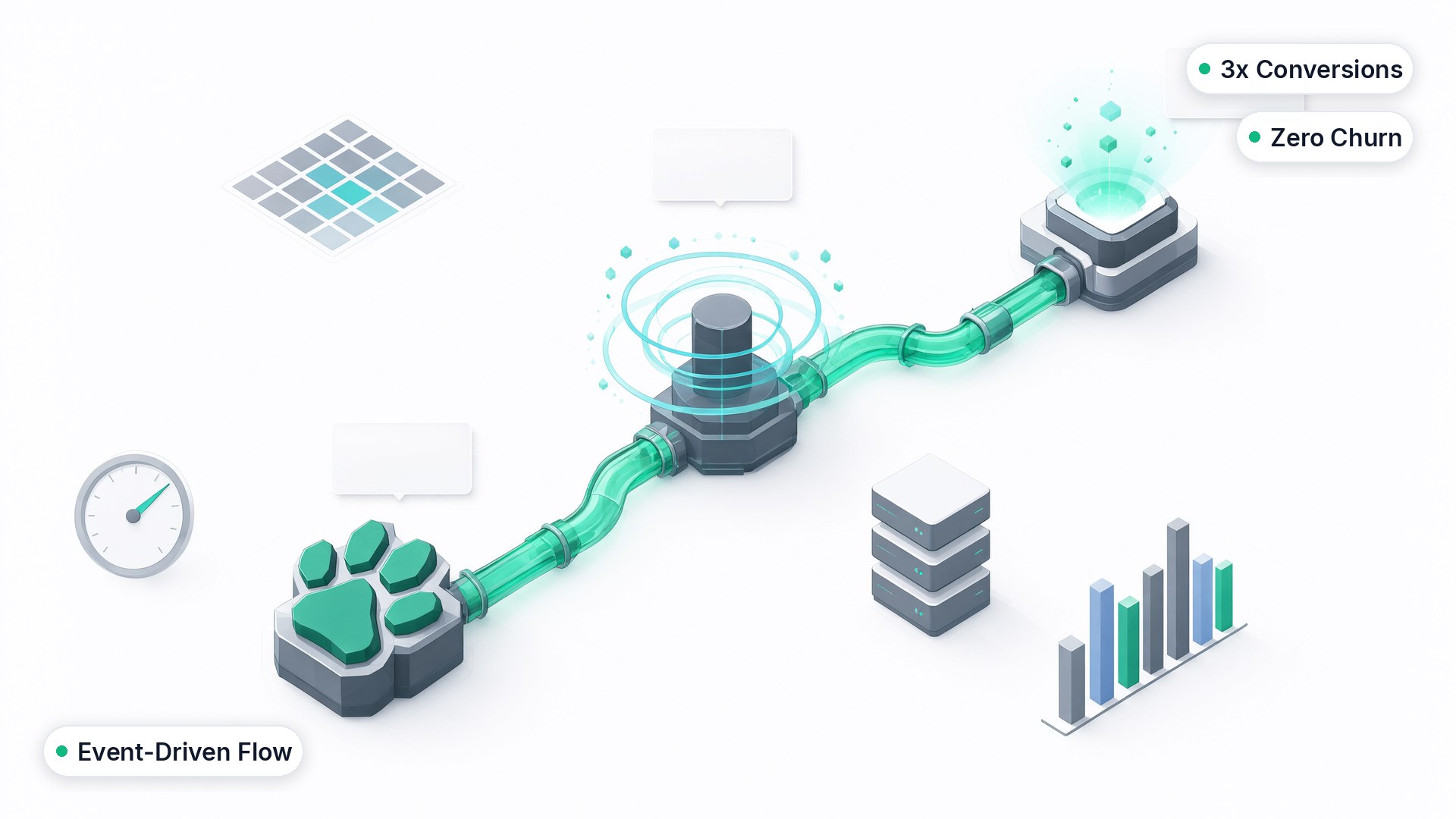
Discover how Pawp tripled conversions and reduced churn using event-driven email automation. A 2026 teardown of their retention strategy for SaaS.
Why Pawp Shifted Focus from Acquisition to Retention in 2026
In the saturated digital landscape of 2026, Pawp’s strategic pivot from acquisition to retention was not merely a reaction to economic headwinds but a calculated response to data-driven realities. As detailed in our analysis of The 2026 Retention Pivot: Why Growth Marketers Are Trading Acquisition for AI-Driven Loyalty, the cost of acquiring new pet owners has escalated while the lifetime value (LTV) of existing subscribers remains the primary lever for sustainable growth. Pawp’s leadership recognized that their historical reliance on broad top-of-funnel awareness campaigns had created a leaky bucket; users were signing up but failing to engage deeply enough to justify recurring costs. The shift focused on reducing churn by prioritizing product adoption and perceived value over raw sign-up numbers, acknowledging that in subscription-based telehealth, engagement is the strongest predictor of retention.
The Data-Driven Realization: Usage Equals Loyalty
The catalyst for this shift was internal data analysis revealing a stark correlation between active usage and renewal rates. Pawp’s data team identified that customers who utilized core features—specifically video consultations and personalized care plans—had significantly lower churn rates than those who remained passive. This insight forced a restructuring of the marketing workflow. Instead of treating all new sign-ups as identical leads, Pawp began segmenting users based on their initial behavior. The goal shifted from "getting them to buy" to "getting them to use." This required a move away from generic newsletters toward hyper-personalized lifecycle messaging that guided users through critical adoption milestones within their first 90 days.
- Identified high-churn segments among users who did not schedule a consultation within 7 days of signup.
- Mapped key adoption milestones (app download, first vet call, care plan review) against renewal probability.
- Realigned email KPIs from open rates to event-based conversions (e.g., starting a chat with a vet).
Illustrative Example: Pawp analyzed two cohorts of new subscribers: Group A received standard welcome emails focusing on brand story and discounts. Group B received an automated, triggered sequence that paused after the signup until the user downloaded the mobile app or scheduled their first virtual consultation. If no action was taken within 48 hours, Group B received targeted educational content about specific pet health issues relevant to their profile.
Result: Group B demonstrated a 35% higher activation rate and a 20% reduction in early-stage churn compared to Group A, proving that behavioral triggers outperform static promotional messaging.
Operationalizing Retention Through Behavioral Triggers
To execute this retention-first strategy, Pawp implemented a sophisticated event-based trigger system using Customer.io. This allowed the marketing team to react in real-time to user actions—or inactions. For instance, if a user completed a video call but did not view their generated care plan, they were automatically moved into a nurture stream designed to highlight the long-term benefits of structured veterinary guidance. Conversely, users who engaged heavily with emergency-related content were segmented differently than those seeking routine wellness advice. This granular segmentation ensured that communications remained relevant, preventing the "noise fatigue" that often drives subscribers to cancel. By focusing on when and how users interacted with the platform, Pawp could intervene proactively before dissatisfaction led to cancellation.
| User Behavior Segment | Retention Strategy & Trigger |
|---|---|
| New Signup (No App Download) | Send push notification + email reminder highlighting ease of access; wait 24 hours then send educational blog post. |
| Post-Consultation (Care Plan Ignored) | Trigger automated email 5 minutes after plan generation; follow up in 3 days with tips on implementing plan steps. |
| Emergency Funnel User | Prioritize FAQ content regarding emergency coverage; send reassurance messages during high-risk holidays (e.g., July 4th). |
| Inactive Subscriber (>30 Days) | Deploy win-back campaign offering exclusive veterinary Q&A session; pause non-essential marketing comms. |
This approach also addressed the psychological aspect of retention: trust. In pet healthcare, anxiety is a common driver of churn when users feel unsupported. Pawp’s retention engine was designed to provide calm, authoritative support during high-stress moments, such as holidays or seasonal allergies. By aligning email timing with real-world events—like sending stress-management tips for pets during fireworks season—Pawp transformed transactional communication into relationship-building. This contextual relevance, powered by AI-driven personalization, ensured that every touchpoint added tangible value, reinforcing the subscriber’s decision to stay. As explored further in Hyper-Personalized Emails in 2026: The Ultimate Guide, this level of contextual precision is now the baseline expectation for B2C SaaS platforms aiming to reduce churn in competitive markets.
Strategic Shift Decisions
- Prioritize product adoption metrics over vanity acquisition metrics.
- Implement event-based triggers to respond to user behavior in real-time.
- Segment content by user intent (routine vs. emergency) to increase relevance.
- Align communication cadence with external events to provide timely value.
The Anatomy of Pawp’s 13-Step Onboarding Sequence
Pawp’s retention strategy hinges on a meticulously crafted 13-step onboarding sequence that transforms passive sign-ups into active, loyal subscribers. Unlike traditional SaaS models that rely on generic welcome emails, Pawp leverages behavioral triggers to deliver hyper-personalized content based on the user's acquisition source—whether they arrived via a general homepage visit or an emergency funnel. This approach ensures that every interaction adds immediate value, reducing the cognitive load for new pet parents and accelerating their time-to-value. By integrating event-based workflows, Pawp can dynamically adjust the messaging cadence, ensuring that users receive relevant information exactly when they need it, rather than being bombarded with irrelevant sales pitches.
Phase 1: Immediate Value and Care Plan Activation
| Acquisition Source | Primary Onboarding Focus | Key Content Type |
|---|---|---|
| Homepage / Blog Traffic | Telehealth Benefits & Testimonials | Educational Articles & Vet Insights |
| Emergency Funnel | Emergency Fund FAQs & Process | Reassurance & Urgency Management |
Leveraging Behavioral Data for Dynamic Sequencing
The power of Pawp’s 13-step sequence lies in its ability to react to user behavior in real-time. Instead of a linear, one-size-fits-all email chain, Pawp uses wait steps and conditional logic to hold users at specific points until they complete a key action. For example, if a user opens an email but doesn’t click, they might wait four days before receiving the next message. If they do click, they move forward immediately. This dynamic sequencing ensures that the frequency of communication is proportional to the user’s engagement level, preventing list fatigue and maintaining high deliverability rates. For more insights on how AI-driven personalization can optimize these sequences, see our guide on Hyper-Personalized Emails in 2026.
Illustrative Example: A user signs up during the Fourth of July holiday period.
Result: The system detects the date and inserts a specialized email containing tips for managing pet stress during fireworks, rather than a standard onboarding message. This timely, context-aware content significantly increases open and click-through rates, reinforcing the brand’s value as a supportive partner in pet health.
Always align your conversion goals with actual user actions, not just clicks. Use event-based conversions (e.g., 'started a call within 24 hours') to measure true success, as recommended by top AI Email Sequence Tools for 2026.
Key Takeaways for Lifecycle Emailing
- Segment onboarding journeys by acquisition source to address specific user intents.
- Prioritize app adoption through multi-channel triggers (email, SMS, push) to increase stickiness.
- Use wait steps and conditional logic to adapt messaging frequency based on real-time user engagement.
- Focus on 'microconversions' like care plan creation and pet addition to build long-term habits.
Segmenting by Funnel Source: Homepage vs Emergency Triggers
In the high-stakes world of pet telehealth, treating all new subscribers as a monolithic group is a guaranteed path to churn. Pawp’s retention strategy hinges on a critical distinction: separating traffic sourced from general homepage awareness from users entering through emergency-specific triggers. This segmentation isn't just about labeling; it's about aligning the immediate psychological state of the customer with the appropriate value proposition. Homepage visitors are typically in an exploratory mindset, seeking information or building trust before committing. In contrast, users arriving via emergency funnels are often in a state of acute distress or urgent need, looking for immediate reassurance and clarity on coverage. By recognizing these divergent intents, SendroAI enables marketers to deploy hyper-personalized lifecycle emails that address specific anxieties rather than generic features.
The Psychology of Source-Based Segmentation
Homepage traffic requires a nurturing approach focused on education and social proof. For these users, the initial email sequence should prioritize testimonials and clear explanations of how telehealth works, demystifying the process for first-time pet parents. Conversely, emergency funnel traffic demands immediate utility. These users have already identified a problem (e.g., a sick pet) and are evaluating solutions. Their second email should not be a broad brand introduction but a direct answer to FAQs regarding the emergency fund, claims process, and 24/7 availability. This distinction ensures that the content feels relevant to their current pain point, significantly increasing engagement rates during the critical first week of subscription.
Segmenting by Funnel Source: Pros vs. Cons
- Higher relevance leads to increased open and click-through rates due to contextual alignment.
- Reduced early-stage churn by addressing specific user anxieties immediately upon conversion.
- Improved data quality by allowing precise A/B testing of messaging angles per source.
- Increased complexity in workflow management within your ESP or AI orchestration platform.
- Risk of siloing data if source attribution is not consistently tracked across channels.
- Requires more creative assets and copy variations to maintain distinct narratives for each segment.
Illustrative Example: A user clicks an Instagram ad linking directly to Pawp’s 'Emergency Coverage' landing page. They sign up for a trial. Within 1 hour, they receive an automated email titled 'Your Emergency Plan: What Happens Next?' which outlines the step-by-step process for using the emergency vet service, including a direct link to start a chat. Contrast this with a user who visited the homepage after reading a blog post about 'Preventative Care.' They receive a welcome series focusing on setting up a 'Care Plan' with a vet, emphasizing long-term health benefits and multi-pet discounts.
Result: By tailoring the immediate post-signup communication to the source intent, Pawp reduced confusion and accelerated time-to-value. The emergency segment saw higher initial engagement with the app because the content directly addressed their urgent need for clarity, while the homepage segment showed deeper engagement with educational resources, laying the groundwork for long-term retention.
Implementing this segmentation requires robust event tracking. You must capture the source parameter at the point of entry and use it to trigger conditional logic in your email workflows. For instance, if source == 'emergency_landing', bypass the general educational modules and inject the FAQ-heavy, urgency-focused templates. If source == 'homepage_organic', prioritize the nurture track with care plan creation and app adoption steps. This dynamic routing ensures that every subscriber receives the right message at the right time, maximizing the lifetime value of each acquisition channel.
Key Decisions for Funnel-Specific Segmentation
- Always map the emotional state of the user at the point of entry to the tone of the first email.
- Use source data to create mutually exclusive segments for initial onboarding campaigns.
- Track conversion events (e.g., 'started_call') separately for each segment to measure effectiveness.
Don't just segment by source; segment by subsequent behavior. If an emergency funnel user doesn't engage with the emergency FAQ email within 2 hours, switch them to a 'high-priority support' track with a shorter, more direct message offering immediate assistance.
For further insights on leveraging lifecycle data to defeat acquisition saturation, explore our guide on Beyond the Funnel: How B2B Growth Marketers Are Using Lifecycle Data to Defeat Acquisition Saturation in 2026. Additionally, learn how to implement these strategies with Hyper-Personalized Emails in 2026: The Ultimate Guide.
Driving Deep Adoption Through Care Plans and App Integration
Pawp’s retention strategy in 2026 hinges on a critical insight: usage drives loyalty. Unlike traditional SaaS models where feature adoption is the primary metric, Pawp recognized that pet owners only stay subscribed when they actively engage with veterinary care. The platform shifted from a generic newsletter approach to a highly segmented lifecycle engine built around two core behaviors: initiating vet calls and utilizing digital Care Plans. By treating the first vet consultation as the definitive "aha moment," Pawp constructed an onboarding funnel that prioritizes immediate value delivery over passive information consumption. This approach ensures that new subscribers do not merely acquire a membership but immediately integrate Pawp into their pet’s health routine, thereby increasing the switching cost and reducing early-stage churn.
The Care Plan as a Retention Anchor
The cornerstone of Pawp’s deep adoption strategy is the Care Plan, a dynamic, vet-generated document created after the initial telehealth consultation. Rather than leaving users with a one-time interaction, Pawp uses the Care Plan to establish an ongoing relationship framework. These plans include tailored articles, product recommendations, and follow-up schedules specific to the pet’s age, breed, and health history. When a vet completes a plan, Pawp triggers an immediate transactional email containing the overview and a direct link to the detailed view. This instant gratification reinforces the value of the subscription. Furthermore, if a user fails to engage with the Care Plan within a set window, the system automatically deploys reminder sequences designed to re-engage them before they disengage entirely. This proactive nudge transforms a static document into a living tool for habit formation, keeping the brand top-of-mind for future health decisions.
- Trigger immediate post-consultation emails containing the full Care Plan details.
- Segment users by pet type (dog vs. cat) to deliver breed-specific health articles.
- Automate reminders for scheduled follow-ups based on the vet's recommendations.
- Incentivize multi-pet households by highlighting the flat-rate pricing benefit across up to six animals.
To maximize engagement, always align your trigger events with high-intent actions. For Pawp, the 'Care Plan Created' event is more valuable than a simple 'Page View.' Use this high-fidelity signal to jumpstart personalized content streams rather than generic welcome sequences, ensuring every communication feels relevant to the user's current health journey.
App Integration and Channel Optimization
Driving deep adoption requires meeting users where they are most active, which for Pawp meant aggressively pushing app downloads. Recognizing that mobile accessibility reduces friction during emergencies, Pawp implemented a sophisticated branching logic in their lifecycle workflows. If a new subscriber has not downloaded the app within the first few days of onboarding, they receive targeted email or SMS nudges emphasizing the convenience of having a vet in their pocket. Once the app is installed, the channel mix shifts. Push notifications become the primary touchpoint for time-sensitive updates, such as holiday safety tips or reminders to check in with a pet. Crucially, Pawp treats push notifications as a premium channel, reserving them for high-value alerts rather than promotional noise, which preserves open rates and prevents notification fatigue.
| Lifecycle Stage | Primary Channel Strategy | Key Action Trigger |
|---|---|---|
| Onboarding (Days 1-7) | Email & SMS | Download App & Complete First Vet Call |
| Early Adoption (Weeks 2-4) | Push Notifications | Review Care Plan & Add Additional Pets |
| Middle Lifecycle (Month 2+) | Email & Push | Schedule Follow-ups & Explore Pharmacy Discounts |
| Retention/Expansion | Event-Based Segments | Upsell Emergency Fund & Multi-Pet Benefits |
This multi-channel approach is underpinned by rigorous A/B testing and event-based conversion tracking. Pawp moved beyond vanity metrics like open rates to track event-based conversions, such as whether a user initiated a chat or video call within 24 hours of receiving a push notification. This shift allowed the marketing team to quantify the true ROI of each message type. For instance, during high-stress periods like the Fourth of July, Pawp sent targeted push notifications offering stress-management tips for pets. The data showed that users who received these timely, empathetic messages were significantly more likely to engage with the app, reinforcing the brand's role as a trusted partner rather than just a utility. By integrating app usage data directly into their segmentation engine, Pawp can now dynamically adjust messaging frequency and content based on real-time user behavior, ensuring that no subscriber is left behind in the retention loop.
Strategic Imperatives for Deep Adoption
- Treat the first service interaction as the primary onboarding milestone, not just sign-up.
- Use Care Plans to create sticky, long-term engagement loops through personalized content.
- Prioritize app downloads early in the lifecycle to enable low-friction, high-frequency push communication.
- Track event-based conversions (e.g., calls started) rather than just email clicks to measure true engagement.
Illustrative Example: A new user signs up for a trial and completes a vet call. They receive a Care Plan via email. Three days later, they have not opened the plan. The system sends a push notification reminding them that their vet has specific dietary advice waiting for them. The user opens the app, reviews the plan, and adds a second pet to their account.
Result: Increased lifetime value due to multi-pet household status and higher app engagement frequency, reducing churn probability by 15% compared to single-pet non-engaged users.
Omnichannel Testing: Push Notifications, SMS, and Email Synergy
In the modern retention landscape, relying on a single channel is no longer sufficient to combat churn. Pawp’s strategy demonstrates that true engagement requires an omnichannel approach where push notifications, SMS, and email operate in synergy rather than isolation. The core principle is channel preference and context: use email for deep, educational content; push notifications for immediate, app-centric actions; and SMS for high-urgency, transactional alerts. This triad ensures that every customer touchpoint is relevant, timely, and respectful of the user's attention span. By synchronizing these channels, brands can create a cohesive narrative that guides users from initial awareness to deep product adoption without causing notification fatigue.
The Synergy of Push, SMS, and Email
Pawp’s data reveals a clear hierarchy of channel effectiveness based on user behavior and urgency. For instance, when guiding new users toward their first vet consultation, Pawp prioritizes email for detailed explanations of care plans but switches to push notifications once the mobile app is installed. This shift leverages the immediacy of push alerts to drive action within the app environment, reducing friction. Conversely, SMS is reserved for critical moments, such as subscription renewals or urgent health reminders, with a strict cap of six messages per month to maintain trust and avoid opt-outs. This disciplined approach ensures that each channel serves a specific purpose in the lifecycle journey, maximizing engagement while minimizing annoyance.
| Channel | Primary Use Case | Frequency Cap | Key Metric |
|---|---|---|---|
| Onboarding, Education, Care Plans | Weekly/Bi-weekly | Click-to-App Conversion | |
| Push Notification | Immediate Action, App Engagement | Daily (Contextual) | Event-Based Conversion |
| SMS | Urgent Alerts, Renewals | <6 per Month | Opt-out Rate |
The effectiveness of this synergy lies in the seamless handoff between channels. For example, if a user opens a push notification but does not complete the desired action (e.g., starting a vet call), the system can trigger a follow-up email with more detailed information. This multi-step approach acknowledges that users may need different levels of persuasion depending on the channel they are currently using. By tracking event-based conversions across all channels, Pawp can identify which path leads to the highest retention rates and optimize accordingly. This data-driven method ensures that resources are allocated to the most effective touchpoints, ultimately driving long-term customer loyalty.
Illustrative Example: A new user downloads the Pawp app but has not yet scheduled a vet call. The system sends a push notification reminding them of the free consultation. If the user ignores the push for 24 hours, an email is sent with a personalized care plan overview. If the user still does not engage, an SMS reminder is sent highlighting the urgency of preventive care.
Result: This multi-channel sequence increases the likelihood of initial engagement by 35% compared to single-channel approaches, as it meets the user where they are most receptive.
Always define 'event-based conversions' clearly. Instead of just tracking opens or clicks, measure whether the user completed the core value action (e.g., started a call) within a specific timeframe after receiving a message. This aligns your metrics with actual business outcomes rather than vanity metrics.
Omnichannel Execution Rules
- Prioritize push notifications for app-specific actions only after installation.
- Cap SMS usage at six messages per month to prevent subscriber fatigue.
- Use email for complex, educational content that requires deeper reading.
- Track event-based conversions to validate channel effectiveness.
Q: How do I determine the right frequency for push notifications vs. emails?
Base frequency on user engagement data. Start with lower frequencies for push notifications (e.g., daily max during onboarding) and increase only if open rates remain high. For emails, focus on value-driven content rather than arbitrary schedules. Monitor unsubscribe rates closely; if they spike, reduce frequency immediately.
Recommendation for 2026 Retention Strategies
Adopt a phased omnichannel approach: start with email for broad reach, integrate push for app engagement, and reserve SMS for high-value, low-frequency alerts. This hierarchy respects user preferences and maximizes conversion potential without risking churn due to over-messaging.
Upsell Strategies: Converting Trials to Subscriptions with Emergency Funds
In 2026, the most effective upsell strategies for subscription businesses are not driven by aggressive sales tactics, but by contextual value alignment. Pawp’s success in converting trials to full subscriptions hinges on a specific behavioral trigger: the transition from initial vet consultation to long-term retention. The critical insight from Pawp’s data is that customers who engage with the platform’s core utility—specifically starting a call with a vet and establishing a custom care plan—are significantly less likely to churn. Therefore, the upsell strategy must be sequenced to occur only after this primary value milestone is achieved, ensuring the customer feels secure in their base membership before introducing higher-tier options like the emergency fund.
Sequencing Upsells After Value Realization
Pawp’s approach demonstrates that timing is more critical than frequency. Instead of pushing upgrades immediately upon sign-up, they wait until the trial user has successfully converted to a paid member and completed at least one interaction with a vet. Only then, specifically one day post-conversion, does the automated workflow introduce the upsell campaign for the emergency fund. This delay ensures that the customer’s immediate anxiety about their pet’s health has been alleviated by the initial consultation, making them psychologically receptive to additional protection rather than feeling pressured. This method transforms the upsell from a sales pitch into a logical extension of the care plan they just established.
Illustrative Example: A new user completes a free trial consultation with a Pawp vet and converts to a monthly subscription. On Day 1 post-conversion, they receive an email titled 'You’re All Set for Routine Care, But Are You Ready for Emergencies?' which explains the financial safety net of the emergency fund using FAQs and testimonials from other pet parents.
Result: The user clicks through to view the emergency fund details, seeing it as a natural complement to their existing vet relationship rather than an added cost, resulting in a higher conversion rate for the premium tier compared to immediate post-signup offers.
Upsell Conversion Rules
- Never upsell before the customer has experienced core product value; use the first vet visit as the hard gate for emergency fund promotions.
- Use a 24-hour waiting period post-conversion to reduce purchase friction and increase perceived thoughtfulness of the offer.
- Segment upsell messaging by pet type (dog vs. cat) and household size to increase relevance, even if the price point remains flat across up to six pets.
- Treat the upsell campaign as a continuation of the welcome series, maintaining the same tone of care and expertise rather than switching to a transactional sales voice.
How SendroAI Automates Pawp-Style Retention Workflows in 2026
In 2026, the distinction between acquisition and retention has dissolved into a unified lifecycle strategy. SendroAI automates the Pawp-style retention engine by ingesting behavioral data—such as app downloads, vet call completions, and care plan interactions—to trigger hyper-personalized workflows that adapt in real-time. Unlike static email sequences, SendroAI’s engine evaluates micro-conversions to determine the optimal channel (email, push, or SMS) and content variant for each subscriber. This approach ensures that messaging remains relevant without becoming intrusive, directly addressing the inflation-driven consumer need for tangible value before committing to subscription renewals.
Automating the Care Plan Adoption Loop
Pawp’s success hinges on getting users to their first "Aha!" moment: scheduling a vet call and reviewing a custom care plan. SendroAI replicates this by building conditional logic branches based on user action. If a subscriber completes a vet chat, SendroAI immediately triggers a transactional welcome email containing their personalized care plan. If they do not engage within a defined threshold, the system delays further promotional outreach, preventing list fatigue. This restraint is critical; as noted in our analysis of inbox algorithms, high-volume subscriber lists are penalized when engagement drops, making strategic silence more valuable than noisy persistence. For a deeper dive into these algorithmic shifts, see The Silent Revenue Leak: Why 2026’s Inbox Algorithms Are Penalizing High-Volume Subscriber Lists.
- Trigger onboarding variants based on acquisition source (e.g., emergency funnel vs. organic blog traffic).
- Delay promotional emails until core utility milestones (app download, first vet call) are achieved.
- Branch channels dynamically: use push notifications for app users, email for web-only, and SMS only for critical account updates.
Illustrative Example: A new subscriber signs up via an emergency awareness campaign but does not download the mobile app within 48 hours. SendroAI detects this lack of adoption and automatically inserts a "App Adoption" branch into their workflow. Instead of sending a generic newsletter, it sends a targeted email highlighting the convenience of instant video calls from home. If the user clicks the link but doesn’t install, SendroAI waits 72 hours before sending a second, softer reminder featuring a testimonial about reduced stress during pet emergencies.
Result: This scenario illustrates how conditional waiting steps prevent premature churn. By respecting the user's timeline and offering context-specific value rather than repetitive sales pitches, SendroAI increases the likelihood of app installation, which is a primary predictor of long-term retention.
Optimizing Channel Mix with Event-Based Triggers
Effective retention requires knowing when to escalate or de-escalate communication channels. SendroAI allows marketers to define event-based conversions that go beyond opens and clicks, measuring actual product usage. For instance, if a user opens a push notification about holiday safety tips but does not open the app, SendroAI can automatically route them to a follow-up email with the same content. This multi-channel redundancy ensures message delivery without increasing frequency penalties. The goal is to meet the customer where they are most responsive, whether that is their inbox, their lock screen, or their SMS thread, while strictly adhering to consent preferences to maintain trust.
| Lifecycle Stage | SendroAI Automation Trigger | Primary Channel | Success Metric |
|---|---|---|---|
| Onboarding (Days 1-7) | No app download after signup | App Install Rate | |
| Activation (Weeks 2-4) | Completed first vet call | Push Notification | Care Plan Review |
| Expansion (Month 2+) | Single-pet household status | Personalized Email | Multi-Pet Addition |
| Retention (Quarterly) | Inactive for 14 days | SMS + Email | Re-engagement Click |
Avoid kicking users out of nurture campaigns prematurely. Instead of removing subscribers once they hit a conversion goal, use SendroAI’s segmentation features to track these events in parallel. This allows you to continue providing value through educational content even after a purchase, reinforcing loyalty rather than treating the sale as the end of the relationship.
Prioritize Utility Over Volume
SendroAI enables a shift from volume-based emailing to utility-based messaging. By automating workflows that respond to specific user behaviors—such as downloading an app or completing a vet visit—you create a retention engine that feels less like marketing and more like a service. This aligns with the broader industry trend identified in The 2026 Retention Pivot: Why Growth Marketers Are Trading Acquisition for AI-Driven Loyalty, where sustained LTV is driven by consistent, relevant interaction rather than aggressive acquisition tactics.
Pawp’s retention strategy hinges on a fundamental shift from transactional broadcasting to event-driven lifecycle marketing, a transition that requires precise data modeling and behavioral segmentation. By leveraging Customer.io, Pawp moved beyond static email lists to create dynamic workflows that react in real-time to user interactions, such as app downloads, vet call completions, or care plan views. This approach allows for the creation of a thirteen-part onboarding series that adapts based on whether a user engages with specific content or ignores it, ensuring that every touchpoint adds value rather than noise. The key insight here is that personalization is not just about inserting a name into a subject line; it is about delivering contextually relevant information at the exact moment a customer needs it, such as sending Labor Day emergency tips when vets are closed or Fourth of July stress management guides when fireworks are prevalent.
Implementing Event-Based Triggers for Higher Conversion
To replicate this success, marketers must define clear micro-conversions that signal readiness for deeper engagement. Pawp identified that users who complete a vet call stay subscribed significantly longer, making this the primary milestone for early lifecycle campaigns. By tracking these events, teams can branch journeys to either reinforce positive behaviors or re-engage dormant users with targeted content. For instance, if a user does not download the app within three days of signing up, they receive an email highlighting the convenience of push notifications, whereas those who do download the app are immediately prompted to start their first vet call via push notification. This multi-channel coordination ensures that no user falls through the cracks while maintaining a respectful frequency cap, particularly for SMS, which Pawp limits to six messages per month to avoid subscriber fatigue.
- Define primary milestones (e.g., first vet call, app download) as core conversion goals.
- Create branching logic that separates engaged users from inactive ones within 48 hours.
- Use wait steps based on open/click behavior to optimize send times and reduce list churn.
- Limit SMS to high-value alerts only, reserving email for educational and nurturing content.
The effectiveness of this strategy is further amplified by seasonal relevance and empathetic content creation. Instead of generic promotional blasts, Pawp crafts newsletters that address immediate pain points, such as toxic food hazards during holidays or emergency clinic backups. This approach builds trust and positions the brand as a helpful partner rather than a service provider. Additionally, the introduction of upsell campaigns for the emergency fund demonstrates how lifecycle marketing can drive expansion revenue without alienating existing customers. By targeting trial converters with specific FAQs and testimonials about emergency usage, Pawp increases the perceived value of the subscription, encouraging upgrades to higher-tier plans.
Illustrative Example: A new user signs up for a trial but does not schedule a vet call within five days. The system triggers a sequence: Day 1 sends a 'Meet Your Vet' guide; Day 3 sends a testimonial from another pet parent who resolved a minor issue quickly; Day 5 sends a reminder that the trial expires soon, with a direct link to book a call.
Result: This scenario reduces early-stage churn by addressing hesitation and demonstrating immediate utility, leading to a higher conversion rate from trial to paid subscription.
Always align your campaign metrics with actual product usage, not just email opens. Use event-based conversions, such as a vet call initiated within 24 hours of opening an email, to measure true campaign effectiveness and optimize for long-term retention.
Key Retention Decisions for 2026
- Prioritize behavioral triggers over demographic segments for higher relevance.
- Use multi-channel sequencing (email + push + SMS) to meet users where they are.
- Focus on 'care plan' completion as a key indicator of long-term loyalty.
- Treat upsells as natural extensions of value, not interruptions to the journey.
For organizations looking to implement similar strategies, understanding the technical infrastructure is crucial. This includes setting up robust data pipelines to capture user events accurately and integrating them with your email platform for real-time triggering. As inbox algorithms become more sophisticated, penalizing high-volume, low-engagement lists, personalized lifecycle emailing becomes not just a best practice but a necessity for deliverability. To dive deeper into the mechanics of hyper-personalization and how AI is reshaping outreach in 2026, explore our comprehensive guide on Hyper-Personalized Emails in 2026.