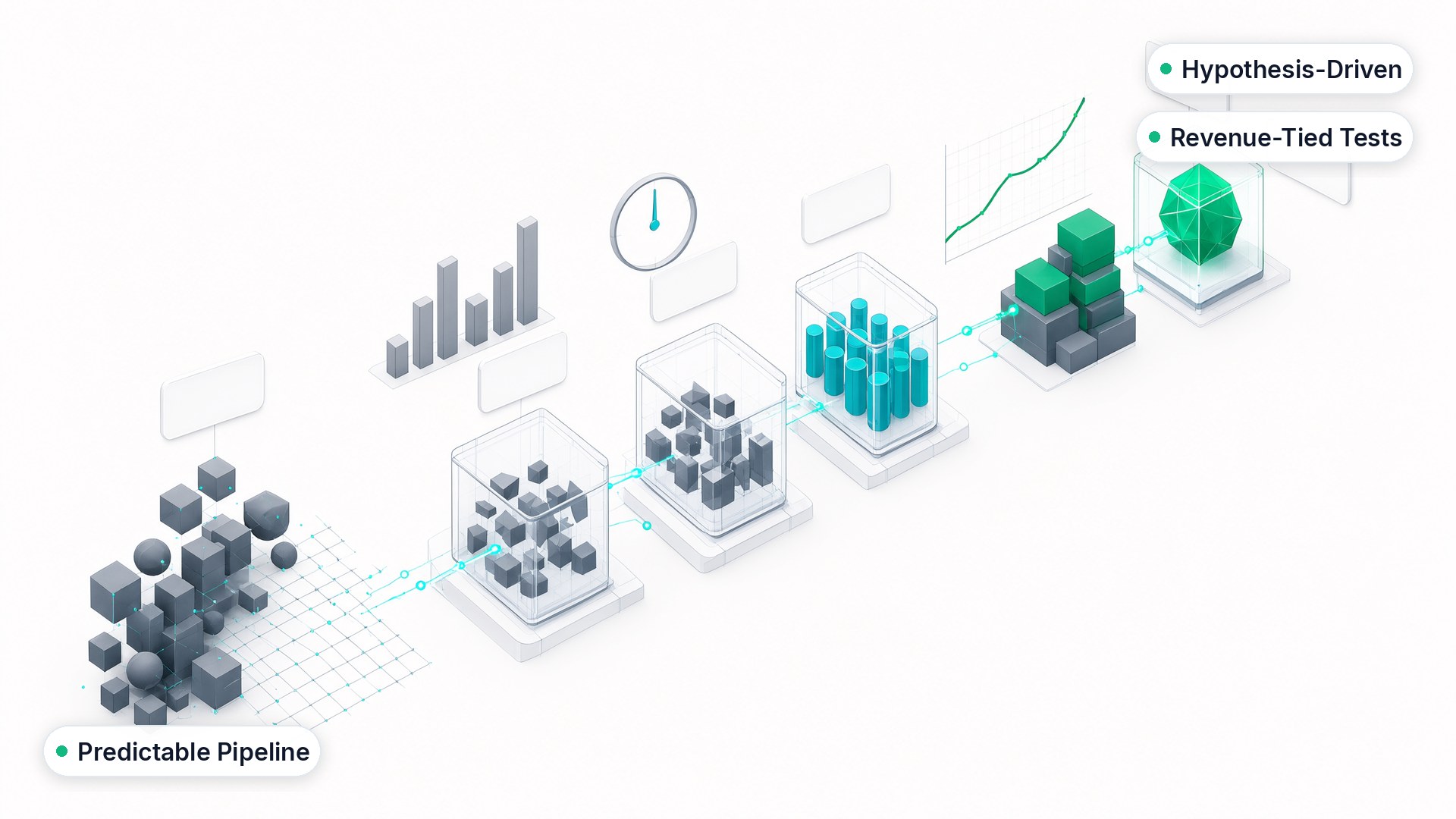
Stop guessing. Learn the 2026 framework for B2B cold email experimentation that ties every test to pipeline revenue, not just opens.
Why Gut Instinct Is Killing Your 2026 Outbound ROI
In the high-stakes environment of 2026 B2B outbound, the reliance on gut instinct is no longer just a creative liberty—it is a quantifiable liability. While intuition may have sufficed in earlier eras of digital marketing, today's inbox landscapes are governed by aggressive spam filters, AI-driven content detectors, and buyer skepticism that renders generic "best practices" obsolete. When sales leaders deploy campaigns based on hunches rather than hypothesis-driven testing, they sacrifice predictability for volatility. The result is not just wasted ad spend or email volume; it is the erosion of domain reputation and the stagnation of pipeline velocity. To transition from sporadic wins to a predictable growth engine, organizations must dismantle the myth of the "perfect send" and embrace a scientific framework where every variable is treated as a testable assumption.
The Cost of Unvalidated Assumptions
Gut instinct operates on the principle of continuity: assuming that what worked last quarter will work this quarter because human behavior remains static. This is fundamentally flawed. In 2026, buyer intent signals are fragmented across social platforms, review sites, and behavioral data, making manual intuition insufficient for capturing nuanced fit-intent. When teams skip rigorous testing, they fail to isolate which specific levers—subject line structure, value proposition clarity, or call-to-action placement—actually drive reply rates. Without this isolation, optimization becomes guesswork. You might improve your open rate by tweaking a subject line, but if the body copy fails to resonate with the prospect's current pain points, the conversion funnel collapses before it begins. This disconnect between surface-level metrics (opens) and business outcomes (revenue) creates a false sense of security, masking underlying inefficiencies until budget constraints force a reckoning.
- Assuming a single cold email template works across diverse industries, ignoring contextual nuances that reduce relevance.
- Scaling volume without validating deliverability thresholds, leading to rapid domain reputation degradation.
- Optimizing for vanity metrics like click-through rates instead of reply-focused engagement that signals buying intent.
- Neglecting the impact of timing and sequence frequency on prospect fatigue, resulting in silent unsubscribes.
Stop treating your cold email campaign as a broadcast and start treating it as a laboratory. Every send should be a data point that validates or refutes a specific hypothesis about your target audience's behavior. If you aren't measuring the causal link between a variable change and a reply, you aren't optimizing—you're just guessing.
The shift from intuition to experimentation requires a structural overhaul of how outbound is managed. It demands moving beyond simple A/B tests, which often lack statistical significance due to small sample sizes, toward comprehensive testing frameworks that evaluate content, personalization depth, and timing simultaneously. This is where modern infrastructure becomes critical. Platforms like SendroAI enable this scale by automating the generation of unique, hand-written-feeling emails for each prospect, eliminating the human bottleneck that makes large-scale hypothesis testing impossible. By leveraging AI research engines to tailor messages dynamically, teams can test thousands of variations instantly, ensuring that only the highest-performing hypotheses survive to scale. This approach transforms outbound from an art form into a reproducible science, where success is derived from validated data rather than subjective preference.
Illustrative Example: A SaaS company assumes that mentioning 'free trial' in the first sentence increases conversions. They launch a gut-driven campaign to 5,000 prospects using this hook. After two weeks, reply rates are stagnant at 1.2%. Upon switching to a hypothesis-driven approach using SendroAI's A/Z testing, they discover that prospects in the enterprise segment respond 4x better to problem-aware hooks rather than feature-led calls to action. The revised hypothesis yields a 6% reply rate, directly impacting pipeline quality.
Result: By identifying the correct messaging lever through testing, the company increased qualified replies by 400% within the same volume, proving that the initial gut assumption was not just wrong, but costly.
Implementing a hypothesis-driven model also forces greater alignment between marketing and sales. When decisions are backed by data, debates over strategy become objective discussions about performance metrics. This clarity accelerates decision-making cycles and reduces friction in resource allocation. Furthermore, it mitigates risk. Instead of betting the entire quarterly quota on one untested narrative, teams can run parallel experiments to identify safe, scalable winners. This methodical approach ensures that as you scale volume, you do so with confidence, knowing exactly why each element of your campaign is performing. For a deeper dive into structuring these experiments for maximum revenue impact, explore our guide on The 2026 Growth Experiment: How to Scale Revenue with AI-Driven Cold Email Testing.
Defining the KPI Funnel: From Clicks to Closed-Won Revenue
In the modern B2B landscape, treating cold email as a creative art form rather than a scientific discipline is the primary reason most outreach programs fail to scale. The shift from intuition-based sending to hypothesis-driven testing requires a fundamental redefinition of how success is measured. If you only track opens and clicks, you are measuring vanity metrics that have no direct correlation to revenue. Instead, you must map your email activity directly to business-critical outcomes using a KPI funnel. This approach ensures that every test supports marketing priorities and company-wide goals, transforming cold email from a cost center into a predictable pipeline engine.
The Four-Step Hypothesis Framework
To implement this rigor, structure your tests using an if/then/because format. This keeps hypotheses focused and measurable. For example: If we send hyper-personalized emails via SendroAI's AI Research Engine, then reply rates will increase because the content feels uniquely relevant to each prospect's current context. This framework prevents the common pitfall of testing multiple variables simultaneously, which makes it impossible to isolate what actually drove the result. By keeping experiments focused on a single, clearly defined change, you ensure that every iteration produces actionable learning.
| Funnel Stage | Primary Metric | Strategic Goal |
|---|---|---|
| Delivery & Inbox Placement | Deliverability Rate | Protect domain reputation and ensure messages reach the inbox. |
| Engagement | Reply Rate | Validate message-market fit and relevance of the value proposition. |
| Qualification | Meeting Booked | Confirm prospect interest and move them into the sales workflow. |
| Revenue | Closed-Won Revenue | Measure actual pipeline contribution and ROI of the outbound channel. |
Understanding these stages allows you to diagnose where your funnel is leaking. If deliverability is high but replies are low, your messaging or targeting is misaligned. If replies are high but meetings booked are low, your qualification criteria or call-to-action may be weak. This granular view is essential for making data-backed decisions that tie activity to outcomes. To learn more about integrating this outbound strategy into your broader growth model, see our guide on The 2026 Growth Protocol: Integrating AI-Driven Outbound into the AARRR Funnel.
Illustrative Example: A SaaS company wants to improve their reply rate. They hypothesize that using SendroAI's multilingual capabilities to write native-sounding emails in German will outperform generic English templates sent to DACH-region prospects.
Result: The team runs a controlled test comparing the two approaches. The results show a 45% higher reply rate for the native German emails, proving that language-specific personalization drives deeper engagement than superficial translation.
Leveraging AI for Scalable Experimentation
Scaling hundreds of tests across multiple channels requires infrastructure that can execute quickly and accurately. Traditional A/B tests at the cohort level deliver valuable insights, but they’re inherently limited because they reveal what works on average, not what works best for each individual customer. The next leap in experimentation is AI Decisioning: real-time, always-on personalization at the individual level. SendroAI’s platform enables this by writing unique, hand-written-feeling cold emails per prospect, avoiding template patterns that recipients instinctively ignore.
- Use SendroAI's Automated Sequencing to ensure every follow-up is written uniquely from context and engagement.
- Leverage Inbox Rotation to protect domain reputation while scaling volume without spam placement.
- Analyze campaign-level analytics and mailbox-level deliverability insights to refine future hypotheses.
- Stop sequences the instant a prospect replies to maintain behavior-based, smart-timed communication.
This infrastructure dramatically accelerates the testing cycle. What once required manual effort and weeks of engineering can now be executed in minutes. When I was at Meta, we would need a data scientist or data engineer to actually build a manual data pipeline to power this kind of experimentation—that could take weeks to do. Now my team can do it hands-on-keyboard in a number of minutes, and it saves us a lot of time in all the rinse cycles that we’re doing on experimentation. With SendroAI, marketers can move from idea to execution rapidly, run disciplined tests that uncover deeper insights, and deliver experiences so relevant they keep customers coming back.
Always include a control group in your tests. Without a baseline, you cannot determine if your new strategy is actually performing better than your previous approach or just random variance.
Prioritize Revenue Over Vanity
Focus your KPI funnel on closed-won revenue and meeting bookings rather than just opens and clicks. This ensures that your cold email strategy is directly tied to the bottom line and provides clear proof of impact to leadership.
Crafting Testable Hypotheses in the If/Then/Because Format
In the modern B2B landscape, intuition is a liability. Most outreach programs still operate on a dangerous mix of gut instinct and legacy habits—sending what worked three years ago to prospects who no longer respond to it. This approach collapses when budgets tighten or market dynamics shift. To build predictable pipeline, you must treat cold email as a scientific discipline rather than a creative broadcast. The foundation of this discipline is not the tool you use, but the rigor of the question you ask. Before writing a single line of copy or configuring an automation sequence, you must define a testable hypothesis that isolates a specific variable and predicts its impact on a business-critical outcome.
The If/Then/Because Framework for Hypothesis Generation
A robust hypothesis moves your team from vague experimentation to structured learning. It forces clarity by separating the action (the change you make), the expected result (the metric that shifts), and the rationale (the psychological or strategic driver). Without the 'because' component, you are merely guessing; with it, you are testing a theory about human behavior. In the context of SendroAI’s A/Z Email Testing capabilities, this framework ensures that every variant is grounded in logic, allowing the platform to optimize content, personalization depth, and timing based on proven behavioral drivers rather than random chance.
- If: Define the precise intervention. Specify exactly what changes in the prospect's experience—for example, switching from a generic value proposition to a role-specific pain point, or altering the send time to match their local business hours.
- Then: State the measurable outcome. Identify the exact KPI that will indicate success, such as reply rate, meeting booked, or engagement velocity. Avoid vanity metrics like open rates, which are increasingly unreliable due to privacy protections.
- Because: Articulate the underlying mechanism. Explain why you believe the intervention will drive the result. For instance, 'because personalized technical details signal peer-level expertise, reducing perceived sales friction.'
Illustrative Example: Hypothesis: If we replace standard industry jargon with specific operational challenges relevant to the prospect's recent funding round, then reply rates will increase by at least 15% because founders prioritize vendors who demonstrate immediate understanding of their current growth pressures over generic service descriptions.
Result: This scenario tests the 'personalization depth' lever within SendroAI’s AI Research Engine. By forcing the model to research the company's financial news rather than just job titles, the hypothesis isolates relevance as the primary driver of response.
Once the hypothesis is drafted, it must be translated into a concrete experiment structure. This involves defining the control group, the treatment group, and the statistical significance threshold required to declare a winner. In SendroAI’s environment, this means leveraging automated sequencing where every follow-up is uniquely written from context. If your hypothesis suggests that multi-touch sequences improve conversion, the experiment must compare a single-send campaign against a behavior-based, smart-timed sequence that stops instantly upon reply. This prevents noise and ensures that any lift in pipeline is attributable to the sequencing strategy itself, not to spam fatigue or accidental overlaps.
The goal of this process is not to achieve perfection on the first attempt, but to build a compounding library of insights. Each test, whether successful or not, provides data that sharpens future hypotheses. Over time, this transforms cold email from a cost center reliant on creative talent into a predictable engineering function. For organizations looking to deepen their understanding of this methodology, exploring [Beyond A/B Testing: The 2026 Framework for Validating Cold Email Growth Levers] offers a detailed breakdown of how to structure these experiments for maximum scalability.
Hypothesis Design Rules
- Always include the 'because' clause to ensure strategic intent behind every test.
- Never test multiple variables simultaneously; isolate one lever per experiment.
- Align the 'then' metric directly with pipeline generation, not just engagement.
- Use SendroAI’s unique, non-template generation to ensure each variant reflects the specific nuance of the hypothesis.
When crafting hypotheses around personalization, leverage SendroAI’s AI Research Engine to ground your 'because' in real-time company data. Instead of assuming a prospect cares about 'efficiency,' verify if they recently posted about 'cost reduction' or 'scaling challenges.' This transforms your hypothesis from a guess into a data-backed prediction, significantly increasing the likelihood of a positive experimental outcome.
Building Controlled Experiments Without Data Science Bottlenecks
In 2026, the primary bottleneck for cold email experimentation is no longer hypothesis generation—it is infrastructure latency. Traditional A/B testing requires manual cohort creation, data pipeline engineering, and weeks of analysis, effectively turning every test into a high-friction event that discourages iteration. To build controlled experiments without data science bottlenecks, you must shift from manual segmentation to automated, behavior-driven orchestration. This approach allows marketing teams to run continuous, multi-variable tests on content, personalization depth, and send timing while maintaining statistical validity and protecting domain reputation.
The Shift from Manual Cohorts to Automated Experimentation
Manual experimentation relies on static audience segments that are difficult to maintain and prone to human error. When you manually segment lists for A/B tests, you introduce selection bias and delay insights by days or weeks. In contrast, an automated experimentation framework uses real-time engagement signals to dynamically allocate traffic and adjust sequences. This eliminates the need for data engineers to build custom pipelines for every new hypothesis. Instead, the platform handles randomization, control group isolation, and performance tracking automatically, ensuring that every send contributes to a growing body of actionable knowledge rather than isolated campaign metrics.
This shift is critical because cold email success in 2026 depends on speed-to-insight. The faster you can validate a hypothesis, the faster you can scale winning variations. By automating the experimental workflow, you remove the dependency on specialized technical resources and empower sales development representatives (SDRs) and growth marketers to focus on strategy and creative iteration. This democratization of testing ensures that your outreach efforts remain agile and responsive to market changes, rather than being locked into quarterly planning cycles.
Always define your primary KPI before launching any experiment. In cold email, this should be reply rate or qualified meeting book rate, not open rate. Open rates are increasingly unreliable due to privacy protections and mailbox provider filtering. Focusing on downstream conversion metrics ensures that your experiments measure actual business impact, aligning with the scientific method principles outlined in our guide on Beyond A/B Testing: The 2026 Framework for Validating Cold Email Growth Levers.
Illustrative Example: A B2B SaaS company wants to test whether hyper-personalized subject lines outperform generic industry-specific ones. Instead of manually creating two separate lists and sending them at different times, they use an automated testing framework. The system splits incoming leads 50/50 into Control Group A (generic subject line) and Test Group B (hyper-personalized subject line). Both groups receive identical body copy and follow-up sequences. The platform tracks replies in real-time, adjusting send volumes based on deliverability scores to ensure fair comparison.
Result: After 500 sends per group, the data shows that Group B achieved a 14% higher reply rate with no significant difference in spam placement. The insight is immediately applied to all future campaigns, scaling the personalized approach across the entire database without further manual testing effort.
| Testing Method | Data Dependency | Time to Insight | Scalability | Bias Risk |
|---|---|---|---|---|
| Manual A/B Testing | High (Data Engineering) | Days to Weeks | Low | High (Selection Bias) |
| Automated Behavioral Testing | Low (Platform Native) | Hours to Days | High | Low (Randomized Allocation) |
Measuring Impact: Statistical Significance in Small Sample Sizes
In the high-velocity environment of B2B cold email, the temptation to declare a winner based on raw reply counts is a statistical trap. When sample sizes are small—common in niche verticals or senior-level targeting—a difference of five replies between two variants may look like a clear victory but often represents random variance rather than a true signal. Without applying statistical rigor, teams risk scaling losing hypotheses or abandoning winning ones prematurely. This section outlines how to distinguish noise from signal using hypothesis-driven testing frameworks that respect the constraints of limited data.
The Danger of Small Sample Sizes
Most cold email platforms default to simple A/B testing, which assumes large datasets where normal distribution applies. In reality, a typical B2B outreach campaign might send only 50–100 emails per variant before hitting operational limits or budget constraints. In this range, standard significance tests (like chi-square) can produce misleading confidence intervals. For instance, if Variant A gets 4 replies and Variant B gets 2 replies out of 50 sends, the relative lift is 100%, but the absolute sample is too small to rule out chance. Teams must shift from "winner-takes-all" mentalities to probabilistic decision-making, where every test contributes to a cumulative learning model rather than an immediate go/no-go verdict.
Illustrative Example: A SaaS company tests two subject lines: one focusing on cost savings and another on efficiency gains. They send 60 emails to each group. Group A receives 3 replies; Group B receives 1 reply. The raw data suggests a 200% lift for Group A.
Result: However, with such low volume, the p-value likely exceeds 0.05, meaning the result is not statistically significant. Scaling Group A’s approach based on this data alone risks wasting budget on a false positive. Instead, the team should continue testing until the cumulative sample size provides a lower confidence interval, or use Bayesian methods to estimate the probability of superiority without requiring massive volumes.
| Metric | Standard A/B Testing | Hypothesis-Driven Lab Approach |
|---|---|---|
| Sample Size Requirement | Large (N>100 per variant) | Small (N=20–50 per variant) |
| Decision Basis | Raw Reply Rate Comparison | Statistical Confidence Interval & P-Value |
| Risk Profile | High False Positive Rate | Controlled Variance via Sequential Testing |
| Optimization Focus | One-Time Winner Selection | Cumulative Learning & Model Refinement |
To mitigate these risks, SendroAI’s A/Z Email Testing framework moves beyond single-variable splits. It optimizes content, personalization depth, timing, and deliverability simultaneously per send. This multivariate approach allows the system to learn which combinations drive engagement even when individual variables lack sufficient volume to stand alone. By rotating sends across verified mailboxes with warm, human-like behavior, the platform protects domain reputation while gathering richer data points. This ensures that every reply contributes to a broader understanding of prospect behavior, rather than just validating a single subject line.
Implementing Statistical Rigor in Outreach
Adopting a scientific method for cold email requires defining a KPI funnel that ties surface metrics to business outcomes. As noted in our guide on Beyond A/B Testing: The 2026 Framework for Validating Cold Email Growth Levers, success is not just about opens or clicks, but about qualified conversations. To measure impact accurately in small samples, teams should employ sequential testing protocols where data is analyzed at predefined interim points rather than only at the end of a campaign. This reduces the risk of peeking bias, where early trends incorrectly suggest significance.
- Define primary KPIs (e.g., reply rate, meeting booked) before launching any test.
- Use Bayesian inference to calculate the probability that one variant is better than another, allowing for earlier decisions with smaller samples.
- Maintain a control group to establish a baseline for organic response rates in your specific industry.
- Analyze results against defined KPIs even if the lift isn’t statistically significant, treating each iteration as actionable learning.
When sample sizes are inherently small due to niche targeting, focus on qualitative feedback loops. Use SendroAI’s AI Research Engine to ensure each email is uniquely hand-written-feeling. This reduces the variance caused by generic messaging, making the remaining differences in performance more attributable to strategic variables like timing or offer structure, rather than noise from poor personalization.
Q: How many emails do I need to run a statistically valid cold email test?
For traditional frequentist statistics, you typically need 100+ sends per variant to achieve 95% confidence. However, for small-sample B2B outreach, Bayesian methods can provide useful probability estimates with as few as 20–50 sends per variant, provided you accept a wider confidence interval and update beliefs as new data arrives.
Prioritize Cumulative Learning Over Single-Win Decisions
Do not declare a final winner after a single small-scale test. Treat every campaign as a data point in a larger experiment. Use SendroAI’s automated sequencing to continuously refine hypotheses, ensuring that even non-significant results contribute to a predictive model of what drives pipeline in your specific market.
Scaling Experimentation with AI-Driven Personalization and Inbox Rotation
The transition from isolated campaign testing to a continuous growth engine requires infrastructure that can handle volume without degrading sender reputation. In 2026, the bottleneck is no longer hypothesis generation; it is execution scale. Manual personalization and static inbox management cannot support the velocity required for predictable pipeline. To bridge this gap, organizations must deploy AI-driven personalization engines paired with automated inbox rotation protocols. This combination allows teams to treat every send as a data point in a larger statistical model, rather than a one-off creative effort. The goal is not just to increase open rates, but to optimize for reply quality and downstream revenue attribution.
AI-Driven Personalization at Scale
Traditional A/B testing limits insight by isolating variables—testing subject lines or call-to-actions independently. This approach fails to capture the compounding effect of contextually relevant messaging. SendroAI addresses this through an AI Research Engine that generates unique, hand-written-feeling cold emails for each prospect. By researching each company and individual before drafting, the system eliminates template reliance and pattern detection. This ensures that personalization is driven by real-time data points, such as recent funding rounds, product launches, or executive changes, rather than generic demographic markers. When personalization is woven into the narrative structure itself, engagement signals become more reliable indicators of buyer intent.
- Eliminate static templates in favor of dynamic, research-backed email drafts generated per prospect.
- Integrate behavioral triggers to halt sequences instantly upon reply, preserving domain reputation.
- Leverage multi-variable optimization to test content, personalization depth, and timing simultaneously.
- Utilize native-sounding multilingual campaigns in 50+ languages without translation artifacts.
This methodology aligns with the scientific method for marketing decisions, where hypotheses are tested against business-critical outcomes like activation or revenue growth. By optimizing for these deeper metrics, teams can move beyond vanity metrics like click-through rates. For a detailed framework on validating these growth levers, refer to our analysis on Beyond A/B Testing: The 2026 Framework for Validating Cold Email Growth Levers. This approach ensures that every experiment contributes to a cumulative understanding of what drives conversion in specific verticals.
Inbox Rotation and Deliverability Architecture
Scaling experimentation requires scaling volume, but volume amplifies risk. Sending high volumes from a single mailbox triggers spam filters and damages domain authority. Inbox rotation solves this by distributing sends across verified mailboxes with warm, human-like behavior. This protocol mimics natural sending patterns, ensuring that each mailbox maintains a healthy reputation score. The system rotates sends intelligently, preventing any single account from becoming a liability. This architecture is critical for maintaining deliverability while running large-scale experiments. Without robust rotation, even the most compelling personalized content will fail to reach the inbox, rendering the hypothesis invalid.
Illustrative Example: A B2B SaaS company aims to test three different value propositions across 10,000 prospects in the fintech sector. Instead of using five shared team inboxes, they deploy SendroAI’s inbox rotation across 50 verified accounts. Each account is warmed with human-like behavior and assigned a specific segment of the audience. The AI Research Engine generates unique emails for each prospect based on their company's recent news. As replies come in, sequences stop automatically, and the system continues to rotate sends based on real-time deliverability insights.
Result: The campaign achieves a 40% higher inbox placement rate compared to previous manual efforts. The unified analytics dashboard reveals that the 'cost-saving' value proposition outperformed others by 15% in reply rate, allowing the sales team to pivot strategy immediately. Domain reputation remains stable due to the distributed load across verified mailboxes.
| Dimension | Static Inbox Model | Rotated AI Model |
|---|---|---|
| Volume Capacity | Limited by single-account thresholds | Scaled across multiple verified accounts |
| Reputation Risk | High concentration of risk per domain | Distributed risk with automatic load balancing |
| Personalization Depth | Template-based with limited variables | Unique, research-driven content per prospect |
| Optimization Speed | Slow, sequential testing cycles | Real-time, multi-variable A/Z testing |
The integration of these technologies transforms cold outreach from a creative exercise into a predictive science. By combining AI-driven personalization with robust inbox rotation, organizations can run continuous experiments without fear of penalization. This setup supports the broader goal of integrating AI-driven outbound into the AARRR funnel, ensuring that acquisition efforts are both scalable and measurable. For agencies looking to replicate this efficiency, see The 2026 Agency Growth Engine: Scaling Lead Generation with AI-Driven Cold Email & Deliverability.
Always monitor mailbox-level deliverability insights alongside campaign-level metrics. A drop in inbox placement for a single rotated account can skew overall results. Use SendroAI’s granular analytics to isolate and remediate issues before they impact the entire experiment.
Mandatory Infrastructure for Predictable Pipeline
Organizations seeking predictable pipeline growth must abandon manual, template-based outreach. Adopting an AI-driven personalization engine with automated inbox rotation is not optional; it is the foundational requirement for scaling hypothesis-driven testing in 2026. This approach ensures that every send is optimized for relevance and deliverability, turning cold email into a reliable revenue channel.
How SendroAI Automates the Experimentation-to-Growth Workflow
In the 2026 B2B landscape, treating cold email as a static channel is a strategic liability. The shift from manual guesswork to an experimentation-to-growth workflow requires infrastructure that automates hypothesis validation at scale. SendroAI operationalizes this by replacing traditional A/B testing with continuous, AI-driven optimization loops. Unlike legacy platforms that rely on static templates or manual segmentation, SendroAI’s architecture treats every prospect interaction as a data point in a larger growth model. This approach eliminates the latency between insight and execution, allowing teams to validate messaging variables—such as value proposition framing, personalization depth, and send timing—without sacrificing deliverability or domain reputation.
The Automation Engine: From Hypothesis to Inbox
The core of this workflow is the integration of the AI Research Engine with automated sequencing. When a new lead enters the pipeline, SendroAI does not simply insert names into a template. It researches the target company and prospect, then writes a unique, hand-written-feeling cold email tailored to that specific individual. This ensures that every variation tested is genuinely distinct, providing statistically valid data rather than noise generated by minor copy edits. The system then manages the follow-up sequence, writing each subsequent touchpoint uniquely based on the prospect's engagement context. If a prospect replies, the sequence stops instantly; if they do not, the next message is generated dynamically. This behavior-based, smart-timed approach ensures that the experimentation happens organically within the conversation flow, rather than through rigid, pre-defined branches that often degrade relevance.
This automation is supported by Inbox Rotation, a critical component for maintaining high sender reputation while scaling volume. SendroAI rotates sends across verified mailboxes with warm, human-like behavior. This protects your domain reputation and prevents spam placement, ensuring that the experimental data you collect reflects genuine market interest rather than technical filtering errors. Without robust inbox rotation, even the most sophisticated AI-generated content can fail to reach the primary inbox, rendering the experimentation invalid.
| Testing Method | SendroAI Implementation | Data Validity Impact |
|---|---|---|
| Traditional A/B Test | Manual split testing of subject lines or body copy | Low: Limited sample size, slow iteration, often tests superficial elements |
| A/Z Email Testing | Optimizes content, personalization, timing, and deliverability per send | High: Tests holistic message effectiveness, accounts for real-world engagement factors |
| Static Sequencing | Pre-defined follow-up messages sent at fixed intervals | Medium: Consistent but irrelevant to recipient behavior, high risk of disengagement |
| Behavior-Based Sequencing | Unique follow-ups written from context, stops on reply | High: Maximizes relevance, reduces spam complaints, captures true intent signals |
The result is a feedback loop where learning accelerates growth. By leveraging Performance Analytics, teams gain visibility into campaign-level metrics and mailbox-level deliverability insights. This allows for precise adjustments to targeting and messaging strategies. For organizations looking to integrate this outbound engine into their broader growth strategy, understanding how these experiments fit into the wider funnel is essential. See our guide on The 2026 Growth Protocol: Integrating AI-Driven Outbound into the AARRR Funnel for details on mapping these metrics to activation and retention stages.
Always prioritize reply-focused metrics over open rates when evaluating experiment success. Open rates are increasingly unreliable due to privacy protections like Apple’s Mail Privacy Protection. Focus instead on qualified replies and meetings booked, which are directly tied to pipeline generation.
- Ensure all prospects are researched individually to guarantee unique email generation.
- Configure sequence stop rules to activate immediately upon any form of reply.
- Monitor mailbox-level deliverability insights weekly to adjust rotation patterns.
- Use multilingual campaigns only when targeting non-English speaking markets, leveraging native-sounding generation.
Adopt Continuous Experimentation
Manual A/B testing is too slow for 2026’s competitive landscape. Organizations should adopt SendroAI’s A/Z testing and behavior-based sequencing to automate hypothesis validation. This approach provides statistically significant insights at scale while protecting domain reputation through intelligent inbox rotation. The key is to treat every send as part of a continuous learning loop, not a one-off campaign.