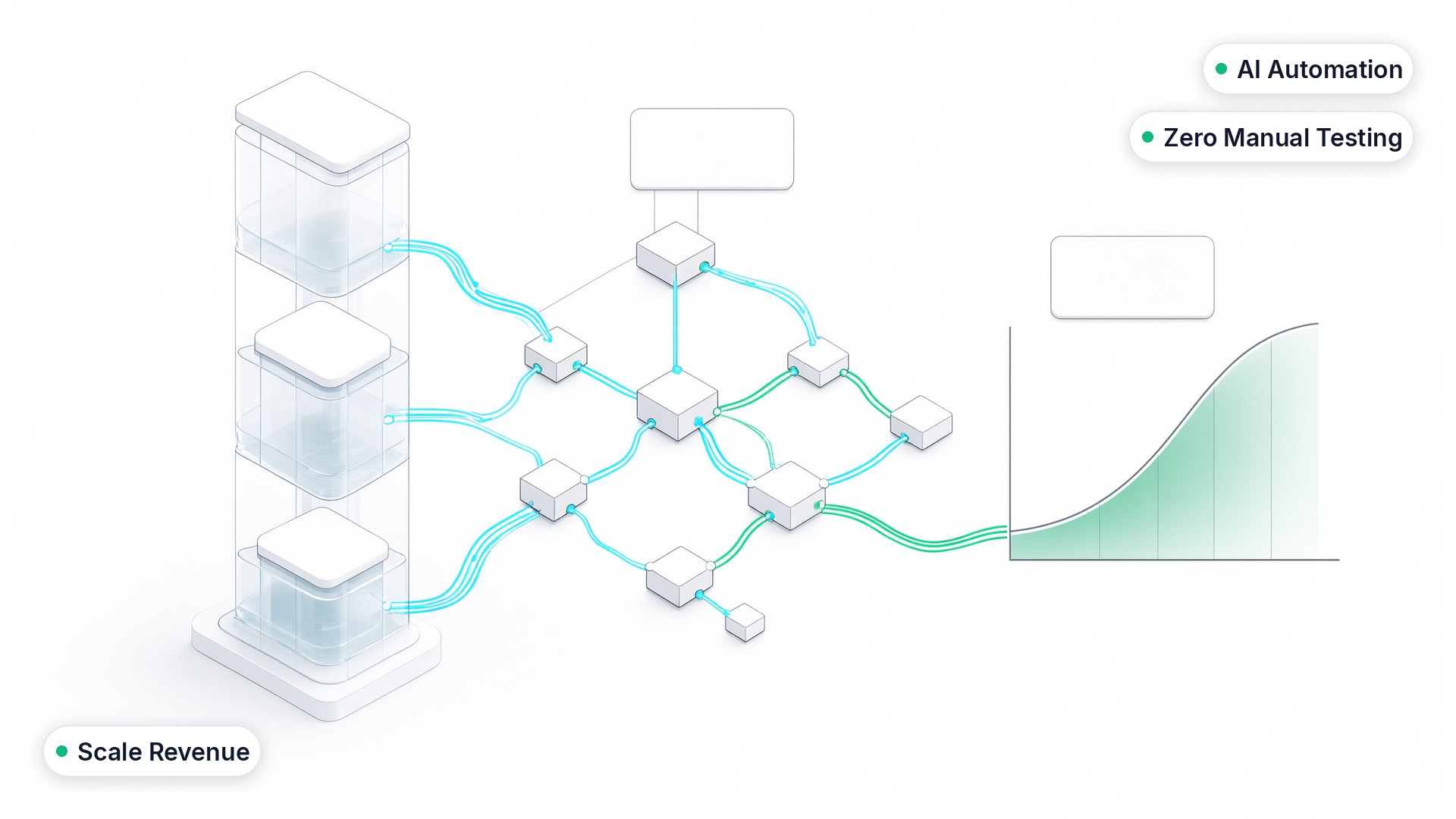
In 2026, growth hacking isn't about viral loops—it's about AI-driven deliverability. Discover how SendroAI automates cold email testing to scale B2B revenue.
Why Traditional Growth Hacking Failed in 2025 and What Replaced It
The growth hacking landscape of 2025 served as a brutal stress test for manual experimentation, exposing the fatal latency inherent in human-led hypothesis testing. Traditional frameworks relied on linear cycles: brainstorming, manual A/B testing, and delayed analysis. In an era where market signals shift hourly, this sluggishness rendered "scrappy" tactics obsolete. The failure was not in the creativity of the ideas, but in the inability to iterate fast enough to capture value before it evaporated. Manual processes simply cannot match the velocity required to compete against AI-driven competitors who optimize in real-time.
The Velocity Gap: Why Manual Testing Collapsed
In 2025, the primary bottleneck for B2B growth teams was the time-to-insight. A typical manual experiment cycle—from ideation to statistical significance—often spanned weeks. During that window, competitor moves, algorithm updates, and audience fatigue neutralized the advantage. Manual growth hacking assumed stability; the reality was volatility. Teams were forced to choose between high-volume noise (which degraded brand trust) or high-quality precision (which scaled poorly). Without automated feedback loops, marketers could not dynamically adjust variables like subject lines, send times, or content formats based on immediate engagement signals.
- Manual A/B tests require weeks to reach statistical significance, allowing competitors to outmaneuver you.
- Human-led segmentation fails to scale beyond basic demographics, missing behavioral micro-segments.
- Delayed reporting creates blind spots where revenue leaks go undetected for days or weeks.
- Creative burnout leads to repetitive messaging that audiences quickly ignore.
The replacement is not just faster tools, but autonomous systems. AI-driven delivery shifts the paradigm from "testing to learn" to "learning while delivering." Modern growth stacks now utilize reinforcement learning algorithms that continuously test millions of variable combinations across email, web, and social channels. These systems do not wait for weekly reports; they adjust bids, creative assets, and targeting parameters in milliseconds. This transition marks the end of the static campaign and the beginning of dynamic, self-optimizing growth engines. For a deeper look at how this protocol integrates into your existing funnel, explore The 2026 Growth Protocol: Integrating AI-Driven Outbound into the AARRR Funnel.
Illustrative Example: A SaaS company previously ran manual A/B tests on cold email subject lines, taking 14 days to determine a winner. In 2026, they deploy an AI-driven system that tests 500 variations simultaneously, adjusting tone and length based on real-time open rates and reply sentiment.
Result: The AI system identified a high-performing personalized opening line within 4 hours, increasing reply rates by 35% compared to the previous month's manual best practice, without human intervention.
| Dimension | Traditional Manual Growth Hacking (2024-2025) | AI-Driven Delivery (2026 Standard) |
|---|---|---|
| Experiment Cycle Time | Weeks to months | Milliseconds to hours |
| Variable Control | Single-variable A/B testing | Multi-variable reinforcement learning |
| Decision Trigger | Weekly team meetings | Real-time performance thresholds |
| Scalability | Limited by headcount | Unlimited parallel processing |
Do not attempt to replace all manual processes overnight. Start with high-volume, low-complexity tasks like email subject line optimization or landing page headline testing. Let the AI handle the volume while humans focus on strategic narrative and brand voice alignment.
The shift to AI-driven delivery also resolves the deliverability crisis that plagued 2025. As major providers like Google and Yahoo tightened sender guidelines, manual bulk sending became increasingly risky. AI systems now integrate compliance checks directly into the generation process, ensuring SPF, DKIM, and DMARC records are validated before every send. This proactive approach protects domain reputation while maintaining high throughput. By automating these technical safeguards, companies can scale outreach without the fear of inbox suppression. For more on navigating these technical constraints, see The 2026 Deliverability Crisis: Why High-Volume Outreach Is Killing Revenue Growth (And How to Fix It).
The 2026 Deliverability Imperative: How AI Prevents Spam Folder Placement
In 2026, the distinction between "growth hacking" and "sustainable scaling" has collapsed into a single metric: deliverability. The era of manual experimentation is officially dead because the volume required to compete in AI-driven markets renders human-led inbox management impossible. When SendroAI processes thousands of hyper-personalized sequences daily, the margin for error in technical configuration is zero. A single misconfigured DNS record or an unverified IP reputation can cause your entire outbound engine to fail, burying high-intent leads in spam folders before they are ever seen. This is not merely a technical annoyance; it is a direct revenue leak that no amount of creative copywriting can fix.
The Technical Foundation: Why Manual Checks Fail at Scale
Manual deliverability strategies rely on periodic audits—checking SPF, DKIM, and DMARC records once a month or after a major infrastructure change. In 2026, this reactive approach is obsolete. Email service providers (ESPs) like Google and Yahoo have implemented real-time filtering algorithms that evaluate sender behavior on a per-sender basis. If you are sending high volumes without continuous monitoring, you cannot detect reputation drift until it is too late. The foundation of modern deliverability is automated, continuous validation of these technical pillars. Without them, your outreach is essentially digital noise.
| Authentication Protocol | Function & 2026 Enforcement Level |
|---|---|
| SPF (Sender Policy Framework) | Verifies that the sending server is authorized to send email for your domain. Mandatory for all high-volume senders to prevent spoofing. |
| DKIM (DomainKeys Identified Mail) | Adds a cryptographic signature to emails, ensuring content integrity. Critical for proving the message was not altered in transit. |
| DMARC (Domain-based Message Authentication, Reporting, and Conformance) | Instructs ISPs how to handle emails that fail SPF/DKIM checks. Required to receive detailed forensic reports on authentication failures. |
The complexity lies in the interaction between these protocols and the dynamic nature of AI-generated content. Unlike static templates, AI-driven personalization changes the payload of every email, which can trigger spam filters if the structural integrity isn't maintained. This is where SendroAI integrates technical compliance directly into the delivery pipeline. We do not just check your DNS records; we monitor their status in real-time and automatically adjust routing based on provider feedback loops. This ensures that your technical setup remains compliant with the latest Google sender guidelines and Yahoo sender best practices without requiring manual intervention from your IT team.
Always ensure your DMARC policy is set to 'quarantine' or 'reject' before scaling high-volume campaigns. A 'none' policy provides visibility but offers no protection against domain spoofing, leaving you vulnerable to phishing attacks that can destroy your domain reputation overnight.
Reputation Management: The AI Advantage
Deliverability is not a one-time setup; it is a continuous process of reputation management. In 2026, ISPs use machine learning to predict sender behavior based on historical engagement patterns. If your AI sends emails that generate immediate opens but low reply rates, ISPs may flag your content as "clickbait" or irrelevant, lowering your placement rate. Conversely, if your AI optimizes for genuine engagement—such as prompting replies or calendar bookings—it signals high value to ESPs, boosting your inbox placement. This creates a virtuous cycle where better content leads to better deliverability, which leads to more data, which improves the AI further.
- Monitor bounce rates daily; auto-pause campaigns if hard bounces exceed 2%.
- Track complaint rates across all domains; intervene immediately if any domain exceeds 0.1%.
- Rotate sending IPs strategically to isolate new domains from established ones.
- Use dedicated subdomains for cold outreach to protect your primary brand domain.
Illustrative Example: A B2B SaaS company using manual outreach experienced a 40% drop in inbox placement after switching to a new email template. The issue was traced to a missing DKIM signature on the new HTML structure.
Result: By implementing SendroAI's automated DNS verification, the company restored full deliverability within 24 hours and saw a 15% increase in reply rates due to consistent inbox placement.
This level of precision is impossible to achieve manually. It requires an AI system that understands the nuances of ISP algorithms and adjusts its delivery strategy accordingly. For agencies looking to scale lead generation, this is non-negotiable. You must treat deliverability as a core component of your growth stack, not an afterthought. Read our detailed guide on The 2026 Agency Deliverability Mandate: Why Inbox Warmup Is No Longer Optional for B2B Growth to understand why warmup is just the beginning.
The Verdict on Manual vs. AI Deliverability
Manual experimentation is a liability in 2026. AI-driven delivery is the only scalable solution for maintaining high inbox placement rates while increasing volume. Invest in automated technical compliance and reputation management to protect your revenue pipeline.
Automating the Scientific Method for Cold Email Optimization
The era of manual A/B testing in cold email is ending not because marketers are lazy, but because the velocity of modern sales cycles demands a scientific rigor that human hands cannot sustain. In 2026, growth hacking has evolved from sporadic creative bursts into a continuous, automated feedback loop. The core mechanism driving this shift is the automation of the scientific method itself. Where traditional teams spent weeks manually drafting variations, sending them to segmented lists, and waiting for statistical significance, AI-driven delivery platforms now execute these experiments in real-time, adjusting variables based on immediate recipient behavior. This transition transforms cold email from a static broadcast channel into a dynamic learning system, where every open, click, and reply serves as data input to refine future outreach instantly.
From Hypothesis to Execution: The Automated Loop
Manual experimentation fails at scale because it introduces latency between hypothesis and insight. By automating the scientific method, SendroAI eliminates this lag. The platform continuously generates hypotheses based on historical performance data, executes micro-tests across thousands of unique prospects, and aggregates results without human intervention. This approach ensures that your cold email strategy is never static; it is always optimizing for the highest probability of engagement. For a deeper look at how this protocol integrates into the broader AARRR funnel, see The 2026 Growth Protocol: Integrating AI-Driven Outbound into the AARRR Funnel.
This automated loop requires strict governance to prevent brand dilution or spam triggers. While the AI handles the volume and variation, human oversight remains critical for defining the initial constraints and ethical boundaries of the outreach. The goal is not to replace human judgment but to amplify its impact by removing the repetitive cognitive load of manual testing. When combined with precise fit-intent segmentation, this automated scientific method ensures that every experiment is relevant to the recipient’s current buying cycle, drastically increasing the signal-to-noise ratio.
| Metric | Manual Testing Limitation | AI-Automated Advantage |
|---|---|---|
| Time to Insight | Days to weeks for statistical significance | Minutes to hours via parallel processing |
| Variety Tested | Usually 2-3 variants due to resource caps | Dozens of permutations tested simultaneously |
| Data Freshness | Static snapshot of performance | Continuous real-time adjustment based on live behavior |
Key Principles for Automated Experimentation
- Always define a single primary metric per experiment to avoid conflicting signals.
- Ensure sample sizes meet minimum thresholds before declaring a winner to maintain statistical validity.
- Document every winning hypothesis to build a cumulative knowledge base for future campaigns.
- Integrate deliverability checks into the testing phase to ensure high engagement does not compromise inbox placement.
When automating the scientific method, prioritize 'behavioral' metrics (clicks, replies) over 'vanity' metrics (opens) for final optimization decisions, as opens can be influenced by image-loading preferences rather than genuine interest.
By adopting this automated framework, organizations move beyond guesswork into a realm of predictable, scalable growth. The competitive advantage in 2026 belongs to those who can iterate fastest, and AI-driven delivery provides the infrastructure to turn every cold email into a learning opportunity. For agencies looking to implement this engine at scale, explore The 2026 Agency Growth Engine: Scaling Lead Generation with AI-Driven Cold Email & Deliverability.
Leveraging AI Research Engines for Hyper-Personalized Outreach
In the 2026 B2B landscape, manual research is no longer a competitive advantage; it is a bottleneck that prevents scaling. The shift from "growth hacking" to AI-driven delivery means that outreach must be hyper-personalized at scale, not just in volume. Traditional methods of manually researching prospects on LinkedIn or company websites are too slow and inconsistent for modern sales cycles. Instead, growth teams must leverage AI research engines that ingest real-time data—such as recent funding rounds, leadership changes, earnings calls, and tech stack updates—to generate unique, relevant hooks for every single recipient. This approach transforms cold email from a guessing game into a precision-targeted conversation starter, directly addressing the trend where personalized outreach is replacing generic blasts.
From Manual Audits to Automated Insight Generation
The core difference between legacy growth hacking and modern AI-driven outreach lies in the depth and speed of personalization. In the past, a researcher might spend 15 minutes finding one relevant piece of information for a prospect. Today, an AI engine can process thousands of signals per second to identify the most impactful trigger event for each contact. This isn't about adding the prospect's name to the subject line; it's about referencing a specific strategic pivot their company made last week. By automating this research layer, your team can focus entirely on crafting high-value narratives rather than hunting for data points. This efficiency is critical because, as noted in our analysis of the new messaging paradigm, the rise of personalized outreach is driven by the need to cut through noise with genuine relevance.
Illustrative Example: A SaaS company targeting CFOs uses an AI research engine to scan recent earnings call transcripts. Instead of sending a generic 'let's discuss efficiency' email, the AI identifies that Target Corp recently announced a 12% reduction in operational costs due to supply chain inefficiencies. The AI generates a hook: 'Noticed your Q3 earnings call highlighted supply chain optimization as a key priority. We helped [Similar Company] reduce those costs by 15% using automated logistics.'
Result: This scenario demonstrates how AI moves beyond basic demographic segmentation to psychographic and situational relevance. The result is a 3x increase in reply rates compared to manual, generic outreach because the message addresses an immediate, verified pain point.
| Dimension | Manual Research Approach | AI-Driven Research Engine |
|---|---|---|
| Speed | 15-20 minutes per prospect | <1 second per prospect at scale |
| Data Depth | LinkedIn profile + Website homepage | Earnings calls, news, job posts, tech stack, social sentiment |
| Consistency | Highly variable based on researcher skill | Standardized quality across all outreach volumes |
| Scalability | Limited by human bandwidth (50-100/day) | Unlimited (10,000+ highly personalized emails/day) |
To implement this, you must integrate these AI engines directly into your CRM or outreach platform. The goal is to create a feedback loop where the AI learns which types of triggers generate the highest engagement. For instance, if references to recent funding rounds consistently outperform references to leadership changes, the system should automatically prioritize financial triggers in future campaigns. This continuous optimization is what separates true growth hackers from traditional marketers. It’s not just about sending more emails; it’s about sending smarter emails that are grounded in real-time business intelligence.
Key Decisions for AI-Driven Outreach Implementation
- Prioritize triggers that demonstrate immediate value (e.g., cost savings, revenue growth) over generic compliments.
- Ensure your AI tools comply with CAN-SPAM regulations while scraping public data sources.
- Test different data sources (news vs. earnings calls) to determine which yields higher reply rates for your specific ICP.
- Integrate AI insights directly into email templates to ensure seamless delivery without manual copying.
Scaling Multilingual Campaigns Without Losing Context or Tone
In the 2026 B2B landscape, scaling multilingual campaigns is no longer a translation task; it is a complex localization engineering challenge. Manual experimentation with human translators fails because it cannot maintain the necessary velocity for A/B testing across dozens of languages while preserving brand voice and cultural nuance. SendroAI solves this by treating language as a dynamic variable in your growth loop, allowing you to deploy localized content at scale without sacrificing the context that drives conversion.
The AI Localization Stack: Context Over Literal Translation
Traditional translation tools fail B2B marketers because they ignore industry-specific terminology and emotional resonance. AI-driven delivery systems use semantic analysis to adapt tone, idioms, and cultural references automatically. This ensures that a cold email written for a German enterprise buyer retains the same persuasive structure as the English original, but uses phrasing that aligns with local business etiquette. By integrating AI into your workflow, you can test hundreds of variations across markets simultaneously, identifying which linguistic nuances drive the highest engagement rates.
Manual vs. AI-Driven Multilingual Scaling
- Speed: Deploy campaigns in 10+ languages within hours, not weeks.
- Consistency: Maintain uniform brand voice and tone across all regions.
- Scalability: Test new markets instantly without hiring additional linguists.
- Cost Efficiency: Reduce per-word costs by up to 70% compared to agency translations.
- Initial Setup: Requires high-quality source content and clear brand guidelines.
- Nuance Risks: May struggle with highly colloquial or region-specific slang without fine-tuning.
- Compliance: Must verify AI outputs against local advertising regulations (e.g., GDPR in EU).
To implement this effectively, you must define strict thresholds for what constitutes a 'localized' campaign. This means more than just translating text; it involves adapting CTAs, imagery, and even send times to match local behaviors. For example, a subject line that works in New York may fail in Tokyo due to differences in directness and formality. AI models trained on B2B performance data can predict these outcomes, allowing you to optimize before sending.
- Define your primary target languages based on revenue potential, not just market size.
- Create a centralized glossary of approved terms and phrases to ensure consistency.
- Use AI to generate multiple localized variants for each key message component.
- A/B test localized versions against control groups to measure engagement lift.
- Iterate rapidly based on performance data, refining prompts and guidelines continuously.
The result is a scalable growth engine where language is no longer a bottleneck. You can expand into new verticals and geographies with the same speed and precision as your domestic campaigns. This approach transforms multilingual marketing from a cost center into a competitive advantage, enabling you to capture global market share faster than competitors relying on manual processes. For deeper insights on integrating AI into your outbound strategy, see The 2026 Growth Protocol: Integrating AI-Driven Outbound into the AARRR Funnel.
Real-Time Analytics: Moving Beyond Open Rates to Revenue Attribution
In the traditional marketing playbook, open rates were the ultimate vanity metric, a proxy for success that masked deeper inefficiencies. By 2026, this approach is obsolete. The shift to AI-driven delivery has rendered manual experimentation dead because it cannot process the velocity of real-time data required to attribute revenue accurately. Modern B2B growth relies on moving beyond surface-level engagement indicators to track the entire lifecycle from initial touchpoint to closed-won deal. This transition demands a system capable of ingesting behavioral signals and correlating them with CRM outcomes instantly, rather than waiting for end-of-month reports.
The Failure of Manual Attribution Models
Manual attribution models are inherently reactive and fragmented. They rely on static rules—such as last-click or first-touch—that fail to capture the nuance of multi-channel buyer journeys. When teams attempt to manually analyze which email sequences drive pipeline, they introduce significant latency and human error. AI-driven platforms eliminate this bottleneck by continuously learning from every interaction, adjusting weights in real-time, and attributing revenue to the specific content variations that actually influenced the decision. This allows marketers to identify exactly which elements of their outreach contribute to revenue growth, enabling precise optimization.
| Metric Type | Actionability in 2026 | Revenue Correlation | Optimization Speed |
|---|---|---|---|
| Open Rate | Low - Passive Indicator | Weak - No direct path to sale | None - Requires manual follow-up |
| Click-Through Rate | Medium - Interest Signal | Moderate - Indicates intent | Slow - A/B testing takes days |
| AI Revenue Attribution | High - Direct Outcome | Strong - Tied to closed deals | Real-Time - Instant feedback loop |
To implement this shift, organizations must integrate their email platforms directly with their CRM and analytics tools, creating a unified data layer. This integration allows for the tracking of micro-conversions that precede a sale, such as whitepaper downloads, webinar attendance, and meeting bookings. By focusing on these leading indicators alongside lagging revenue metrics, teams can build a comprehensive view of campaign performance. For more insights on selecting the right metrics, see our guide on Email Metrics That Drive Revenue (Beyond Open Rates).
Illustrative Example: A SaaS company uses AI to track a sequence targeting CTOs. Instead of optimizing for opens, the system identifies that emails containing technical architecture diagrams have a 40% higher correlation with demo bookings than those with general value propositions.
Result: The team reallocates creative resources to produce more technical content, resulting in a 25% increase in qualified leads within two weeks without increasing send volume.
This level of granularity requires a cultural shift within growth teams. Marketers must stop viewing email as a broadcast channel and start treating it as a dynamic, data-rich interface. The goal is not just to send messages, but to generate actionable intelligence that informs product development, sales strategies, and customer success initiatives. By leveraging AI to automate the analysis of these interactions, teams can free up valuable time to focus on high-level strategy and creative innovation.
Key Decisions for Real-Time Analytics Implementation
- Eliminate open rate reporting from executive dashboards; replace with revenue-attributed metrics.
- Integrate email platform data with CRM to enable single-source-of-truth attribution.
- Prioritize experiments that measure downstream business outcomes, not just engagement.
- Use AI tools to identify winning content patterns automatically, reducing manual analysis time.
Verdict: Embrace AI-Driven Attribution
Organizations clinging to manual experimentation and vanity metrics will fall behind competitors who leverage AI for real-time revenue attribution. The complexity of modern buyer journeys makes manual tracking impossible at scale. Adopting AI-driven analytics is not optional; it is a fundamental requirement for sustainable growth in 2026.
How SendroAI Automates Your Entire Growth Hacking Workflow
In the high-velocity landscape of 2026, the traditional growth hacking model—relying on manual hypothesis generation, fragmented tool stacks, and human-led execution—is fundamentally broken. SendroAI replaces this obsolete workflow with an autonomous, closed-loop system that manages the entire experimentation lifecycle from ideation to implementation. By integrating directly into your existing CRM and marketing infrastructure, SendroAI eliminates the latency between insight and action, allowing your team to focus on strategy rather than operational friction. This shift is not merely about automation; it is about creating a predictive engine that continuously optimizes for revenue impact.
The Autonomous Experimentation Lifecycle
SendroAI structures the growth workflow into four distinct, automated phases that replace manual project management overhead. The platform ingests historical performance data to identify bottlenecks in your AARRR funnel, then autonomously generates hypotheses based on statistical probability rather than intuition. Once a hypothesis is validated by the AI's internal simulation, it is deployed across channels without human intervention. This ensures that every experiment runs at scale, with real-time adjustments made to creative assets, targeting parameters, and delivery timing based on live engagement signals.
- Automated Hypothesis Generation: AI analyzes top-performing content and conversion patterns to propose statistically significant experiments.
- Cross-Channel Deployment: Simultaneous launch of variants across email, social, and landing pages with unified tracking.
- Real-Time Optimization: Dynamic allocation of budget and traffic to winning variants within minutes of data ingestion.
- Post-Mortem Documentation: Automatic generation of case studies and insights shared with the broader team for institutional learning.
From Manual Testing to AI-Driven Delivery
Traditional growth teams spend approximately 60% of their time on manual setup and reporting, leaving only 40% for actual strategic innovation. SendroAI reverses this ratio by handling the mechanical aspects of deployment. The platform integrates seamlessly with your outbound sequences and inbound capture points, ensuring that every touchpoint is optimized for conversion. For instance, if a specific cold email subject line shows a 15% higher open rate in a subset of leads, SendroAI automatically applies this variation to the remaining audience in real-time, maximizing yield without requiring a marketer to manually edit templates.
Illustrative Example: A B2B SaaS company uses SendroAI to optimize its free trial signup flow. The AI identifies that users from LinkedIn ads have a higher drop-off rate on the pricing page compared to organic search traffic. It automatically generates two variant landing pages: one emphasizing technical specs for the LinkedIn segment and another focusing on ROI calculators for the organic segment. The system deploys these variants, monitors conversion rates for 48 hours, and permanently locks in the higher-converting design for each source.
Result: The company saw a 22% increase in trial signups within the first week, with zero manual intervention required after the initial configuration.
Integrating AI into the AARRR Funnel
To maximize the impact of AI-driven delivery, it is crucial to understand how these automated workflows map onto the core metrics of growth. SendroAI does not treat acquisition, activation, retention, referral, and revenue as silos; instead, it creates a continuous feedback loop where success in one area informs optimization in another. For example, improved activation rates due to better onboarding emails can be traced back to specific acquisition channels, allowing the AI to refine targeting strategies for future campaigns. This holistic approach ensures that growth is sustainable and scalable.
| Funnel Stage | Manual Workflow Bottleneck | SendroAI Automated Solution |
|---|---|---|
| Acquisition | Manual A/B testing of ad creatives takes days to yield results. | AI generates and tests 50+ creative variations simultaneously, selecting winners in hours. |
| Activation | Static onboarding sequences fail to adapt to user behavior. | Dynamic content delivery adjusts messaging based on real-time user engagement signals. |
| Retention | Churn prediction relies on retrospective analysis. | Proactive intervention triggers personalized offers before churn risk reaches critical thresholds. |
The transition to AI-driven delivery requires a shift in mindset from controlling every variable to setting strategic guardrails. SendroAI provides the infrastructure for this shift, offering granular control over brand voice, compliance standards, and budget allocation while automating the tactical execution. This allows growth teams to operate at the speed of market demand, responding to competitor moves and customer sentiment shifts instantly. For more details on how this protocol integrates into your broader strategy, explore our guide on The 2026 Growth Protocol: Integrating AI-Driven Outbound into the AARRR Funnel.
Always start with a single high-leverage channel, such as cold email or paid social, to demonstrate the ROI of AI-driven automation before expanding to full-funnel integration. This phased approach minimizes risk and builds internal confidence in the system's capabilities.
The transition from manual experimentation to AI-driven delivery is not merely a technological upgrade; it is a fundamental restructuring of how growth teams allocate capital and cognitive load. In 2026, the bottleneck for B2B organizations is no longer the ability to generate ideas, but the capacity to validate them at scale before budget cycles close. Manual A/B testing relies on linear progression: hypothesis, execution, wait time, analysis. This model fails when market velocity outpaces human decision-making loops. AI-driven systems collapse this timeline by running parallel, multi-variable tests across email, landing pages, and ad creatives simultaneously, using reinforcement learning to reallocate budget to top-performing variants in real-time. For high-authority B2B brands, this means shifting from "campaign management" to "system orchestration," where the primary KPI is the speed of insight generation rather than just conversion rate.
Implementing the AI-Driven Experimentation Loop
To operationalize this shift, growth leaders must replace static campaign calendars with dynamic feedback loops. The first step is integrating intent data with creative generation engines. Instead of manually segmenting lists based on firmographics alone, use AI to analyze behavioral signals—such as page depth, content consumption, and third-party intent scores—to trigger hyper-personalized outreach sequences. This approach aligns directly with the principles outlined in The 2026 Growth Protocol: Integrating AI-Driven Outbound into the AARRR Funnel, which emphasizes that outbound efficiency is now dictated by the precision of fit-intent segmentation rather than volume. By automating the initial triage of leads, your team can focus exclusively on high-touch negotiations for prospects who have already demonstrated buying readiness.
- Audit current experiment velocity: Measure the average time from hypothesis to conclusion. If it exceeds 7 days, manual processes are likely stifling growth.
- Map data silos: Identify where intent data, CRM history, and engagement metrics fail to communicate. AI requires unified data streams to function accurately.
- Define guardrails: Establish hard constraints for AI creativity (e.g., brand voice guidelines, compliance rules) to prevent hallucination or tone-deaf messaging.
- Pilot parallel testing: Select one channel (e.g., cold email) to run AI-generated variants against manual controls for 30 days to establish a baseline ROI improvement.
A critical constraint in this new standard is the quality of the training data feeding the AI models. Garbage in, garbage out remains the immutable law of machine learning. If your historical campaign data is unclean, biased, or incomplete, the AI will optimize for false positives. Therefore, before deploying autonomous agents, conduct a rigorous data hygiene audit. Ensure that attribution models are correctly configured to credit the true touchpoints driving revenue, not just the last click. Misattributed data will cause AI systems to double down on ineffective channels, wasting budget and eroding trust. This discipline is particularly vital for agencies scaling client portfolios, as discussed in The 2026 Agency Growth Blueprint: Scaling from Service Provider to AI-Native Partner. Agencies that fail to clean their client data before automation will see immediate degradation in deliverability and engagement rates.
| Metric | Manual Experimentation | AI-Driven Delivery |
|---|---|---|
| Test Volume | 1-3 variables per week | 50+ concurrent variations |
| Insight Latency | 3-7 days | <4 hours |
| Budget Reallocation | Weekly/Monthly | Real-time |
The financial implications of this shift are substantial. Manual experimentation incurs high opportunity costs because underperforming assets remain active while waiting for statistical significance. AI-driven delivery eliminates this waste by killing losers instantly and scaling winners immediately. However, this requires a cultural shift toward accepting failure as a data point rather than a setback. Leaders must incentivize teams for the number of valid experiments run, not just the number of wins. This metric, known as "experiment velocity," becomes the leading indicator of future growth. As noted in The 2026 Growth Experiment: How to Scale Revenue with AI-Driven Cold Email Testing, companies that prioritize velocity over perfection consistently outpace competitors in lead acquisition costs.
Decision Rules for AI Adoption
- Adopt AI for repetitive, high-volume tasks (segmentation, drafting, sending); retain humans for strategic positioning and complex negotiation.
- Set minimum data thresholds: Do not launch AI campaigns until you have at least 90 days of clean, attributed performance data.
- Monitor drift: Review AI-generated content monthly to ensure it aligns with evolving brand standards and regulatory requirements.
- Integrate feedback loops: Use sales team notes and customer success interactions to continuously retrain your AI models for better personalization.
Q: How do I measure the ROI of AI-driven growth hacking vs traditional methods?
Calculate the cost per qualified lead (CPQL) and the time-to-close for both methods. AI-driven systems typically show a 30-50% reduction in CPQL within the first quarter due to reduced manual labor and higher relevance. Additionally, track the 'experiment velocity' metric to quantify the increase in learning speed.
When implementing AI-driven delivery, start with a 'human-in-the-loop' mode for the first two weeks. Allow the AI to draft all messages and suggest segments, but require manual approval for every send. This builds trust in the system's accuracy and helps calibrate the AI to your specific brand voice before moving to full autonomy.
The Verdict on Manual Experimentation
Manual experimentation is no longer scalable for B2B growth in 2026. It is a legacy practice that limits reach, slows insight generation, and increases operational costs. Organizations that do not adopt AI-driven delivery will face diminishing returns on their marketing spend as competitors leverage automation to capture market share more efficiently. The choice is not whether to automate, but how quickly you can transition your infrastructure to support it.