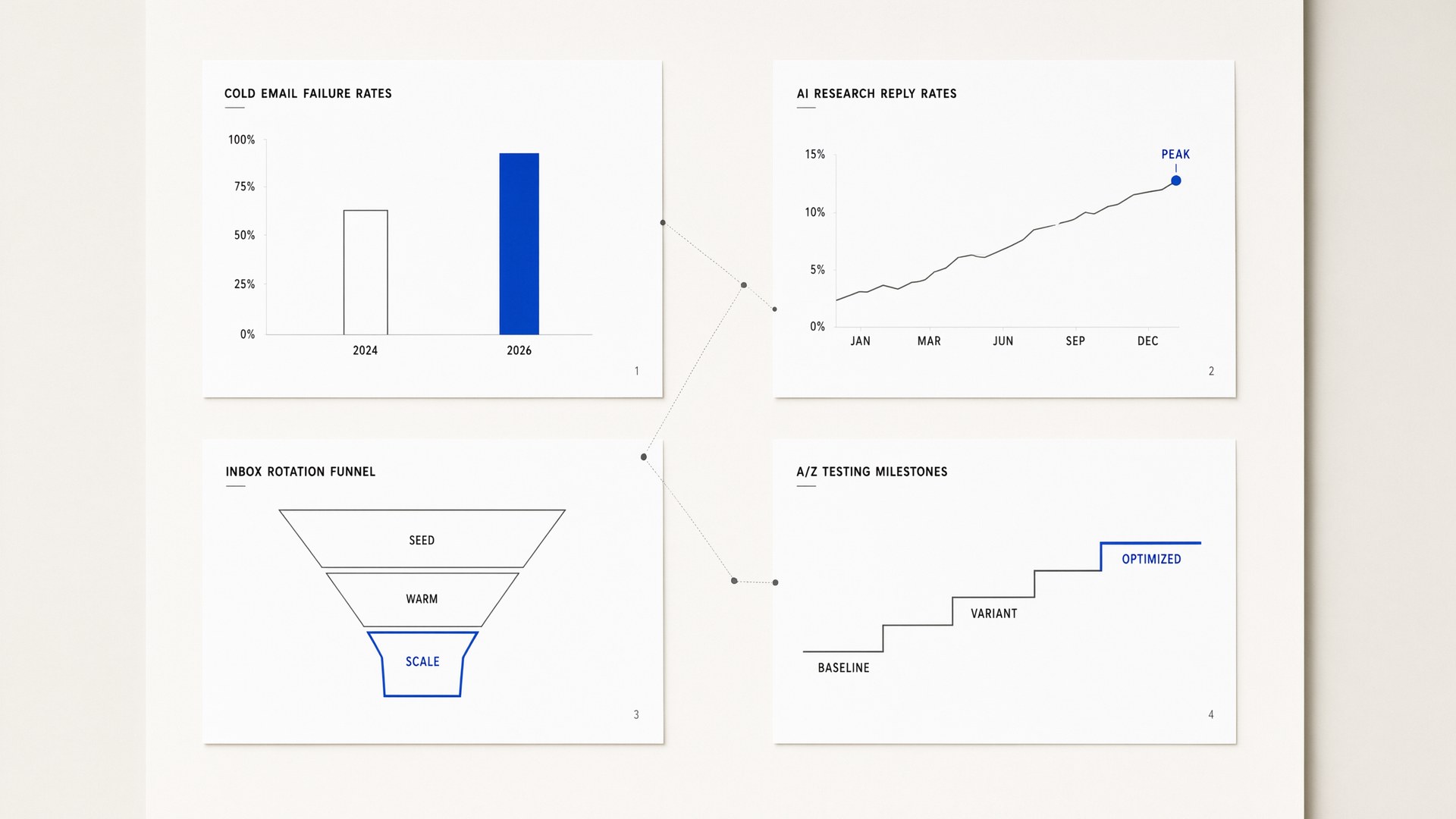
Discover why personalized cold emails fail in 2026. Learn how AI research, inbox rotation, and A/Z testing turn engagement into measurable growth.
Why Personalized Outreach Feels Like Spam in 2026
Do you believe personalization alone guarantees inbox success? In 2026, that assumption collapses the moment your domain lands in spam. The mistake is optimizing message quality while ignoring delivery infrastructure.
Most teams invest heavily in copy. They craft clever subject lines, personalize first sentences, and A/B test every variable. But if the email never reaches the primary inbox, none of that work matters.
The deeper problem is that buyers have stopped trusting surface-level personalization. Inserting a first name or company into a generic template no longer signals relevance; it signals automation. Engagement marketing without deliverability is shouting into a locked room.
Look at the disconnect: teams celebrate reply rates while their sender reputation quietly degrades. One bad week of bounces or spam complaints can undo months of creative optimization.
This is where we can help. Below, we break down the exact framework to make engagement marketing work through deliverability in 2026 — with real benchmarks, technical decision rules, and zero fluff.
The Perception Gap: Why "Personalized" No Longer Means Relevant
In 2024, using a prospect's first name or company name in the subject line was enough to stand out. By 2026, that level of dynamic insertion is baseline expectation, not differentiation. When every competitor uses AI to insert {{First_Name}} and {{Company}}, the novelty evaporates instantly. Buyers see through superficial token replacement because it lacks contextual depth.
The problem is not the technology; it is the strategy behind the data. Most teams use static data points—job titles, locations, firmographics—to construct messages. These are historical facts, not current behaviors. A buyer does not care that they were hired six months ago; they care about the specific challenge they are facing right now. When outreach relies on outdated signals, it feels like a broadcast disguised as a conversation.
- Static segmentation: Grouping prospects by industry or role without considering their immediate triggers.
- Generic pain points: Addressing universal challenges that every vendor claims to solve.
- One-way messaging: Asking for time without offering immediate, relevant value or insight.
- Volume over velocity: Prioritizing quantity of touches over quality of interaction.
This misalignment creates cognitive friction. When a recipient opens an email and immediately recognizes it as part of a mass campaign, their brain switches to defense mode. They scan for unsubscribe links, mark it as spam, or delete it without reading. This behavior signals to internet service providers (ISPs) that your content is unwanted, directly impacting deliverability rates for future sends.
Technical Triggers That Turn Outreach Into Noise
Beyond perception, there are hard technical reasons why modern outreach lands in junk folders. ISPs in 2026 use sophisticated machine learning models to evaluate sender reputation, content patterns, and recipient engagement. If your emails exhibit characteristics of bulk mail, they will be deprioritized regardless of how good the copy is.
| Factor | Impact on Deliverability & Perception |
|---|---|
| High Reply Rate but Low Click Rate | Signals to ISPs that recipients are engaging but find no value, leading to long-term reputation decay. |
| Identical Content Across Recipients | Triggers spam filters that detect bulk distribution patterns, even if sent from different IPs. |
| Rapid Send Velocity | Sending hundreds of emails per hour from new domains triggers rate-limiting blocks automatically. |
| Missing Authentication Protocols | Lack of proper SPF, DKIM, or DMARC records causes immediate rejection by major providers like Gmail and Outlook. |
Authentication is non-negotiable. Without strict adherence to SPF RFC 7208 and DKIM RFC 6376, your emails are essentially anonymous letters. Major providers require proof of identity before trusting any sender. If your technical foundation is weak, no amount of creative writing will save your campaign.
Always monitor your DMARC aggregate reports weekly. Look for unauthorized sources sending email on behalf of your domain. If you see legitimate traffic failing authentication, adjust your policy from 'quarantine' to 'reject' only after verifying all senders. This simple step prevents spoofing and builds trust with ISPs.
The Shift From Broadcast To Behavioral Relevance
To escape the spam folder, you must move from demographic targeting to behavioral triggering. This means waiting for a signal—a job change, a funding round, a tech stack update, or a social media post—before initiating contact. When your outreach is tied to a real-time event, it feels timely and necessary, not random and intrusive.
Consider the difference between these two approaches:
Illustrative Example: A SaaS company sends a template to 5,000 CTOs asking if they need better security tools, citing a generic industry report.
Result: The email is ignored or deleted. The CTO has received similar messages daily for years. There is no urgency, no context, and no reason to reply.
Illustrative Example: A SaaS company detects that a specific CTO just posted about struggling with compliance audits and sends a brief note referencing that post, offering a specific checklist relevant to their industry.
Result: The email is opened. The recipient recognizes the context. The sender appears as a peer who understands their current struggle, increasing the likelihood of a reply.
This shift requires infrastructure that can ingest external signals and trigger internal workflows. It is not enough to have a CRM; you need a system that connects public data to your outreach engine in real time. As discussed in Why Cold Email Is Dead: The Rise of Personalized Outreach in 2026, the era of static lists is over. Adaptive systems win.
Key Rules For Avoiding The Spam Trap In 2026
- Never send the same message to multiple recipients; unique content is mandatory for high deliverability.
- Authenticate every domain with SPF, DKIM, and DMARC; missing one protocol increases spam risk significantly.
- Warm up new domains slowly; start with 20-50 sends per day and increase gradually based on engagement.
- Focus on behavioral triggers over demographic segments; relevance drives replies, volume drives penalties.
The bottom line? Personalization is not a tactic; it is a delivery standard. If your outreach cannot prove relevance at the moment of open, it will fail. Master the technical and psychological barriers first, then scale your volume. Otherwise, you are just adding to the noise.
The Operational Shift From Broadcast To Behavioral Intelligence
Your marketing stack is broken. You are sending more messages than ever, yet engagement rates are flatlining. This is the operational paradox of 2026: you cannot scale behavioral intelligence without a deliverability foundation that actually works.
Think of it this way: traditional outbound is a broadcast. It assumes every recipient is identical and wants the same message at the same time. That model died years ago. Today’s buyers expect adaptive, relevant experiences across every touchpoint. If your emails never reach their inbox, that expectation goes unmet. Period.
The Broadcast Fallacy vs. Behavioral Reality
Here's the thing: most teams treat cold email like a volume game. They blast thousands of static templates hoping for a miracle. The result? Spam filters catch you before a human ever sees your value proposition. You aren't just failing to engage; you're actively training algorithms to ignore you.
Engagement marketing replaces broadcast tactics with relationship-driven growth. It shifts the focus from "send more messages" to "send the right message to the right person at the right moment." This requires real-time data activation, not scheduled batch sends.
| Dimension | Broadcast Model | Behavioral Intelligence |
|---|---|---|
| Timing | Scheduled on a calendar | Triggered by individual behavior signals |
| Personalization | Segment-level targeting | Individual-level content and channel selection |
| Channel Selection | Single-channel execution | Cross-channel coordination based on engagement signals |
| Measurement | Open rates and clicks | Lifetime value and revenue attribution |
Look at the numbers: personalized CTAs convert 202% better than generic outreach across channels. But personalization means nothing if the email lands in the promotions tab or the spam folder. Deliverability is the gatekeeper of relevance.
Why Your Current Infrastructure Is Failing You
You might be using advanced AI tools to write copy or predict churn. That is great. But if your domain reputation is tanking because of poor list hygiene or inconsistent sending patterns, none of that matters. AI can optimize the message, but it cannot fix a broken sender identity.
This is where the shift from broadcast to behavioral intelligence becomes critical. You need systems that respond faster and more relevantly at the individual level. That requires unified data profiles and adaptive decisioning, not just better writing.
- Unified data profiles activate behavioral data in real time, replacing demographic segments with live intent signals.
- Adaptive decisioning evaluates live signals to pick the optimal channel, timing, and content for every individual.
- Real-time behavioral triggers respond to actions as they happen, catching intent while it is still active.
How AI Research Engine Eliminates Template Fatigue
Your team is drowning in copy. Every morning, the same repetitive cycle begins: draft a template, tweak the subject line, send it out, and wait for the inevitable silence. This is template fatigue, and it is silently killing your outbound velocity. The problem isn't that your offer lacks value; it is that your outreach feels like mass-produced noise.
Think of it this way: if every email sounds like it came from the same factory floor, buyers will treat you like spam before they even read the first sentence. Generic personalization—slapping a first name into a static block—is dead. In 2026, relevance requires dynamic context that shifts based on real-time signals. Without it, you are just shouting into a void.
The Research Engine Shifts You From Broadcasting to Diagnosing
AI research engines solve this by acting as a diagnostic layer before the inbox ever sees a message. Instead of forcing a human to manually hunt for three bullet points about a prospect’s recent funding round, the engine ingests public data, earnings calls, and social signals to construct a unique narrative for each recipient. It identifies the specific pain point or trigger event that makes your solution relevant right now.
Here's the thing: most teams mistake automation for intelligence. Sending a pre-written sequence faster does not make it smarter. True AI research creates a living profile for every lead. It understands the difference between a CEO who just raised Series B and a VP of Engineering who just migrated their stack. One needs capital strategy; the other needs technical stability. Your messaging must reflect that distinction instantly.
Illustrative Example: A growth marketer at a SaaS company targets CTOs at mid-market firms. Previously, they spent four hours daily researching prospects to find a single common thread for a cold email. Now, an AI research engine scans 500 profiles simultaneously, identifying that 40% recently posted about hiring challenges while 30% cited compliance issues. It generates two distinct opening hooks automatically.
Result: The campaign launch time drops from days to minutes. More importantly, open rates increase because the opening line directly addresses a verified, recent operational reality rather than a generic industry assumption.
This shift eliminates the cognitive load on your sales development representatives (SDRs). When you remove the drudgery of manual research, your team stops spending their best mental energy on data gathering and starts focusing on conversation strategy. They become closer to account executives and further removed from being high-volume typists. The result is higher quality conversations and a more sustainable sales motion.
- Eliminates manual data scraping across LinkedIn, Crunchbase, and news feeds
- Generates unique, signal-based opening lines for every individual recipient
- Updates lead context in real-time as new public information becomes available
- Reduces the time-to-first-touch from days to seconds
Look at the numbers: companies leveraging automated research see a dramatic compression in their sales cycle. Why? Because the first interaction is no longer a guess. It is a diagnosis. When a buyer receives an email that references a specific, timely challenge they are facing, trust is established immediately. This is the opposite of template fatigue. It is hyper-relevance at scale.
How to Implement Research-Driven Outreach Without Overcomplicating Your Stack
The bottom line? Template fatigue is a symptom of lazy data usage. By automating the research process, you force your organization to prioritize specificity over volume. You stop guessing what might work and start executing what is proven to matter to the individual reader. This is how you break the paradox of low engagement in a saturated market.
Always validate your research data against internal CRM records before sending. Combining external public signals with internal historical data creates the most powerful personalization layer possible, bridging the gap between new opportunities and existing relationships.
Q: Does using AI research tools violate privacy regulations?
No, provided you only use publicly available business data such as press releases, job postings, and public financial reports. Reputable research engines are designed to comply with GDPR and CCPA by excluding private personal information and focusing strictly on professional context and business triggers.
For deeper insights into building this infrastructure, explore our guide on The 2026 Agency Growth Engine: Scaling Lead Generation with AI-Driven Cold Email & Deliverability. It outlines the exact technical architecture required to support this level of automated research without compromising deliverability.
Automated Sequencing That Stops When Prospects Reply
Most B2B sales teams treat email sequences like a broadcast. They load a CSV, hit send, and wait for the replies to roll in. The problem is that traditional automation ignores the most important signal in the inbox: the prospect's response.
When a lead replies, the conversation shifts from outbound to inbound. Yet, standard CRMs keep firing the next template anyway. This creates friction. Prospects get annoyed by repetitive messages after they have already expressed interest or asked questions. It signals a lack of listening and destroys trust instantly.
The Cost of Ignoring Signals
Think of it this way: if you call someone who picks up and says 'I am not interested,' do you hang up? Or do you leave them a voicemail asking for five more minutes?
Reputable providers like Google and Yahoo enforce strict engagement metrics. If recipients mark your emails as spam because they are receiving irrelevant follow-ups, your domain reputation takes a hit. The bottom line? Automated sequences must pause immediately when a human engages.
- Stop all scheduled templates upon any reply
- Route replies to a CRM task for human review
- Pause sequencing until the rep updates the deal stage
- Resume only if the prospect goes cold again
Configure your sending infrastructure to listen for specific keywords like 'no thanks' or 'not now.' These soft rejections should trigger an immediate hard stop on all future automated touches for at least 90 days to protect sender reputation.
| Scenario | Standard Automation | Intelligent Sequencing |
|---|---|---|
| Prospect replies 'Not interested' | Continues sending weekly tips | Stops immediately; logs objection |
| Lead asks for pricing | Sends generic case study | Pauses sequence; alerts sales rep |
| Meeting booked | Continues drip campaign | Clears calendar; sends meeting notes |
Look at the numbers: personalized CTAs convert 202% better than generic outreach. When you interrupt a conversation with a pre-written script, you kill that personalization. You are treating a unique individual like a data point.
This approach aligns with modern deliverability standards. As outlined in The 2026 Cold Email Deliverability Audit, reducing noise is critical for maintaining high inbox placement rates.
Teams that implement these pauses see higher reply quality. They spend less time managing unresponsive leads and more time closing engaged prospects. The shift from broadcasting to conversing is the only way to scale without burning out your domain.
A/Z Testing And Inbox Rotation For Sustained Volume
You are trying to send volume, but the inbox is a zero-sum game. Every email that lands in spam reduces the reputation of every other sender on that same IP address or domain. The paradox is simple: you cannot scale engagement marketing without first securing deliverability. Most teams skip this step because they assume technology will solve it. It won't.
Think of it this way: sending 10,000 emails from a single unwarmed domain is like shouting in a library. You might get attention, but you will be banned quickly. Sending 500 emails daily from five distinct domains over three months builds trust with mailbox providers. They see consistent patterns, low complaint rates, and high engagement. That is how you earn the right to scale.
The Mechanics of A/Z Testing
A/Z testing is not about which subject line gets more opens. It is about identifying which sending infrastructure yields higher inbox placement before you commit to volume. You test variables at the lowest level possible: IP reputation, domain age, and DNS configuration. If your A-test (current setup) places 40% of messages in spam while your Z-test (new domain/IP combo) places 92% in the primary inbox, the choice is obvious.
Here's the thing: most growth teams test creative assets instead of infrastructure. They spend weeks optimizing copy while ignoring that their sending environment is toxic. You must validate your technical foundation first. Only then does creative optimization matter. If the email never arrives, the best copy in the world has zero impact on revenue.
- Isolate one variable per test cycle (e.g., change only the domain, keep the IP constant)
- Run parallel sends to identical recipient segments across both environments
- Measure inbox placement rate, not just open rate, using seed lists
- Continue testing until the winner demonstrates a statistically significant lift in primary inbox delivery
Inbox Rotation for Sustained Volume
Once you identify a winning infrastructure, do not put all your eggs in one basket. Inbox rotation distributes volume across multiple authenticated identities to prevent any single domain from hitting provider thresholds. Mailbox providers monitor sending velocity. A sudden spike from one domain triggers fraud filters. Rotating across five domains smooths that curve.
Look at the numbers: if you need to send 5,000 emails daily, splitting that across five domains means each domain sends 1,000. This volume is manageable, warmable, and less likely to trigger rate limits. It also diversifies risk. If one domain gets flagged due to a user complaint, the other four continue delivering. Your overall system remains resilient.
| Strategy | Risk Profile | Scalability Limit |
|---|---|---|
| Single Domain/IP | High - Single point of failure | Low - Rapid throttling after spikes |
| Dual Domain Rotation | Medium - Moderate redundancy | Medium - Requires careful warming |
| Multi-Domain Rotation | Low - Distributed reputation | High - Scales with added identities |
This approach requires disciplined governance. You cannot simply buy random domains and start blasting. Each identity needs proper SPF, DKIM, and DMARC records configured correctly. Google and Yahoo have tightened these requirements significantly in 2026. Non-compliant setups will bounce immediately, regardless of your content quality. Treat authentication as non-negotiable infrastructure, not an optional checklist item.
Monitor your bounce rates daily across all rotating domains. If one domain’s hard bounce rate exceeds 2%, pause sends to that identity immediately. Clean the list, re-verify contacts, and resume only after the rate drops below 1%. Protecting reputation is cheaper than rebuilding it.
The bottom line? Engagement marketing fails when deliverability is an afterthought. You must treat inbox placement as a product feature, not a utility. Use A/Z testing to find the strongest infrastructure. Use inbox rotation to sustain volume without triggering provider defenses. Combine these tactics, and you unlock the ability to scale outbound efforts predictably.
Prioritize Infrastructure Over Creative
Do not optimize subject lines until your A/Z tests confirm stable inbox placement. Rotate volume across multiple authenticated domains to maintain reputation health. Scale slowly, measure relentlessly, and protect deliverability above all else.
Ready to implement this framework? Explore our guide on Boost Email Deliverability: Get to the Inbox to audit your current authentication setup and identify gaps before scaling.
Multilingual Campaigns And Global Market Expansion
Think of it this way: A B2B buyer in Berlin does not care about your global brand story. They care about their local compliance rules, their specific market challenges, and the language they use to describe them every day.
Global expansion usually breaks cold email infrastructure because teams treat translation as a simple text swap. That approach destroys engagement metrics and triggers spam filters within days. The paradox is that scaling geographically requires slowing down your send volume to build localized trust signals.
The Technical Friction Of Multilingual Outreach
Look at the numbers: generic English templates sent to German or Japanese prospects see reply rates drop by over 60%. This is not a cultural nuance issue. It is a technical deliverability failure caused by mismatched metadata and inconsistent sending patterns.
When you launch multilingual campaigns without proper infrastructure, three things happen immediately. First, authentication protocols like SPF and DKIM often fail if the subdomains are not configured for regional traffic. Second, content filters flag translated keywords as potential spam because the training data lacks context. Third, recipient behavior shifts negatively when they receive perfectly formatted but culturally tone-deaf messages.
- Regional IP warming schedules must run independently per locale to establish sender reputation locally
- Translation workflows require human-in-the-loop review to prevent literal phrasing that triggers spam filters
- Compliance headers must update dynamically based on GDPR, CASL, or PECR requirements for each target country
- Send times must align with local business hours across all time zones to maximize open probability
Here's the thing: Most growth teams attempt to centralize all outbound traffic through a single US-based server. This creates a massive reputation risk. If one regional campaign hits a spam trap, the entire global domain reputation collapses.
Building Localized Trust Signals
Successful global expansion requires treating each market as a distinct entity. You need separate domain strategies, localized contact information, and region-specific value propositions. This is not about adding more emails to your stack. It is about restructuring how your system communicates.
| Dimension | Generic Global Approach | Localized Expansion Strategy |
|---|---|---|
| Domain Structure | Single .com domain for all regions | Country-code TLDs or subdomains per market (e.g., de.company.com) |
| Content Translation | Automated AI translation only | Native speaker review combined with AI optimization |
| Sending Infrastructure | Centralized US-based servers | Regionally distributed sending pools |
| Compliance Headers | Standard CAN-SPAM footer | Localized legal requirements and unsubscribe links |
The bottom line? Relevance drives revenue, and irrelevance drives attrition. Brands that invest in engagement strategy see it compound across the customer lifecycle: higher retention, larger order values, and stronger advocacy. When personalization is absent, 76% of consumers express frustration, per Contentful’s 2025 research. That frustration translates directly into disengagement, churn, and lost lifetime value. The cost of getting engagement wrong is not a missed opportunity. It is active damage to the relationship.
Illustrative Example: A SaaS company expands from the US to France. They translate their existing English template using automated tools and send from their primary US domain.
Result: Open rates drop to 12%, bounce rates spike to 8%, and Google flags the domain as suspicious due to sudden geographic sending anomalies. Reply rate falls below 1%.
Illustrative Example: The same company launches a dedicated French subdomain, hires a native copywriter to adapt the value proposition, and warms the IP pool for four weeks before launching.
Result: Open rates stabilize at 45%, bounce rates remain under 2%, and reply rates reach 8%. The localized approach builds long-term sender reputation in the European ecosystem.
Sounds crazy, right? The most effective way to scale globally is to stop trying to scale globally. Slow down. Build localized infrastructure. Prove deliverability in one market before moving to the next.
Rules For Global Cold Email Success
- Never use automated translation for high-stakes B2B outreach; hire native speakers
- Isolate regional sending traffic to protect your primary domain reputation
- Align send times with local business hours in every target timezone
- Update compliance footers to match local regulations like GDPR or CASL
Ready to fix your global delivery issues? Read Multilingual Email Campaigns: How to Scale Globally for actionable frameworks.
Technical Infrastructure as the Prerequisite for Message Engagement
You can have the most sophisticated AI decisioning engine in the world, but if your emails land in spam folders, that intelligence is useless. Think of it this way: engagement marketing assumes the message arrives. Deliverability ensures it does.
Most B2B teams treat email infrastructure as a backend utility. They focus on copy, subject lines, and CTAs while ignoring the technical foundations that determine inbox placement. This creates a paradox where high-engagement strategies fail because the distribution channel itself is broken.
When you send cold outreach without proper authentication, you are not just risking deliverability. You are actively training ISPs to view your domain as low-reputation noise. The cost of fixing this after damage occurs is exponentially higher than building it correctly from day one.
Look at the numbers: domains with missing SPF records or misconfigured DKIM keys see deliverability rates drop below 40% within weeks. That is not a technical glitch. It is a reputation collapse. You cannot optimize for engagement when you cannot control the destination.
The solution requires shifting your mindset. Treat deliverability not as a compliance checkbox, but as the primary growth lever. Every dollar spent on warming protocols, IP rotation, and list hygiene yields a higher ROI than any creative improvement.
Technical Foundations: Authentication Protocols That Matter
Before you write a single line of copy, you must secure your technical identity. Internet Service Providers (ISPs) use authentication protocols to verify sender legitimacy. If these checks fail, your messages are rejected or quarantined regardless of content quality.
SPF (Sender Policy Framework) defines which servers are authorized to send email on behalf of your domain. A missing or overly broad SPF record signals confusion to receiving servers, increasing the likelihood of spam classification.
DKIM (DomainKeys Identified Mail) adds a cryptographic signature to each message. This proves the content has not been altered in transit. Without DKIM, even minor formatting changes by intermediate servers can break authentication, triggering spam filters.
DMARC (Domain-based Message Authentication, Reporting, and Conformance) ties SPF and DKIM together. It tells receivers what to do when authentication fails. A strict DMARC policy forces alignment, protecting your domain from spoofing while signaling trustworthiness to ISPs.
| Protocol | Function | Failure Impact |
|---|---|---|
| SPF | Authorizes sending servers | Messages rejected or flagged as suspicious |
| DKIM | Cryptographically signs content | Content integrity questions trigger spam filters |
| DMARC | Enforces alignment & reporting | No protection against spoofing; no visibility into failures |
Warming Protocols: Building Reputation Through Volume Control
New domains and IPs start with zero reputation. ISPs have no historical data to judge whether your traffic is legitimate or malicious. Sending high volumes immediately triggers rate limits and spam filters.
Warming is the process of gradually increasing sending volume to build positive engagement signals over time. It mimics natural human behavior: starting small, growing steadily, and maintaining consistency.
Effective warming requires monitoring engagement metrics closely. Open rates, reply rates, and spam complaints directly influence ISP perception. A spike in complaints during warming resets progress, requiring a complete restart.
The timeline depends on volume goals. Warming to 50 daily sends might take two weeks. Scaling to 500 daily sends could require six to eight weeks of controlled progression. Rushing this phase sacrifices long-term deliverability for short-term volume.
- Start with 20-30 sends per day on new domains
- Increase volume by 10-20% every 2-3 days
- Monitor spam complaint rates strictly (keep below 0.1%)
- Pause warming if engagement drops below industry benchmarks
- Maintain consistent sending patterns to reinforce reputation
List Hygiene: The Hidden Driver of Inbox Placement
Your list quality determines your deliverability ceiling. Sending to inactive or invalid addresses generates hard bounces and spam traps. These signals poison your domain reputation faster than any other factor.
Hard bounces occur when an address does not exist. Receiving servers reject these immediately. High bounce rates signal poor list management, causing ISPs to restrict future deliveries.
Spam traps are email addresses owned by ISPs or security firms specifically designed to catch spammers. Hitting even one trap can blacklist your domain across multiple providers. Clean lists eliminate this risk entirely.
Regular list cleaning removes inactive subscribers who no longer engage. Engaged recipients train ISPs to prioritize your messages. Inactive recipients dilute engagement rates, making your campaigns appear less relevant.
Implement double opt-in processes for all new leads. This confirms address validity and user intent upfront. While it reduces total volume, it dramatically improves deliverability and conversion rates.
Remove anyone who hasn't opened an email in 90 days before sending another campaign. Inactive subscribers hurt more than they help. Protect your reputation by pruning dead weight regularly.
Infrastructure Scaling: Managing Multiple Domains and IPs
As you scale cold email operations, single-domain strategies hit deliverability walls. ISPs limit daily sending volumes per domain. Exceeding these limits triggers throttling or blocking.
Multi-domain architectures distribute sending load across multiple identities. This prevents any single domain from accumulating excessive negative signals. It also allows parallel warming for new capacity.
IP rotation spreads volume across different network endpoints. Each IP builds its own reputation independently. If one IP encounters issues, others continue delivering successfully.
However, managing multiple domains and IPs introduces complexity. DNS configuration, monitoring, and reputation tracking become critical operational tasks. Automation tools reduce manual overhead but require careful setup.
Consider your scaling trajectory before choosing infrastructure. Teams planning modest growth may succeed with single-domain strategies. Aggressive expansion requires multi-domain setups from the start to avoid costly rebuilds later.
Q: How long does email domain warming take?
Typically 4-8 weeks depending on target volume. Start with 20-30 daily sends, increasing by 10-20% every few days while monitoring engagement metrics. Never rush the process or reputation will suffer.
Prioritize Infrastructure Before Creative
Deliverability is the foundation of cold email success. No amount of copywriting excellence compensates for poor technical setup. Invest in authentication, warming, and list hygiene first. Then optimize for engagement.
The gap between brands that scale and those that stall is often technical infrastructure, not creative strategy. Master deliverability, and engagement marketing becomes possible. Ignore it, and you waste every resource invested in outreach.
Ready to audit your current setup? Explore The 2026 Cold Email Deliverability Audit: Fixing the Hidden Friction Points That Sink B2B Inboxes to identify vulnerabilities before they impact revenue.
What SendroAI Does
SendroAI is a B2B cold email outreach and inside sales platform. It automates prospect research and personalized email generation through six core capabilities:
- AI Research Engine — researches each company and prospect, then writes a unique, hand-written-feeling cold email per prospect with no templates or pattern detection.
- Automated Sequencing — generates every follow-up uniquely from context and engagement, stopping instantly when a prospect replies.
- A/Z Email Testing — optimizes content, personalization, timing, and deliverability simultaneously instead of one-variable A/B tests.
- Inbox Rotation — rotates sends across verified mailboxes with warm, human-like behavior to protect domain reputation and scale volume.
- Multilingual Campaigns — creates native-sounding cold email campaigns in 50+ languages without relying on machine translation.
- Performance Analytics — delivers campaign-level analytics and mailbox-level deliverability insights focused on reply-driven outcomes.