Quick decision verdict
Executive rulings based on technical testing and pricing data.
Best for Autonomous Cold Outreach
SendroAI eliminates manual research by generating unique, AI-researched emails for every lead, whereas Dux Soup relies on template-driven LinkedIn actions.
Best for Traditional Database Lookups
Dux Soup is suitable if your primary channel is LinkedIn networking and you require specific profile-viewing automation rather than high-volume email sequencing.
Best for Cost Predictability at Scale
SendroAI offers flat monthly pricing with unlimited mailboxes and campaigns, avoiding the per-seat cost explosion inherent in Dux Soup's model as teams grow.
SendroAI vs Dux Soup at a glance
Side-by-side core specifications and live platform viewports.
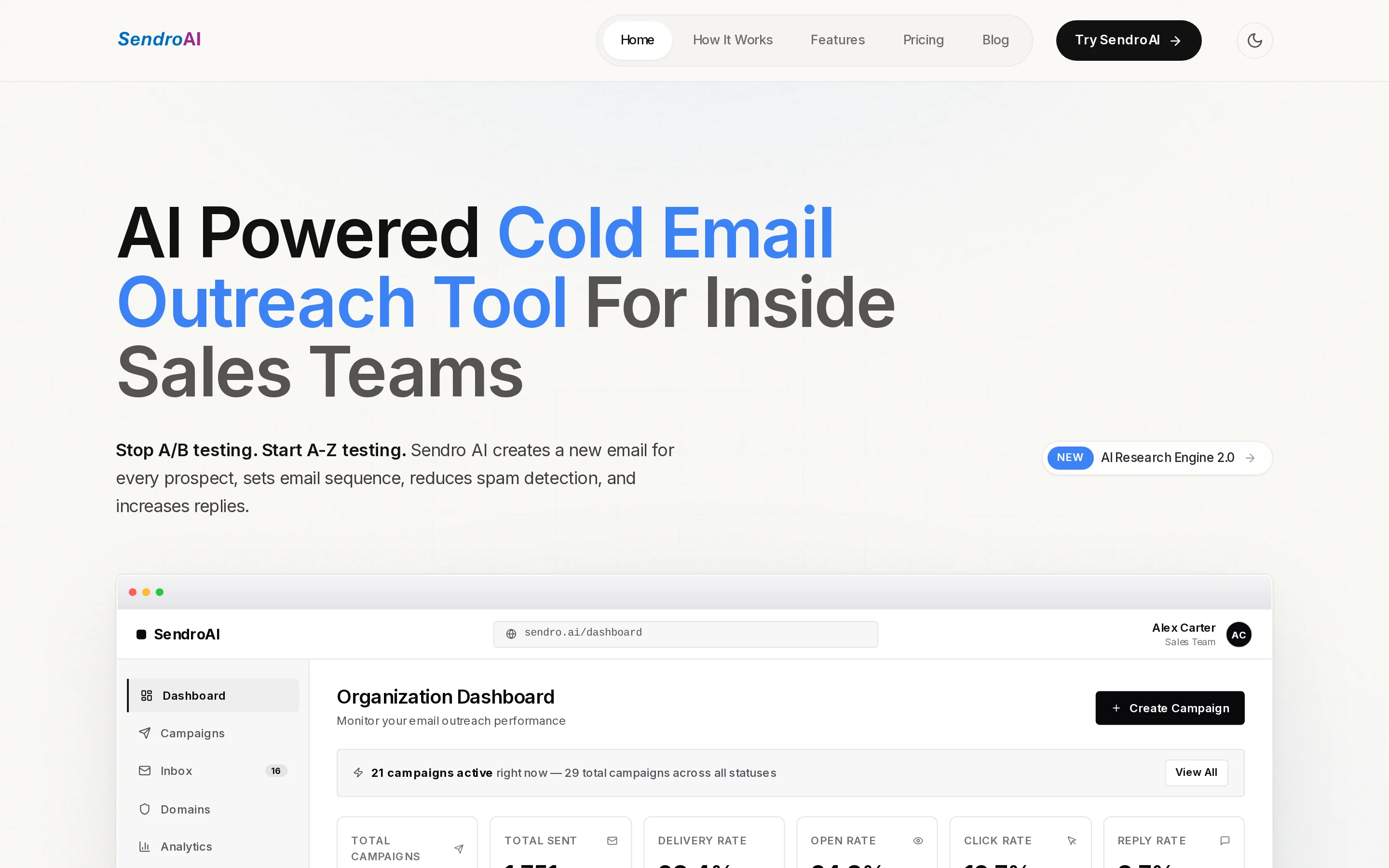
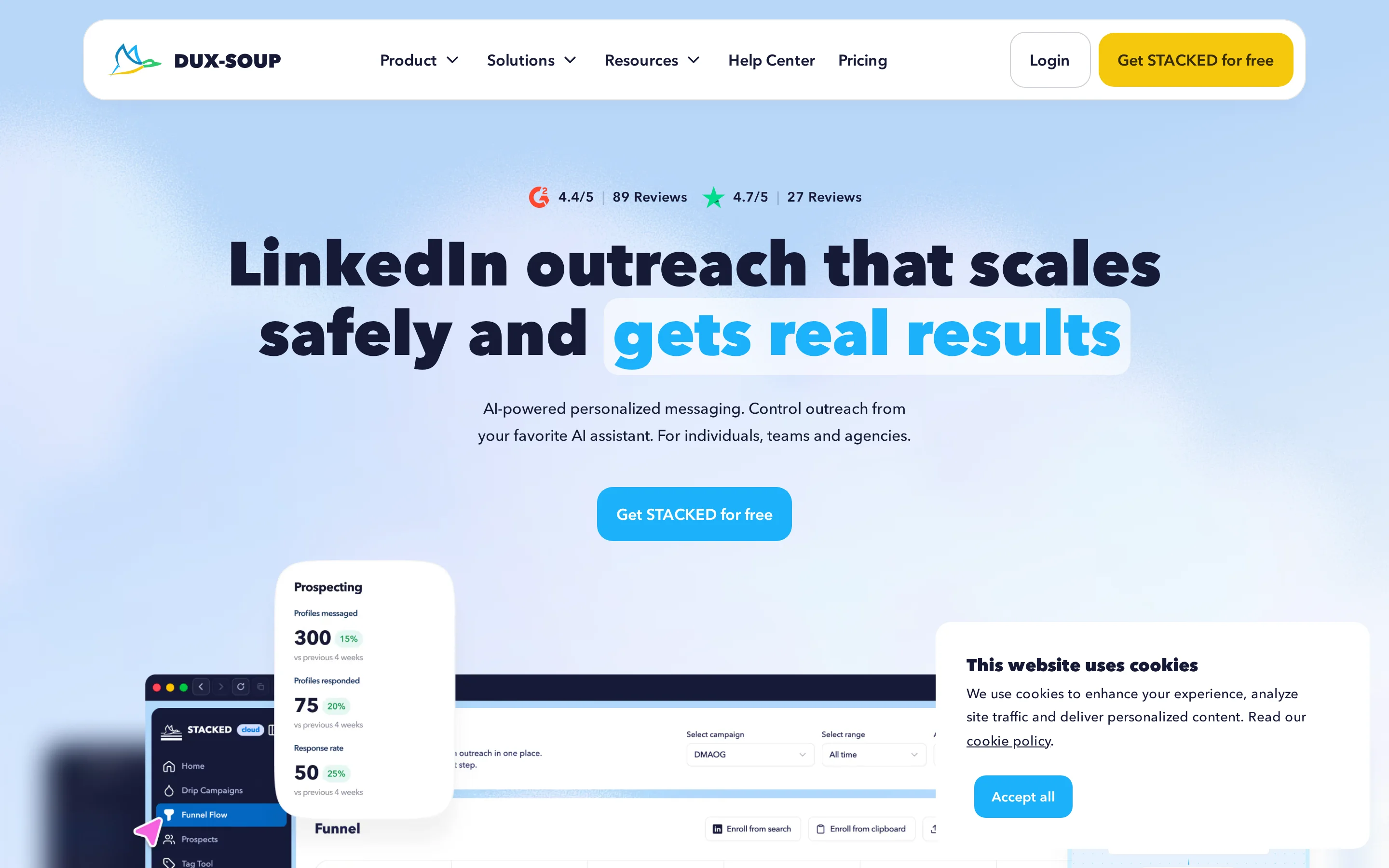
| Attribute | SendroAI | Dux Soup |
|---|---|---|
| Primary Purpose | Autonomous AI Outbound Engine (Email) | LinkedIn Automation & Lead Gen Tool |
| Starting Price | $85/mo (Billed Annually) / $99/mo (Monthly) | $41.25/mo (Local, Billed Annually) / $55.00/mo (Local, Monthly) |
| Personalization Depth | Deep 1:1 Contextual Research (No Templates) | Static Templates / Merge Tags / AI-assisted but rule-based |
| Mailbox Rotation | Smart Automated Multi-Domain Rotation | N/A (Focuses on LinkedIn Account Activity) |
| Pricing Model | Flat Rate (Unlimited Domains/Mailboxes/Campaigns) | Per-Seat Pricing (Scales linearly with team size) |
Feature-by-feature matrix
Audited capabilities across data sourcing, sending infrastructure, and integrations.
| Capability | Why it matters | SendroAI | Dux Soup | Winner |
|---|---|---|---|---|
| Autonomous Prospect Research | Unique personalized angles per lead to bypass spam filters | ✓ Native (Real-time company & prospect intelligence) | — None (Relies on user input or basic scraping) | sendroai |
| AI Copywriting | Eliminating template pattern detection and sounding human | ✓ Native (Hand-written feel, never templated) | ◐ Partial (AI-powered personalization within templates) | sendroai |
| Smart Mailbox Rotation | Distributing load to protect domain reputation at scale | ✓ Native (Automatic rotation across verified mailboxes) | — None (Not applicable to LinkedIn-only automation) | sendroai |
| Auto-Pause on Reply | Preventing awkward follow-ups after lead responds | ✓ Native (Reply-safe auto-pause logic) | ✓ Yes (Detects responses and pauses campaigns) | Tie |
| Multilingual Support | Native outreach without translation tools | ✓ Native (Writes natively in 50+ languages) | — Limited (Dependent on user-provided content) | sendroai |
| Deployment Infrastructure | Ease of management and uptime | Cloud-Native (Managed sending infrastructure) | Local/Cloud Options (Desktop app or managed cloud) | sendroai |
Technical deep dives
Architectural comparisons derived from live platform testing.
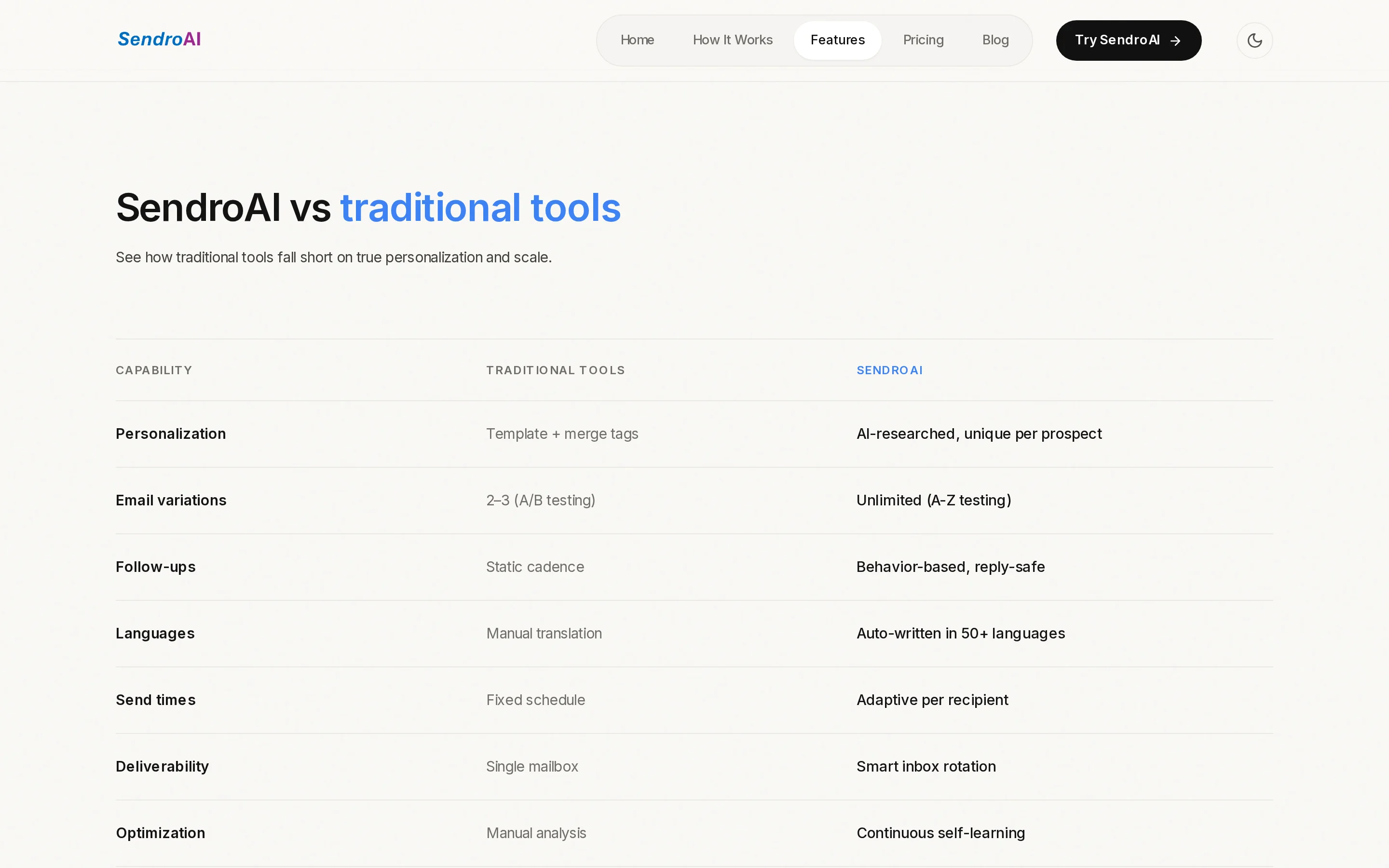 Full resolution
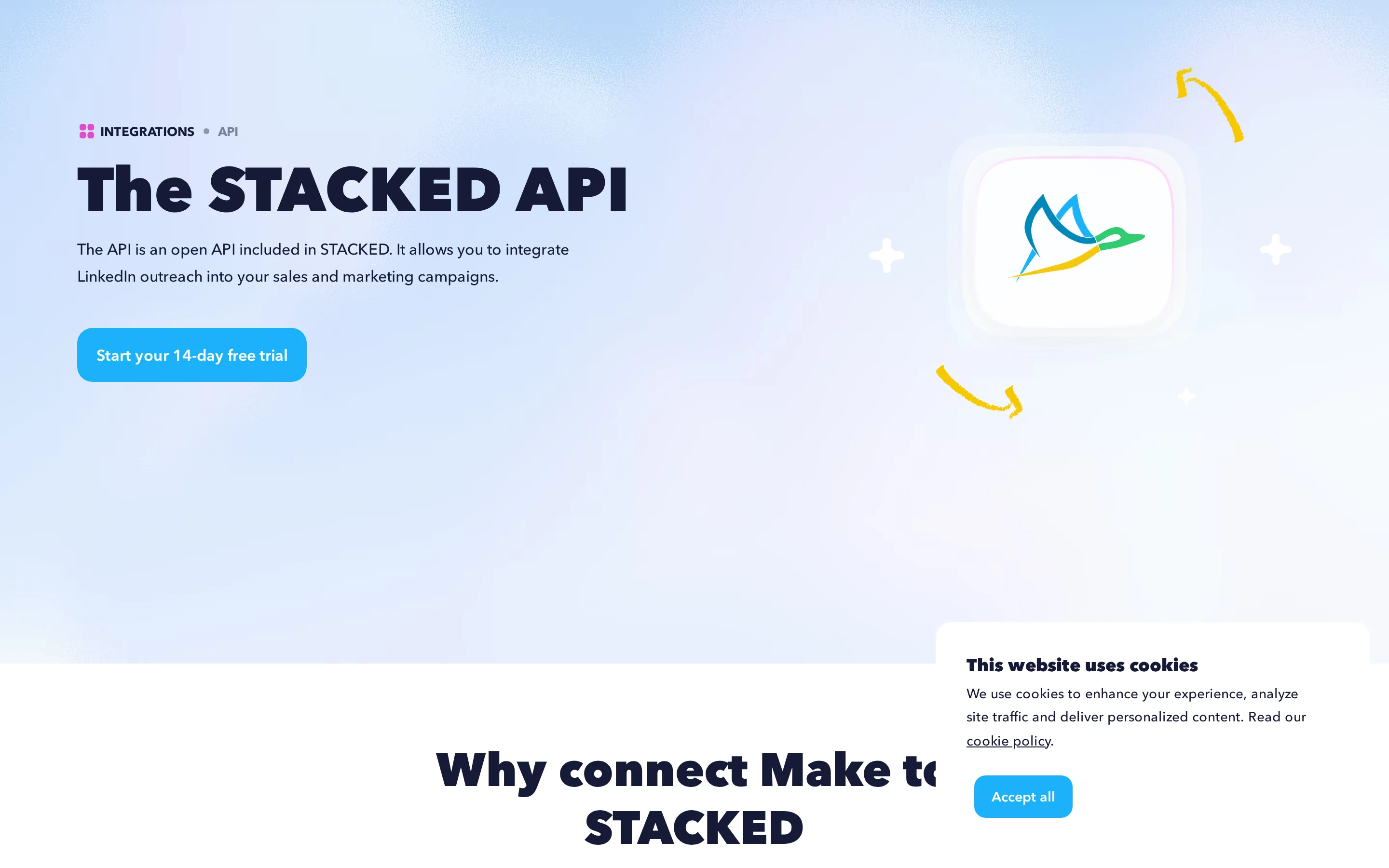 Full resolution
Prospect Intelligence: Autonomous 1:1 Research vs. Template-Driven Automation
Dux Soup operates primarily as a LinkedIn automation tool that executes predefined sequences such as viewing profiles, sending connection requests, and messaging. Its 'AI-powered' features generally assist in filling merge tags or suggesting minor variations within static templates. This approach often results in generic outreach that can be easily detected by spam filters or ignored by recipients who recognize the pattern. In contrast, SendroAI employs an autonomous research engine that analyzes each prospect's company and role in real-time before writing a single word. It generates unique, hand-written-feeling cold emails from scratch, ensuring that no two messages are identical and that every touchpoint demonstrates genuine relevance.
For sales teams, the workflow difference is stark. With Dux Soup, reps must manually curate lists, define rigid campaign steps, and monitor for template fatigue. The system acts as a bot executing rules. With SendroAI, the platform acts as an intelligent co-pilot. You import leads, describe your product once, and the AI handles the research, writing, and sequencing. This shift from 'automation of tasks' to 'autonomy of outcomes' allows teams to scale hyper-personalization without increasing headcount.
The tradeoff is clear: if your strategy relies heavily on LinkedIn-specific interactions like endorsements or post likes, Dux Soup has niche utility. However, for modern outbound teams focused on high-reply rates via email, SendroAI’s ability to bypass pattern detection through deep contextual research provides a significant competitive advantage in deliverability and engagement.
Sending Infrastructure: Secondary Domain Rotation vs. Primary Account Dependency
Deliverability is the backbone of any successful outbound campaign. Dux Soup automates activity on your primary LinkedIn account. While it includes safety features to mimic human behavior, any misconfiguration or aggressive usage risks flagging the core professional identity of the sales rep. There is no concept of 'domain rotation' because the channel is social, not email. Conversely, SendroAI is built around a robust secondary domain strategy. Users connect their own domains, and SendroAI creates and manages mailboxes specifically for outreach. This isolates cold traffic from the company's primary communication channels.
SendroAI’s Smart Mailbox Rotation automatically distributes sends across multiple verified mailboxes using warm, human-like patterns. This protects the sender reputation of each individual mailbox and prevents any single point of failure. If one mailbox encounters issues, the system seamlessly rotates to others, maintaining campaign continuity. Dux Soup lacks this architectural resilience; if a LinkedIn account gets restricted, the entire campaign halts until resolved.
For enterprises concerned about brand safety and IP protection, SendroAI’s infrastructure is superior. It ensures that high-volume outreach never compromises the reputation of the company’s primary domain or the personal credibility of its executives on LinkedIn. The separation of concerns—primary domain for business, secondary domains for outreach—is a standard best practice that SendroAI enforces natively, while Dux Soup does not address this risk vector.
Total Cost of Ownership: Flat Unlimited Scaling vs. Per-Seat & Tiered Complexity
Dux Soup’s pricing model is fundamentally tied to headcount. At $55/month per seat for local deployment and $99/month per seat for cloud, costs scale linearly with team size. A 10-person sales team pays $550-$990 monthly just for access, regardless of volume efficiency. Furthermore, users must choose between local (requires keeping machines on) and cloud (higher cost) infrastructures, adding operational complexity. SendroAI disrupts this model with flat-rate pricing starting at $85/month (annual billing). Crucially, all plans include unlimited connected domains, mailboxes, and campaigns.
This means a startup paying $85/month can run the same number of mailboxes and campaigns as an enterprise paying $205/month, differing only in daily send caps. There is no 'seat tax.' As your team grows from 2 to 20 SDRs, your software cost remains constant unless you need higher volume limits, which are still capped at reasonable tiers ($125/$205). This predictability allows finance teams to forecast ROI accurately without worrying about hidden per-user fees or infrastructure surcharges.
When calculating Total Cost of Ownership (TCO), one must also consider the labor cost saved by SendroAI’s autonomous research. Dux Soup requires manual list building and template management. SendroAI automates the research and writing, effectively replacing the need for dedicated SDRs to spend hours on data entry and copy drafting. For most outbound-focused organizations, SendroAI delivers a lower TCO and higher scalability ceiling than Dux Soup’s per-seat, LinkedIn-centric model.
Pricing & true cost
Published tier structures, credit scaling mechanics, and total outbound cost.
 Full resolution
 Full resolution
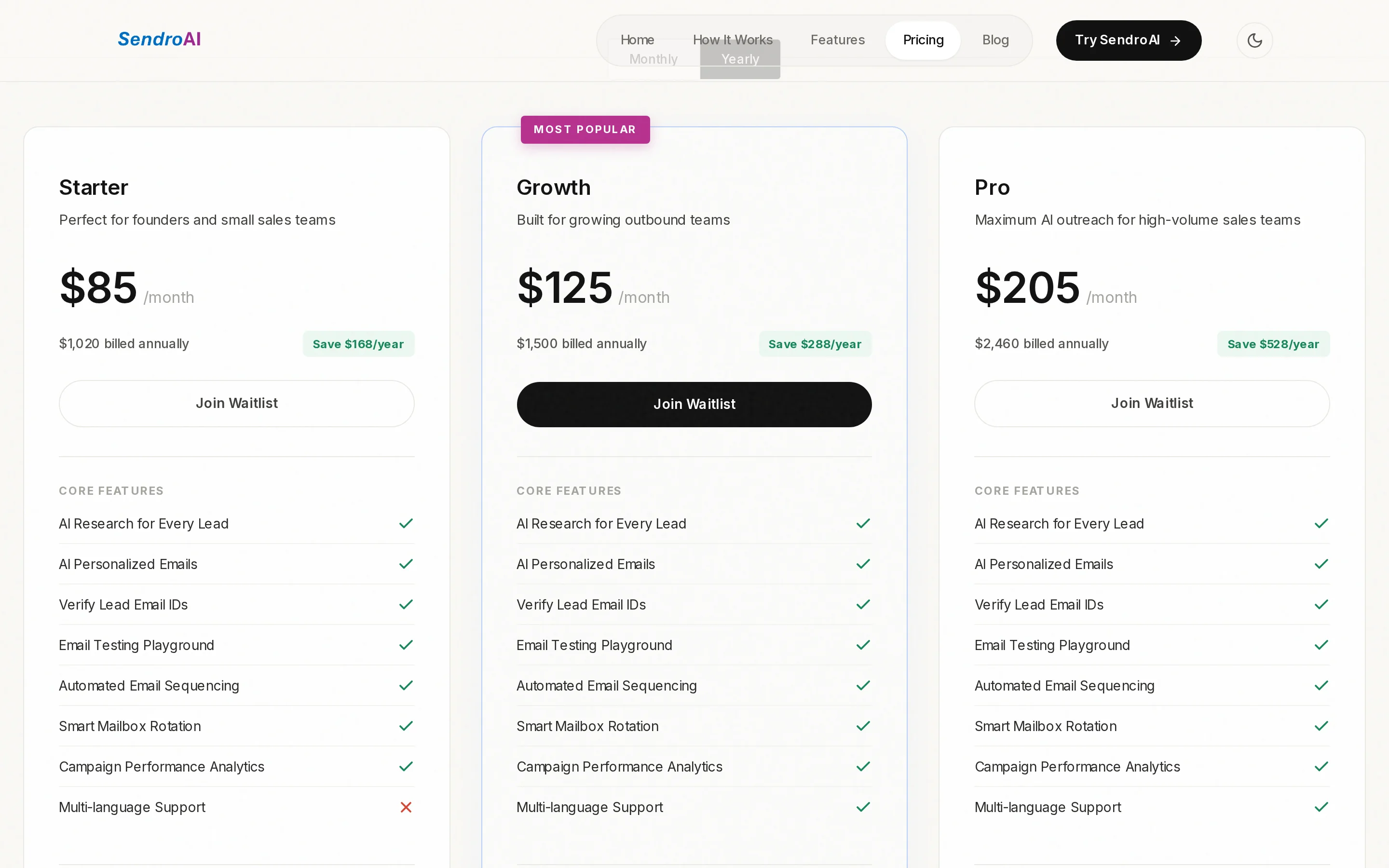
SendroAI plans
- Starter: $85/mo (billed annually) — 25 intro emails/day, 4,100 emails/mo, Unlimited domains/mailboxes
- Growth: $125/mo (billed annually) — 50 intro emails/day, 8,200 emails/mo, Unlimited domains/mailboxes
- Pro: $205/mo (billed annually) — 100 intro emails/day, 16,400 emails/mo, Unlimited domains/mailboxes
- All plans include: AI Research, Auto-Sequencing, Smart Mailbox Rotation, Multilingual Support, Analytics
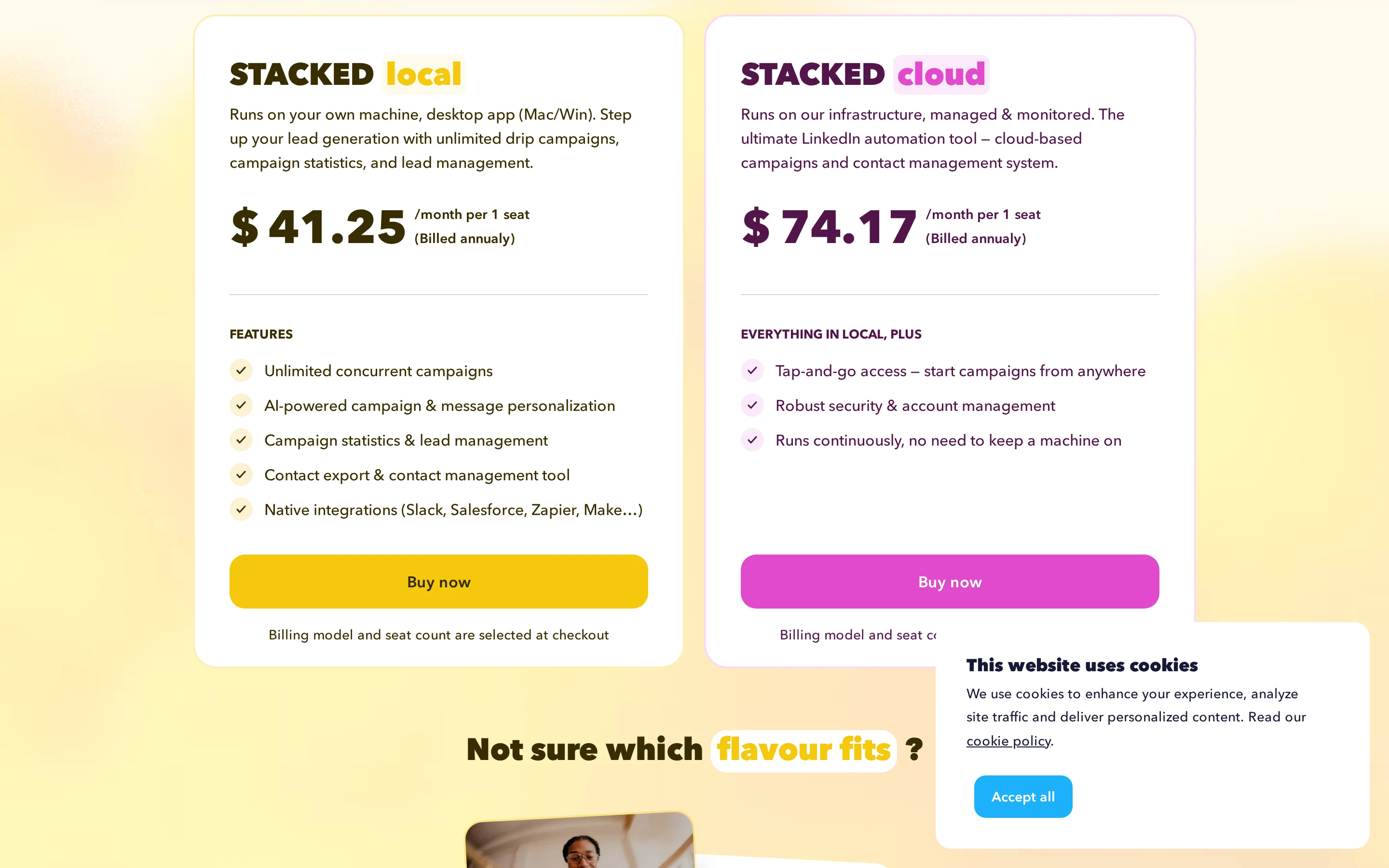
Dux Soup plans
- STACKED Local: $55.00/month per seat (or $41.25 billed annually) — Desktop app, unlimited concurrent campaigns
- STACKED Cloud: $99.00/month per seat (or $74.17 billed annually) — Managed infrastructure, tap-and-go access
- Note: Pricing is strictly per-seat; costs increase linearly with team size.
SendroAI offers a transparent, flat-rate model that decouples cost from headcount, allowing unlimited domains and mailboxes on all tiers. Dux Soup charges per seat, meaning a growing team faces exponentially increasing costs. For example, a 5-person team pays ~$275-$495/month for Dux Soup, whereas SendroAI covers the entire team’s infrastructure needs for $85-$205/month depending on volume, making SendroAI significantly more cost-effective for scaling outbound operations.
of Ownership Analysis
Beyond subscription fees, SendroAI reduces operational overhead by eliminating the need for separate research tools, copywriters, and complex CRM integrations for basic sequencing. Dux Soup’s local version requires maintaining active desktop environments, adding IT support costs, while its cloud version carries a premium. SendroAI’s inclusion of unlimited mailboxes means no extra fees for adding sending capacity, a common hidden cost in other platforms. The true cost of Dux Soup is high due to per-seat taxes and limited channel focus (LinkedIn only), whereas SendroAI provides a complete email stack at a predictable price.
Which fits your outbound model?
Match your team size, deal complexity, and lead volume to the right engine.
High-Value Account Executive Outreach
SendroAI crafts deep 1:1 tailored messaging that triggers replies from senior leaders, whereas Dux Soup’s template approach may lack the nuance required for C-level engagement.
Global Market Expansion
SendroAI natively writes in 50+ languages, enabling seamless international campaigns. Dux Soup requires manual translation or external tools for non-English markets.
LinkedIn Profile Viewing & Networking
If your primary goal is purely LinkedIn networking (views, follows, endorsements) without email integration, Dux Soup is specialized for this task.
Small Team Bootstrapping
SendroAI’s Starter plan ($85/mo) supports unlimited mailboxes, ideal for founders wearing multiple hats. Dux Soup’s per-seat cost becomes prohibitive quickly even for small teams.
Where each platform falls short
Constructive limitations and architectural trade-offs to weigh before signing.
Where SendroAI falls short
- Focused exclusively on email outbound; does not automate LinkedIn actions (views, connects, likes).
- Requires users to provide their own lead lists; no built-in prospect database.
- Does not support SMS, WhatsApp, or voice calling features.
Where Dux Soup falls short
- Per-seat pricing penalizes team growth and increases TCO linearly.
- Limited to LinkedIn ecosystem; no native cold email sequencing or domain rotation capabilities.
- Local version requires active machine uptime; Cloud version is significantly more expensive.
- Personalization relies on templates and merge tags, lacking deep autonomous research.
The switching playbook
What you gain and give up when migrating across platforms.
- -
- Access to speciali
- Paying per-seat charges that scale with team si
Frequently asked questions
Direct technical answers about SendroAI and Dux Soup.
How does SendroAI differ from Dux Soup?
SendroAI is an autonomous cold email engine that uses AI to research prospects and write unique emails, featuring smart mailbox rotation and flat pricing. Dux Soup is a LinkedIn automation tool that executes template-based actions like profile views and connection requests, priced per seat.
Can I connect multiple secondary domains to SendroAI?
Yes, SendroAI includes unlimited connected domains and mailboxes on all plans, allowing you to rotate sends across multiple domains to protect your primary domain’s reputation.
Does SendroAI replace my SDR team?
SendroAI acts as an autonomous outbound co-pilot, conducting research and drafting personalized copy so your reps can focus on closing deals. It augments rather than replaces human judgment in the final stages of the sales cycle.
Is Dux Soup good for cold email?
No, Dux Soup is designed for LinkedIn automation. It does not have native cold email sequencing, domain rotation, or email deliverability features. For cold email, SendroAI is the appropriate choice.
Sources & methodology
Every claim is grounded in official vendor documentation and live audits.