Quick decision verdict
Executive rulings based on technical testing and pricing data.
Best for Enterprise Outbound
AI-Softphone provides the raw telephony infrastructure and REST API control necessary for high-volume, automated voice dialing campaigns.
Best for Visual Product Sales
Vizaye is superior for surface material businesses needing room visualization, digital catalogs, and WhatsApp-based lead qualification.
Best for High-Volume Prospecting
AI-Softphone allows programmatic call initiation via POST /calls endpoints, enabling scalable outbound sequences that Vizaye lacks.
Best Overall Value
Vizaye offers a transparent tiered pricing model with a free entry point, whereas AI-Softphone requires custom enterprise negotiation.
AI-Softphone vs Vizaye at a glance
Side-by-side core specifications and live platform viewports.
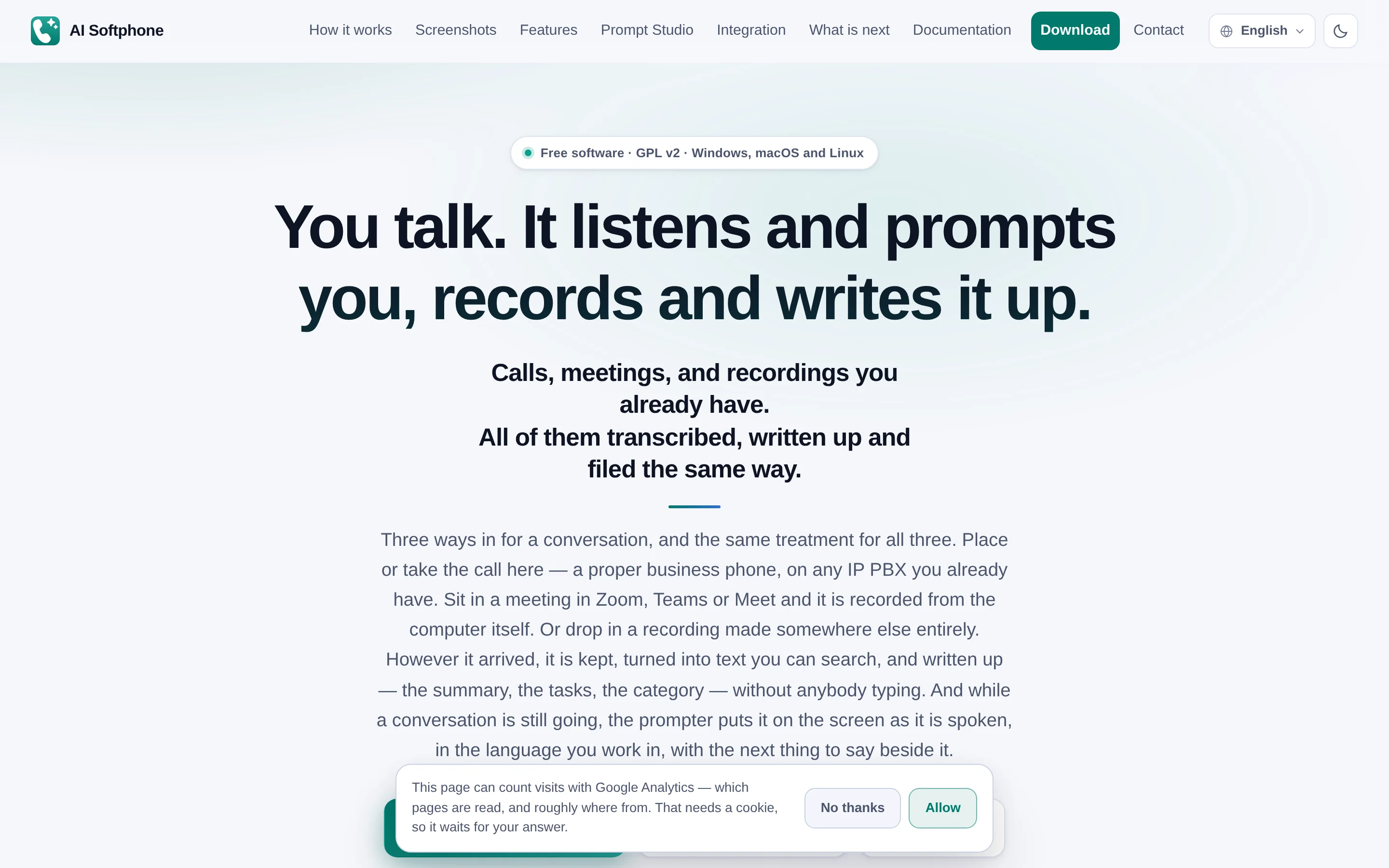
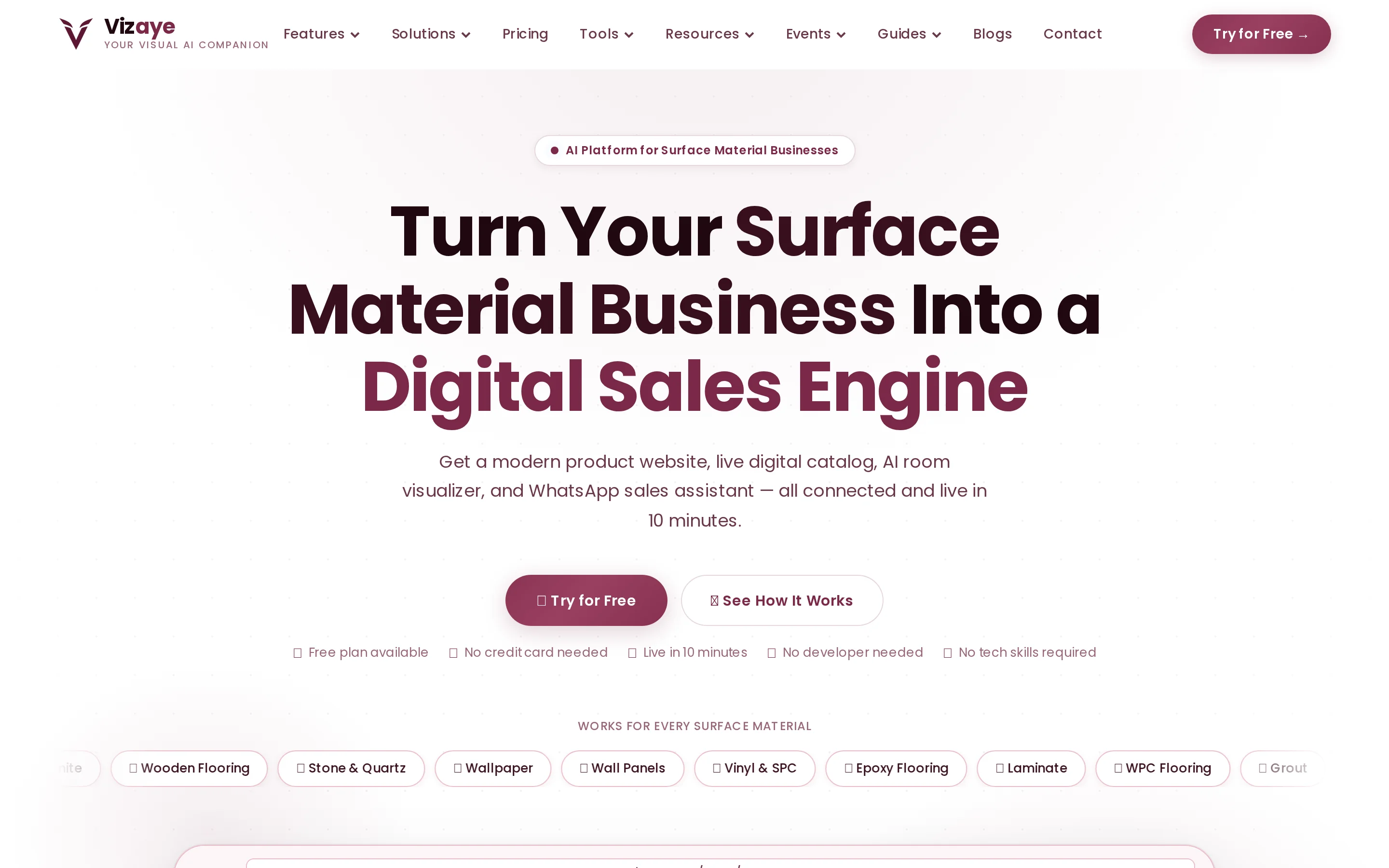
| Attribute | AI-Softphone | Vizaye |
|---|---|---|
| Primary Purpose | SIP/Telephony Infrastructure & Voice AI Integration | Visual Commerce & Surface Material Sales Enablement |
| Starting Price | Custom Enterprise Pricing (Contact Sales) | Free (with limits) / ₹15+ per unit usage fees |
| Free Plan | No public self-serve plan found | Yes (Free setup for first 5 businesses/month) |
| Core Strength | Real-time call control, DTMF, Transfer, and Webhook events | Room Visualizer, WhatsApp AI Assistant, and QR Code Engagement |
Feature-by-feature matrix
Audited capabilities across data sourcing, sending infrastructure, and integrations.
| Capability | Why it matters | AI-Softphone | Vizaye | Winner |
|---|---|---|---|---|
| B2B Contact Database | Access to net-new leads | — None | — None | Tie |
| Email Finder | Discovering verified addresses | — None | — None | Tie |
| Voice Dialing Infrastructure | Executing outbound calls | ✓ Native | — None | ai-softphone |
| WhatsApp Automation | Asynchronous lead nurturing | — None | ✓ Native | vizaye |
| CRM Integration | Syncing pipeline data | → Integration | → Integration | Tie |
| Product Catalog Management | Showcasing inventory | — None | ✓ Native | vizaye |
| Room Visualization | Enhancing buyer confidence | — None | ✓ Native | vizaye |
| Call Recording & Transcription | Quality assurance and training | ✓ Native | — None | ai-softphone |
| Lead Qualification Logic | Filtering uninterested prospects | ◐ Partial | ✓ Native | vizaye |
| API Access | Custom workflow automation | ✓ Native | ◐ Partial | ai-softphone |
| Multi-location Support | Scaling across branches | N/A | ✓ Native | vizaye |
| White-label Branding | Maintaining brand consistency | — None | ✓ Native | vizaye |
Technical deep dives
Architectural comparisons derived from live platform testing.
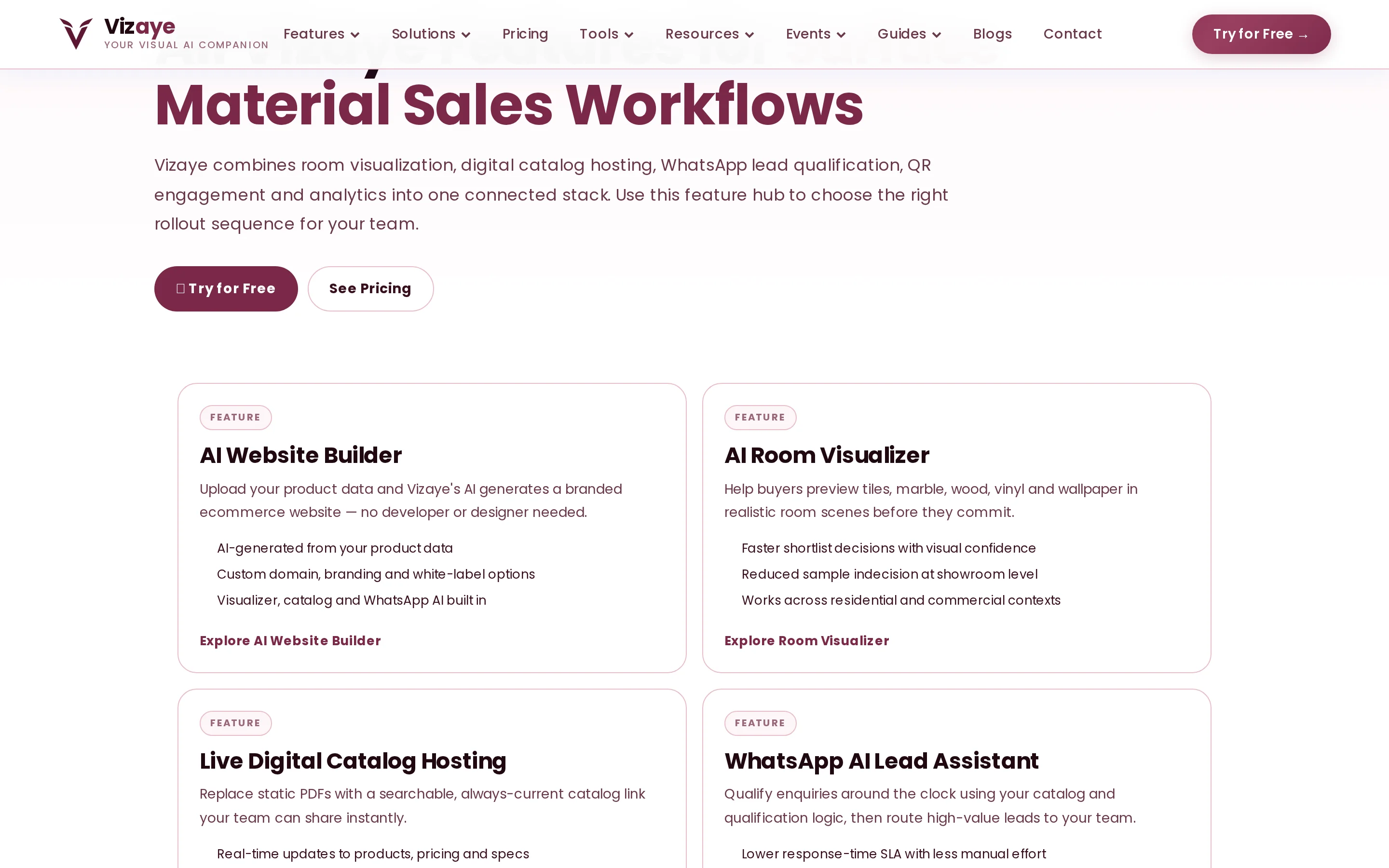 Full resolution
Core Value Proposition: Communication Infrastructure vs. Visual Commerce Enablement
Paragraph 1 (Architecture & Data Layer): AI-Softphone operates as a low-level telephony engine, exposing REST endpoints like `POST /calls` and `GET /metrics` to manage SIP accounts and active sessions. It is designed for developers building custom voice-AI agents or predictive dialers. In contrast, Vizaye is a vertical-specific SaaS platform tailored for surface material retailers (tiles, marble, flooring). Its architecture centers on product SKUs, room visualizers, and customer-facing micro-sites rather than raw communication protocols.
Paragraph 2 (Execution & Workflow): Day-to-day, an AI-Softphone user interacts with codebases and webhook configurations to trigger calls, answer them programmatically, or transfer them to human agents. A Vizaye user interacts with a dashboard to upload product images, configure WhatsApp greeting messages, and monitor quote requests from showroom kiosks or online visitors. The former is an infrastructure play; the latter is a sales enablement play.
Paragraph 3 (Tradeoffs & Ruling): If your business relies on cold calling at scale, AI-Softphone is the only viable option here. However, if you sell physical products where visualization drives conversion, Vizaye’s specialized tools offer immediate ROI without requiring engineering resources to build a front-end experience.
Lead Qualification Mechanism: AI Voice Agents vs. WhatsApp AI Assistant & Quote Requests
Paragraph 1 (Core Execution): AI-Softphone facilitates synchronous lead qualification through real-time voice interactions. While it doesn't natively host an 'AI Agent' in the research data, its API structure (`/calls/{id}/dtmf`, `/calls/{id}/transfer`) supports integration with external voice bots that can qualify leads during the call. Vizaye employs an asynchronous WhatsApp AI Assistant that engages users after they scan a QR code or visit a catalog, using pre-set logic to match products and capture contact details into a quote inbox.
Paragraph 2 (Daily Operational Realities): With AI-Softphone, qualification happens in seconds during a live call, requiring immediate agent availability or robust IVR scripting. This creates high-interruption workflows but yields instant feedback. Vizaye’s WhatsApp flow allows buyers to browse at their own pace, reducing friction. Leads are qualified based on engagement metrics (e.g., time spent in visualizer, specific SKU interest) rather than verbal responses.
Paragraph 3 (Tradeoffs & Ruling): For B2B outbound teams needing rapid filtering of large lists, AI-Softphone’s voice-centric approach is more direct. For retail consumers who prefer non-intrusive browsing, Vizaye’s WhatsApp assistant provides a higher-quality, context-rich lead profile before a human ever touches the phone.
Integration & Data Model: CRM-Centric Call Logs vs. Product-Centric Catalog Analytics
Paragraph 1 (Ecosystem & Data Hygiene): AI-Softphone integrates primarily with CRMs by pushing call logs, duration, and status codes (answered, missed, declined) via webhooks. Its data model is transactional and temporal, focused on pipeline velocity and agent performance. Vizaye integrates with inventory systems to track SKU-level engagement. Its analytics dashboard focuses on which products are viewed, how often rooms are visualized, and conversion rates from digital inquiries to quotes.
Paragraph 2 (Automation & Extensibility): AI-Softphone offers a granular REST API (`http://127.0.0.1:8377`) allowing deep customization of call flows, hold states, and DTMF inputs. This is ideal for developers building bespoke sales tech stacks. Vizaye’s extensibility is limited to its native modules (Catalog, Visualizer, WhatsApp); while it offers API access on Enterprise plans, the core value lies in its out-of-the-box vertical features rather than raw programmability.
Paragraph 3 (Tradeoffs & Ruling): Choose AI-Softphone if you need to build a custom outbound dialer integrated tightly with Salesforce or HubSpot via API. Choose Vizaye if you want pre-built analytics on product popularity and customer behavior within a retail showroom context without writing code.
Pricing & true cost
Published tier structures, credit scaling mechanics, and total outbound cost.
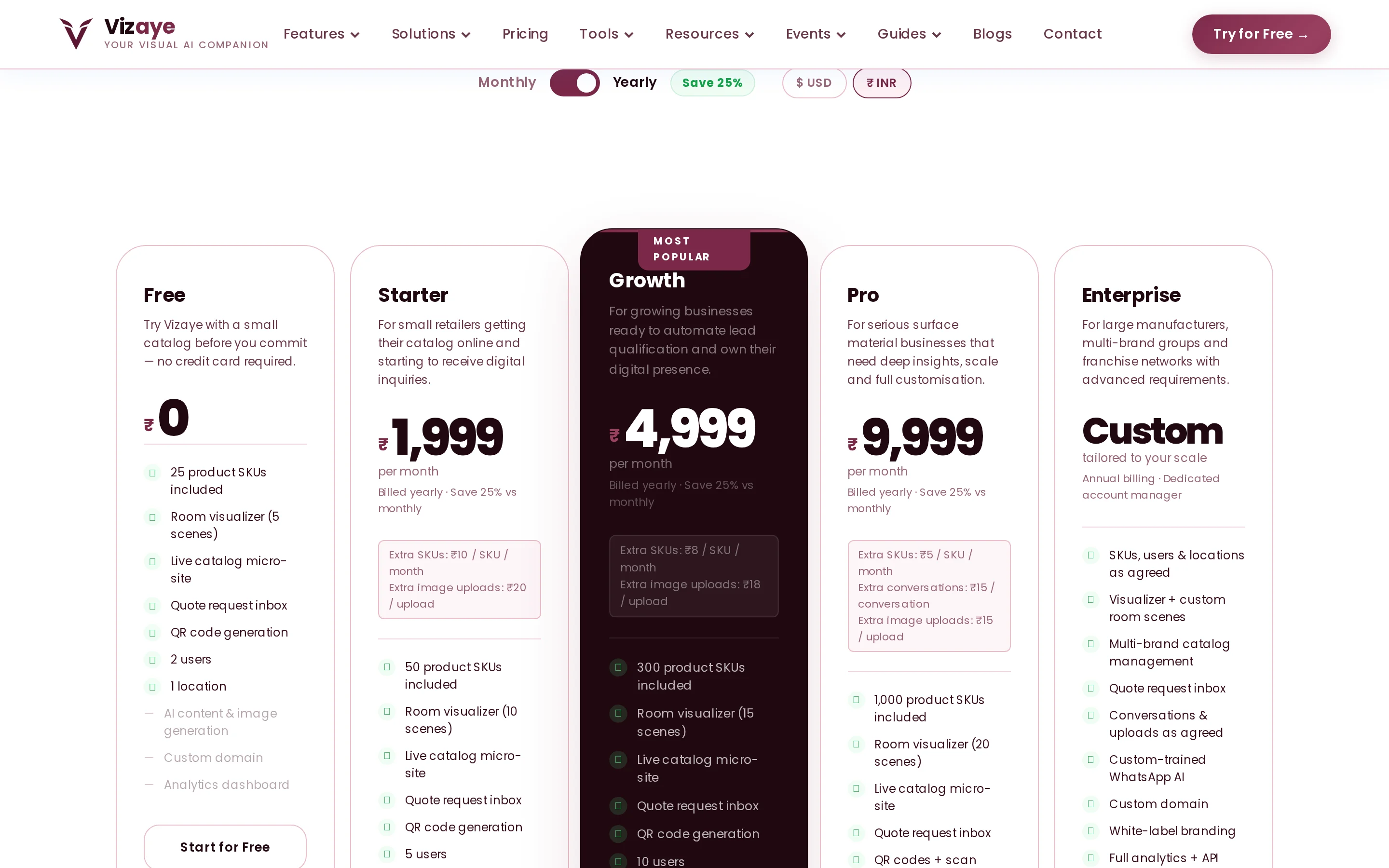 Full resolution
AI-Softphone plans
- Custom Enterprise Pricing (Contact Sales)
Vizaye plans
- Free: $0/mo (25 SKUs, 2 Users)
- Starter: ~$10/mo equivalent (50 SKUs, 5 Users, ₹10/SKU extra)
- Growth: ~$20/mo equivalent (300 SKUs, 10 Users, ₹8/SKU extra)
- Pro: ~$50/mo equivalent (1,000 SKUs, 20 Users, ₹5/SKU extra)
- Enterprise: Custom Quote (Unlimited SKUs, White-label)
Vizaye provides transparent, tiered pricing starting with a free plan and scaling up to Enterprise, with clear per-SKU and per-conversation overage fees (in INR, normalized to USD estimates). AI-Softphone does not publish self-serve pricing, indicating a likely custom-negotiated model suited for larger enterprises or technical integrators. For small-to-mid-sized businesses, Vizaye offers predictable costs; for those needing raw telephony power, AI-Softphone requires a sales conversation to determine TCO.
of Ownership Analysis
For a 5-person team: Vizaye's 'Growth' plan (10 users included) would cost approximately $20-$30/month plus potential overages for conversations or SKUs, totaling under $100/month for moderate use. AI-Softphone's cost is unknown without a quote, but typically such infrastructure charges per concurrent call or per minute. Assuming a standard market rate of $0.02/min for VoIP and $50/user for software licensing, a 5-person team making 1,000 minutes of calls daily could see costs exceed $500-$1,000/month depending on volume. Vizaye is significantly cheaper for non-voice-centric sales.
Which fits your outbound model?
Match your team size, deal complexity, and lead volume to the right engine.
High-Volume Cold Outbound
AI-Softphone is built for this, offering API-driven call initiation and management.
Retail Showroom Digitalization
Vizaye excels here with kiosk modes, QR codes, and room visualizers.
Developer API Data Pipelines
AI-Softphone's detailed REST documentation makes it ideal for custom integrations.
WhatsApp Lead Nurturing
Vizaye has a native WhatsApp AI Assistant; AI-Softphone does not support messaging channels.
Where each platform falls short
Constructive limitations and architectural trade-offs to weigh before signing.
Where AI-Softphone falls short
- No public pricing transparency.
- Lacks native CRM or marketing automation features (requires external integration).
- Not suitable for non-voice sales channels like email or social media.
Where Vizaye falls short
- Strictly vertical-focused (surface materials), limiting utility for other industries.
- No native voice calling or telephony infrastructure.
- Pricing overages (SKUs, conversations) can accumulate quickly at scale.
The switching playbook
What you gain and give up when migrating across platforms.
- Full control over call routing and timing via API.
- Ability to integrate with any existing CRM or database.
- Scalable voice infrastructure for high-volume dialing.
- Immediate deployment of digital catalogs and visuali
- Inability to make outbound voice calls directly.
- Limited customi
Frequently asked questions
Direct technical answers about AI-Softphone and Vizaye.
Which platform has better data accuracy?
Neither platform is a data provider. AI-Softphone manages call metadata accurately, while Vizaye tracks product engagement. You must bring your own contact lists to both.
How do their starting costs compare?
Vizaye starts at $0 (Free Plan). AI-Softphone requires contacting sales for a custom quote, likely involving monthly minimums or per-seat fees.
Can I connect unlimited mailboxes?
No. Neither tool is an email client. AI-Softphone connects SIP trunks/accounts; Vizaye connects WhatsApp Business numbers.
Which tool is easier to learn?
Vizaye is easier for non-technical sales teams due to its UI-driven catalog and visualizer setup. AI-Softphone requires developer knowledge to utilize its REST API effectively.
Sources & methodology
Every claim is grounded in official vendor documentation and live audits.
Compare with sendroAI
See how sendroAI replaces manual research, credit limits, and deliverability traps with full autonomous execution.