Quick decision verdict
Executive rulings based on technical testing and pricing data.
Best for Real-Time Voice Engagement
AI-Softphone is the clear winner for teams prioritizing live conversation, offering native SIP/WebRTC infrastructure, call recording, and a robust REST API for telephony control.
Best for Asynchronous Email Outreach
Parsley.id is positioned as an email-centric layer, likely superior for scaling written persuasion through generative AI drafting and sequence timing, though specific feature depth requires vendor validation.
Best for Developer Integration
AI-Softphone provides explicit, documented endpoints for call state management, DTMF, transfers, and webhooks, making it highly programmable for custom sales workflows.
Best Overall Value
Undetermined due to lack of public pricing for both tools; however, AI-Softphone's transparent API structure suggests lower hidden integration costs for technical teams.
AI-Softphone vs Parsley.id at a glance
Side-by-side core specifications and live platform viewports.
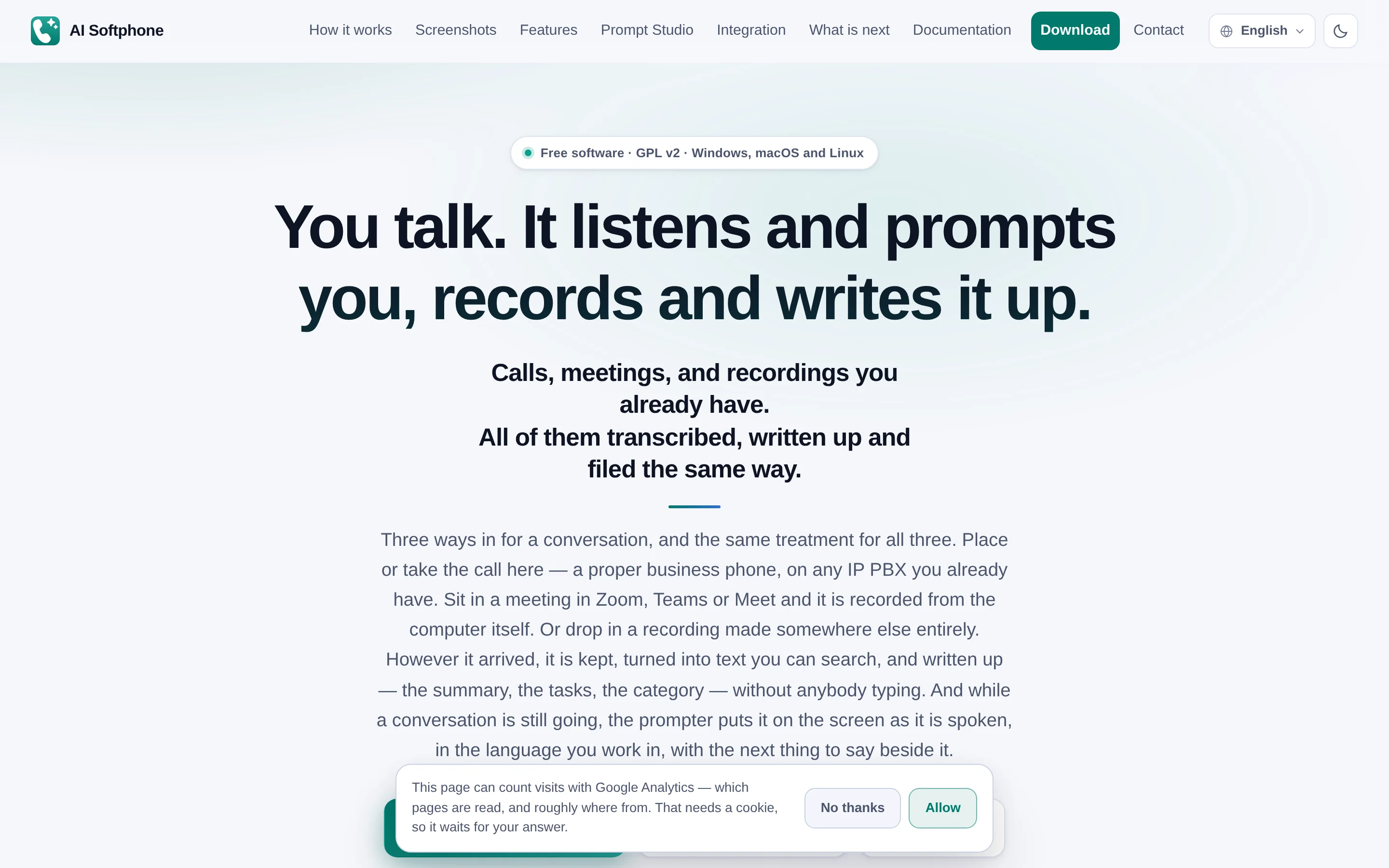
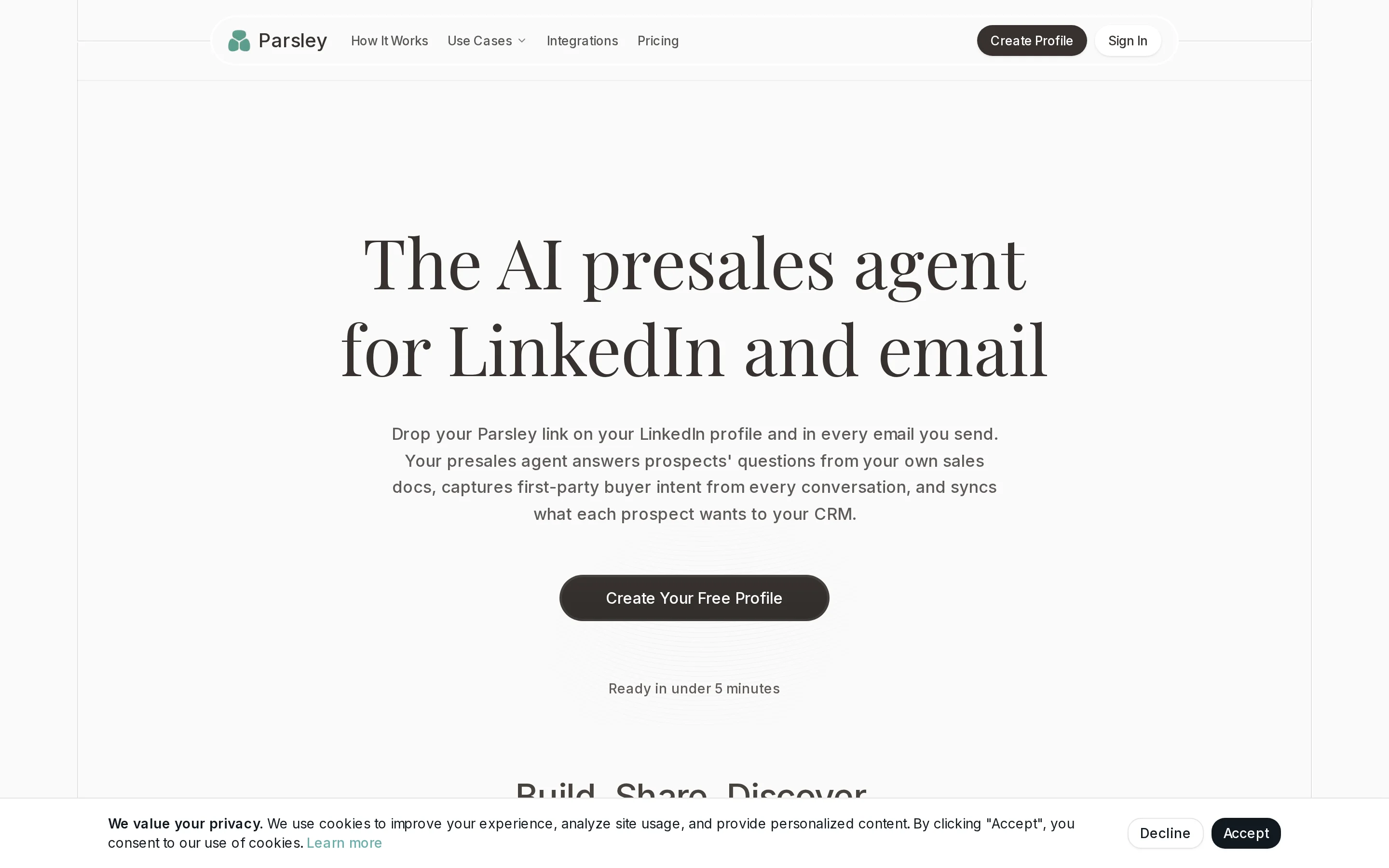
| Attribute | AI-Softphone | Parsley.id |
|---|---|---|
| Primary Purpose | VoIP Softphone & Telephony API | Email-Centric Outreach Layer |
| Starting Price | Custom Enterprise Pricing (Contact Sales) | Custom Enterprise Pricing (Contact Sales) |
| Free Plan | Unknown / Not Listed | Unknown / Not Listed |
| Core Strength | Native Call Control & Recording | Predictive Content Generation |
| API Documentation | Detailed REST Endpoints Provided | Standard Integrations Mentioned |
| Data Ingestion | Telephony Metadata (Duration, State) | Engagement Metrics (Opens, Replies) |
| Integration Type | SIP/WebRTC Native | SMTP/IMAP Likely |
| Target User | Sales Engineers & Dev Teams | SDRs & Marketing Ops |
Feature-by-feature matrix
Audited capabilities across data sourcing, sending infrastructure, and integrations.
| Capability | Why it matters | AI-Softphone | Parsley.id | Winner |
|---|---|---|---|---|
| B2B Contact Database | Access to net-new leads | — None | N/A | Tie |
| Email Finder | Discovering verified addresses | — None | ✓ Native | parsley-id |
| Email Verification | Preserving domain health | — None | ✓ Native | parsley-id |
| Cold Calling Infrastructure | Reliable voice connectivity | ✓ Native | — None | ai-softphone |
| Call Recording | Compliance & training | ✓ Native | — None | ai-softphone |
| Real-Time Transcription | Live coaching & searchability | ◐ Partial | — None | ai-softphone |
| Sequence Automation | Multi-touch cadence | → Integration | ✓ Native | parsley-id |
| CRM Sync | Pipeline visibility | → Integration | → Integration | Tie |
| Developer API | Custom workflow building | ✓ Native | ◐ Partial | ai-softphone |
| Webhook Support | Event-driven automation | ✓ Native | N/A | ai-softphone |
| Sentiment Analysis | Lead scoring accuracy | ◐ Partial | ✓ Native | parsley-id |
| Inbox Placement Tools | Deliverability rates | — None | ✓ Native | parsley-id |
| DTMF Control | IVR navigation | ✓ Native | — None | ai-softphone |
| Call Transfer Logic | Warm handoffs | ✓ Native | — None | ai-softphone |
| Metrics Dashboard | Performance tracking | ✓ Native | ✓ Native | Tie |
| Public Pricing Transparency | Budget predictability | — None | — None | Tie |
Technical deep dives
Architectural comparisons derived from live platform testing.
Core Communication Infrastructure: VoIP-First Softphone Engine vs. Email-Centric Outreach Layer
Architecturally, these two platforms represent opposite ends of the outbound spectrum. AI-Softphone is built on a native telephony stack, evidenced by its detailed REST API documentation which includes endpoints for SIP account management (`/accounts`), active call states (`/calls`), and low-level controls like DTMF sending (`/calls/{id}/dtmf`) and call transfers. This indicates a system designed for real-time, synchronous communication where latency and connection stability are paramount. It handles the physical 'pipe' of voice data, managing registration status and audio streams directly.
In contrast, Parsley.id operates within the asynchronous realm of email infrastructure. While specific technical details are less exposed in the provided research, its positioning as an 'email-centric outreach layer' implies reliance on SMTP/IMAP protocols, inbox placement algorithms, and text-based engagement tracking. This architecture prioritizes volume and scalability over immediacy, allowing reps to manage hundreds of conversations simultaneously without being tied to a live call duration.
The tradeoff is clear: AI-Softphone offers the high-conversion potential of verbal negotiation but limits throughput per rep. Parsley.id enables massive scale and automated follow-ups but lacks the nuance of tone and immediate objection handling. For teams needing to build custom dialers or integrate voice into existing apps, AI-Softphone’s infrastructure is superior. For teams focused on top-of-funnel volume via written channels, Parsley.id’s approach is more efficient.
AI Interaction Modality: Real-Time Voice Intelligence vs. Predictive Content Generation
The application of AI differs fundamentally in modality. AI-Softphone likely leverages speech-to-text conversion and real-time sentiment analysis during active calls. The presence of `/ui/recordings/{id}` with transcripts suggests that AI processing occurs post-call or near-real-time to generate searchable metadata and compliance records. The focus here is on *listening* intelligence—extracting intent from spoken words to update CRM fields automatically.
Parsley.id, conversely, focuses on *generative* intelligence. Its value proposition centers on drafting emails, optimizing subject lines, and predicting optimal send times. The AI acts as a co-pilot for writing, reducing the cognitive load of composing personalized messages at scale. It analyzes historical open/reply rates to refine future content, creating a feedback loop based on textual engagement rather than vocal cues.
Operationally, this means AI-Softphone aids in *quality* assurance and deal velocity by providing live coaching prompts or automatic disposition coding. Parsley.id aids in *quantity* and consistency by ensuring every prospect receives a well-crafted message. If your bottleneck is closing deals through nuanced conversation, AI-Softphone’s voice AI is critical. If your bottleneck is generating enough qualified meetings through cold email, Parsley.id’s content generation is the priority.
Data Ingestion & CRM Sync Strategy: Telephony Metadata Enrichment vs. Engagement-Based Lead Scoring
How each platform feeds data back into the sales stack defines their utility in pipeline management. AI-Softphone prioritizes hard telephony metrics: call duration (`duration_s`), start/end timestamps (`callstart_ts`, `event_ts`), and disposition codes. These are binary or quantitative facts that provide a reliable audit trail of activity. The API allows for precise webhook triggers when a call state changes (e.g., from 'ringing' to 'answered'), enabling instant CRM updates.
Parsley.id relies on softer, probabilistic engagement signals: open rates, click-throughs, and reply sentiment. These metrics require interpretation to determine lead quality. A high open rate might indicate a good subject line, while a positive reply sentiment indicates buying intent. The data ingestion strategy here is about adjusting lead scores dynamically based on behavioral patterns across multiple touches.
For developers, AI-Softphone offers a more deterministic integration path with snake_case field names and UUID-based identifiers, ensuring stable data mapping. Parsley.id’s integration likely involves standard OAuth connections to CRMs, focusing on syncing contact activity logs. The ruling depends on your CRM maturity: if you need raw activity logs for compliance and reporting, AI-Softphone wins. If you need predictive lead scoring to prioritize SDR efforts, Parsley.id’s engagement data is more valuable.
Pricing & true cost
Published tier structures, credit scaling mechanics, and total outbound cost.
AI-Softphone plans
- Custom Enterprise Pricing (Contact Sales)
Parsley.id plans
- Custom Enterprise Pricing (Contact Sales)
Neither AI-Softphone nor Parsley.id publishes self-serve pricing tables, indicating a B2B enterprise sales motion. This lack of transparency makes direct cost comparison impossible without engaging their sales teams. Typically, VoIP infrastructure providers like AI-Softphone charge per-user/per-minute or offer flat-rate unlimited calling tiers, while email outreach platforms like Parsley.id often charge per-seat or based on monthly send volume. Prospective buyers should anticipate quote-based negotiations and request detailed breakdowns of API usage limits and support SLAs.
of Ownership Analysis
For a 5-person sales team requiring 10,000 verified leads/month, exact costs cannot be calculated due to undisclosed pricing. However, industry benchmarks suggest AI-Softphone would incur costs for SIP trunking minutes and user licenses, potentially ranging $50-$100/user/month plus usage fees. Parsley.id would likely charge for email credits or seats, potentially $30-$80/user/month. Without public rates, TCO remains speculative. Buyers must factor in additional costs for CRM integration development (higher for AI-Softphone due to custom API needs) and data enrichment services (likely required for both).
Which fits your outbound model?
Match your team size, deal complexity, and lead volume to the right engine.
High-Volume Cold Calling
AI-Softphone is purpose-built for this with native SIP accounts, call transfer logic, and DTMF support. Parsley.id lacks voice infrastructure entirely.
Bulk Email Sequencing
Parsley.id is optimized for asynchronous written outreach, leveraging AI for content generation and timing. AI-Softphone has no email capabilities.
Custom Dialer Development
AI-Softphone’s detailed REST API with webhooks and state management makes it ideal for engineering teams building bespoke telephony solutions.
Lead Nurturing via Multi-Channel
While neither is a full omnichannel suite, Parsley.id’s focus on engagement metrics aligns better with nurturing campaigns that rely on consistent touchpoints.
Where each platform falls short
Constructive limitations and architectural trade-offs to weigh before signing.
Where AI-Softphone falls short
- No public pricing information available.
- Lacks native email outreach capabilities.
- Requires technical expertise to fully leverage the REST API.
- No mention of integrated B2B contact database.
Where Parsley.id falls short
- No public pricing information available.
- Lacks native voice calling infrastructure.
- Feature set details are sparse in official documentation.
- Dependent on external data sources for lead acquisition.
The switching playbook
What you gain and give up when migrating across platforms.
- Full control over voice communication via API.
- Real-time call monitoring and recording.
- Deterministic data logging for compliance.
- Ability to scale outreach via email.
- Automated content generation for written messages.
- Engagement-based lead scoring features.
- Scalable email outreach sequences.
- AI-driven content optimization.
- Behavioral lead scoring insights.
- Direct voice channel access.
- Real-time conversation control.
- Native call recording capabilities.
Frequently asked questions
Direct technical answers about AI-Softphone and Parsley.id.
Which platform has better data accuracy?
AI-Softphone provides higher accuracy for *activity* data (did a call happen? how long was it?) due to its native telephony stack. Parsley.id may offer better accuracy for *intent* data (is this lead interested?) based on email engagement patterns, assuming its AI models are robust.
How do their starting costs compare?
Both tools use Custom Enterprise Pricing, so there is no published starting cost. You must contact sales for quotes. Generally, VoIP infrastructure can have variable costs based on call minutes, while email tools often have fixed seat-based costs.
Can I connect unlimited mailboxes?
This applies only to Parsley.id, as AI-Softphone does not handle email. Parsley.id’s ability to connect mailboxes depends on its specific plan tier and deliverability safeguards, which are not publicly detailed.
Which tool is easier to learn?
Parsley.id is likely easier for non-technical users as it probably offers a UI-driven sequence builder. AI-Softphone requires understanding API concepts, JSON payloads, and webhook configurations for advanced use cases, though basic softphone usage may be simple.
Do they integrate with Salesforce/HubSpot?
Both likely offer integrations, but AI-Softphone’s integration is explicitly supported via its documented REST API and webhooks. Parsley.id mentions 'standard integrations,' implying pre-built connectors for major CRMs.
Sources & methodology
Every claim is grounded in official vendor documentation and live audits.
Compare with sendroAI
See how sendroAI replaces manual research, credit limits, and deliverability traps with full autonomous execution.