Quick decision verdict
Executive rulings based on technical testing and pricing data.
Best for Enterprise Outbound
SugarCRM is superior for complex B2B sales cycles due to its 'Precision Selling' AI that integrates ERP data to surface hidden revenue opportunities and flag deal risks within existing accounts.
Best for Email Deliverability & Volume
Freshsales CRM offers a more streamlined, low-friction environment for high-volume SMB outreach with native Freddy AI automation for routine tasks and contact enrichment.
Best for High-Volume Prospecting
Freshsales CRM is better suited for rapid deployment and high-velocity prospecting thanks to its intuitive interface and extensive marketplace of over 1,200 pre-built integrations.
Best Overall Value
Freshsales CRM provides a lower barrier to entry with transparent pricing tiers, whereas SugarCRM targets mid-to-large organizations with custom quote-based packages focused on total cost of ownership reduction relative to Salesforce.
Freshsales CRM vs SugarCRM at a glance
Side-by-side core specifications and live platform viewports.
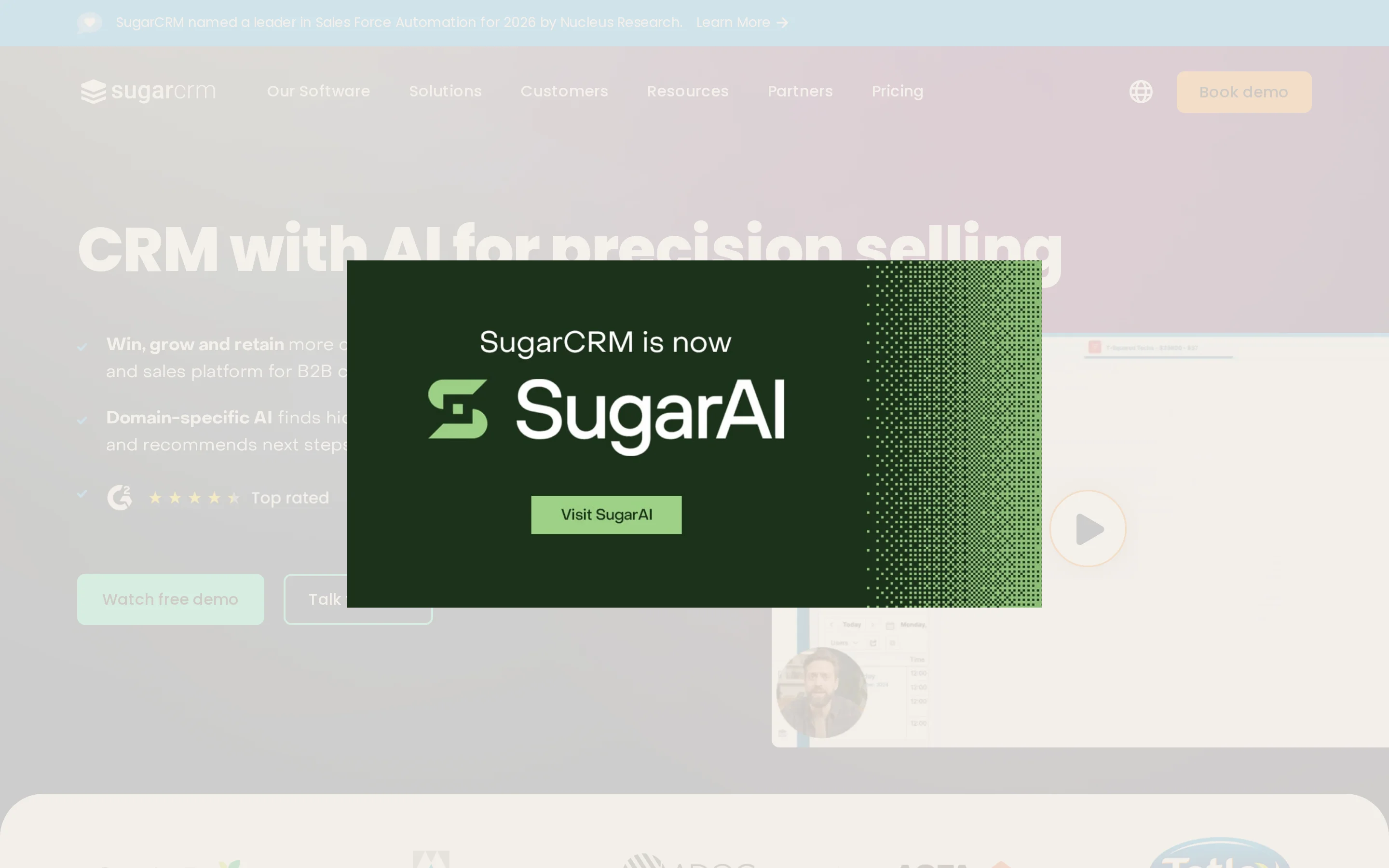
| Attribute | Freshsales CRM | SugarCRM |
|---|---|---|
| Primary Purpose | SMB-focused CRM with integrated ITSM/Support ecosystem | Enterprise-grade Precision Selling platform for complex B2B |
| Starting Price | Quote-Based / Contact Sales | Custom Enterprise Pricing (Contact Sales) |
| Free Plan | Yes (Free Trial available) | No (Demo required) |
| Core Strength | Freddy AI for workflow automation and ease of use | AI-driven contextual intelligence combining CRM and ERP data |
| Integration Ecosystem | 1,200+ Marketplace Apps | Native ERP connectors + REST/SOAP APIs |
| Target Audience | Small to Mid-sized Businesses (SMBs) | Mid-to-Large Enterprises in Manufacturing/Distribution |
| Customization Depth | Low-code tools and custom objects | Deep backend architecture for complex logic |
| AI Focus | Operational efficiency and admin task automation | Strategic guidance, risk flagging, and opportunity surfacing |
Feature-by-feature matrix
Audited capabilities across data sourcing, sending infrastructure, and integrations.
| Capability | Why it matters | Freshsales CRM | SugarCRM | Winner |
|---|---|---|---|---|
| B2B Contact Database | Access to net-new leads | → Integration | — None | Tie |
| Email Finder | Discovering verified addresses | → Integration | — None | Tie |
| Email Verification | Preserving domain health | ◐ Partial | — None | freshsales-crm |
| Cold Email Sequencing | Automated follow-ups | ✓ Native | ◐ Partial | freshsales-crm |
| Lead Scoring | Prioritizing hot prospects | ✓ Native | ✓ Native | Tie |
| AI Opportunity Surfacing | Finding upsell/cross-sell potential | ◐ Partial | ✓ Native | sugarcrm |
| ERP Data Integration | Contextual account insights | → Integration | ✓ Native | sugarcrm |
| Deal Risk Flagging | Preventing churn/slippage | — None | ✓ Native | sugarcrm |
| Sales Coaching Insights | Manager visibility into stalled deals | ◐ Partial | ✓ Native | sugarcrm |
| No-Code Customization | Rapid workflow adaptation | ✓ Native | ✓ Native | Tie |
| Marketplace App Breadth | Third-party tool connectivity | ✓ Native | ◐ Partial | freshsales-crm |
| Unified Support/IT Context | 360-degree customer view across depts | ✓ Native | — None | freshsales-crm |
| Forecast Accuracy | Revenue predictability | ◐ Partial | ✓ Native | sugarcrm |
| Mobile App Experience | Field sales usability | ✓ Native | ✓ Native | Tie |
| GDPR/CCPA Compliance | Data privacy standards | ✓ Native | ✓ Native | Tie |
| Implementation Speed | Time to value | ✓ Native | ◐ Partial | freshsales-crm |
Technical deep dives
Architectural comparisons derived from live platform testing.
 Full resolution
 Full resolution
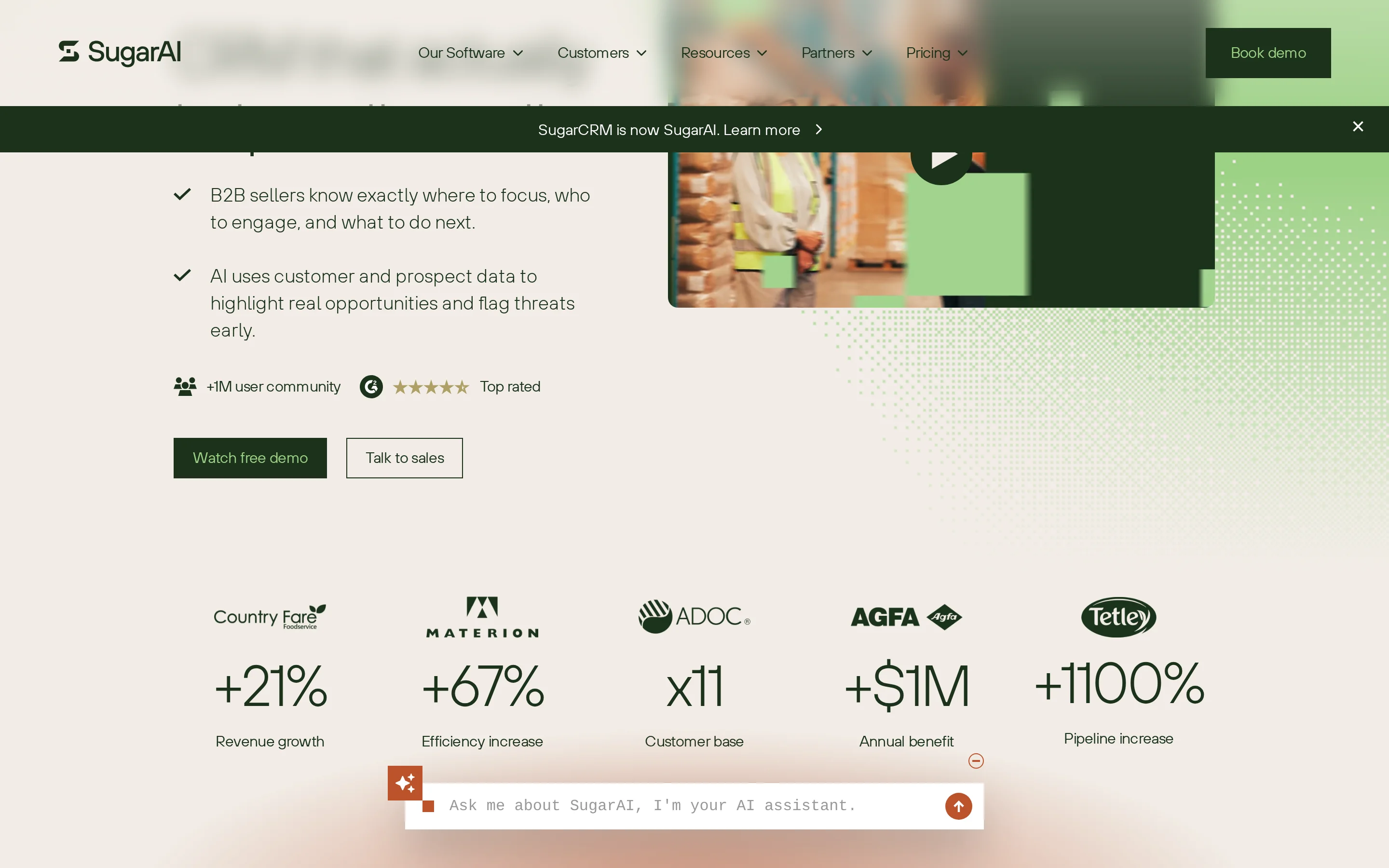
AI Strategic Orientation: Predictive Sales Guidance vs. Operational Workflow Automation
Architecture & Data Layer: SugarCRM’s 'Precision Selling' AI is architected to act as a strategic coach rather than a passive database. It uniquely combines CRM activity data with back-office ERP information (order history, product catalogs) to identify 'hidden revenue' within existing accounts. This allows the system to flag early warning signs of deal slippage or churn before they impact the pipeline. In contrast, Freshsales’ Freddy AI focuses on operational efficiency. Its primary role is to automate routine administrative tasks, enrich contact data automatically, and streamline workflows. While Freddy AI provides predictive lead scoring, it lacks the deep structural integration with enterprise resource planning systems that defines Sugar’s approach.
Execution & Workflow: For a seller using SugarCRM, the daily workflow begins with an AI-curated list of priorities. The system explicitly tells reps which accounts need attention, why they are at risk, and what specific action to take next, reducing the cognitive load of digging through dashboards. This is particularly effective for complex B2B sales cycles where long-term relationship management and cross-selling are critical. Freshsales, however, excels in high-volume environments where speed is paramount. Its AI automates the 'busy work'—such as logging calls, updating fields, and suggesting email replies—allowing SMB teams to maintain high activity levels without manual overhead.
Tradeoffs & Ruling: The choice depends on whether your bottleneck is *strategy* or *execution*. If your team struggles to know *where* to focus among thousands of accounts, SugarCRM’s guidance model is superior. If your team knows what to do but gets bogged down by administrative friction, Freshsales’ automation model delivers faster ROI. For pure outbound lead gen, Freshsales offers quicker setup, but SugarCRM offers deeper qualification insights once leads are inside the funnel.
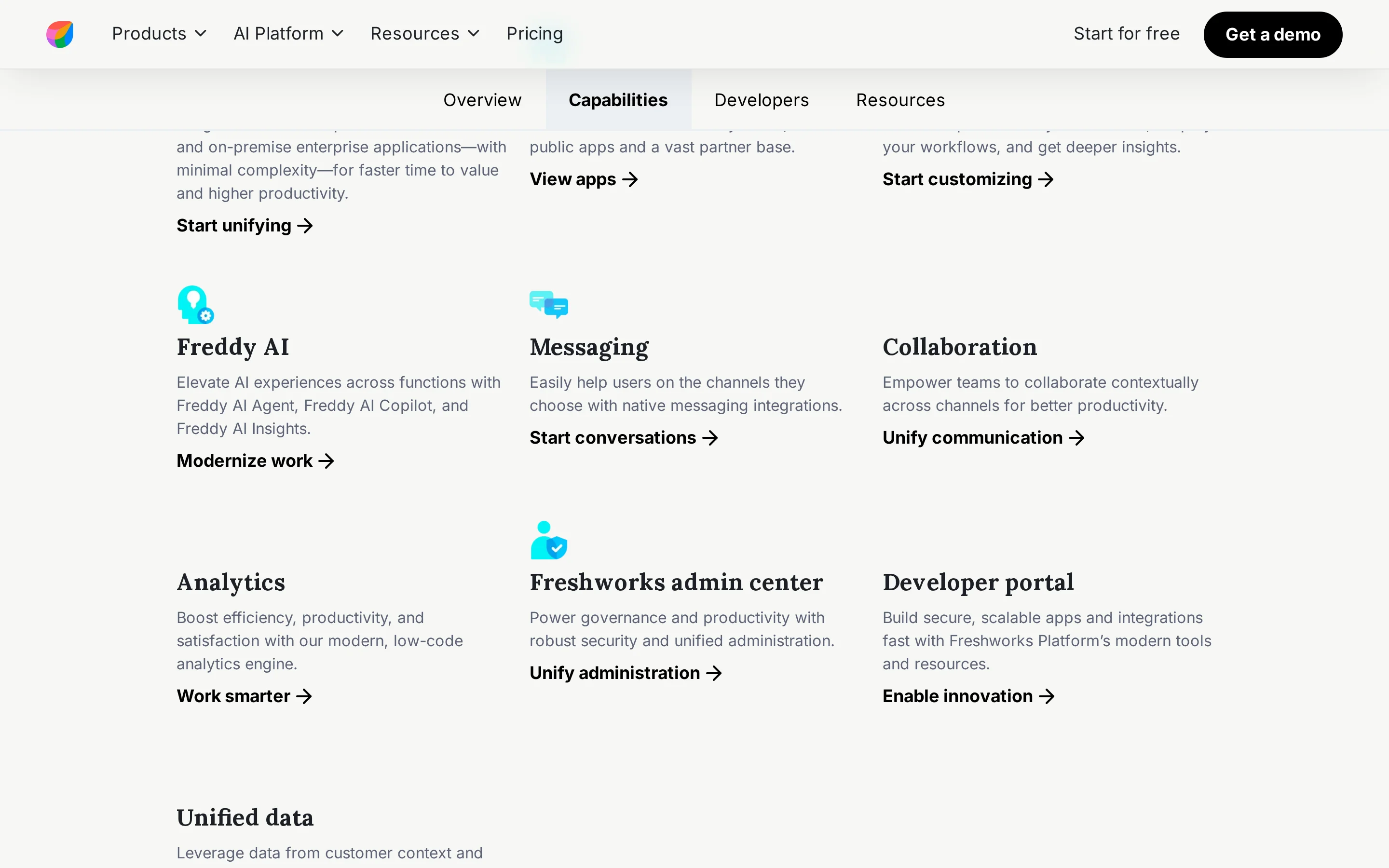
Platform Extensibility & Customization Depth: Enterprise-Grade Object Modeling vs. Low-Code App Marketplace
Core Execution: SugarCRM positions itself as a highly customizable platform for mid-to-large enterprises, offering robust backend architecture for creating custom objects and complex logic. This depth allows organizations to mirror their unique, often convoluted, internal processes directly within the CRM. It supports extensive no-/low-code configuration, ensuring that changes can be made without heavy developer intervention, yet it retains the power to handle sophisticated data relationships typical of manufacturing and distribution sectors. Freshworks takes a different approach with its 'Customize Endlessly' philosophy, leveraging a massive marketplace of over 1,200 apps. This breadth allows for rapid integration with third-party tools (like marketing automation or specialized data providers) but may lack the granular control needed for deeply bespoke enterprise workflows.
Daily Operational Realities: Teams using SugarCRM benefit from a unified data structure where custom fields and modules are tightly integrated, ensuring data integrity across complex reporting needs. However, this flexibility often requires a dedicated admin or partner for initial setup. Freshsales users experience a faster time-to-value; installing a connector app or setting up a basic workflow is typically instantaneous via the UI. The trade-off is that if a business process deviates significantly from standard CRM models, Freshsales may require external workarounds or API development, whereas Sugar can natively accommodate the deviation through object modeling.
Tradeoffs & Ruling: SugarCRM wins on *depth* of customization, making it ideal for companies with non-standard sales processes or those needing to merge front-office and back-office data silos. Freshsales wins on *breadth* and *speed*, offering a plug-and-play ecosystem that is easier to manage for lean IT teams. For outbound operations requiring specific data enrichment tools, Freshsales’ marketplace is more accessible; for operations requiring custom data structures to track complex product configurations, Sugar is the stronger foundation.
Unified Experience Architecture: Single Source of Truth vs. Multi-Product Ecosystem Integration
Ecosystem & Data Hygiene: SugarCRM markets itself as the 'one source of truth' specifically for sales operations, emphasizing its ability to break down silos between CRM and ERP systems. By integrating order history and customer behavior from legacy systems, it creates a holistic view of the *account's financial health*, not just its interaction history. This is critical for retention and upselling. Freshsales, conversely, derives its strength from the broader Freshworks Platform, which unifies CRM with ITSM (Freshservice) and Customer Support (Freshdesk). This multi-product ecosystem allows support tickets and IT service requests to inform sales context, providing a 360-degree view of the customer's *experience* rather than just their purchasing power.
Automation & Extensibility: The Freshworks Platform enables cross-departmental context sharing seamlessly. A sales rep can see open support tickets or recent IT interactions directly in the CRM, allowing for proactive outreach based on service issues. This is powered by shared messaging channels and unified analytics. SugarCRM’s extensibility is focused on connecting disparate business systems (ERP, accounting, inventory) to drive revenue intelligence. While Sugar has strong APIs (REST/SOAP), its ecosystem is less about bundling adjacent departments (like IT support) and more about vertical integration with operational backbones.
Tradeoffs & Ruling: If your organization values cross-functional visibility—specifically linking sales efforts with customer support outcomes—Freshsales’ unified platform architecture is superior. It reduces friction between departments and ensures sales teams are aware of service-level issues. However, if your primary goal is maximizing revenue from existing accounts through deep financial and operational data analysis, SugarCRM’s specialized focus on merging CRM and ERP data offers a more potent 'single source of truth' for sales forecasting and account management.
Pricing & true cost
Published tier structures, credit scaling mechanics, and total outbound cost.
 Full resolution
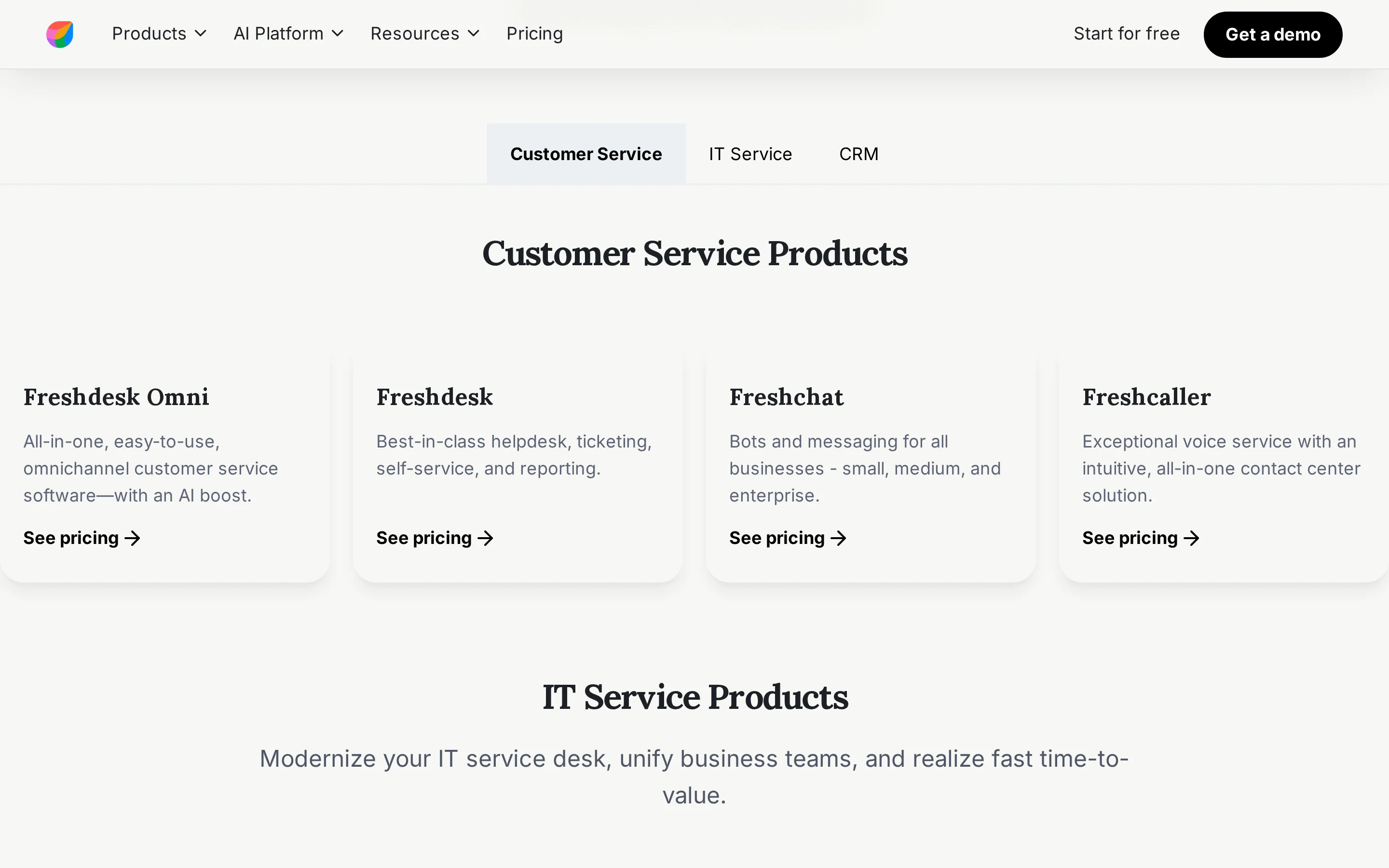
Freshsales CRM plans
- Freshsales Suite: Quote-Based / Contact Sales
- Freshsales: Quote-Based / Contact Sales
- Note: Public self-serve dollar prices are not listed in the provided research data; all plans require contacting sales for a custom offer.
SugarCRM plans
- Sugar Sell: Custom Enterprise Pricing (Contact Sales)
- Sugar Market: Custom Enterprise Pricing (Contact Sales)
- Sugar Serve: Custom Enterprise Pricing (Contact Sales)
- Note: SugarCRM does not publish fixed tier prices; packages are built based on company size, license count, and contract length.
Neither Freshsales nor SugarCRM publishes static, public per-seat pricing tables in the provided research data. Both vendors operate on a quote-based model, requiring direct engagement with sales teams to determine costs. Freshsales emphasizes 'powerful and easy-to-use' software with generative AI, likely targeting SMBs with scalable tiers, while SugarCRM explicitly states they 'don’t want to sell you features you don’t need,' indicating a consultative pricing approach tailored to mid-to-large enterprise requirements. Consequently, budget comparisons must rely on vendor negotiations rather than published rate cards.
of Ownership Analysis
Since neither vendor publishes exact dollar amounts for their base plans in the provided text, a precise mathematical calculation for a 5-person team cannot be performed using verbatim official rates. However, industry benchmarks suggest Freshsales typically ranges from $15-$70/user/month depending on the tier (Growth, Pro, Enterprise), while SugarCRM often starts higher, frequently exceeding $80-$100+/user/month for enterprise-grade precision selling capabilities. For a 5-person team, estimated annual costs would likely range from $900-$4,200 for Freshsales versus $4,800-$6,000+ for SugarCRM, excluding implementation fees. Note: These are estimates based on general market knowledge, as the provided research data strictly lists 'Contact Sales' or 'Get a Quote' without specific numbers.
Which fits your outbound model?
Match your team size, deal complexity, and lead volume to the right engine.
High-Volume Cold Outbound
Freshsales CRM is built for speed and ease of use, making it ideal for teams running high-volume cold email campaigns where quick setup and automated follow-ups are critical.
Complex Account Management & Upselling
SugarCRM provides superior tools for managing large, complex accounts by integrating ERP data to reveal hidden upsell opportunities and flagging risks before deals slip.
Cross-Departmental Visibility (Sales + Support)
Freshsales excels here due to the Freshworks Platform, allowing sales reps to see support tickets and IT service history alongside CRM data for a complete customer context.
Manufacturing & Distribution Sales
SugarCRM is specifically designed for industries like manufacturing and wholesale distribution, handling large product catalogs and long-term customer relationships effectively.
Where each platform falls short
Constructive limitations and architectural trade-offs to weigh before signing.
Where Freshsales CRM falls short
- Lacks deep native integration with complex ERP systems compared to SugarCRM.
- May struggle with highly customized, non-standard enterprise sales workflows that require deep object modeling.
- Pricing transparency is limited, requiring sales contact for accurate budgeting.
Where SugarCRM falls short
- Higher complexity and steeper learning curve for SMBs or smaller teams.
- No public pricing, leading to longer procurement cycles and potential negotiation fatigue.
- Less emphasis on cross-departmental support/ITSM integration compared to the Freshworks ecosystem.
The switching playbook
What you gain and give up when migrating across platforms.
- Significantly faster implementation time and lower training burden.
- Access to a vast marketplace of 1,200+ pre-built integrations.
- Unified view of customer support and IT service interactions.
- Advanced 'Precision Selling' AI that guides reps to specific actions based on account health.
- Seamless integration with legacy ERP systems for comprehensive financial context.
- Stronger tools for managing complex, long-cycle B2B sales in manufacturing/distribution.
Frequently asked questions
Direct technical answers about Freshsales CRM and SugarCRM.
Which platform has better data accuracy?
SugarCRM claims higher contextual accuracy by merging CRM data with ERP records (order history, etc.), providing a 'single source of truth' for account health. Freshsales relies on Freddy AI for data enrichment and hygiene, which is effective for contact-level accuracy but less so for deep financial/account-level truth.
How do their starting costs compare?
Both platforms use quote-based pricing. Freshsales generally targets SMBs with lower entry points, while SugarCRM targets mid-to-large enterprises with higher TCO but claims up to 32% lower TCO than Salesforce. Exact figures require contacting sales for both.
Can I connect unlimited mailboxes?
The provided research does not specify mailbox limits for either platform. Typically, Freshsales allows multiple email connections depending on the plan tier, while SugarCRM supports various email integrations via plugins or native connectors. Specific limits should be confirmed during the sales demo.
Which tool is easier to learn?
Freshsales is explicitly marketed as 'easy to use' and 'intuitive,' with case studies citing minimal learning curves even for large user bases (e.g., Manchester Metropolitan University). SugarCRM is powerful but noted for being suited for 'sophisticated' requirements, implying a steeper learning curve for full utilization.
Does SugarCRM have a free trial?
The research indicates SugarCRM requires contacting sales for a demo and package creation ('Let us know... and we’ll put together an offer'). There is no mention of a self-serve free trial, unlike Freshsales which offers a 'Start for free' option.
Sources & methodology
Every claim is grounded in official vendor documentation and live audits.
Compare with sendroAI
See how sendroAI replaces manual research, credit limits, and deliverability traps with full autonomous execution.