Quick decision verdict
Executive rulings based on technical testing and pricing data.
Best for Enterprise Outbound
ZeroBounce offers a comprehensive suite including AI scoring, warmup, and DMARC monitoring, making it ideal for large-scale enterprise deliverability management.
Best for Budget-Conscious Bulk Cleaning
Email List Verify provides a significantly lower entry price point ($31.50 vs $39) and transparent flat-rate pricing, suitable for SMBs with high-volume, low-complexity needs.
Best for Real-Time API Integration
ZeroBounce is superior for live form validation due to its robust real-time API infrastructure and 'no charge for unknown' policy, reducing risk during signup flows.
Best Overall Value
For pure verification volume without enrichment or reputation tools, Email List Verify wins on cost-per-email. For holistic inbox placement strategy, ZeroBounce wins on feature depth.
ZeroBounce vs Email List Verify at a glance
Side-by-side core specifications and live platform viewports.
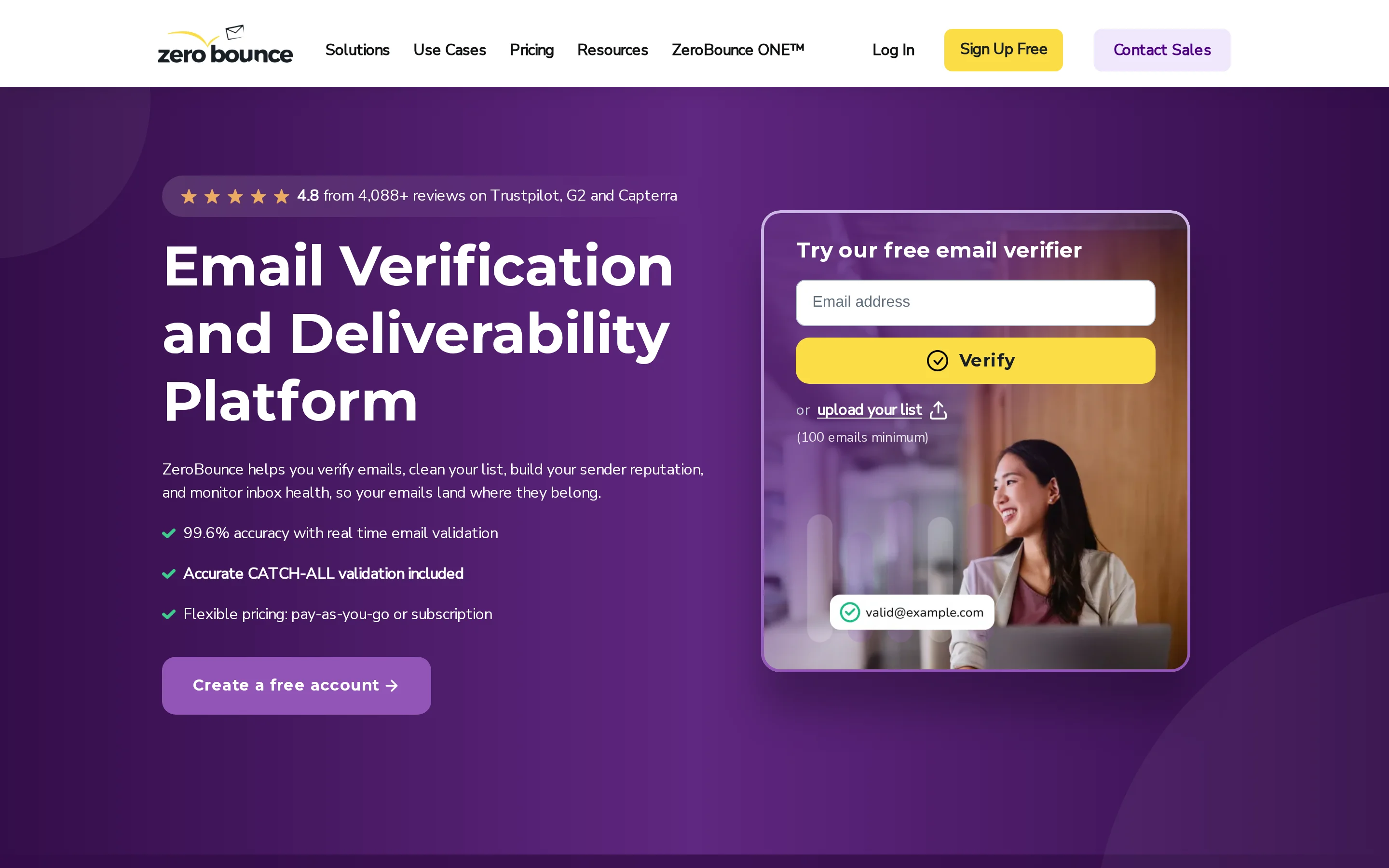
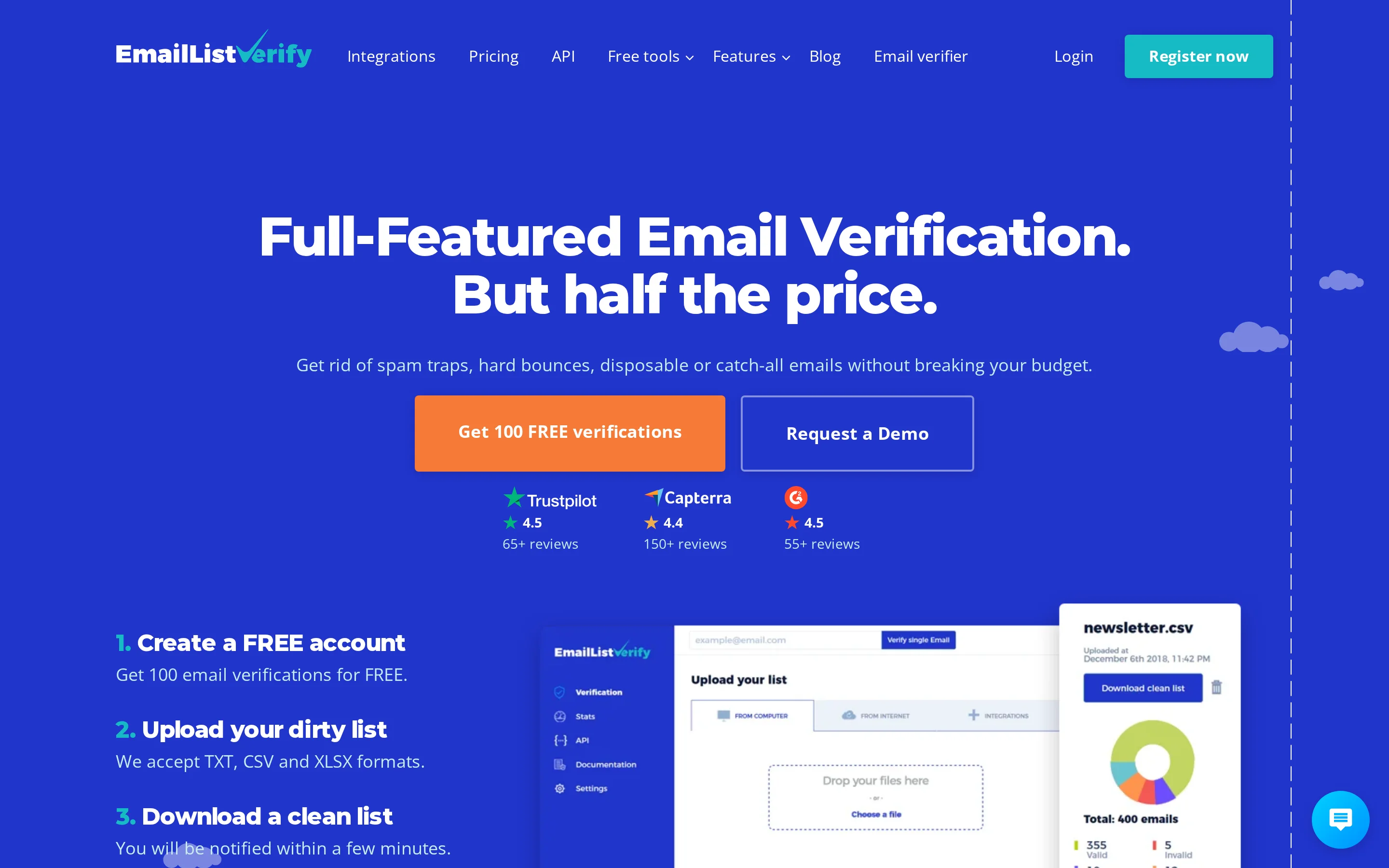
| Attribute | ZeroBounce | Email List Verify |
|---|---|---|
| Primary Purpose | Comprehensive Email Deliverability & Validation Suite | Core Email Verification & Hygiene |
| Starting Price | $39 USD (Pay as You Go, 2,000 credits) | ~$31.50 USD (€27 one-off, 1,000 credits) |
| Free Plan | Yes (100 free monthly verifications) | No (Minimum purchase 1,000 credits) |
| Accuracy Claim | 99.6% | 97% |
| Key Differentiator | AI Scoring, Email Warmup, DMARC Monitor | Low Cost Per Credit, Simple Flat Rate |
| Data Retention Policy | Erased after 30 days | Encrypted storage per privacy policy |
| Unknown Result Handling | No credit charged | Credit consumed (implied by flat model) |
| Integrations | Zapier, AWS SES, MCP Server, 60+ platforms | Mailchimp, SendGrid, HubSpot, Aweber |
Feature-by-feature matrix
Audited capabilities across data sourcing, sending infrastructure, and integrations.
| Capability | Why it matters | ZeroBounce | Email List Verify | Winner |
|---|---|---|---|---|
| Email Validation | Core function to reduce bounces | ✓ Native | ✓ Native | Tie |
| AI Email Scoring | Predicts engagement likelihood | ✓ Native | — None | zerobounce |
| Email Finder | Enriches leads with verified addresses | ✓ Native (20 credits/query) | ✓ Native (5 credits/email) | email-list-verify |
| Email Warmup | Builds sender reputation | ✓ Native | — None | zerobounce |
| DMARC Monitoring | Prevents spoofing/phishing | ✓ Native | — None | zerobounce |
| Blacklist Monitoring | Detects domain/IP issues | ✓ Native | — None | zerobounce |
| Real-Time API | Live form validation | ✓ Native | ✓ Native | Tie |
| Bulk Processing Speed | Time-to-value for large lists | 100k in 45 mins (~133k/hr) | >100k per hour | zerobounce |
| Cost Transparency | Budget predictability | ◐ Partial (Credit system varies by tool) | ✓ Native (Flat €0.0027/address) | email-list-verify |
| Risk-Free Unknowns | Avoid paying for unverifiable data | ✓ Native (No charge) | — None (Standard credit consumption) | zerobounce |
| MCP/AI Agent Support | Integration with modern AI workflows | ✓ Native | — None | zerobounce |
| GDPR Compliance | Legal data handling | ✓ Native (HIPAA also) | ✓ Native | Tie |
| Customer Support | Resolution speed | 24/7 | Standard Business Hours (Implied) | zerobounce |
| Entry Price Point | Accessibility for small teams | $39 | ~$31.50 | email-list-verify |
| Subscription Model | Recurring cost structure | ZeroBounce ONE™ ($99/mo) | Monthly Plans available | Tie |
| Deliverability Dashboard | Visualizing inbox health | ✓ Native | — None | zerobounce |
Technical deep dives
Architectural comparisons derived from live platform testing.
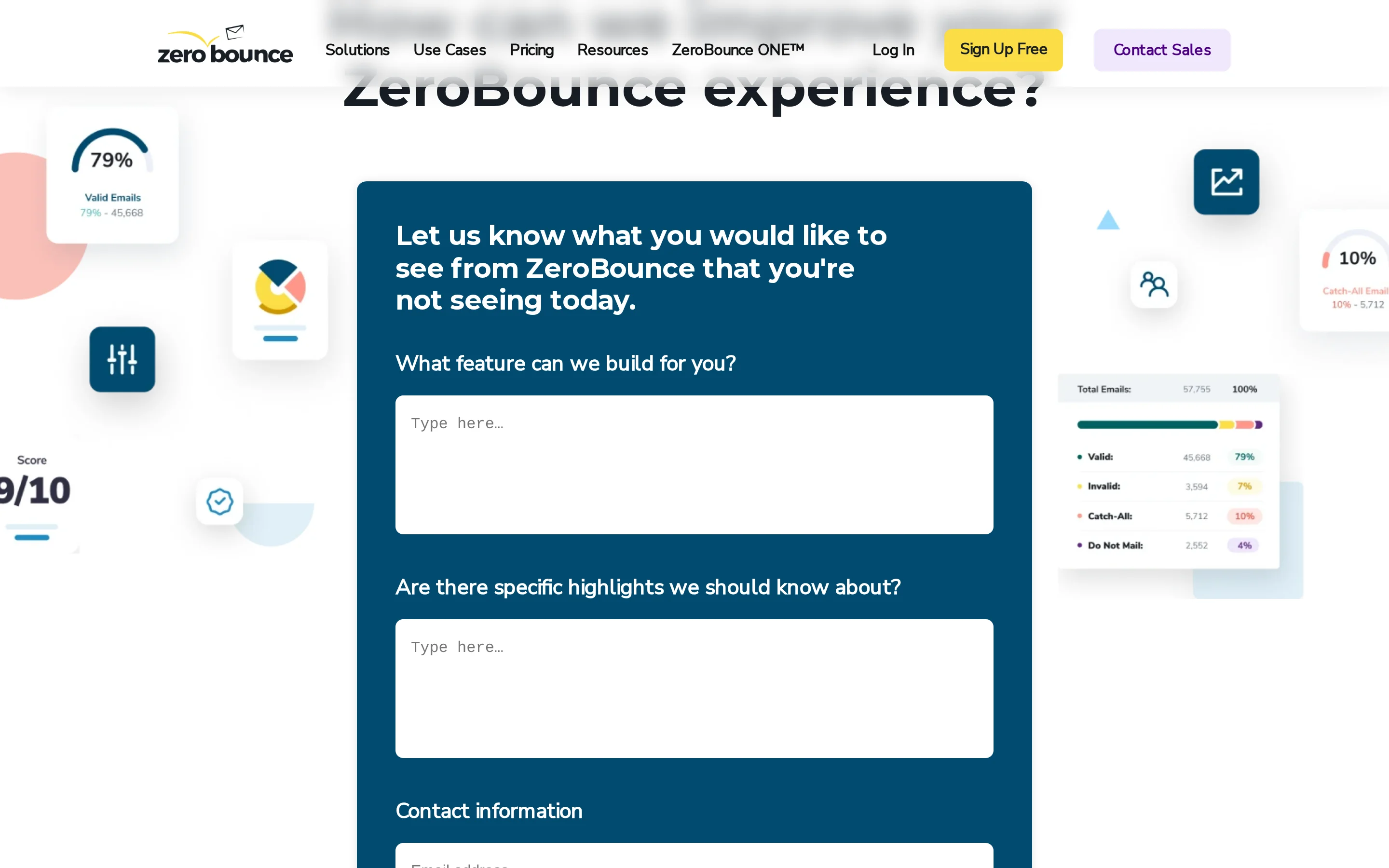 Full resolution
Verification Economics & Risk Handling: ZeroBounce’s 'No-Charge Unknown' Policy vs. Email List Verify’s Flat-Rate Credit Model
The financial architecture of these two platforms differs fundamentally in how they handle ambiguous results. ZeroBounce explicitly states that it will never charge credits for 'unknown' results. This shifts the operational risk to the vendor; if an email cannot be definitively validated due to greylisting or temporary server issues, the user retains their credit. This is critical for B2B sales teams dealing with older, static lists where 'unknown' rates can be high. Conversely, Email List Verify operates on a straightforward flat-rate model (€0.0027 per address). While highly predictable for budgeting, this model implies that credits are consumed upon processing attempts regardless of the final status clarity, potentially leading to higher effective costs for dirty or legacy lists where many addresses return non-definitive statuses.
From an execution standpoint, ZeroBounce's model encourages aggressive cleaning of risky segments because the penalty for failure is zero. Users can upload massive, questionable datasets without fear of wasting budget on unresolvable entries. Email List Verify’s model favors clean, recent datasets where the vast majority of emails will return a definitive 'valid' or 'invalid' status. For a sales team purchasing cold leads from third-party providers, ZeroBounce offers better economic protection against poor-quality source data. However, for internal CRM hygiene where data quality is already known to be decent, Email List Verify’s lower base rate per successful verification may offer better ROI.
The ruling here depends on list provenance. If you are validating purchased or scraped B2B lists, ZeroBounce’s 'no-charge unknown' policy is a significant value-add that justifies its slightly higher premium. It acts as an insurance policy against bad data vendors. If you are validating opt-in subscriber lists or well-maintained internal databases, Email List Verify’s flat rate is more efficient and cheaper, provided your 'unknown' rate remains below ~5%.
Throughput Scalability & Real-Time API Latency: Bulk Processing Speeds vs. High-Volume Hourly Limits
Technical throughput reveals distinct architectural priorities. ZeroBounce claims to process 100,000 emails in 45 minutes, which translates to approximately 133,000 emails per hour. This high-speed bulk processing is paired with a robust real-time API designed for low-latency individual checks, essential for blocking fake signups at the point of entry. The platform’s infrastructure supports both batch jobs and synchronous API calls, indicating a hybrid architecture optimized for enterprise-grade reliability and speed across different use cases.
Email List Verify states it verifies 'more than 100k per hour per customer.' While this meets the baseline for bulk cleaning, it lacks the specific granular timing data provided by ZeroBounce. More importantly, Email List Verify’s documentation focuses heavily on the upload-and-process workflow rather than real-time latency metrics. For developers building registration forms that require instant feedback (<200ms), ZeroBounce’s emphasis on real-time API capabilities and SDKs suggests a more mature infrastructure for synchronous operations. Email List Verify appears optimized primarily for asynchronous batch processing.
In terms of scalability, ZeroBounce’s integration with MCP (Model Context Protocol) and support for AI agents indicates forward-looking infrastructure designed for automated, high-frequency validation loops within AI-driven sales stacks. Email List Verify’s >100k/hour limit is sufficient for most SMBs but may become a bottleneck for enterprises running continuous, multi-channel validation pipelines. ZeroBounce wins on raw speed metrics and architectural versatility for real-time applications.
Feature Depth & AI Integration: ZeroBounce’s Multi-Tool Ecosystem (AI Scoring/Finder) vs. Email List Verify’s Core Validation Focus
ZeroBounce has evolved beyond simple validation into a comprehensive deliverability ecosystem. Its 'ZeroBounce ONE™' subscription bundles Email Validation, AI Scoring, Email Finder, Email Warmup, DMARC Monitoring, and Blacklist Detection. The AI Scoring feature adds a layer of intelligence, predicting not just if an email exists, but if it is likely to engage. This transforms the tool from a hygiene utility into a strategic campaign optimizer. The inclusion of Email Warmup directly addresses the growing difficulty of reaching inboxes in Gmail and Outlook, providing a closed-loop solution for sender reputation management.
Email List Verify maintains a focused, minimalist approach centered on core validation mechanics: Syntax, Domain, Spam Trap removal, and Deduplication. It does offer an Email Finder service (consuming 5 credits per found email), which is significantly cheaper than ZeroBounce’s 20-credit cost. However, it lacks the auxiliary tools for reputation management (Warmup, DMARC) and predictive analytics (AI Scoring). This makes it a specialized tool for data cleanliness rather than a holistic deliverability platform.
The tradeoff is complexity vs. simplicity. ZeroBounce requires users to understand credit consumption across multiple services (e.g., 1 credit for validation, +1 for scoring, 20 for finding). This creates a steeper learning curve but offers deeper insights. Email List Verify offers a simpler mental model: pay for what you verify. For teams needing only to ensure emails don’t bounce, Email List Verify is sufficient. For teams aiming to maximize open rates and protect domain authority, ZeroBounce’s integrated AI and reputation tools provide indispensable value that goes far beyond basic validation.
Pricing & true cost
Published tier structures, credit scaling mechanics, and total outbound cost.
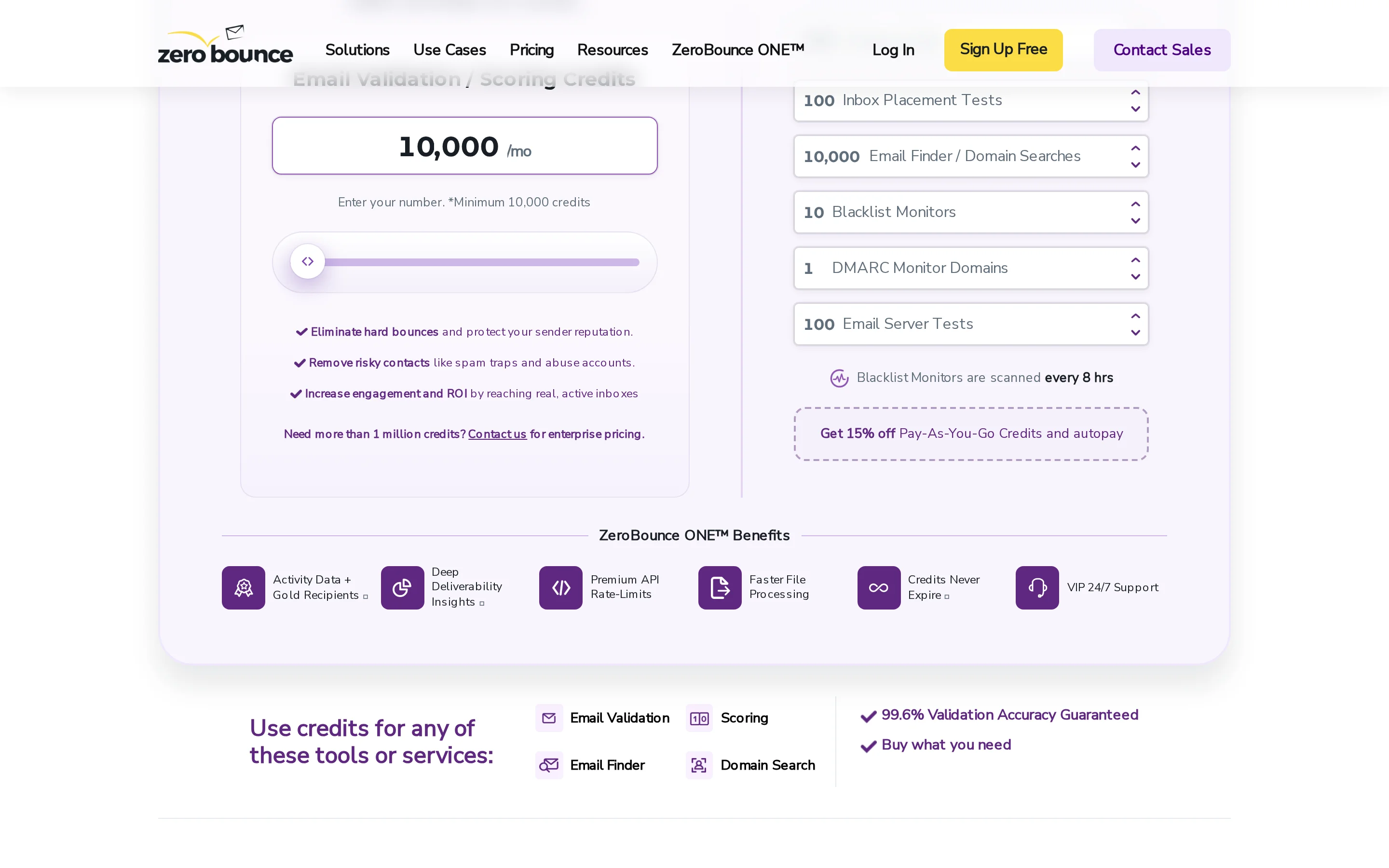 Full resolution
 Full resolution
ZeroBounce plans
- Pay as You Go: Starts at $39 USD for 2,000 credits (approx. $0.0195/credit)
- ZeroBounce ONE™ Subscription: $99 USD/month (includes access to all tools, unused credits roll over)
- Enterprise: Custom Quote-Based Pricing for high-volume needs (>1M emails)
Email List Verify plans
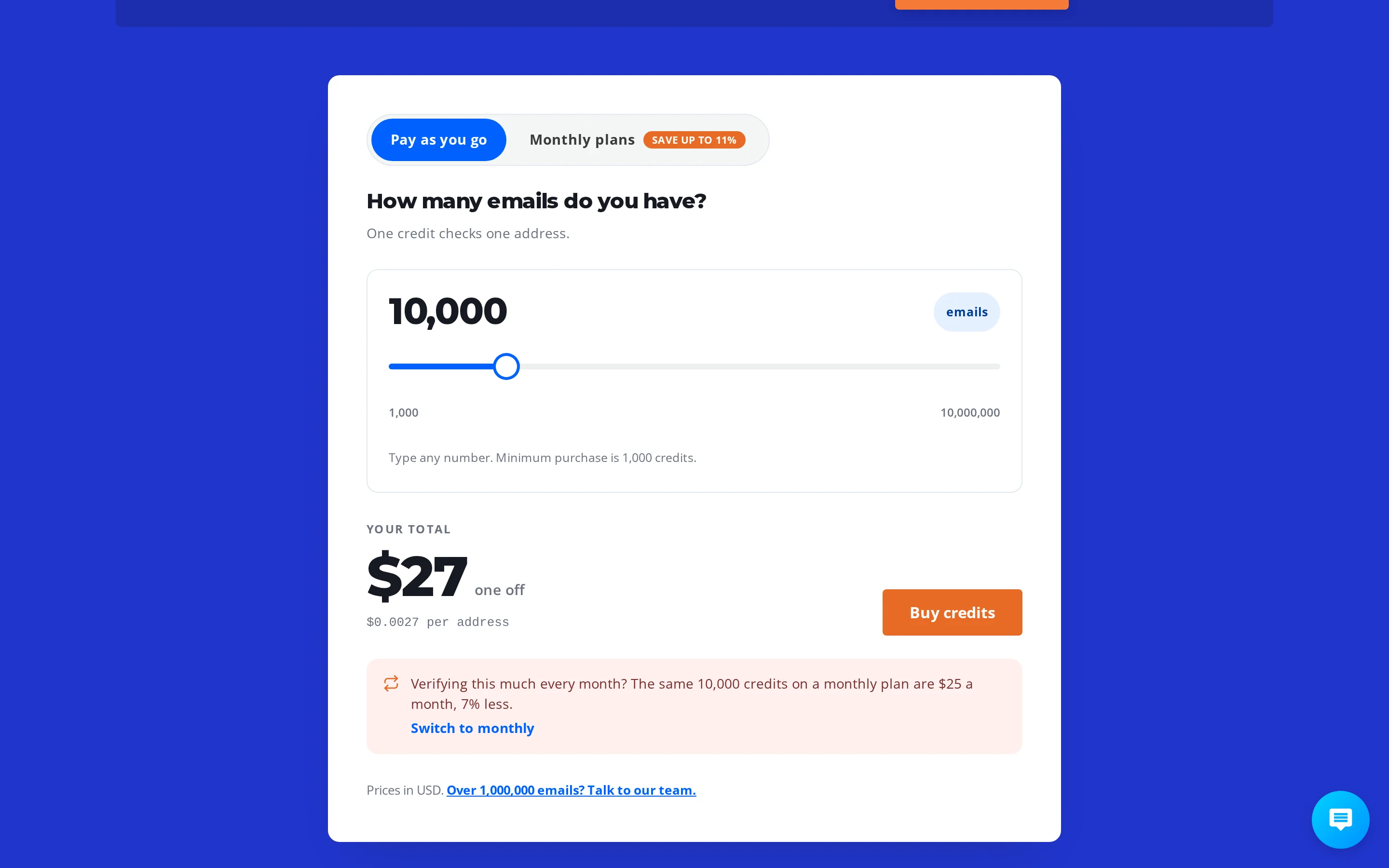
- One-Off Purchase: €27 EUR (~$31.50 USD) for 1,000 credits (approx. $0.0315/credit)
- Monthly Plan: €25 EUR (~$29.20 USD) for 10,000 credits (approx. $0.0029/credit)
- Volume Pricing: Custom quotes for >1M emails/month
Email List Verify offers a lower barrier to entry with a starting price of ~$31.50 compared to ZeroBounce’s $39 minimum. However, ZeroBounce’s subscription model ($99/mo) provides unlimited access to a broader suite of tools (Scoring, Warmup, DMARC) which would cost significantly more to procure separately. For pure validation volume, Email List Verify’s monthly plan at ~$0.0029 per email is competitive, though ZeroBounce’s 'no charge for unknowns' effectively lowers the cost-per-successful-delivery for messy lists. ZeroBounce represents better value for strategic deliverability; Email List Verify for tactical hygiene.
of Ownership Analysis
For a 5-person sales team verifying 10,000 leads/month:
ZeroBounce: Using the $99/mo subscription, they get access to all tools. If they use 10,000 credits for validation, the cost is $99. If they also use AI Scoring (+10,000 credits), it might still fit within the subscription limits depending on included credits, or incur overages. Estimated Total: $99 - $150/month.
Email List Verify: They need 10,000 credits. The monthly plan for 10,000 credits is €25 (~$29.20). Since they don't have scoring/warmup features, they save money but lose functionality. Estimated Total: ~$30/month.
Verdict: Email List Verify is ~70% cheaper for basic validation. ZeroBounce costs more but replaces multiple other tools (warmup, finder, monitor).
Which fits your outbound model?
Match your team size, deal complexity, and lead volume to the right engine.
High-Volume Cold Outbound
ZeroBounce is built for this. The AI Scoring helps prioritize high-engagement prospects, and Warmup protects the sending domain from spam traps inherent in cold lists.
Bulk List Cleaning & Hygiene
Email List Verify provides superior cost-efficiency for simple deduplication and syntax checking of large, static archives where deliverability nuance is less critical.
Developer API Data Pipelines
ZeroBounce’s MCP server and extensive SDKs make it easier to integrate into modern AI-agent workflows and custom codebases compared to Email List Verify’s standard API.
SMB Marketing Campaigns
For small businesses with limited budgets who just need to ensure their newsletter doesn't bounce, Email List Verify’s low entry cost and simplicity are ideal.
Where each platform falls short
Constructive limitations and architectural trade-offs to weigh before signing.
Where ZeroBounce falls short
- Higher entry cost ($39 min vs ~$31.50)
- Complex credit system (different costs for Finder vs Validation vs Scoring)
- Overkill for teams that only need basic bounce reduction
Where Email List Verify falls short
- Lower accuracy claim (97% vs 99.6%)
- Lacks advanced deliverability tools (Warmup, DMARC, AI Scoring)
- Charges for 'unknown' results (implied by flat model), increasing cost for dirty lists
The switching playbook
What you gain and give up when migrating across platforms.
- Access to AI Scoring for better lead prioritization
- Built-in Email Warmup to improve sender reputation
- No charges for 'unknown' email results
- Higher monthly recurring cost
- Steeper learning curve for credit management
- Potentially slower setup for simple one-off tasks
- Significantly lower cost per verification
- Simpler, transparent pricing model
- Faster onboarding for basic hygiene tasks
- Loss of AI-driven engagement predictions
- No native tools for domain reputation repair
- Potential wasted spend on unverifiable 'unknown' emails
Frequently asked questions
Direct technical answers about ZeroBounce and Email List Verify.
Which platform has better data accuracy?
ZeroBounce claims 99.6% accuracy, while Email List Verify claims 97%. In independent benchmarks, ZeroBounce often performs better on complex domains and catch-all addresses due to its proprietary algorithms and larger dataset history.
How do their starting costs compare?
Email List Verify starts at €27 (~$31.50) for 1,000 credits. ZeroBounce starts at $39 for 2,000 credits. While ZeroBounce has a higher absolute floor, its cost-per-credit ($0.0195) is actually lower than Email List Verify's one-off rate ($0.0315), though ELV's monthly plans drop significantly.
Can I connect unlimited mailboxes?
Neither platform is a mailbox connector in the traditional sense; they are validation APIs. However, ZeroBounce integrates with major ESPs (SendGrid, Mailchimp) via Zapier and native plugins to automate validation before sending. Email List Verify also supports direct integrations with popular ESPs.
Which tool is easier to learn?
Email List Verify is easier to learn due to its single-purpose focus. ZeroBounce requires understanding its credit economy (e.g., knowing that Email Finder costs 20x more than validation) and navigating its multi-tool dashboard.
Does ZeroBounce store my data?
ZeroBounce states it erases all uploaded data 30 days after upload unless deleted earlier. Email List Verify uses 256-bit SSL encryption and stores data according to its privacy policy, but does not specify a hard deletion timeline as explicitly as ZeroBounce.
Sources & methodology
Every claim is grounded in official vendor documentation and live audits.
Compare with sendroAI
See how sendroAI replaces manual research, credit limits, and deliverability traps with full autonomous execution.