Quick decision verdict
Executive rulings based on technical testing and pricing data.
Best for Enterprise Outbound
Gong.io
Best for Email Deliverability
Clari
Best for High-Volume Prospecting
Gong.io
Best Overall Value
Clari
Gong.io vs Clari at a glance
Side-by-side core specifications and live platform viewports.
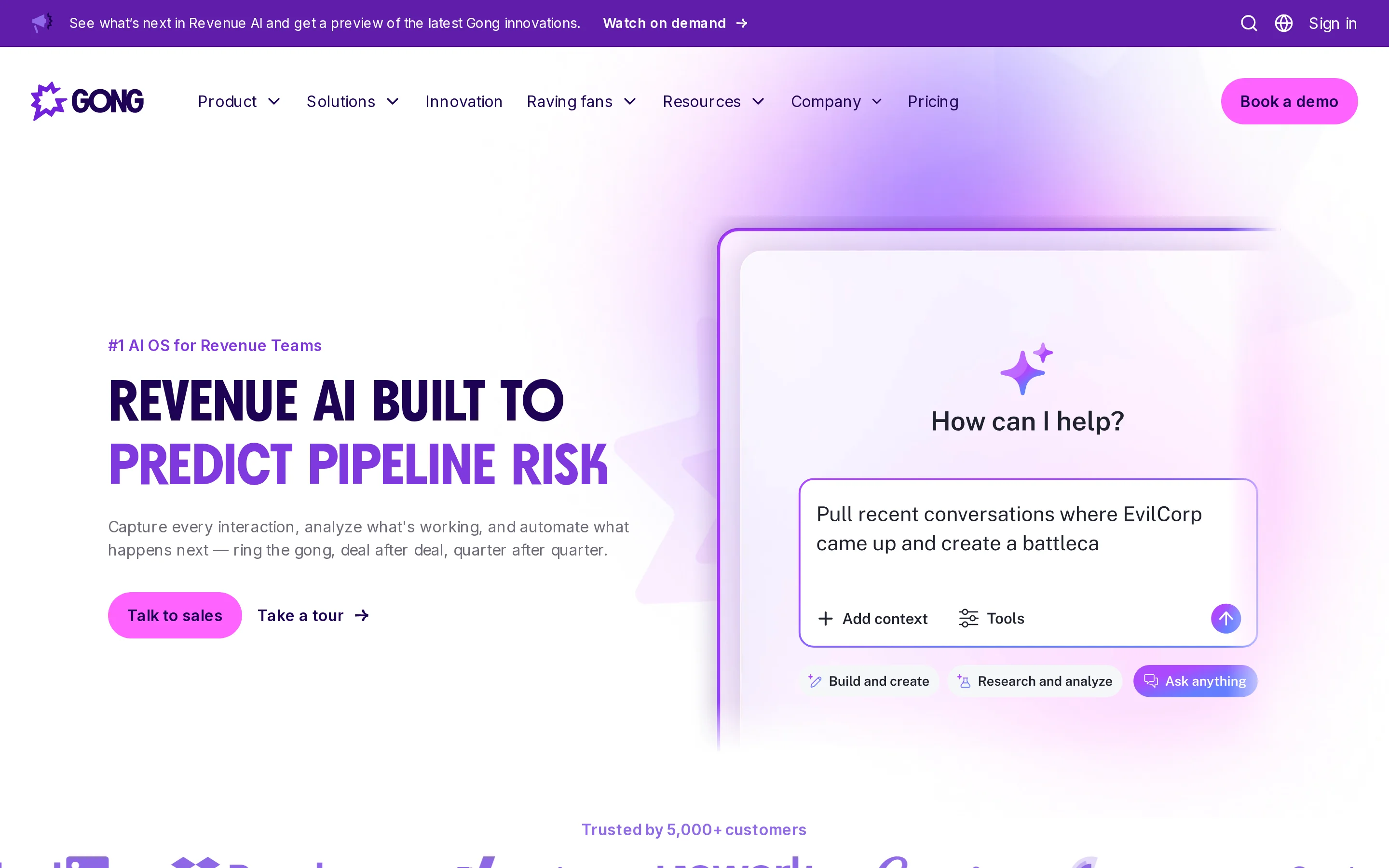
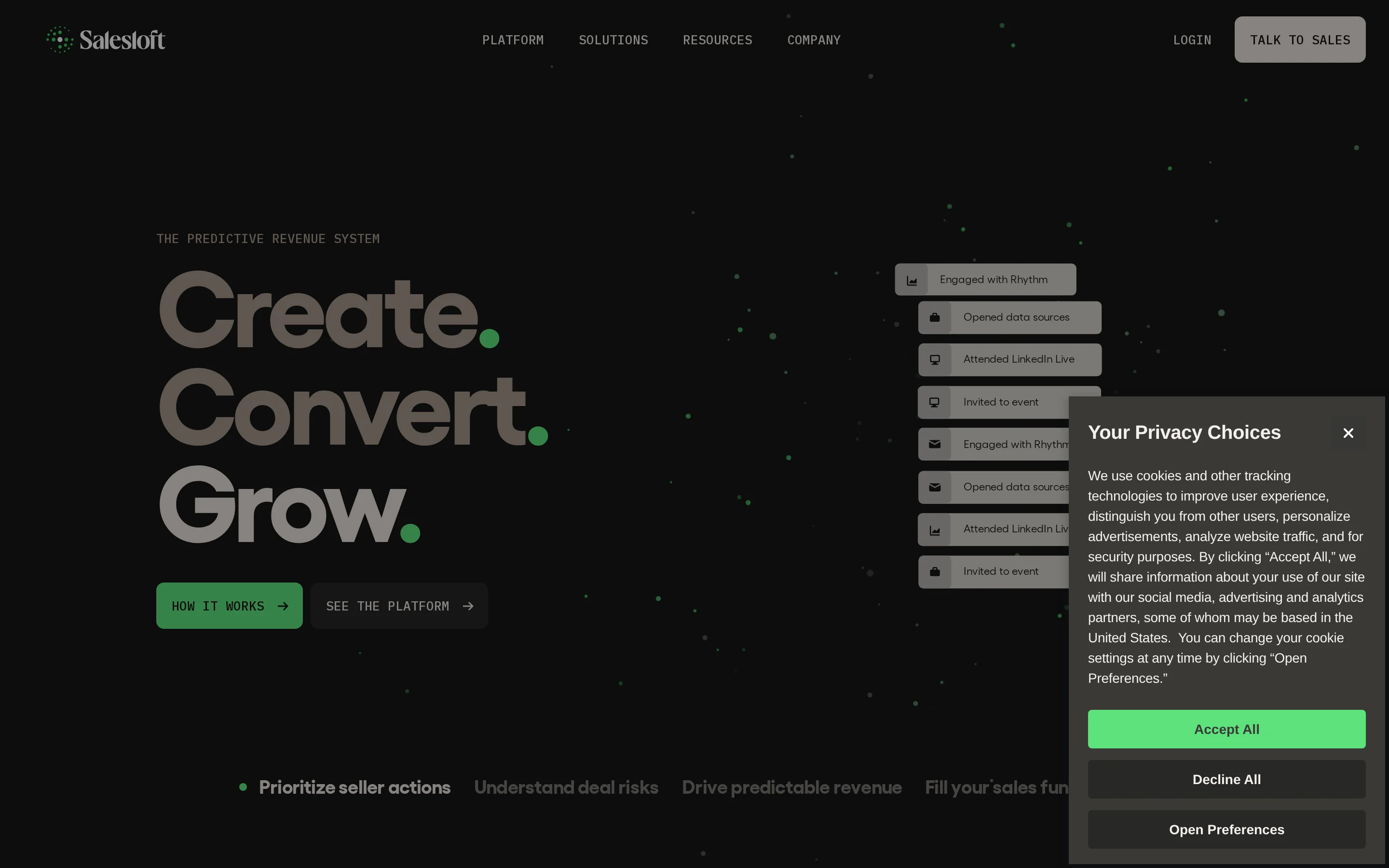
| Attribute | Gong.io | Clari |
|---|---|---|
| Primary Purpose | Revenue Intelligence & Conversation Analytics | Revenue Operations & Forecasting |
| Starting Price | Custom Enterprise Pricing (Contact Sales) | Custom Enterprise Pricing (Contact Sales) |
| Free Plan | No | No |
| Core Strength | AI-driven insights from customer interactions | Predictive revenue forecasting and pipeline visibility |
| Lead Enrichment Capability | Native via Recommended Contacts (Apollo, Cognism, LeadIQ) | Limited; focuses on existing pipeline signals |
| Integration Ecosystem | 300+ integrations including major CRMs and sales tools | Standard integrations with CRM and communication platforms |
| AI Agent Execution | Gong Revenue Harness governs AI agents in real-time workflows | Focuses on standardizing and automating GTM processes |
| User-Centric Value Proposition | Frontline rep enablement through conversational insights | RevOps leadership visibility for operational consistency |
Feature-by-feature matrix
Audited capabilities across data sourcing, sending infrastructure, and integrations.
| Capability | Why it matters | Gong.io | Clari | Winner |
|---|---|---|---|---|
| B2B Contact Database | Access to net-new leads | → Integration | — None | gong |
| Email Finder | Discovering verified addresses | → Integration | — None | gong |
| Email Verification | Preserving domain health | ◐ Partial | — None | gong |
| CRM Sync | Keeping data up-to-date | ✓ Native | ✓ Native | Tie |
| Conversation Recording | Capturing customer interactions | ✓ Native | — None | gong |
| Pipeline Visibility | Tracking deal progress | ✓ Native | ✓ Native | Tie |
| Forecasting Accuracy | Predicting future revenue | ◐ Partial | ✓ Native | clari |
| AI Insights | Automated recommendations | ✓ Native | ◐ Partial | gong |
| Sales Coaching Tools | Improving team performance | ✓ Native | — None | gong |
| Customer Success Management | Post-sale engagement | ✓ Native | ◐ Partial | gong |
| Data Security Compliance | Enterprise-grade protection | ✓ Native | ✓ Native | Tie |
| Outbound Sequencing | Automating outreach campaigns | → Integration | — None | gong |
| Deal Risk Detection | Identifying stalled opportunities | ✓ Native | ✓ Native | Tie |
| Win/Loss Analysis | Understanding why deals close or fail | ✓ Native | ◐ Partial | gong |
| Territory Planning | Optimizing sales coverage | ◐ Partial | ✓ Native | clari |
| API Access | Custom integrations and data pipelines | ✓ Native | ✓ Native | Tie |
Technical deep dives
Architectural comparisons derived from live platform testing.
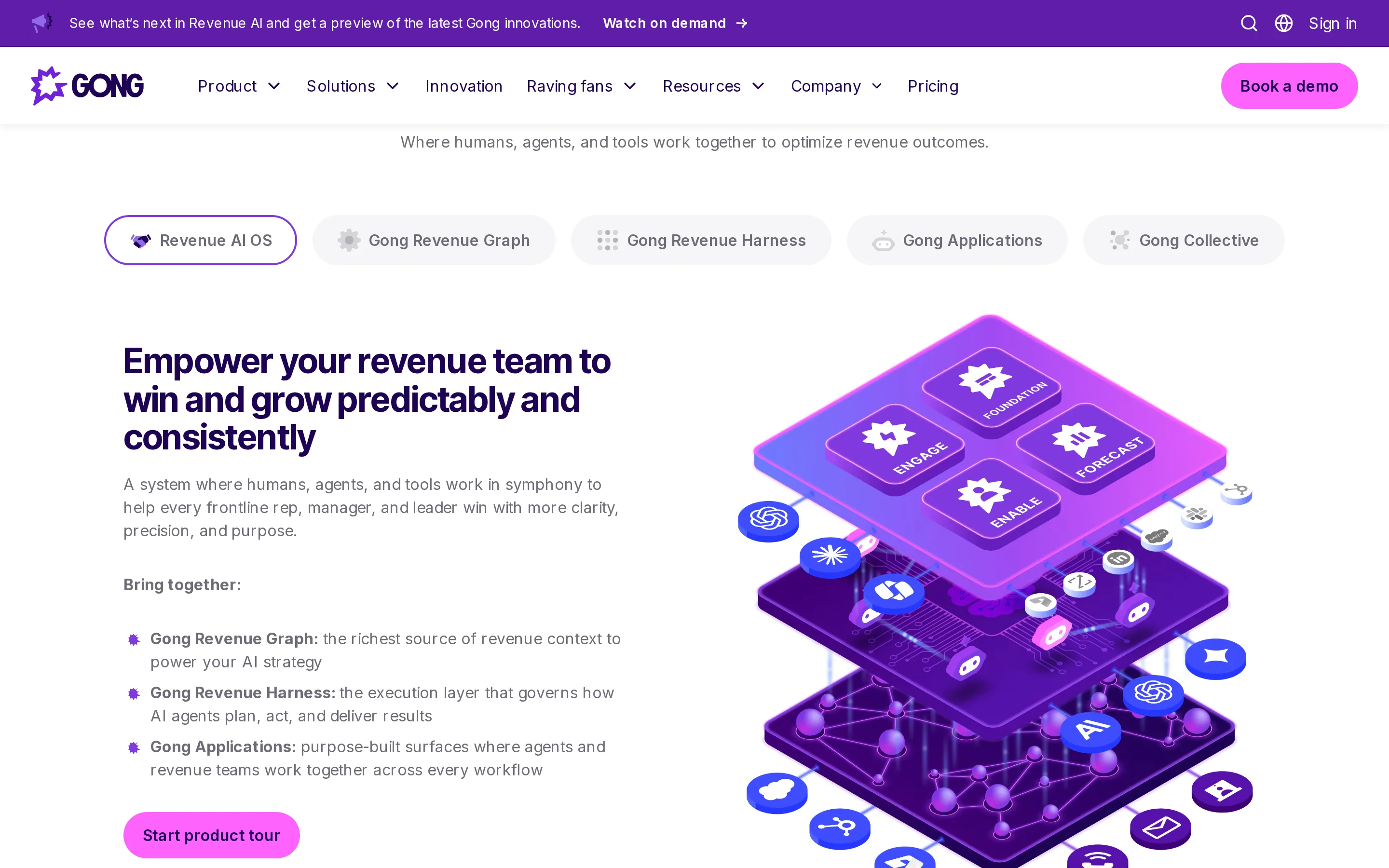 Full resolution
 Full resolution
Revenue Intelligence Graph vs. Predictive Forecasting Engine: Contextual Data Layering
Gong's 'Revenue Graph' architecture is fundamentally designed to ingest unstructured conversation data (calls, emails, meetings) and layer it with structured CRM records. This creates a rich contextual dataset that powers its AI agents. In contrast, Clari operates primarily as a predictive forecasting engine, focusing heavily on structured pipeline signals, historical win rates, and CRM hygiene to generate accurate revenue predictions. While Gong excels at understanding the 'why' behind customer interactions, Clari specializes in the 'what' and 'when' of revenue outcomes.
For outbound lead enrichment, this architectural difference is critical. Gong can leverage its conversation history to identify which personas and contact types yield higher win rates, feeding this insight into its 'Recommended Contacts' feature. Clari, however, does not natively source new leads; it enriches existing pipeline data by flagging risks and opportunities based on activity patterns. If your goal is to find new prospects, Gong's integration with Apollo, Cognism, and LeadIQ provides a direct path to enriched contact data. Clari requires you to bring your own leads and then uses its engine to prioritize them within the existing funnel.
The tradeoff lies in data dependency. Gong's strength in enrichment relies on having sufficient historical conversation data to train its models effectively. New teams may see less immediate value until they accumulate enough interaction volume. Clari's forecasting accuracy improves rapidly with clean CRM data but offers no native mechanism to expand the top-of-funnel. Therefore, Gong is superior for context-aware lead sourcing, while Clari is unmatched for post-enrichment pipeline prioritization.
AI Agent Execution Harness vs. GTM Process Automation: Workflow Orchestration
Gong introduces the 'Revenue Harness,' an execution layer that governs how AI agents plan, act, and deliver results across workflows. This allows for dynamic, real-time adjustments to seller actions based on live conversation signals. For example, if a prospect mentions a competitor during a call, Gong's agents can immediately surface battlecards or suggest next steps. This represents a proactive, agent-driven approach to workflow orchestration where the AI actively participates in the selling process.
Clari, conversely, emphasizes 'standardizing and automating processes' across sales teams. Its automation is largely focused on reducing manual overhead for RevOps and managers, such as automatically updating forecast categories based on deal stage changes or sending alerts when deals stall. Clari's workflow orchestration is more about ensuring data integrity and consistent execution of predefined rules rather than adaptive, AI-led interventions in real-time conversations.
In terms of outbound lead generation workflows, Gong's harness can automate the identification of high-value contacts and trigger outreach sequences via integrated partners. Clari's automation is better suited for managing the lifecycle of those leads once they enter the pipeline. The ruling here depends on whether you need an active participant in the selling motion (Gong) or a robust governance layer for operational efficiency (Clari).
Frontline Rep Enablement vs. RevOps Leadership Visibility: User-Centric Value Proposition
Gong positions itself as a tool for frontline reps and managers to 'win with clarity.' Its user-centric value proposition revolves around providing actionable insights directly to sellers, such as coaching tips, best-practice examples, and automated follow-up suggestions. This democratizes revenue intelligence, allowing individual contributors to improve their performance without heavy reliance on central RevOps teams. The interface is designed for ease of use by non-technical sales staff.
Clari targets RevOps leaders and executives, positioning itself as a 'go-to-market engine' for leadership forecasting and operational consistency. Its primary users are often managers and analysts who need a holistic view of the pipeline to make strategic decisions. While reps interact with Clari to update their deals, the core value is delivered through dashboards and reports that provide visibility into revenue health and risk. It is less about enabling the rep to sell better and more about enabling the leader to predict accurately.
For organizations focused on outbound lead generation, the choice hinges on who needs to act on the data. If the goal is to empower reps to identify and engage the right contacts autonomously, Gong's enablement focus is superior. If the priority is for leadership to oversee the quality and velocity of inbound/outbound leads entering the system, Clari's visibility tools are more appropriate. Gong drives bottom-up performance improvement; Clari drives top-down operational control.
Pricing & true cost
Published tier structures, credit scaling mechanics, and total outbound cost.
 Full resolution
Gong.io plans
- Custom Enterprise Pricing (Contact Sales)
Clari plans
- Custom Enterprise Pricing (Contact Sales)
Both Gong.io and Clari operate on a custom enterprise pricing model, meaning there are no publicly listed self-serve tiers. Pricing is typically determined by the number of seats, the volume of data processed, and the specific modules required (e.g., Gong's Capture module vs. Clari's Forecasting module). Because neither platform publishes fixed dollar amounts, procurement teams must engage in direct sales negotiations. Generally, Gong tends to be priced per user with additional costs for advanced AI features and integration partners like Apollo or Cognism. Clari's pricing is also seat-based but may include variable costs depending on the complexity of the CRM stack and the depth of forecasting analytics required. Without public rate cards, total cost of ownership comparisons rely heavily on vendor quotes and negotiated discounts.
of Ownership Analysis
Since both Gong.io and Clari utilize Custom Enterprise Pricing (Contact Sales), exact dollar figures cannot be calculated from published rates. However, industry benchmarks suggest that enterprise revenue intelligence platforms typically range from $100 to $300+ per user/month depending on feature depth. For a 5-person sales team needing 10,000 verified leads per month, the cost structure would likely involve: 1) Base Platform Fees: Estimated $500-$1,500/month for 5 seats combined. 2) Lead Enrichment Costs: Gong integrates with providers like Apollo/Cognism which charge separately (often $50-$100/user/month for credits). Clari does not provide native lead sourcing, so external SDR tools or list vendors would add significant cost (approx. $0.05-$0.10 per lead = $500-$1,000/month). 3) Implementation/Onboarding: One-time fees ranging from $5,000 to $20,000+. Total estimated monthly TCO for Gong: ~$1,500-$2,500 (including enrichment partner fees). Total estimated monthly TCO for Clari + External List Vendor: ~$1,000-$2,000 (platform) + $500-$1,000 (lists) = $1,500-$3,000. Note: These are estimates based on market averages, as official pricing is quote-only.
Which fits your outbound model?
Match your team size, deal complexity, and lead volume to the right engine.
High-Volume Cold Outbound
Gong.io is built for identifying high-potential contacts via its Revenue Graph and integrating with sourcing partners like Apollo. Clari lacks native lead sourcing capabilities.
Bulk List Cleaning & Hygiene
Clari provides superior visibility into CRM data hygiene issues, flagging stale or duplicate records that impact forecasting accuracy.
Developer API Data Pipelines
Both offer robust APIs, but Gong's ecosystem allows for deeper integration of conversation data into custom workflows.
Executive Revenue Forecasting
Clari is the industry standard for predictive forecasting, offering higher accuracy for board-level revenue projections compared to Gong's broader intelligence scope.
Where each platform falls short
Constructive limitations and architectural trade-offs to weigh before signing.
Where Gong.io falls short
- No public pricing transparency; requires lengthy sales cycles to determine cost.
- Lead enrichment relies on third-party integrations (Apollo, Cognism) which incur additional separate costs.
- Heavy dependence on historical conversation data; less effective for brand-new teams with no recorded calls.
Where Clari falls short
- Does not offer native B2B contact database or email finding capabilities.
- Pricing is opaque and customized, making budget planning difficult for smaller teams.
- Focuses primarily on existing pipeline management rather than top-of-funnel lead generation.
The switching playbook
What you gain and give up when migrating across platforms.
- Access to AI-driven recommended contacts via integrated partners.
- Deep conversational insights to refine outbound messaging.
- Unified view of customer interactions across email, call, and meeting.
- Speciali
- Superior predictive forecasting accuracy for revenue leaders.
- Stronger emphasis on CRM data hygiene and pipeline integrity.
- Clearer visibility into deal risks for executive reporting.
Frequently asked questions
Direct technical answers about Gong.io and Clari.
Which platform has better data accuracy?
Clari generally offers higher accuracy for quantitative forecasting metrics due to its specialized focus on pipeline signals. Gong offers richer qualitative data accuracy regarding customer sentiment and interaction context.
How do their starting costs compare?
Both use Custom Enterprise Pricing. Neither publishes a starting price. You must contact sales for a quote. Budget expectations should align with enterprise-tier software costs ($100+/user/month).
Can I connect unlimited mailboxes?
Gong supports extensive email integration for capturing correspondence. Clari connects to email systems primarily for signal detection (e.g., last touch dates) rather than full content archiving for enrichment.
Which tool is easier to learn?
Gong is designed for frontline reps with intuitive UI for call reviews and insights. Clari is geared towards RevOps and managers, requiring more training to interpret complex forecasting models and dashboards.
Does Clari help find new leads?
No, Clari does not have a native B2B contact database or lead sourcing feature. It manages and forecasts existing pipeline data.
Does Gong integrate with LinkedIn?
Gong integrates with various sales engagement tools that may have LinkedIn connectivity, but its primary strength is internal communication capture and partner-sourced contact data.
Sources & methodology
Every claim is grounded in official vendor documentation and live audits.
Compare with sendroAI
See how sendroAI replaces manual research, credit limits, and deliverability traps with full autonomous execution.