Quick decision verdict
Executive rulings based on technical testing and pricing data.
Best for Enterprise Revenue Intelligence
Gong.io dominates with its 'Revenue AI OS', capturing every customer interaction to build a proprietary context graph that informs strategy.
Best for Custom Data Enrichment Workflows
Clay Agent excels in flexible, multi-source enrichment, allowing teams to aggregate data from hundreds of providers without rigid platform constraints.
Best for Automated Coaching & Forecasting
Gong.io provides native AI agents for pipeline review, deal risk assessment, and rep coaching, which Clay lacks entirely.
Best Overall Value for Mid-Market
Clay offers more accessible entry points for pure lead generation tasks, whereas Gong is an enterprise-grade investment focused on the entire revenue lifecycle.
Gong.io vs Clay Agent at a glance
Side-by-side core specifications and live platform viewports.
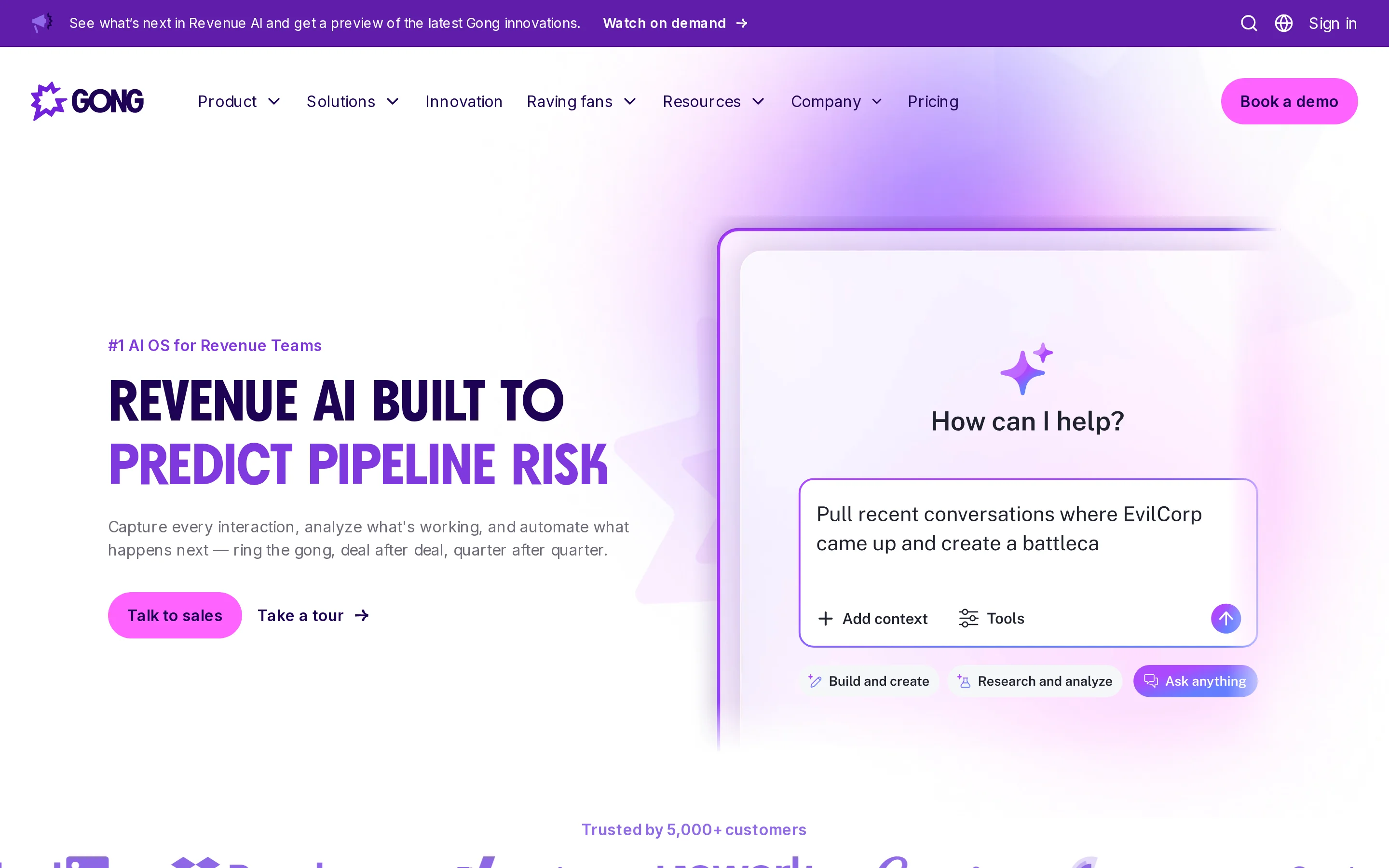
| Attribute | Gong.io | Clay Agent |
|---|---|---|
| Primary Purpose | Revenue Intelligence & Conversation Analytics | Lead Enrichment & Data Automation |
| Starting Price | Custom Enterprise Pricing (Contact Sales) | Quote-Based / Not Publicly Listed |
| Free Plan | No (Demo only) | Unknown (Likely Trial-based) |
| Core Strength | Proprietary Revenue Graph & AI Agents | Multi-Source Data Aggregation & Flexibility |
| CRM Integration | Native Deep Sync (Salesforce/HubSpot) | API/Webhook based |
| AI Capabilities | Governed Revenue Harness (Coaching, Forecasting) | Autonomous Enrichment Agents |
| Data Source | Internal Customer Interactions (Calls/Emails) | External Providers & Crawlers |
| Target User | RevOps, Sales Leaders, CSMs | Growth Hackers, SDRs, Data Engineers |
Feature-by-feature matrix
Audited capabilities across data sourcing, sending infrastructure, and integrations.
| Capability | Why it matters | Gong.io | Clay Agent | Winner |
|---|---|---|---|---|
| Conversation Recording & Analysis | Capturing real-time buyer signals | ✓ Native | — None | gong |
| B2B Contact Database | Access to net-new leads | → Integration (Apollo/Cognism) | ✓ Native (Aggregated) | clay-agent |
| Email Finder | Discovering verified addresses | ◐ Partial (via Partners) | ✓ Native | clay-agent |
| Email Verification | Preserving domain health | ◐ Partial | ✓ Native | clay-agent |
| AI Sales Coaching | Rep skill development | ✓ Native | — None | gong |
| Pipeline Forecasting | Revenue predictability | ✓ Native | — None | gong |
| Deal Risk Detection | Proactive intervention | ✓ Native | — None | gong |
| Custom Data Workflows | Flexible enrichment logic | — None | ✓ Native | clay-agent |
| CRM Two-Way Sync | Data hygiene & context | ✓ Native | → Integration | gong |
| Intent Signal Capture | Identifying buying readiness | ✓ Native (Behavioral) | ◐ Partial (Firmographic) | gong |
| Outreach Sequencing | Automated touchpoints | ✓ Native (Gong Engage) | — None | gong |
| Enterprise Security (SOC2/GDPR) | Compliance requirements | ✓ Native | N/A (Not specified) | gong |
| Integration Ecosystem Size | Tech stack compatibility | 300+ Partners | Standard APIs | gong |
| Ease of Setup | Time-to-value | Complex (Enterprise) | Moderate (Technical) | Tie |
| Pricing Transparency | Budget planning | Opaque (Sales-led) | Opaque (Sales-led) | Tie |
Technical deep dives
Architectural comparisons derived from live platform testing.
 Full resolution
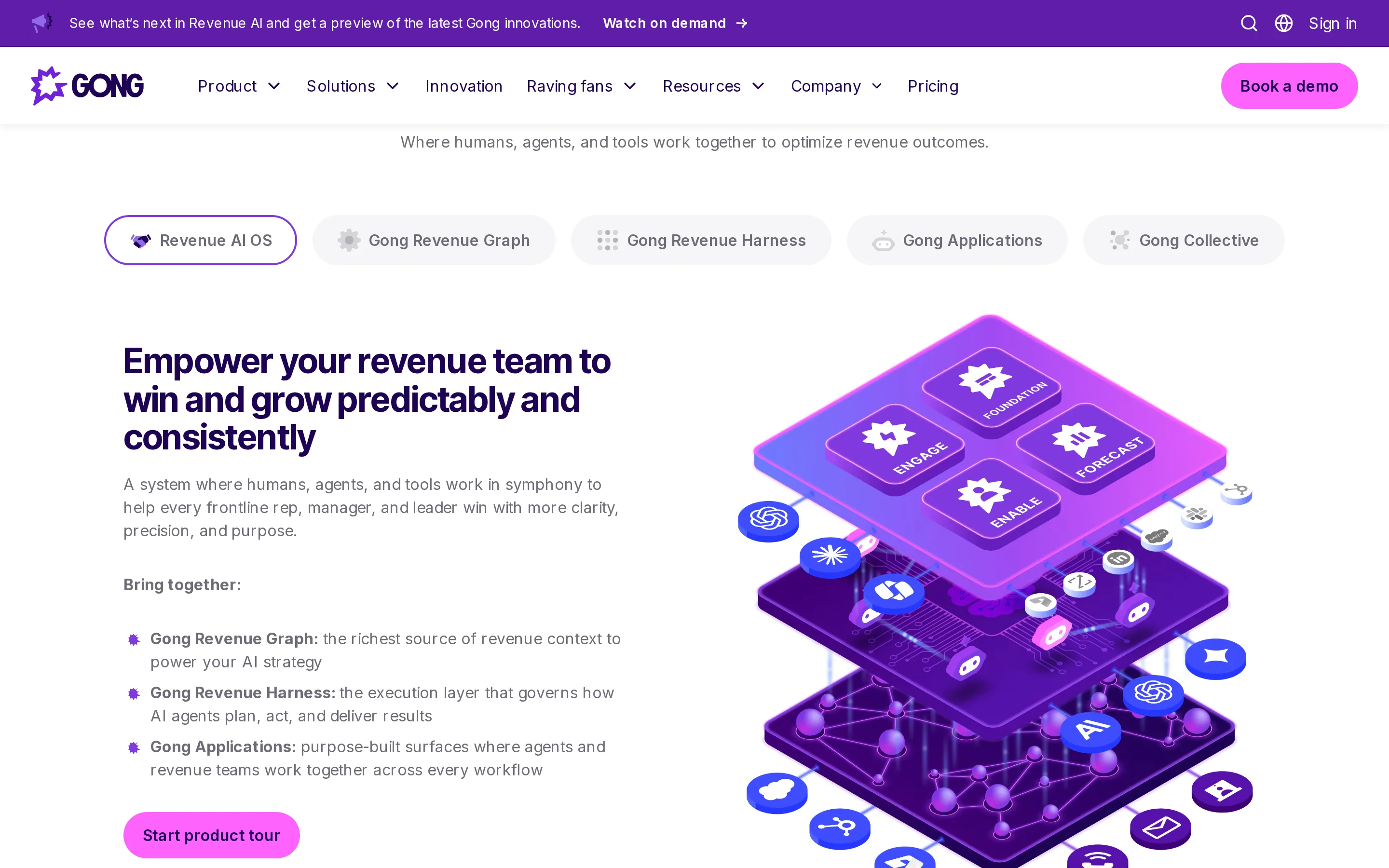
Data Source Architecture: Proprietary Revenue Graph vs. Multi-Source Enrichment Engine
Gong.io operates on a fundamentally different data philosophy than traditional lead-gen tools. Its core asset is the 'Gong Revenue Graph,' a living network built exclusively from captured customer interactions—calls, emails, and meetings. This architecture prioritizes depth and behavioral verification over breadth. By mapping raw conversation data back to business context, Gong creates a proprietary dataset that reveals *how* deals are won or lost, not just who the contacts are. In contrast, Clay Agent functions as a multi-source enrichment engine. It aggregates data from hundreds of external providers and real-time crawlers to build comprehensive contact profiles. While Clay excels at discovering net-new leads and filling firmographic gaps, it lacks the inherent behavioral context that Gong derives from actual sales conversations.
Operationally, this means Gong's data is self-validating within the sales cycle; if a VP of Sales speaks on a call, their role and influence are confirmed by the interaction itself. Clay's data requires external validation or cross-referencing across multiple sources to ensure accuracy. For outbound teams, Gong uses this rich context to power 'Recommended Contacts,' leveraging historical win rates to suggest specific personas likely to drive success. Clay, however, focuses on maximizing the volume of reachable contacts, offering superior flexibility for building large-scale prospect lists but requiring additional layers of verification to match Gong's level of contextual certainty.
The verdict depends on your primary bottleneck. If you struggle with finding enough leads, Clay's aggregation model is superior. However, if your challenge is converting existing leads through better targeting and messaging, Gong's Revenue Graph provides unmatched strategic advantage. Gong turns data into actionable revenue intelligence, while Clay turns data into actionable lists.
AI Execution Model: Governed Revenue Harness vs. Autonomous Agent Workflows
Gong.io has evolved beyond simple analytics into an 'AI Operating System' governed by what they call the 'Revenue Harness.' This execution layer strictly controls how AI agents plan, act, and hand off tasks to humans. The focus is on high-stakes revenue outcomes: pipeline review, deal risk mitigation, and automated coaching. These agents operate within defined workflows, ensuring that AI interventions align with corporate strategy and maintain human oversight where judgment is critical. This governance model ensures consistency and reliability, particularly for enterprise teams needing predictable results from their GTM motions.
Clay Agent, conversely, emphasizes autonomous task completion for lead generation and enrichment. Its AI workflows are designed for flexibility and speed, allowing users to chain together complex data operations without rigid structural constraints. While this enables rapid experimentation and custom automation pipelines, it often lacks the sophisticated governance found in Gong. Clay's agents are tools for efficiency in data processing, whereas Gong's agents are partners in revenue execution. The trade-off is control versus agility: Gong sacrifices some ad-hoc flexibility for guaranteed alignment with revenue goals, while Clay prioritizes the ability to build bespoke workflows quickly.
For RevOps leaders, Gong's approach reduces risk by encoding winning patterns directly into the agent behavior. It ensures that every AI action contributes to measurable revenue metrics like win rate or forecast accuracy. Clay's model is ideal for growth hackers who need to spin up new data sources or testing methodologies overnight. Ultimately, Gong is built for optimizing the *outcome* of the sale, while Clay is built for optimizing the *input* of the funnel.
Integration & Context Depth: Native CRM Sync vs. Flexible API/Webhook Ecosystem
Gong.io distinguishes itself through deep, native two-way synchronization with major CRMs like Salesforce and HubSpot. This integration is not merely about data transfer; it ties conversation intelligence directly to deal stages and account history. When a rep updates a field in the CRM, Gong understands the context of the preceding calls and emails, creating a unified view of the customer lifecycle. This tight coupling ensures data hygiene is linked to actual sales activity, providing leaders with unbiased pipeline signals and centralized visibility that isolated enrichment tools cannot replicate.
Clay Agent relies on a highly flexible API and webhook ecosystem. It can plug into virtually any tech stack, making it an excellent middleware solution for connecting disparate data sources. However, because it lacks native conversational context, its integrations are primarily transactional—moving data from point A to point B. While this allows for extensive customization and connectivity with niche tools, it does not offer the holistic 'single source of truth' experience that Gong provides. Users must manually stitch together the narrative between enriched data and actual sales performance.
In terms of ecosystem reach, Gong boasts over 300 partners, including key contact data providers like Apollo and Cognism, which feed into its Recommended Contacts feature. This curated ecosystem ensures quality and security compliance at an enterprise level. Clay's open-ended integration capability offers broader theoretical reach but requires more manual configuration and maintenance. For organizations seeking a turnkey solution with robust security and governance, Gong's integrated approach is superior. For those with dedicated engineering resources looking to build custom data pipelines, Clay's flexibility wins.
Pricing & true cost
Published tier structures, credit scaling mechanics, and total outbound cost.
 Full resolution
Gong.io plans
- Custom Enterprise Pricing (Contact Sales)
- Quote-Based (Annual Contracts Typical)
Clay Agent plans
- Quote-Based / Not Publicly Listed
- Custom Enterprise Pricing (Contact Sales)
Both platforms operate on opaque, sales-led pricing models typical of enterprise B2B software. Gong.io positions itself as a premium Revenue AI OS, with costs reflecting its extensive feature set including conversation recording, AI coaching, forecasting, and engagement tools. Expect significant annual contracts tailored to seat count and usage volume. Clay Agent, while potentially lower in absolute cost due to its narrower focus on enrichment, also lacks public self-serve pricing. Its cost structure likely revolves around credit consumption or API usage tiers. Neither tool offers transparent monthly rates, requiring direct negotiation with sales teams to determine total cost of ownership.
of Ownership Analysis
For a 5-person sales team, exact dollar amounts cannot be calculated due to the lack of published pricing for both Gong.io and Clay Agent. Gong.io typically requires an enterprise contract, often starting in the tens of thousands annually depending on features like Gong Engage and Enable. Clay Agent's cost would depend on the volume of enrichments and credits used. Without public rates, a realistic estimate involves contacting sales for quotes. Generally, Gong represents a higher fixed-cost investment for broad revenue transformation, while Clay may offer variable costs tied to lead volume, but both require custom budgeting.
Which fits your outbound model?
Match your team size, deal complexity, and lead volume to the right engine.
High-Volume Cold Outbound
Clay Agent is superior for generating massive lists of enriched leads quickly. Gong supports outbound via 'Gong Engage' but is optimized for quality over quantity using internal data.
Sales Team Coaching & Enablement
Gong.io is the undisputed leader here, using AI to analyze calls and provide personalized coaching paths. Clay has no such capabilities.
Accurate Pipeline Forecasting
Gong's 'Revenue Graph' provides unbiased signals from actual conversations, enabling precise forecasting. Clay cannot access this behavioral data.
Custom Data Enrichment Pipelines
Clay Agent allows for highly flexible, multi-source data aggregation and custom workflow creation that Gong's structured environment does not support.
Where each platform falls short
Constructive limitations and architectural trade-offs to weigh before signing.
Where Gong.io falls short
- Opaque Pricing: No public self-serve options; requires lengthy sales cycles to obtain quotes.
- Overkill for Pure Lead Gen: If you only need contact data, Gong's full suite is unnecessary and expensive.
- Implementation Complexity: Requires significant setup to integrate deeply with CRM and capture all communication channels effectively.
Where Clay Agent falls short
- Lack of Behavioral Context: Cannot analyze *how* prospects interact, only *who* they are.
- No Native Outreach Tools: Does not include email sequencing or calling capabilities; requires third-party integrations.
- Unclear Pricing Structure: Like Gong, lacks transparent public pricing, making budget forecasting difficult.
The switching playbook
What you gain and give up when migrating across platforms.
- Holistic Revenue Visibility: Access to conversation intelligence and deal risk analysis.
- Automated Coaching: AI-driven rep development and best-practice replication.
- Unified Platform: Combines engagement, forecasting, and enablement in one system.
- Flexibility in Data Sources: Less ability to arbitrarily mix and match external data providers compared to Clay.
- Lower Volume Focus: Optimized for quality/context rather than sheer list size.
- Agile Data Operations: Ability to build custom enrichment workflows rapidly.
- Broader Reach: Access to diverse external data sources for net-new lead discovery.
- Simplicity: Focused toolset for enrichment without the overhead of full revenue management.
- Loss of Context: No insight into buyer sentiment or conversation dynamics.
- Fragmented Stack: Requires separate tools for outreach, CRM sync, and coaching.
Frequently asked questions
Direct technical answers about Gong.io and Clay Agent.
Which platform has better data accuracy?
Gong.io offers higher *contextual* accuracy because its data is derived from verified customer interactions. Clay Agent offers broader *firmographic* coverage but requires cross-validation to ensure accuracy.
How do their starting costs compare?
Neither publishes starting costs. Both are enterprise-focused with quote-based pricing. Gong is generally considered a higher-ticket item due to its comprehensive Revenue AI OS scope.
Can I connect unlimited mailboxes?
Gong.io connects to email systems for recording and analysis, subject to licensing limits. Clay Agent processes data via APIs and does not natively manage mailbox connections for sending/receiving.
Which tool is easier to learn?
Clay Agent has a steeper learning curve for non-technical users due to its workflow-building nature. Gong.io is designed for ease of use by sales reps, automating data capture without manual input.
Does Gong replace a CRM?
No, Gong integrates deeply with CRMs (Salesforce, HubSpot) to enhance them with conversation intelligence and AI insights, but it does not replace the core CRM functionality.
Sources & methodology
Every claim is grounded in official vendor documentation and live audits.
Compare with sendroAI
See how sendroAI replaces manual research, credit limits, and deliverability traps with full autonomous execution.