Quick decision verdict
Executive rulings based on technical testing and pricing data.
Best for Enterprise Revenue Intelligence
Gong.io dominates by capturing behavioral data from actual customer interactions to build a proprietary 'Revenue Graph' that informs next-best-actions.
Best for Competitive Positioning & Battlecards
Klue excels at aggregating external market data and competitor news to generate real-time battlecards, essential for positioning against rivals.
Best for Native Workflow Integration
Gong.io embeds insights directly into the execution layer (calls/emails), whereas Klue requires integration plugins to push content to reps.
Best Overall Value for Pure Enrichment
Neither is a traditional 'lead finder.' Gong offers value through deal risk prediction; Klue offers value through win-rate improvement via better messaging.
Gong.io vs Klue at a glance
Side-by-side core specifications and live platform viewports.
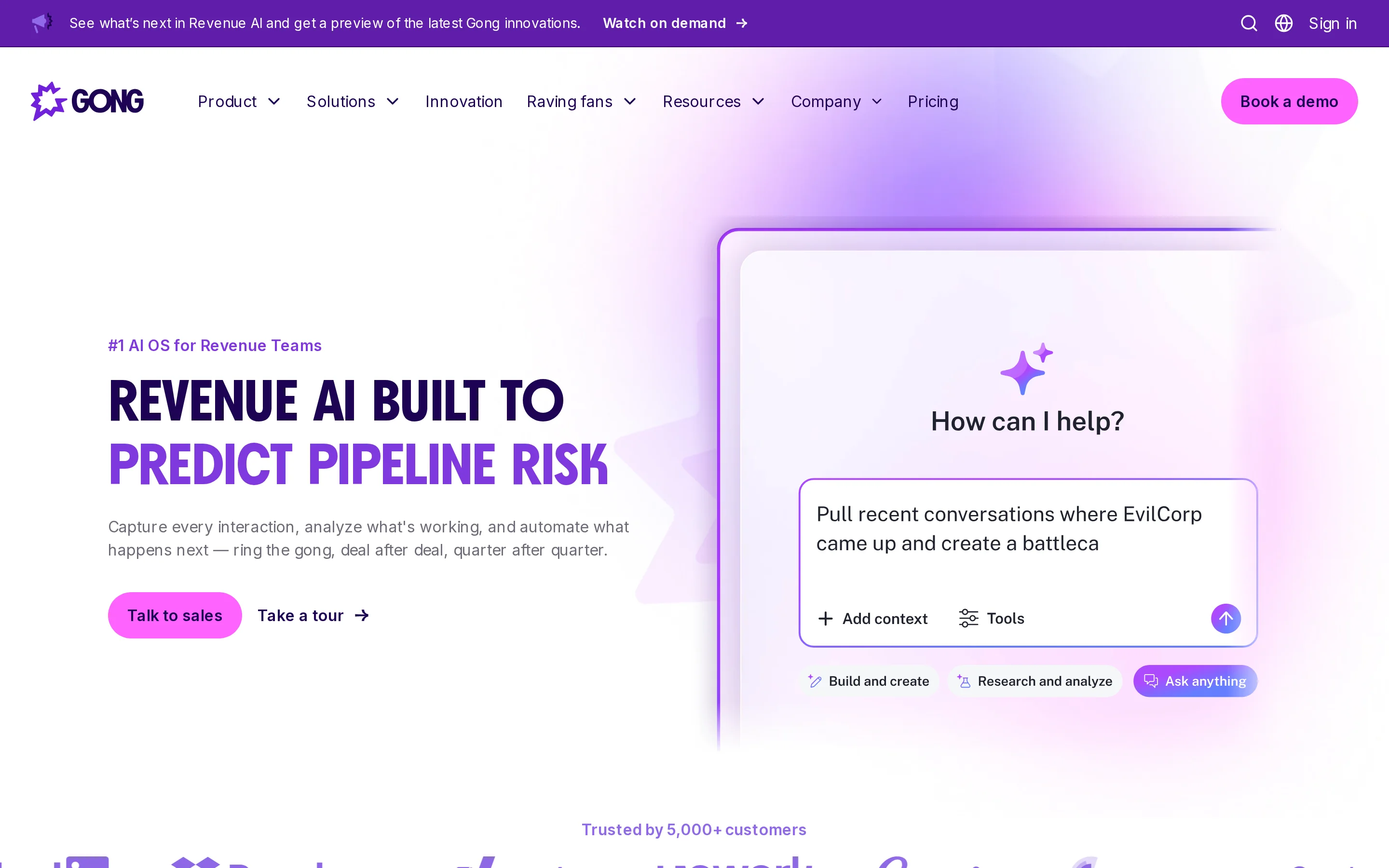
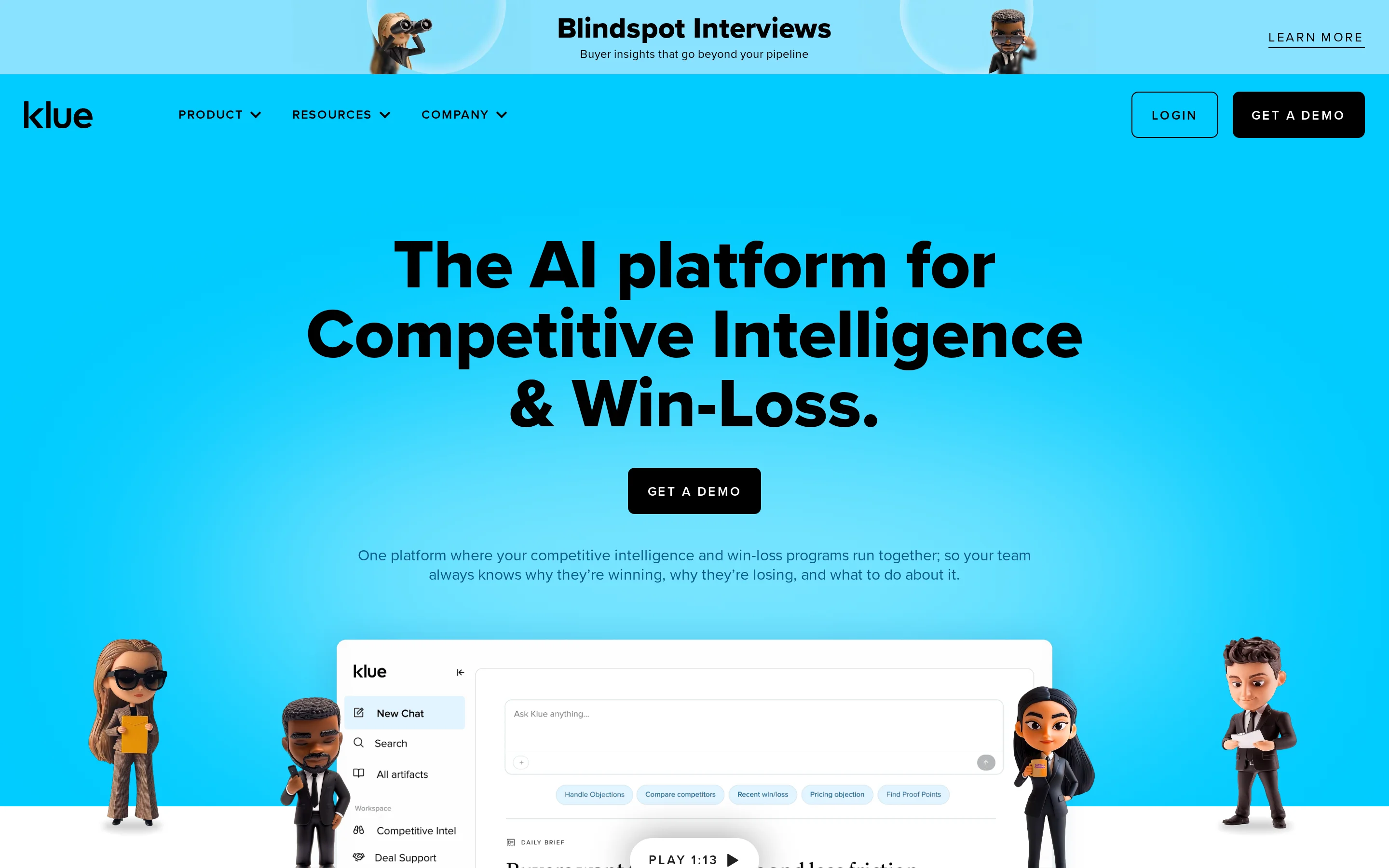
| Attribute | Gong.io | Klue |
|---|---|---|
| Primary Purpose | Revenue AI OS & Conversation Intelligence | Competitive Intelligence & Enablement |
| Starting Price | Custom Enterprise Pricing (Contact Sales) | Custom Enterprise Pricing (Contact Sales) |
| Free Plan | No (Demo/Form only) | No (Demo/Form only) |
| Core Strength | Behavioral Data & Deal Risk Prediction | Market Context & Battlecard Generation |
| Data Source | Internal Customer Interactions (Calls/Emails) | External Market News & Competitor Content |
| AI Architecture | Predictive Models on Billions of Interactions | LLM Summarization & Narrative Generation |
| Integration Depth | Native CRM & Communication Layer | Slack/CRM Plugins for Distribution |
| Target User | Sales Reps, Managers, RevOps | Product Marketing, Sales Enablement, Reps |
Feature-by-feature matrix
Audited capabilities across data sourcing, sending infrastructure, and integrations.
| Capability | Why it matters | Gong.io | Klue | Winner |
|---|---|---|---|---|
| B2B Contact Database | Access to net-new leads | → Integration | — None | gong |
| Email Finder | Discovering verified addresses | → Integration | — None | Tie |
| Email Verification | Preserving domain health | ◐ Partial | — None | gong |
| Lead Scoring | Prioritizing outreach efforts | ✓ Native | — None | gong |
| Competitive Battlecards | Winning deals against rivals | ◐ Partial | ✓ Native | klue |
| Conversation Recording | Capturing intent signals | ✓ Native | — None | gong |
| Deal Risk Analysis | Forecast accuracy | ✓ Native | — None | gong |
| Market News Aggregation | Staying current on competitors | — None | ✓ Native | klue |
| CRM Integration | Workflow continuity | ✓ Native | ✓ Native | Tie |
| Slack Integration | Real-time alerts | ✓ Native | ✓ Native | Tie |
| API Access | Custom data pipelines | ✓ Native | ✓ Native | Tie |
| Automated Follow-ups | Reducing manual admin | ✓ Native | — None | gong |
| Content Personalization | Relevance in outreach | ◐ Partial | ✓ Native | klue |
| Team Coaching Insights | Rep development | ✓ Native | — None | gong |
| Pricing Transparency | Budget planning | — None | — None | Tie |
| Enterprise Security | Data compliance | ✓ Native | ✓ Native | Tie |
| User Interface Ease | Adoption rate | ◐ Partial | ✓ Native | klue |
| Mobile App | On-the-go access | ✓ Native | ◐ Partial | gong |
Technical deep dives
Architectural comparisons derived from live platform testing.
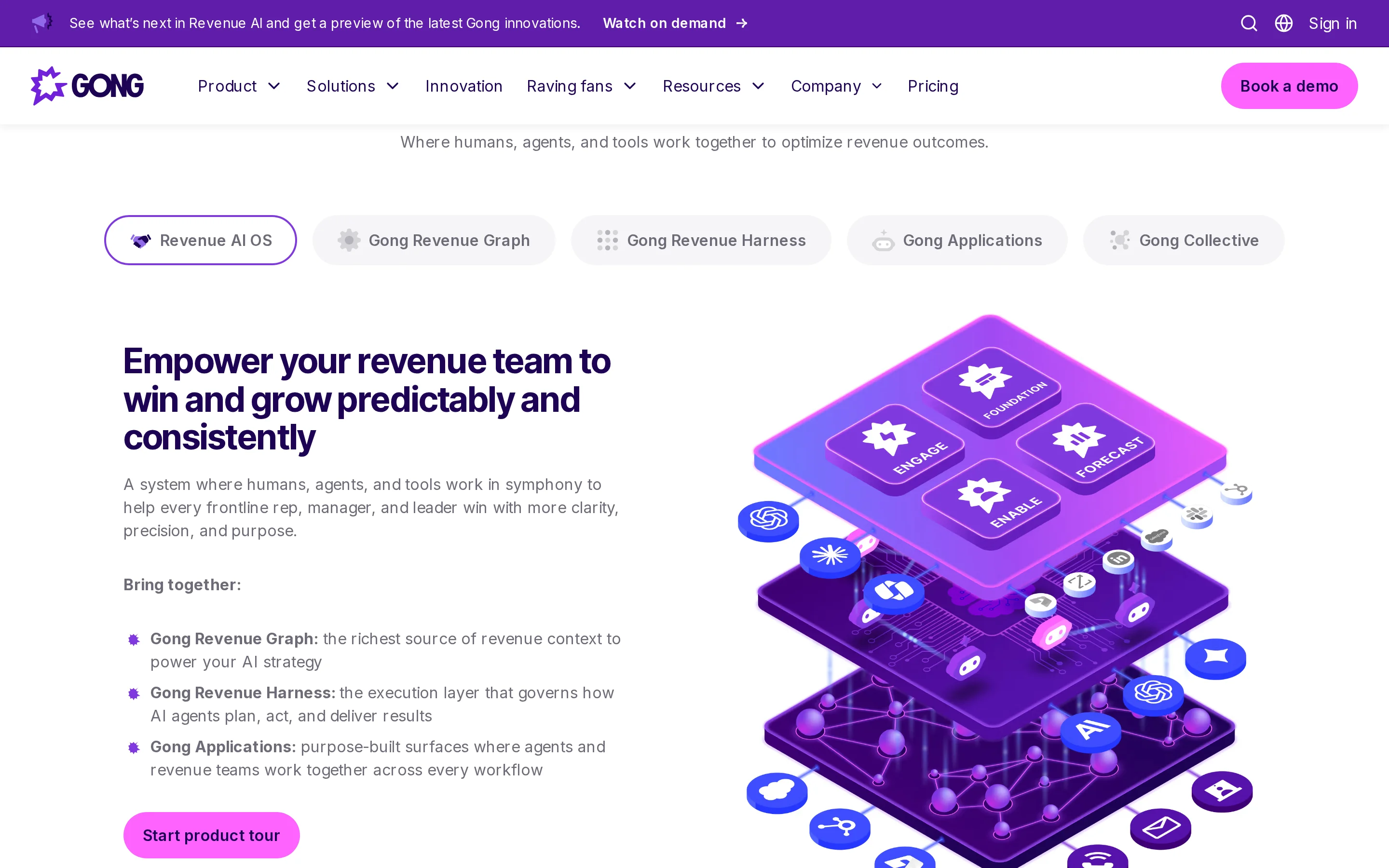 Full resolution
 Data Source & Enrichment Philosophy: Gong’s Conversation-First Revenue Graph vs. Klue’s Competitive Intelligence Aggregation
Gong.io approaches 'enrichment' not as finding new contact details, but as enriching existing accounts with behavioral context. Its core asset is the 'Revenue Graph,' built from billions of recorded calls, emails, and meetings. This allows Gong to infer lead quality based on interaction patterns, sentiment, and engagement frequency. In contrast, Klue aggregates external data sources—competitor websites, news feeds, and third-party databases—to provide market context. For an outbound team, Gong answers 'Is this prospect likely to buy?' based on past behavior, while Klue answers 'What should we say to beat the competition?' based on external narratives.
The operational reality differs significantly. Gong requires active participation from the sales team to capture data (recording calls, syncing emails). The more the team interacts, the richer the 'enrichment' becomes. Klue operates independently of individual rep activity, pulling from centralized marketing and product intel sources. This means Klue provides consistent, standardized intelligence across the organization, whereas Gong's insights can be fragmented if reps do not consistently use the platform.
For pure lead generation, neither tool is a traditional database like Apollo or ZoomInfo. However, Gong's 'Recommended Contacts' feature, powered by partner integrations (Apollo, Cognism), bridges the gap by suggesting decision-makers based on historical win rates. Klue lacks native contact discovery capabilities entirely. Therefore, Gong wins on 'contextual enrichment' for existing pipelines, while Klue wins on 'narrative enrichment' for competitive positioning.
Operational Workflow Integration: Gong’s Native Revenue Execution Harness vs. Klue’s Standalone Battlecard Distribution
Gong integrates deeply into the execution layer of the sales process. It sits within the communication channels (Zoom, Salesforce, Outlook) allowing agents to act on insights without leaving their workflow. The 'Revenue Harness' governs how AI agents plan and deliver results, meaning enrichment triggers actions (e.g., 'Send follow-up email') directly within the interface. Klue, conversely, functions primarily as a knowledge base. While it integrates with Slack and CRMs to distribute battlecards, the consumption of this data often happens outside the immediate outreach workflow, creating a potential disconnect between acquiring insight and executing the next step.
In daily operations, a Gong user sees deal risks, coaching tips, and next-best-actions overlaid on their pipeline view. A Klue user typically searches for a competitor name to retrieve a battlecard or receives automated updates via Slack. For high-volume outbound teams, Gong's approach reduces friction by keeping the 'what to do' close to the 'how to do it.' Klue's approach requires reps to switch contexts to find the right messaging, which can slow down velocity unless heavily automated via API hooks.
Gong's native integration ensures that enrichment data flows back into the CRM automatically, updating account records with new insights. Klue's data is generally static until manually updated or refreshed by its ingestion engines. For teams prioritizing seamless workflow automation and reduced admin time, Gong offers superior operational cohesion. Klue is better suited for teams where strategic messaging alignment is the bottleneck, rather than workflow efficiency.
AI Architecture & Predictive Capability: Gong’s Proprietary Revenue AI OS vs. Klue’s Generative Content Summarization
Gong utilizes a proprietary AI model trained specifically on revenue outcomes. It predicts deal risk, forecast accuracy, and win probability by analyzing successful patterns from its vast dataset. This quantitative approach enriches leads with probability scores, helping reps prioritize high-intent opportunities. Klue leverages Large Language Models (LLMs) primarily for qualitative tasks: summarizing competitor news, generating battlecard text, and identifying key themes in market shifts. Klue's AI focuses on narrative coherence and information synthesis rather than predictive scoring.
The extensibility of these architectures varies. Gong's AI is embedded in its 'Revenue AI OS,' offering specialized agents for different roles (reps, managers, leaders). It acts as a system of record and action. Klue's AI is a content generation engine, designed to keep sales enablement materials fresh and relevant. For outbound teams, Gong's predictive capability helps identify *which* leads to pursue, while Klue's generative capability helps determine *how* to message them effectively against specific competitors.
Gong's strength lies in its closed-loop learning: it knows what worked because it captures the outcome. Klue's strength lies in its breadth of external knowledge: it knows what the market is saying. If your outbound strategy relies on data-driven prioritization, Gong's architecture is superior. If it relies on differentiated messaging in crowded markets, Klue's generative summarization provides the necessary edge.
Pricing & true cost
Published tier structures, credit scaling mechanics, and total outbound cost.
 Full resolution
 Gong.io plans
- Standard: Custom Quote-Based Pricing
- Advanced: Custom Quote-Based Pricing
- Enterprise: Custom Quote-Based Pricing
Klue plans
- Essentials: Custom Quote-Based Pricing
- Professional: Custom Quote-Based Pricing
- Enterprise: Custom Quote-Based Pricing
Both Gong.io and Klue operate on a custom enterprise pricing model, requiring direct engagement with their sales teams for quotes. Neither publishes public self-serve dollar amounts. Gong's pricing is typically driven by per-user licenses plus a platform fee based on total users, reflecting its heavy infrastructure requirements for recording and processing conversation data. Klue's pricing is generally structured around seat counts and module usage (e.g., number of competitors tracked or battlecards generated). Because both are enterprise-grade solutions, costs can vary significantly based on negotiation, contract length, and bundle discounts. Buyers should anticipate six-figure annual contracts for mid-sized teams, with no transparent entry-level tiers.
of Ownership Analysis
For a 5-person sales team needing 10,000 verified leads per month, neither Gong nor Klue is a standalone solution. Both require integration with a dedicated lead database provider (like Apollo, ZoomInfo, or Cognism).
Estimated Annual Cost Breakdown:
1. Gong.io: ~$3,000 - $5,000 per user/year (estimated industry average for advanced tiers). Total: $15,000 - $25,000.
2. Klue: ~$2,000 - $4,000 per user/year (estimated for professional tier). Total: $10,000 - $20,000.
3. Lead Database (Required Add-on): To get 10,000 leads/month, you need a provider like Apollo (~$50/user/mo + credits) or ZoomInfo. Estimated cost: $6,000 - $12,000/year.
Total TCO: Approximately $31,000 - $57,000/year depending on the chosen combination. Note: These figures are estimates based on typical enterprise SaaS benchmarks, as official prices are quote-only.
Which fits your outbound model?
Match your team size, deal complexity, and lead volume to the right engine.
High-Volume Cold Outbound
Neither tool is ideal for pure cold outbound volume. Gong helps qualify leads after contact, and Klue helps message them. You still need a separate prospecting tool.
Competitive Displacement Campaigns
Klue is superior here. It provides the battlecards and market intel needed to position against specific competitors during outbound sequences.
Account-Based Marketing (ABM) Enrichment
Gong excels at ABM by providing deep behavioral insights into target accounts, helping tailor outreach based on actual engagement history.
Sales Team Onboarding & Training
Gong's call recordings and coaching features accelerate ramp-up time. Klue aids training by providing up-to-date product/competitor knowledge.
Where each platform falls short
Constructive limitations and architectural trade-offs to weigh before signing.
Where Gong.io falls short
- Does not have a native B2B contact database; relies on partners for lead sourcing.
- Requires significant change management; low adoption by reps leads to poor data quality.
- Expensive for small teams due to platform fees and per-seat licensing.
- Privacy concerns regarding call recording may limit international expansion.
Where Klue falls short
- No native lead generation or contact finding capabilities.
- Value depends heavily on the quality of input data from marketing/product teams.
- Can become cluttered if battlecards are not actively maintained.
- Lacks predictive analytics for deal risk or lead scoring.
The switching playbook
What you gain and give up when migrating across platforms.
- Deep visibility into customer conversations and deal dynamics.
- Predictive insights on which leads are most likely to convert.
- Automated administrative tasks for reps (logging calls, updating CRM).
- Centrali
- Real-time competitive battlecards and market news.
- Improved messaging consistency across the sales team.
- Easier deployment for non-revenue focused teams (marketing/product).
Frequently asked questions
Direct technical answers about Gong.io and Klue.
Which platform has better data accuracy?
Gong.io has higher accuracy for *internal* behavioral data (what happened in a call). Klue has higher accuracy for *external* market data (what competitors are doing). They measure different types of truth.
How do their starting costs compare?
Both are quote-based. Generally, Gong is more expensive per seat due to its heavy infrastructure (audio/video processing). Klue is often priced lower per seat but may charge for additional modules like competitor tracking limits.
Can I connect unlimited mailboxes?
Gong connects to standard business email providers (Office 365, Gmail) for monitoring. Klue does not monitor mailboxes; it ingests data from CMS, social media, and news feeds.
Which tool is easier to learn?
Klue is generally easier for end-users (reps) because it functions like a search engine for battlecards. Gong requires training on how to interpret dashboards, manage call recordings, and act on AI recommendations.
Do they replace a CRM?
No. Both integrate with CRMs (Salesforce, HubSpot). Gong enhances the CRM with conversation data; Klue enhances it with competitive context. Neither replaces the system of record.
Sources & methodology
Every claim is grounded in official vendor documentation and live audits.
Compare with sendroAI
See how sendroAI replaces manual research, credit limits, and deliverability traps with full autonomous execution.