Quick decision verdict
Executive rulings based on technical testing and pricing data.
Best for Enterprise Outbound
lemlist is the superior choice for teams needing an all-in-one GTM platform with CRM sync, multi-channel outreach (LinkedIn/SMS), and centralized contact management.
Best for Email Deliverability
MailReach.co wins for pure deliverability infrastructure, offering specialized warmup algorithms and spam testing that outperform generalist platforms' built-in features.
Best for High-Volume Prospecting
lemlist provides a native 650M+ lead database and AI-driven enrichment, allowing users to find and engage prospects without external data providers.
Best Overall Value
MailReach.co offers lower entry costs ($25/mailbox) for specific utility needs, while lemlist requires higher investment but replaces multiple tools in the stack.
lemlist vs MailReach.co at a glance
Side-by-side core specifications and live platform viewports.
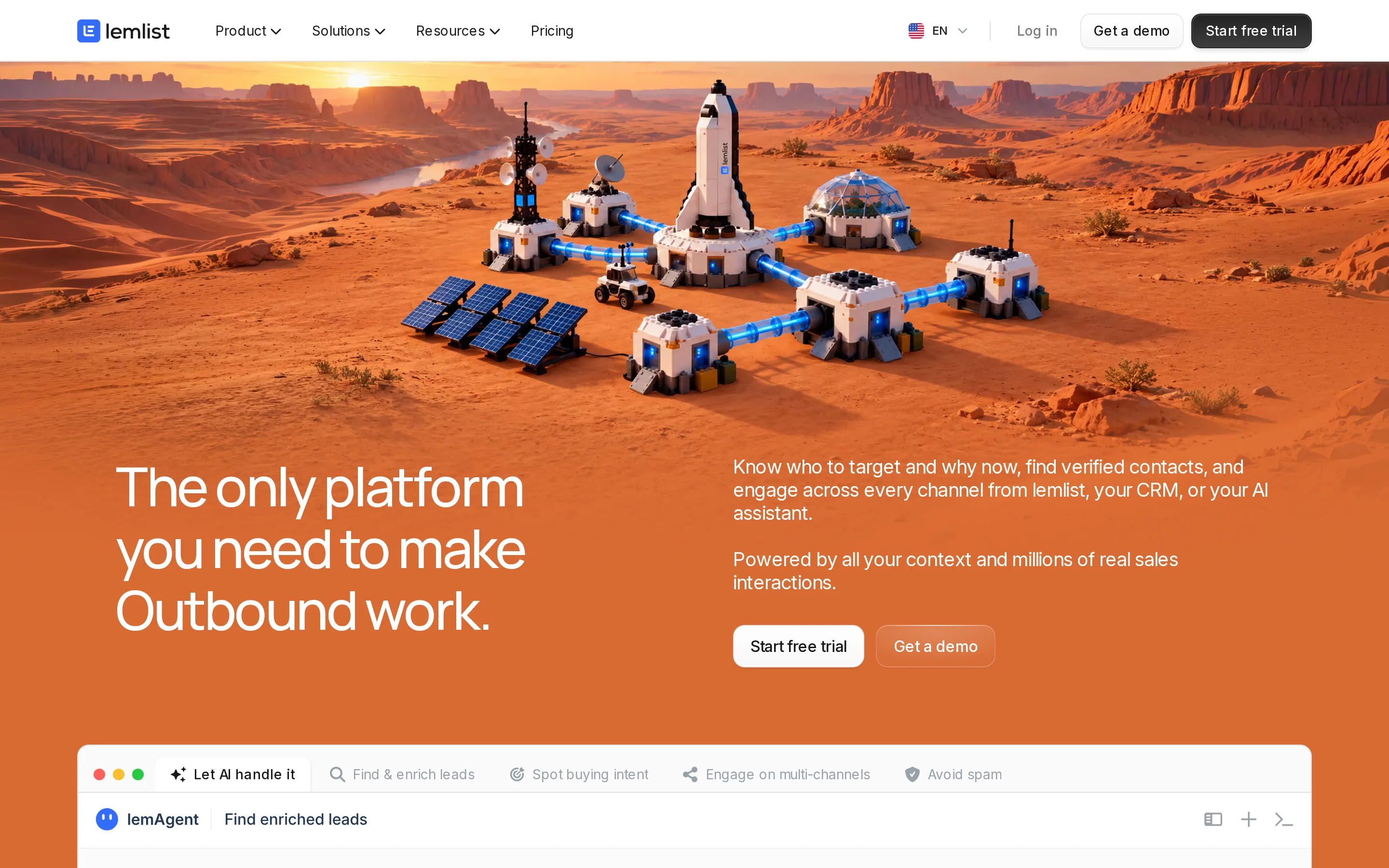
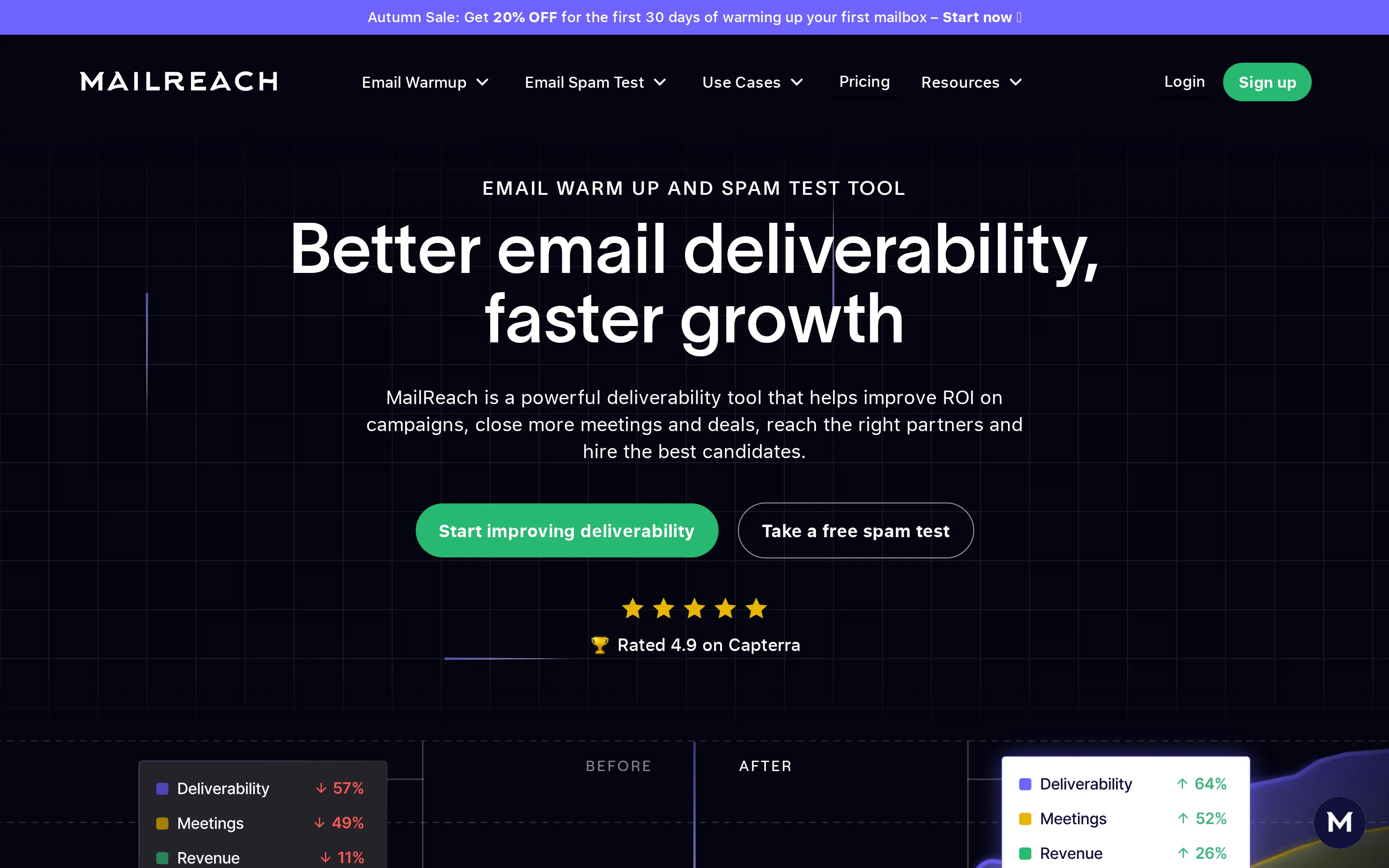
| Attribute | lemlist | MailReach.co |
|---|---|---|
| Primary Purpose | All-in-one sales engagement & prospecting platform | Email deliverability, warmup, and spam testing tool |
| Starting Price | Custom / Quote-Based (Self-serve plans vary by volume) | $25 per mailbox/month |
| Free Plan | No (Free trial available) | No (Paid only) |
| Core Strength | AI-generated personalized sequences & multi-channel outreach | Algorithmic inbox warming & reputation monitoring |
| Lead Database | Native 650M+ leads included | None (Requires external source) |
| Integrations | Deep CRM (HubSpot, Salesforce), LinkedIn, VoIP | Limited (API/Webhooks for sending platforms) |
| User Management | Unlimited users & email senders on paid plans | Per-mailbox licensing model |
Feature-by-feature matrix
Audited capabilities across data sourcing, sending infrastructure, and integrations.
| Capability | Why it matters | lemlist | MailReach.co | Winner |
|---|---|---|---|---|
| B2B Contact Database | Access to net-new leads without external providers | ✓ Native | — None | lemlist |
| Email Finder | Discovering verified addresses from domains/names | ✓ Native | — None | lemlist |
| Email Verification | Preserving domain health before sending | ◐ Partial | ✓ Native | mailreach.co |
| Inbox Warmup | Building sender reputation to avoid spam folders | ◐ Partial | ✓ Native | mailreach.co |
| Spam Testing | Pre-send analysis of content quality | ◐ Partial | ✓ Native | mailreach.co |
| Multi-Channel Outreach | Engaging via Email, LinkedIn, SMS, WhatsApp | ✓ Native | — None | lemlist |
| AI Sequence Generation | Automating copywriting and personalization | ✓ Native | — None | lemlist |
| CRM Integration | Syncing activities to HubSpot/Salesforce | ✓ Native | → Integration | lemlist |
| LinkedIn Automation | Profile visits, follows, and InMail | ✓ Native | — None | lemlist |
| Deliverability Alerts | Real-time monitoring of reputation drops | ✓ Native | ✓ Native | Tie |
| API Access | Custom developer workflows | ✓ Native | ✓ Native | Tie |
| Team Collaboration | Shared campaigns and roles | ✓ Native | — None | lemlist |
| Domain Health Monitoring | Tracking blacklists and DNS records | ◐ Partial | ✓ Native | mailreach.co |
| Voice Cloning/AI Voice | Personalized audio messages at scale | ✓ Native | — None | lemlist |
| Intent Signals | Identifying buying triggers | ✓ Native | — None | lemlist |
| Cost Efficiency (Small Team) | Budget impact for <5 users | ◐ Partial | ✓ Native | mailreach.co |
Technical deep dives
Architectural comparisons derived from live platform testing.
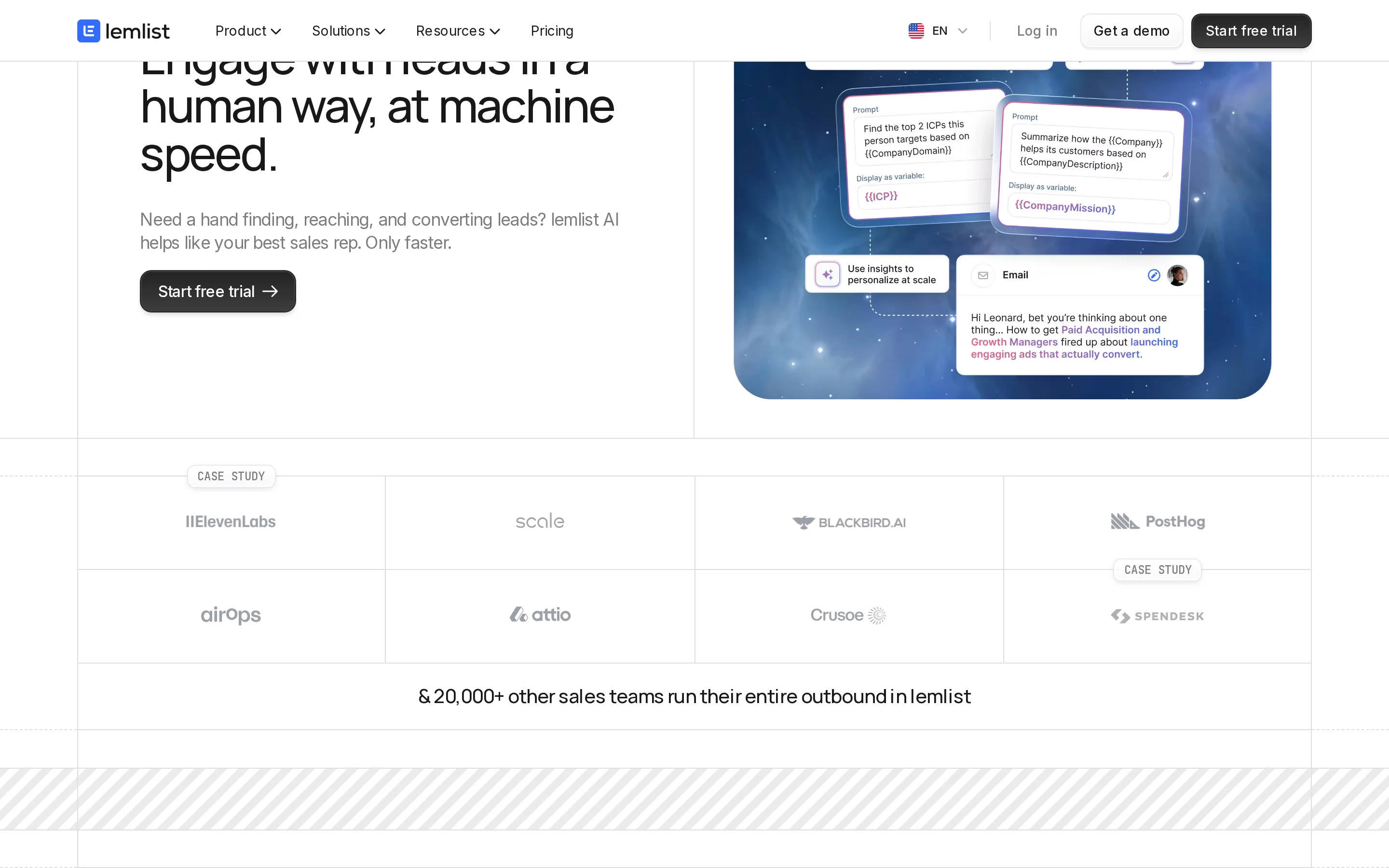 Full resolution
Core Value Proposition & Scope: Full-Stack Sales Engagement vs. Specialized Deliverability Infrastructure
Architecture & Data Layer: lemlist operates as a comprehensive Go-To-Market (GTM) platform, integrating a massive 650M+ lead database directly into its interface. This allows sales teams to prospect, enrich, and engage within a single system of record. In contrast, MailReach.co is a specialized utility focused exclusively on the 'plumbing' of email delivery. It does not provide leads or manage contacts; instead, it acts as an upstream service that ensures the emails sent by other platforms actually land in the inbox. The breadth of lemlist means it covers the entire funnel from identification to conversion, whereas MailReach covers only the technical delivery aspect.
Execution & Workflow: For a sales team, lemlist enables end-to-end execution. Users can find a lead, verify their email, craft an AI-personalized sequence, send it across email and LinkedIn, and log the result in HubSpot—all without leaving the app. MailReach requires a separate sending platform (like Instantly, Smartlead, or even Gmail/Outlook manually). Its workflow is strictly about warming up those accounts and testing templates. If you use lemlist, you are using its internal 'lemwarm' feature, which is functional but generic. If you use MailReach, you are leveraging a dedicated network of high-quality inboxes specifically designed to boost reputation metrics more aggressively than generalist tools.
Tradeoffs & Ruling: The tradeoff is complexity versus specialization. lemlist simplifies the tech stack by consolidating tools, but its deliverability features are secondary to its engagement capabilities. MailReach.co offers superior, granular control over sender reputation but adds another layer to the tech stack. For most modern B2B teams, lemlist's integrated approach reduces friction, but high-volume agencies often pair lemlist (or similar tools) with MailReach to maximize deliverability rates beyond what native warming can achieve.
AI Implementation Strategy: Generative Outreach Personalization vs. Algorithmic Reputation Management
Core Execution: lemlist leverages Generative AI (via lemAgent) to solve the problem of relevance. It uses LLMs to scrape web data, identify pain points, and generate hyper-personalized copy, subject lines, and even voice notes. The goal is to increase reply rates by making the message feel human and tailored. MailReach.co, conversely, uses algorithmic AI to simulate human behavior for warming purposes. It analyzes engagement patterns, adjusts sending volumes dynamically, and tests against spam filters to optimize inbox placement. One AI writes your emails; the other AI teaches the internet to trust your server.
Daily Operational Realities: With lemlist, the AI is in the driver's seat for content creation. A user prompts lemAgent to 'find leads who just raised Series A,' and the AI builds the campaign. This saves hours of manual research and writing. With MailReach, the AI runs in the background. The user sees dashboards showing reputation scores and spam test results. The operational burden shifts from 'writing good copy' to 'monitoring health metrics.' If your copy is bad, lemlist's AI helps fix it. If your domain is burned, MailReach's AI helps heal it.
Tradeoffs & Ruling: lemlist's AI strategy yields higher ROI in terms of time saved on prospecting and copywriting. However, excellent copy fails if it goes to spam. MailReach's strategy yields higher ROI in terms of deliverability percentages. The ideal scenario for a mature outbound team is to use lemlist's generative AI for message construction and MailReach's algorithmic AI for infrastructure maintenance. Choosing one over the other depends on whether your bottleneck is 'getting replies' (content) or 'getting seen' (deliverability).
Operational Workflow Integration: End-to-End Pipeline Execution vs. Critical Pre-Send Dependency
Ecosystem & Data Hygiene: lemlist is designed to be the central hub of the sales ecosystem. It offers deep, two-way integrations with major CRMs like HubSpot, Salesforce, and Pipedrive, ensuring that every open, click, and reply is synced back to the pipeline. It also integrates with LinkedIn for social selling and various VoIP providers for calling. MailReach.co has a much narrower integration scope. It primarily connects via API or SMTP settings to sending platforms. It does not sync with CRMs because it doesn't handle deals or contacts; it handles servers. This makes MailReach a 'set-and-forget' utility rather than an active workspace.
Automation & Extensibility: lemlist supports advanced automation through Zapier, Make, n8n, and Clay, allowing complex data flows where leads are enriched externally and pushed into lemlist campaigns automatically. It also offers an API for custom development. MailReach also offers an API, particularly for its spam testing and warmup status, allowing developers to build custom dashboards or automate checks. However, lemlist's extensibility is geared toward business logic (who to talk to, when to follow up), while MailReach's is geared toward technical monitoring (is my IP clean?).
Tradeoffs & Ruling: lemlist fits better as a primary System of Record for sales operations due to its CRM connectivity and unified inbox. MailReach.co functions best as a critical pre-send dependency—a mandatory check before launching campaigns on any platform. If you are building a lean startup, lemlist might suffice alone. If you are scaling to thousands of emails per day, relying solely on lemlist's native warming may risk domain burnout, making MailReach.co an essential addition to the workflow despite its lack of broader integration.
Pricing & true cost
Published tier structures, credit scaling mechanics, and total outbound cost.
 Full resolution
 Full resolution
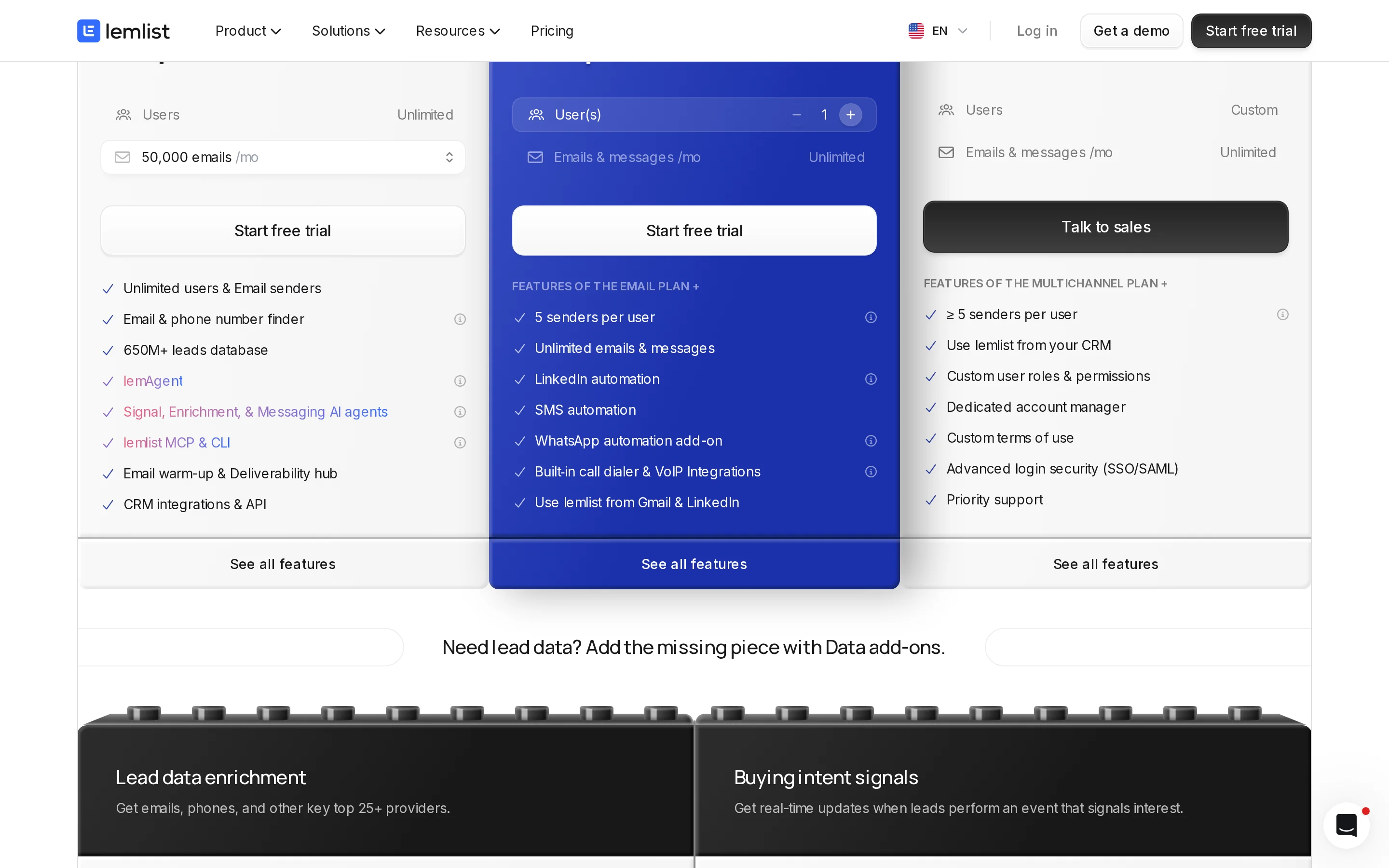
lemlist plans
- Email Plan: Pricing based on monthly email volume (Quote-based/Self-serve tiers)
- Multichannel Plan: Pricing based on number of users (Includes LinkedIn, Email, etc.)
- Enterprise: Custom pricing for large teams requiring SSO, dedicated support, and custom limits
MailReach.co plans
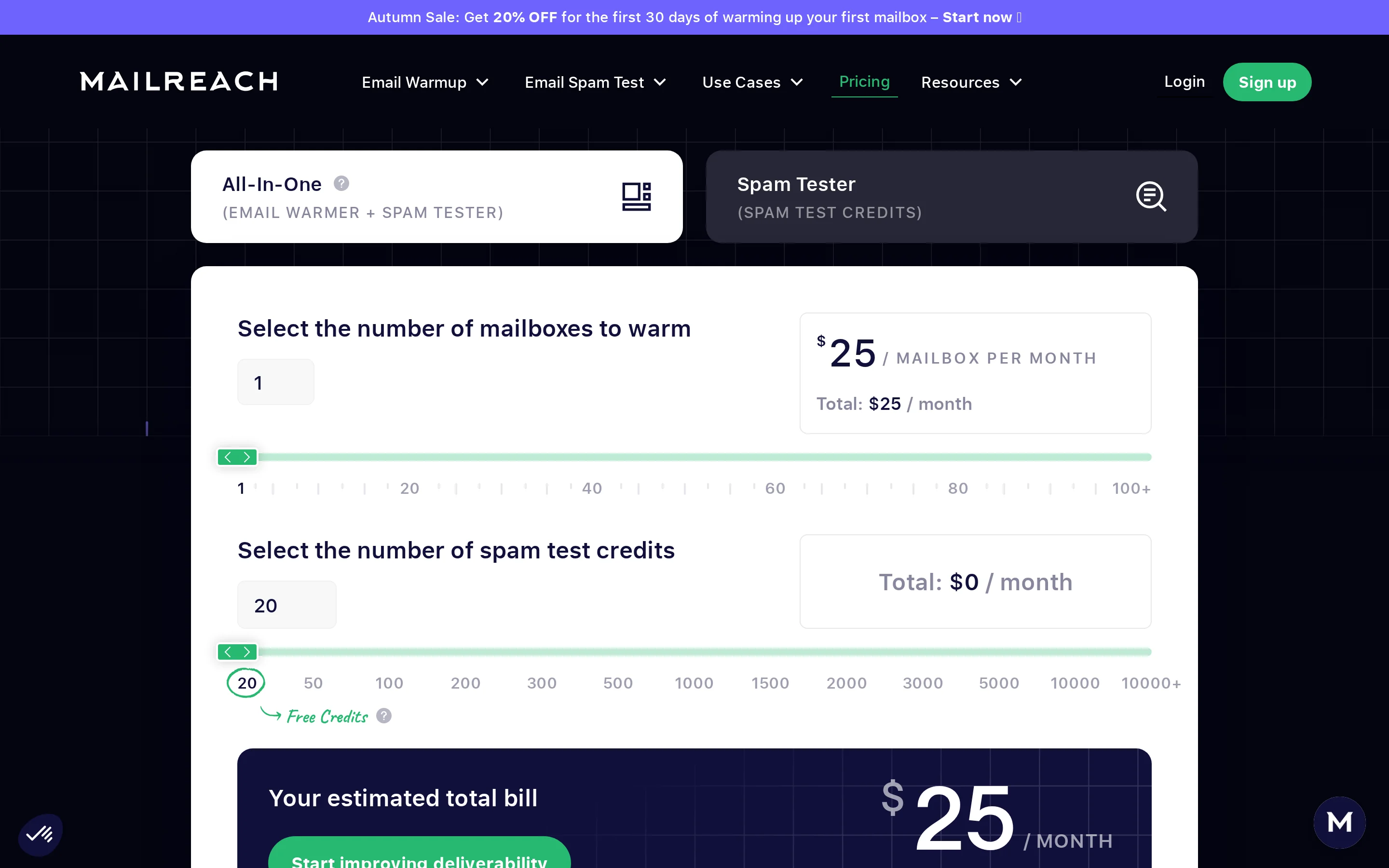
- All-In-One Warmup: $25 per mailbox per month
- Spam Tester: Credit-based pricing (included with warmup plans)
- Annual Discount: Save 20% when billed annually
lemlist employs a hybrid pricing model that combines usage-based (email volume) and seat-based (users) components, which can become expensive for small teams but scales efficiently for larger organizations needing unlimited users. MailReach.co uses a straightforward per-mailbox subscription model ($25/mo), making it highly predictable and affordable for teams with limited domains. For a 5-person team, MailReach is significantly cheaper upfront, whereas lemlist requires a larger commitment to unlock its full multi-channel potential.
of Ownership Analysis
For a 5-person sales team sending 10,000 emails/month:
MailReach.co: Assuming each person uses 1 dedicated mailbox for outreach, the cost is 5 mailboxes * $25 = $125/month. This covers warmup and basic spam testing.
lemlist: To send 10,000 emails safely with unlimited users, you would likely need a mid-tier Multichannel plan. While exact public pricing varies by volume, comparable enterprise-grade engagement platforms typically range from $300 - $600/month depending on credit usage for data enrichment.
Total Cost Comparison: MailReach is ~$125/mo. lemlist is ~$400+/mo. However, lemlist includes the lead database and CRM sync, potentially saving $200-$300/mo in external data provider costs (e.g., Apollo, ZoomInfo). Therefore, the 'net' cost difference narrows if lemlist replaces other tools.
Which fits your outbound model?
Match your team size, deal complexity, and lead volume to the right engine.
High-Volume Cold Outbound
lemlist is built for this, combining volume sending with AI personalization. MailReach supports it but doesn't execute it.
Bulk List Cleaning & Hygiene
MailReach.co provides superior spam testing and verification insights compared to lemlist's basic verifier.
Developer API Data Pipelines
MailReach's API is lightweight and easy to embed for checking deliverability status programmatically.
Agency White-Labeling
lemlist offers robust client management and reporting features suitable for agencies managing multiple accounts.
Where each platform falls short
Constructive limitations and architectural trade-offs to weigh before signing.
Where lemlist falls short
- Native warmup ('lemwarm') is less aggressive and effective than dedicated tools like MailReach for severely damaged domains.
- Pricing can escalate quickly with heavy use of AI credits and data enrichment.
- Complexity: The sheer number of features (SMS, WhatsApp, Voice, LinkedIn) can overwhelm simple email-only teams.
Where MailReach.co falls short
- No lead database: You must bring your own list from other sources.
- No sending capability: Cannot send actual cold emails; requires integration with a separate ESP.
- Limited collaboration: No shared workspaces, CRM sync, or task management for sales teams.
The switching playbook
What you gain and give up when migrating across platforms.
- Access to 650M+ leads and built-in enrichment.
- Ability to run multi-channel campaigns (LinkedIn, SMS) alongside email.
- Centralized CRM sync and unified inbox for better pipeline visibility.
- Potentially lower inbox placement rates if relying solely on lemlist's native warming.
- Higher monthly costs compared to standalone utilities.
- Superior deliverability and reputation management.
- Lower fixed costs for small teams.
- Specialized spam testing insights.
- Loss of lead sourcing and enrichment capabilities.
- Need to purchase and maintain a separate sending platform (ESP).
- Fragmented workflow with no CRM integration.
Frequently asked questions
Direct technical answers about lemlist and MailReach.co.
Which platform has better data accuracy?
lemlist has better data accuracy for finding leads, as it includes a native 650M+ database with AI-powered verification and enrichment. MailReach.co does not have a lead database.
How do their starting costs compare?
MailReach.co starts at $25 per mailbox per month. lemlist's pricing is variable based on email volume and user count, typically starting higher but offering more bundled value.
Can I connect unlimited mailboxes?
lemlist allows unlimited email senders on its paid plans. MailReach.co charges per mailbox, so connecting unlimited mailboxes would require unlimited budget.
Which tool is easier to learn?
MailReach.co is simpler to learn as it focuses on one task (warming/testing). lemlist has a steeper learning curve due to its extensive multi-channel and AI features.
Does lemlist replace MailReach?
Not entirely. lemlist has built-in warming ('lemwarm'), but many high-volume senders still use MailReach.co alongside lemlist to ensure maximum deliverability.
Sources & methodology
Every claim is grounded in official vendor documentation and live audits.
Compare with sendroAI
See how sendroAI replaces manual research, credit limits, and deliverability traps with full autonomous execution.