Quick decision verdict
Executive rulings based on technical testing and pricing data.
Best for Enterprise Outbound
Outplay HQ offers unlimited seats on Growth/Enterprise plans with robust admin controls, making it superior for scaling large sales teams.
Best for AI Autonomy
Crono.one provides autonomous AI agents that execute workflows independently, whereas Outplay's AI is primarily an assisted writing tool.
Best for High-Volume Prospecting
Outplay HQ supports up to 100k prospects on Growth and unlimited on Enterprise, significantly outpacing Crono.one's single-user license model.
Best Overall Value
Outplay HQ includes a Free Forever plan and transparent tiered pricing, while Crono.one requires paid subscriptions plus variable credit costs for enrichment.
Outplay HQ vs Crono.one at a glance
Side-by-side core specifications and live platform viewports.
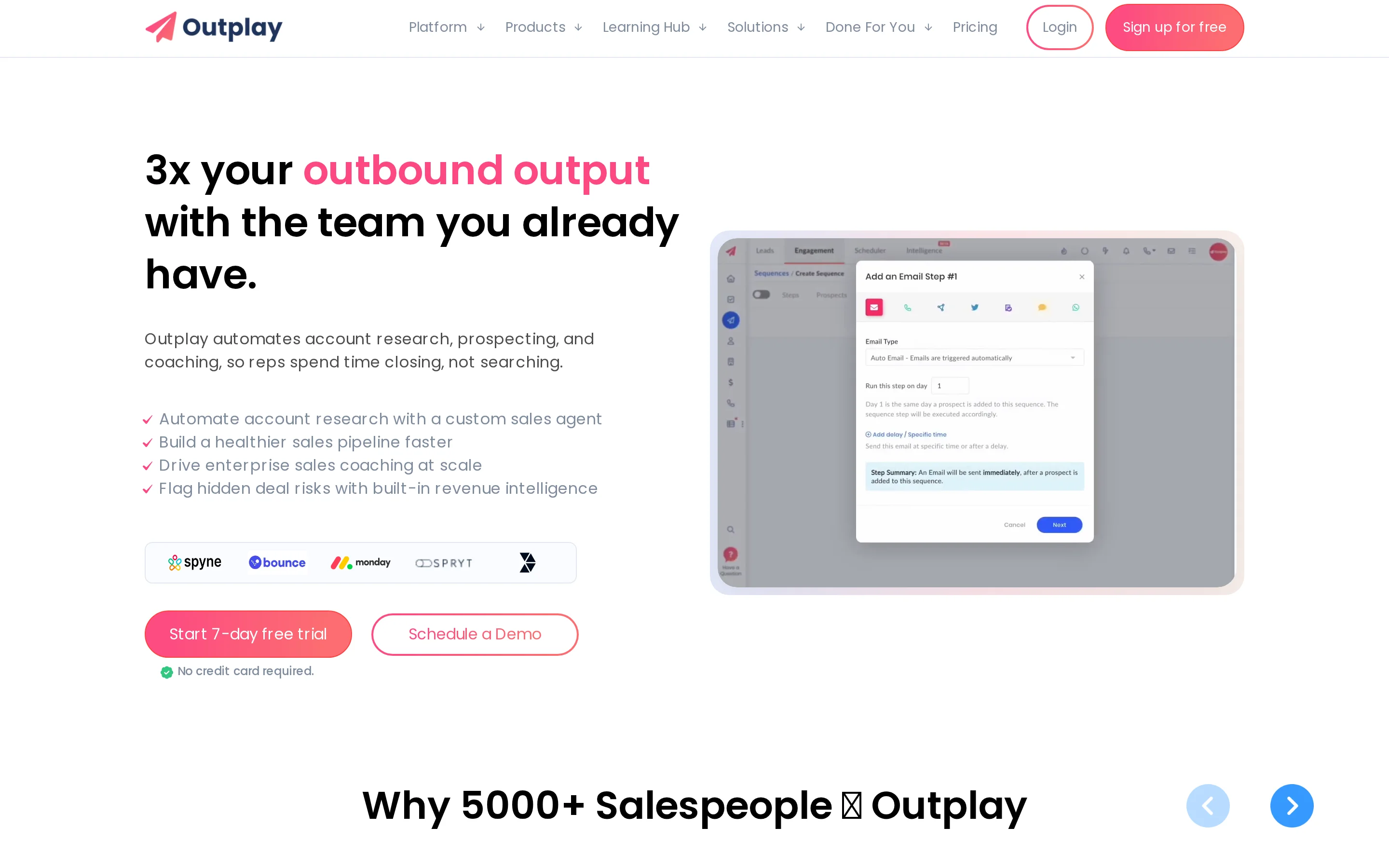
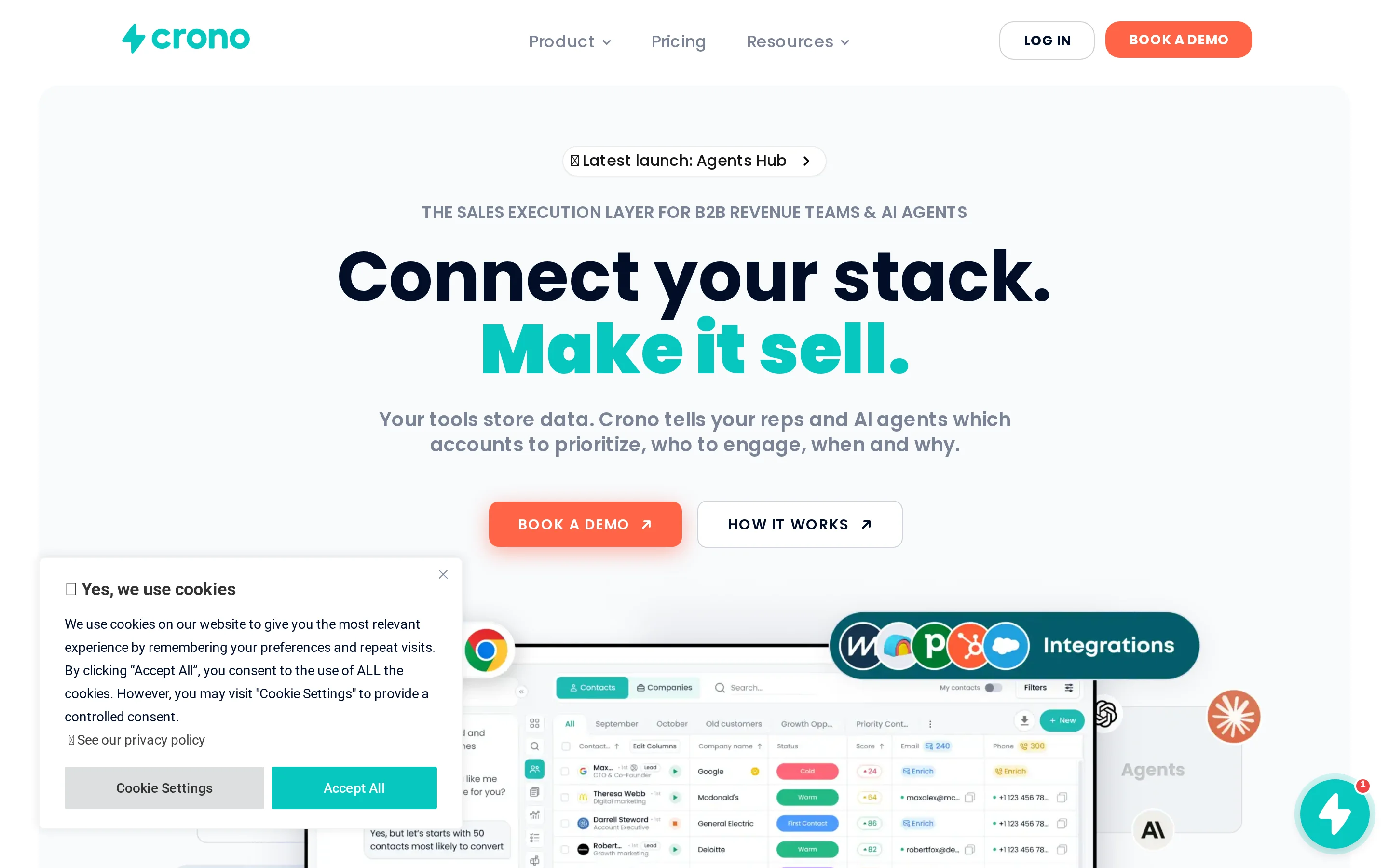
| Attribute | Outplay HQ | Crono.one |
|---|---|---|
| Primary Purpose | Multichannel Sales Engagement & Sequencing | Agentic GTM Execution Layer |
| Starting Price | $0/mo (Free Plan) | Quote-Based / Custom Pricing |
| Free Plan | Yes (Free Forever) | No (Demo only) |
| Core Strength | Unlimited Seats & CRM Integrations | Autonomous AI Agents & Signal Detection |
| User Model | Per Seat (Unlimited on Growth+) | Single User per Account License |
| Data Enrichment | Native Import & Extension | Credit-Based Waterfall Lookup |
| Calling Features | Built-in Dialer & Power Dialer | Integration via Aircall/Ringover |
| AI Capabilities | Assisted Writing & Objection Handling | Autonomous Agents & Meeting Prep |
Feature-by-feature matrix
Audited capabilities across data sourcing, sending infrastructure, and integrations.
| Capability | Why it matters | Outplay HQ | Crono.one | Winner |
|---|---|---|---|---|
| B2B Contact Database | Access to net-new leads without external tools | → Integration | ✓ Native | crono-one |
| Email Finder | Discovering verified addresses for outreach | ◐ Partial | ✓ Native | crono-one |
| Email Verification | Preserving domain health and deliverability | ◐ Partial | ✓ Native | crono-one |
| Multichannel Sequences | Engaging prospects across email, phone, and social | ✓ Native | ✓ Native | Tie |
| Built-in Calling/Dialer | Reducing friction in outbound call execution | ✓ Native | → Integration | outplay-hq |
| SMS Messaging | High open-rate channel for follow-ups | ✓ Native | → Integration | outplay-hq |
| LinkedIn Automation | Social selling at scale | ✓ Native | ◐ Partial | outplay-hq |
| CRM Integrations | Syncing pipeline data seamlessly | ✓ Native | ✓ Native | Tie |
| AI Sequence Writer | Generating initial outreach copy | ✓ Native | ✓ Native | Tie |
| Autonomous AI Agents | Executing tasks without human prompting | — None | ✓ Native | crono-one |
| Buying Signal Detection | Prioritizing warm leads based on intent | ◐ Partial | ✓ Native | crono-one |
| Custom Fields & Logic | Adapting the platform to unique processes | ◐ Partial | ✓ Native | crono-one |
| Team Leaderboards | Gamifying performance for SDRs | ✓ Native | — None | outplay-hq |
| Call Recording Storage | Training and compliance archiving | ✓ Native | → Integration | outplay-hq |
| SAML Single Sign-On | Security and enterprise access control | ✓ Native | N/A | outplay-hq |
| Unlimited Mailboxes | Scaling send volume without throttling | ✓ Native | N/A | outplay-hq |
Technical deep dives
Architectural comparisons derived from live platform testing.
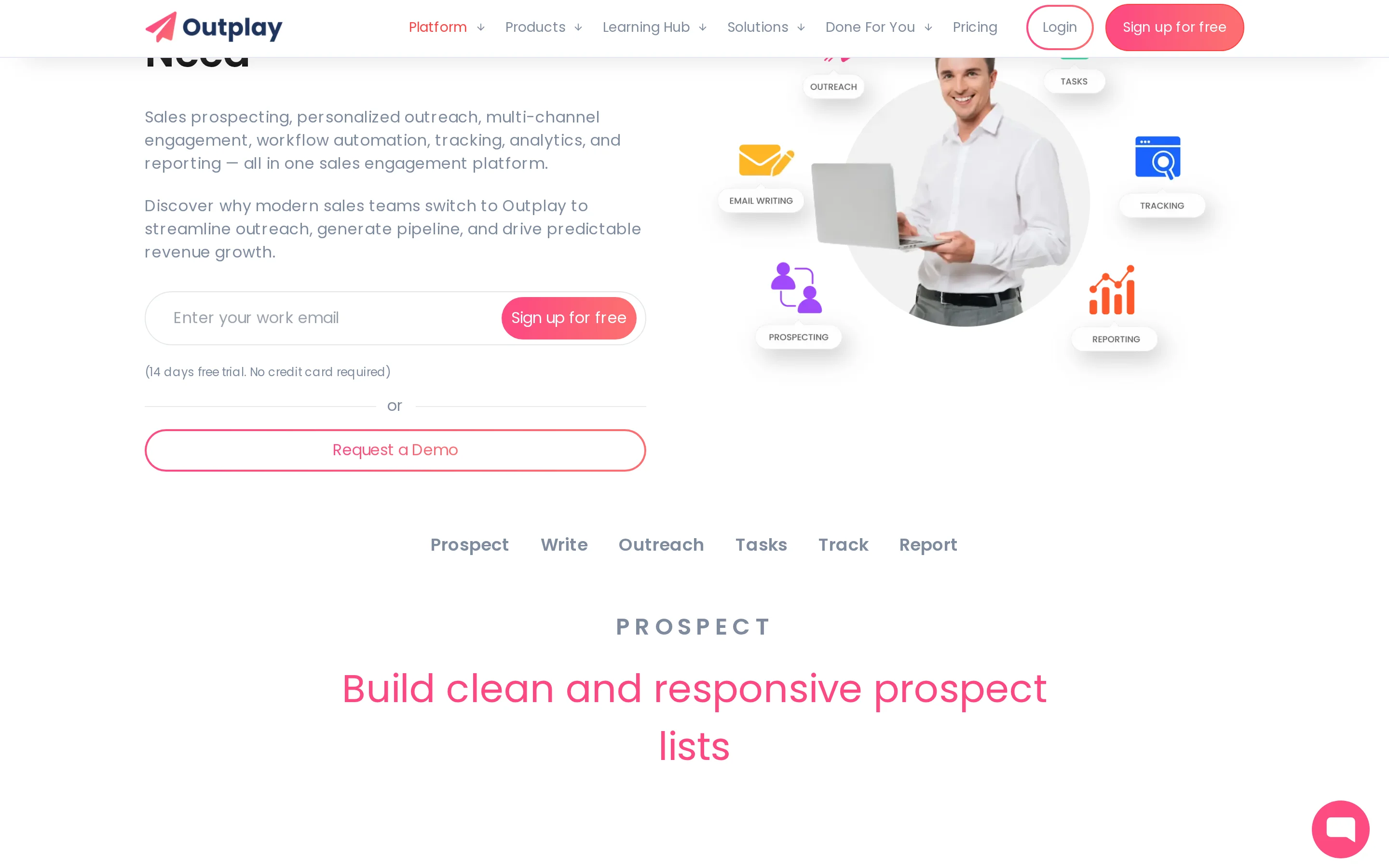 Full resolution
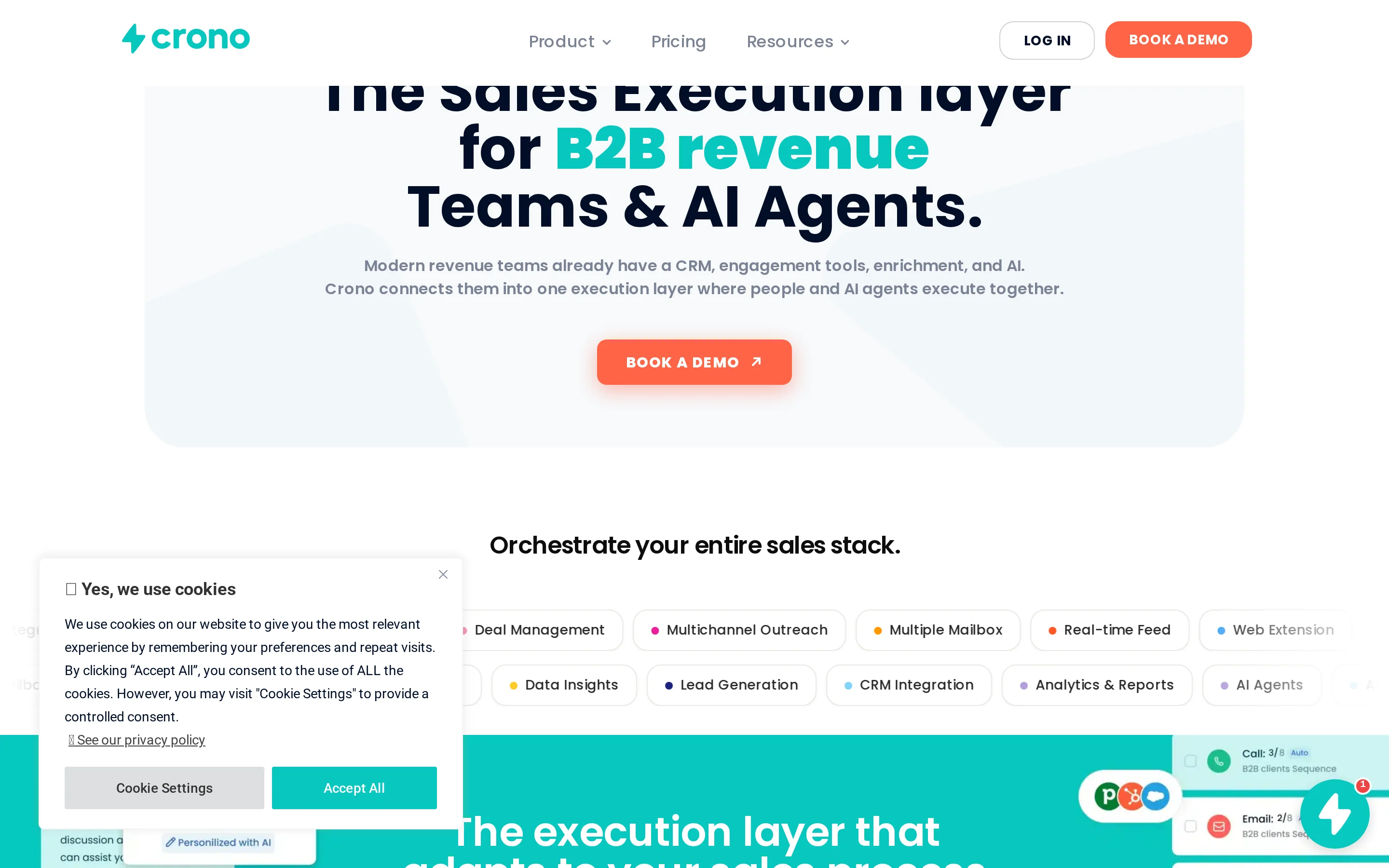 Full resolution
AI Execution Model: Assisted Content Generation vs. Autonomous Agent Workflows
Outplay HQ positions its AI capabilities as productivity boosters for human reps. Features like the 'AI Sequence Writer' and 'AI Objection Handling' are designed to assist in drafting content or responding to specific triggers within a fixed workflow. The AI does not operate independently; it requires human initiation and oversight, serving as a co-pilot rather than an autopilot. This model ensures that sales leaders maintain strict control over messaging tone and strategy, but it limits the potential for fully automated lead nurturing cycles.
In contrast, Crono.one treats AI as an autonomous 'execution layer.' Its architecture allows for the deployment of AI agents that can independently detect buying signals, filter leads, and even generate meeting briefs without direct human prompting. These agents work alongside reps, executing repetitive tasks such as re-engagement sequences or data validation automatically. This shift from 'assisted' to 'autonomous' represents a fundamental difference in operational philosophy: Outplay augments the human seller, while Crono attempts to replace the manual labor components of the sales process entirely.
The tradeoff lies in control versus efficiency. Outplay’s approach is safer for brands requiring precise message adherence and complex objection handling logic managed by humans. Crono’s agent-based model offers higher scalability for teams drowning in administrative overhead, allowing them to offload signal detection and basic outreach to AI. For most B2B revenue teams, the right choice depends on whether they need a tool to help their reps write better emails (Outplay) or a system that acts on behalf of the rep when they are offline (Crono).
Data Enrichment Strategy: Native CRM Sync & CSV Imports vs. Credit-Based Real-Time Lookup
Outplay HQ relies heavily on existing data sources. It integrates natively with major CRMs (Salesforce, HubSpot, Pipedrive) and offers a Chrome extension for one-click prospecting from Gmail or LinkedIn. While it supports bulk CSV imports, it does not publish a native, pay-per-lookup enrichment engine within its core pricing tiers. Instead, it often directs users to integrate with third-party data providers or use its own limited internal capabilities. This makes Outplay ideal for teams who already have clean CRM data and need a sequencing engine to act on it.
Crono.one utilizes a distinct credit economy for data enrichment. Users purchase credits specifically for 'Email Finder' (starting at €10 for 100 credits) and 'Mobile Finder' (starting at €50 for 100 credits). This waterfall approach leverages over 10 data providers to find contact details in real-time. By decoupling enrichment costs from seat licenses, Crono allows teams to scale their data acquisition efforts independently of their headcount. This is particularly advantageous for lean teams that need high-volume prospecting without paying for unused seats.
The operational reality differs significantly. With Outplay, if your CRM data is stale, you must rely on external integrations or manual updates before launching sequences. With Crono, the platform actively seeks out missing data during the workflow execution, filling gaps via its credit-based lookup. However, this introduces variable costs; heavy usage of enrichment features in Crono can lead to unpredictable monthly bills, whereas Outplay’s predictable subscription model (with optional add-ons) offers more financial stability for budget-conscious managers.
Workflow Customization: Pre-Built Multichannel Sequences vs. Logic-Driven Custom Fields
Outplay HQ excels at standardized multichannel cadences. It provides pre-built templates for Email, SMS, Phone, and Twitter touches, allowing reps to snap together sequences quickly. The platform emphasizes ease of use and rapid deployment, with features like 'Dynamic Sequences' that move leads based on engagement triggers (opens, clicks, replies). While powerful, the customization is largely confined to these predefined sequence structures and integration points. Admin controls focus on user permissions and mailbox management rather than deep structural changes to the data model.
Crono.one focuses on building a custom execution layer. It allows users to create custom fields, workflows, and logic that match exactly how their team operates. Rather than forcing reps into rigid sequence templates, Crono adapts to the internal process. This flexibility extends to its AI agents, which can be assigned to specific steps in a bespoke workflow. The platform is designed as a 'GTM backbone,' meaning it prioritizes structural adaptability over out-of-the-box simplicity.
The ruling here depends on organizational maturity. Outplay is superior for teams that want to implement industry-best-practice sequences immediately with minimal setup time. It reduces the cognitive load on sales ops. Crono is better suited for companies with unique, non-standard sales motions that require custom data structures and logic flows. If your team sells in a way that doesn't fit standard '7-touch' models, Crono’s logic-driven approach provides the necessary architectural freedom, albeit with a steeper learning curve.
Pricing & true cost
Published tier structures, credit scaling mechanics, and total outbound cost.
 Full resolution
 Full resolution
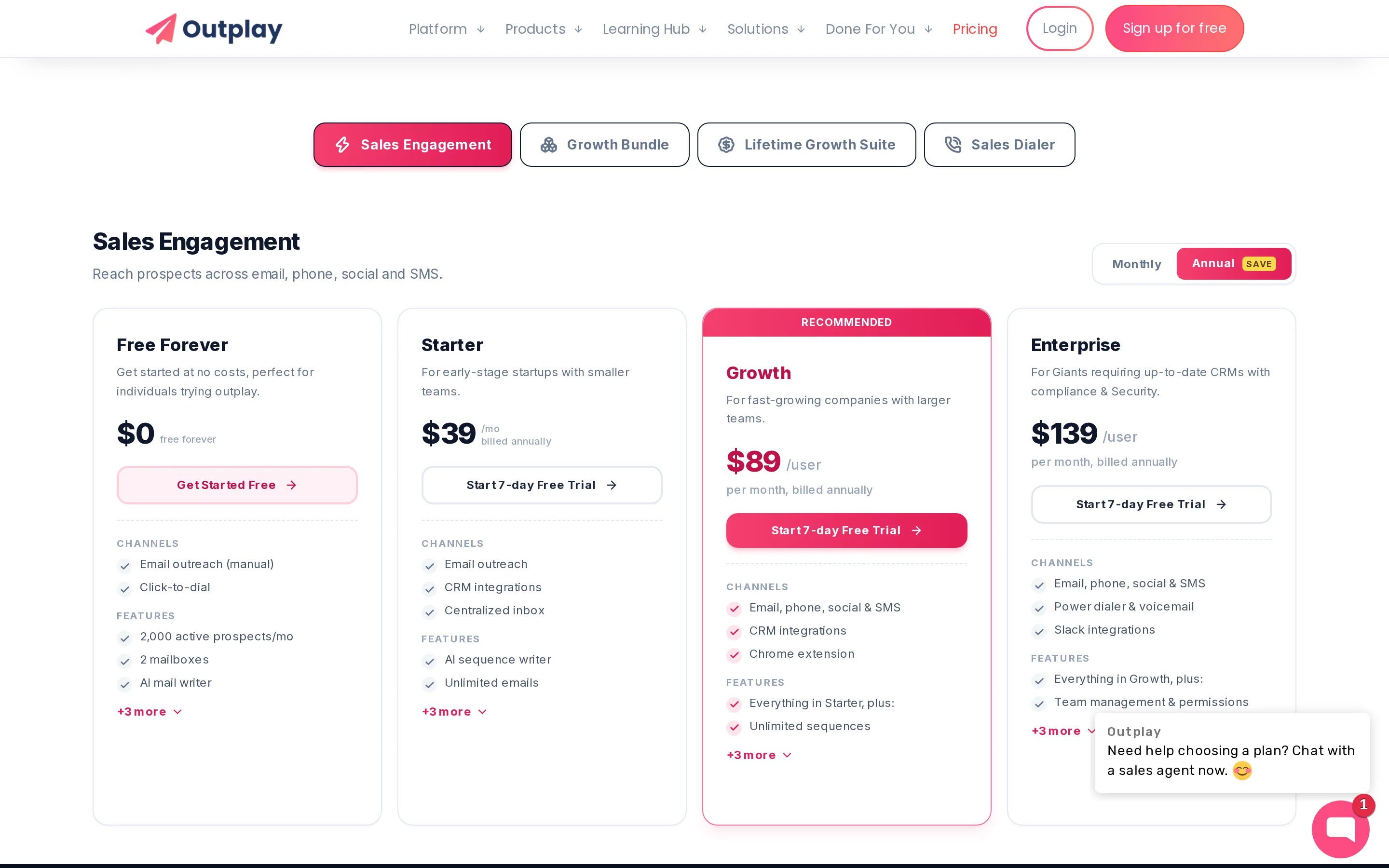
Outplay HQ plans
- Free Forever: $0/mo (1 User, 5k Prospects, 2 Mailboxes)
- Starter: Quote-Based (1 User, 20k Prospects, 5 Mailboxes)
- Growth: Quote-Based (Unlimited Users, 100k Prospects, Unlimited Mailboxes)
- Enterprise: Quote-Based (Unlimited Users, Unlimited Prospects, Advanced Security)
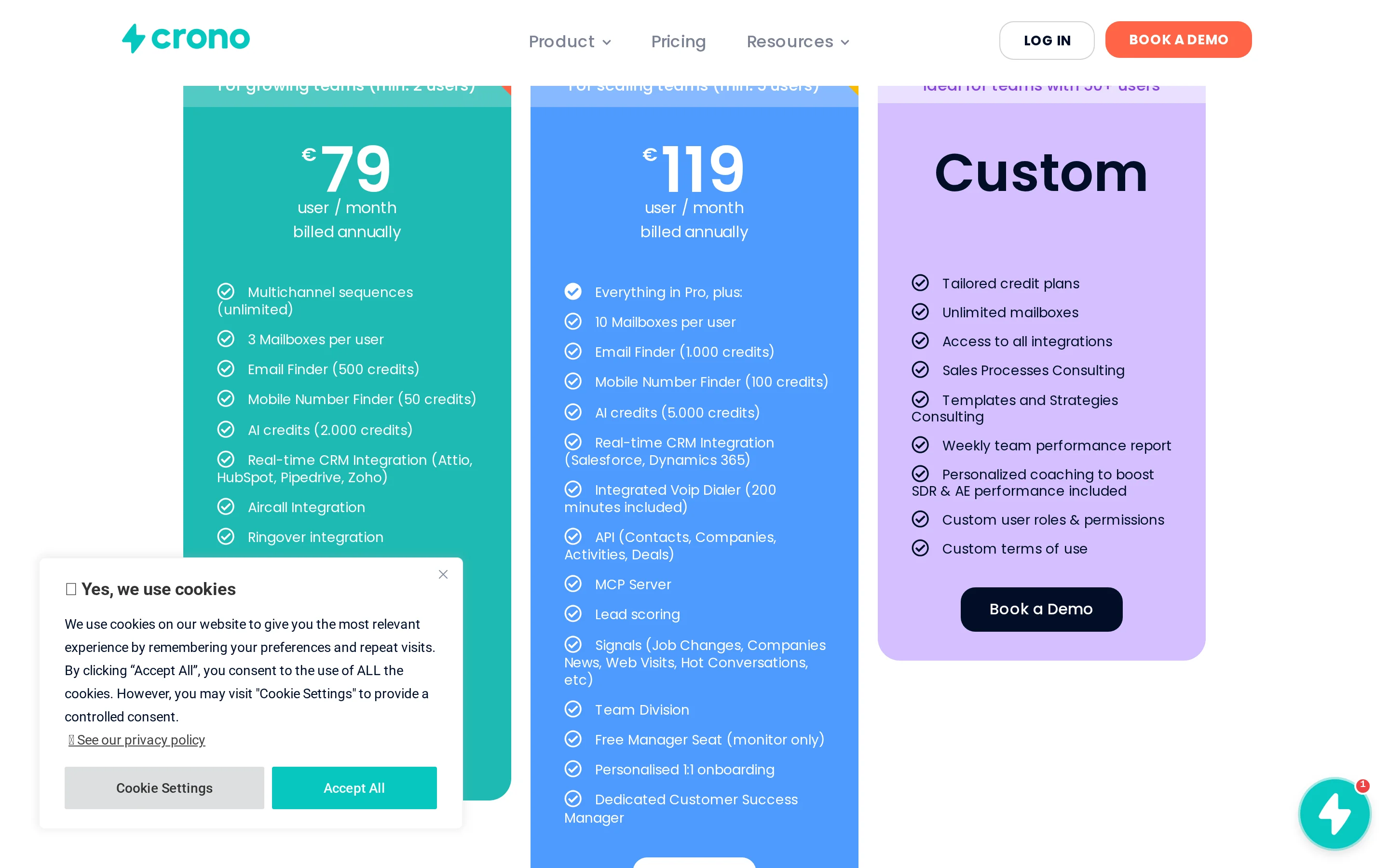
Crono.one plans
- Standard Plans: Quote-Based (Single User License)
- Enrichment Add-ons: Starting at €10 for 100 Email Credits
- Mobile Data Add-ons: Starting at €50 for 100 Mobile Credits
- AI Credits: Starting at €69 for 10,000 Credits
Outplay HQ offers a transparent tiered structure with a genuine free entry point, making it accessible for startups and individual sellers. Its paid plans are likely seat-based or volume-based, providing predictable monthly costs for scaling teams. Crono.one employs a hybrid model where the base platform is quote-based (likely per-user), but significant value is unlocked through variable credit purchases for enrichment and AI actions. This means Crono's total cost of ownership can fluctuate based on usage intensity, whereas Outplay's costs remain relatively stable once the plan tier is selected.
of Ownership Analysis
For a 5-person sales team needing 10,000 verified leads per month:
Outplay HQ: Assuming the 'Growth' plan (which supports unlimited users and 100k prospects), the cost is a flat monthly subscription (typically ~$100-$150/user/month in market estimates, though exact figures are quote-based). No additional cost for enrichment if using existing CRM data or free extensions. Estimated Monthly Cost: ~$500 - $750.
Crono.one: Base subscription (quote-based, estimated ~$80-$120/user/month) + Enrichment Credits. To get 10,000 emails, assuming 1 credit per email, the team needs 10,000 credits. At €10 per 100 credits, that is €1,000 (~$1,100 USD) per month just for data. Plus mobile numbers if needed. Estimated Monthly Cost: ~$400 (Seats) + $1,100 (Credits) = ~$1,500.
Verdict: Outplay is significantly cheaper for high-volume prospecting if the team already has data sources. Crono becomes expensive due to the pay-per-lead nature of its enrichment engine.
Which fits your outbound model?
Match your team size, deal complexity, and lead volume to the right engine.
High-Volume Cold Outbound
Outplay HQ is built for scale with unlimited mailboxes and prospect storage on Growth/Enterprise plans, ensuring deliverability and capacity for massive campaigns.
Lean Team with No CRM Data
Crono.one provides superior integrated enrichment, allowing small teams to build lists from scratch using its credit-based finder without needing separate data subscriptions.
Complex Custom Sales Processes
Crono.one offers higher flexibility with custom fields and logic-driven workflows, adapting to unique sales motions better than Outplay's standardized sequence templates.
Large Enterprise Sales Teams
Outplay HQ supports unlimited users, SAML SSO, and dedicated success managers, making it the viable choice for organizations with 50+ reps requiring centralized governance.
Where each platform falls short
Constructive limitations and architectural trade-offs to weigh before signing.
Where Outplay HQ falls short
- Lacks native, high-volume data enrichment engine; relies on integrations or external tools.
- AI features are assistive (writing/drafting) rather than autonomous (executing full workflows).
- Pricing for Starter/Growth tiers is not publicly listed, requiring sales contact for accurate budgeting.
Where Crono.one falls short
- Single-user license model restricts collaboration and team-wide visibility compared to multi-seat platforms.
- Variable credit costs for enrichment can lead to unpredictable monthly billing spikes.
- No public self-serve pricing; all plans require demo/sales interaction to determine cost.
The switching playbook
What you gain and give up when migrating across platforms.
- Predictable flat-rate pricing without variable credit costs.
- Robust team management features including leaderboards and unlimited seats.
- Stronger native support for calling/SMS channels within the platform interface.
- Loss of autonomous AI agents that execute tasks independently.
- Need to source external data enrichment tools if CRM data is incomplete.
- Less flexibility in creating custom data fields and non-standard workflow logic.
- Access to autonomous AI agents for signal detection and meeting prep.
- Integrated credit-based enrichment for finding emails and mobile numbers on-demand.
- Greater flexibility to customize workflows and fields to match unique internal processes.
- Higher variable costs due to pay-per-use enrichment credits.
- Limited team collaboration features due to single-user license constraints.
- Potential loss of native dialer/SMS functionality if relying solely on integrations.
Frequently asked questions
Direct technical answers about Outplay HQ and Crono.one.
Which platform has better data accuracy?
Crono.one claims 84% accuracy using a waterfall approach across 10+ providers. Outplay relies on the accuracy of the data imported from your CRM or connected enrichment tools, so its accuracy depends on your upstream data sources.
How do their starting costs compare?
Outplay starts with a Free Forever plan ($0/mo). Crono.one does not list public starting prices, operating on a quote-based model with additional costs for data credits.
Can I connect unlimited mailboxes?
Yes, Outplay HQ offers unlimited mailboxes on the Growth and Enterprise plans. Crono.one's mailbox limits are not explicitly published but are generally tied to the single-user license structure.
Which tool is easier to learn?
Outplay is generally considered easier for standard sales teams due to its pre-built sequence templates and familiar UI. Crono.one requires more setup to configure custom fields and AI agents, appealing more to power users or RevOps specialists.
Does either platform offer a free trial?
Outplay offers a 7-day free trial of the Growth plan. Crono.one typically requires booking a demo to see the platform in action, with no explicit self-serve free trial mentioned in the research data.
Sources & methodology
Every claim is grounded in official vendor documentation and live audits.
Compare with sendroAI
See how sendroAI replaces manual research, credit limits, and deliverability traps with full autonomous execution.