Quick decision verdict
Executive rulings based on technical testing and pricing data.
Best for Enterprise Outbound
Brevo. Its native CRM pipeline, multi-channel API support (SMS/WhatsApp), and enterprise-grade data control make it superior for complex B2B sales cycles.
Best for Email Deliverability
Tie. Both platforms offer robust deliverability tools, but Brevo's dedicated IP options on Enterprise plans provide more granular reputation control for high-volume senders.
Best for High-Volume Prospecting
Brevo. The ability to manage unlimited contacts with pay-as-you-go email credits allows for aggressive list growth without the steep tiered pricing jumps found in MailChimp.
Best Overall Value
Brevo. For teams needing both marketing automation and basic sales CRM features, Brevo consolidates costs better than MailChimp + a separate CRM stack.
MailChimp vs Brevo at a glance
Side-by-side core specifications and live platform viewports.

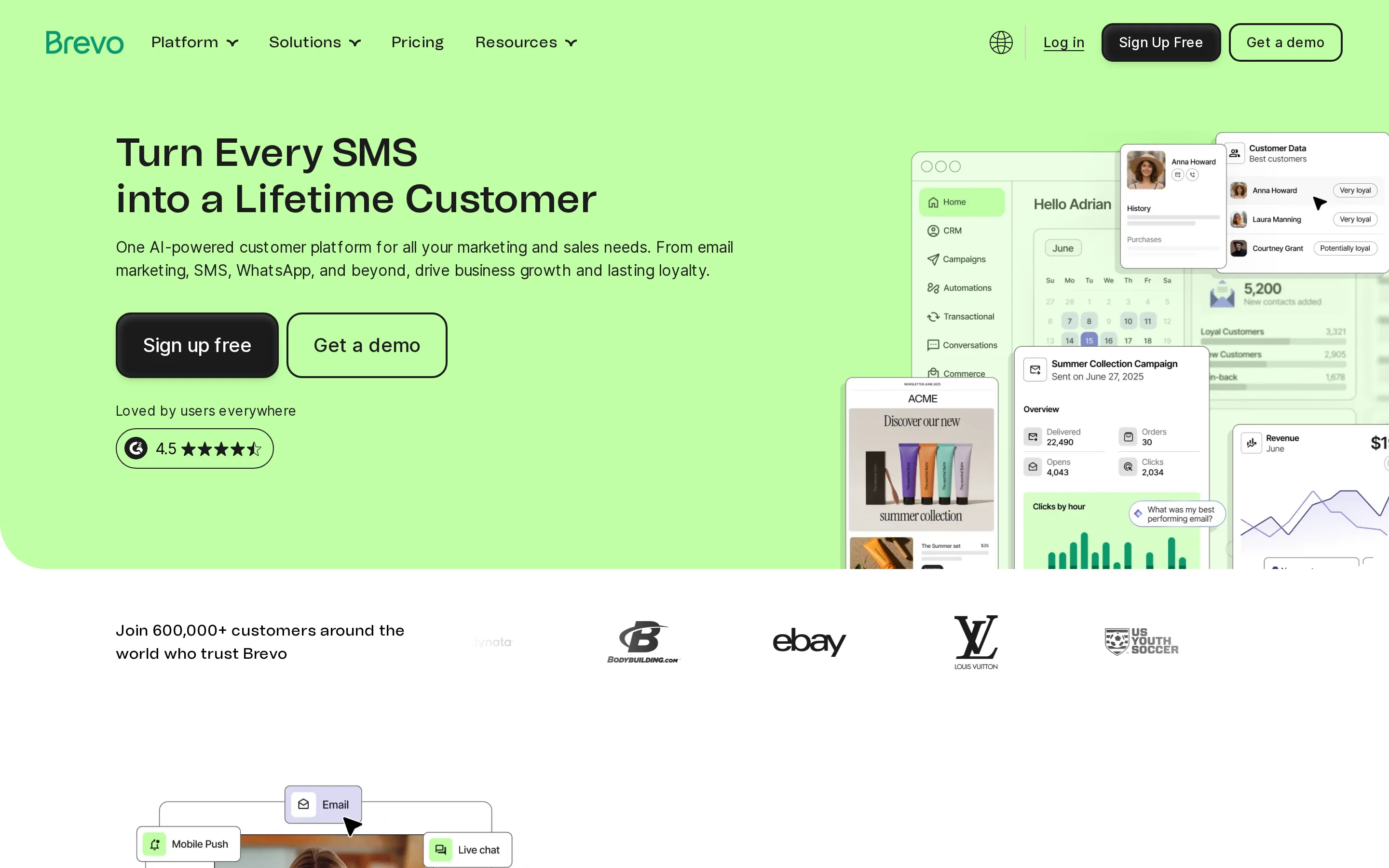
| Attribute | MailChimp | Brevo |
|---|---|---|
| Primary Purpose | Email Marketing & Audience Segmentation | All-in-One Marketing, Sales & Transactional Messaging |
| Starting Price | $13/mo (Essentials) or $99/mo (Standard) | $25/mo (Starter) or $45/mo (Standard) |
| Free Plan | Yes (Up to 500 contacts) | Yes (Unlimited contacts, 300 emails/day) |
| Core Strength | Advanced E-commerce Integrations & Predictive Analytics | Native CRM Pipeline & Multi-Channel API (SMS/WhatsApp) |
| Sales CRM | No Native CRM (Marketing Automation only) | Yes (Drag-and-drop pipelines, deal tracking) |
| Multi-Channel Support | Email, Social Ads, Landing Pages | Email, SMS, WhatsApp, Push Notifications |
| AI Capabilities | Generative Content & Send Time Optimization | Action-Oriented Agents & AI Data Analyst |
| Enterprise Features | Priority Support, Custom Templates | Dedicated IPs, SSO/SAML, Custom Objects |
Feature-by-feature matrix
Audited capabilities across data sourcing, sending infrastructure, and integrations.
| Capability | Why it matters | MailChimp | Brevo | Winner |
|---|---|---|---|---|
| B2B Contact Database | Access to net-new leads | — None | — None | Tie |
| Email Finder | Discovering verified addresses | — None | → Integration | brevo |
| Email Verification | Preserving domain health | ◐ Partial | ✓ Native | brevo |
| Sales Pipeline Management | Tracking deals from lead to close | — None | ✓ Native | brevo |
| Meeting & Call Recording | Capturing sales context | — None | ✓ Native | brevo |
| SMS Marketing | High-engagement channel | → Integration | ✓ Native | brevo |
| WhatsApp Messaging | Global customer engagement | — None | ✓ Native | brevo |
| Transactional Email API | System-triggered messages | → Integration | ✓ Native | brevo |
| Landing Page Builder | Lead capture optimization | ✓ Native | ✓ Native | Tie |
| A/B Testing | Optimizing conversion rates | ✓ Native | ✓ Native | Tie |
| Predictive Segmentation | Targeting based on behavior | ✓ Native | ✓ Native | Tie |
| E-commerce Integrations | Syncing store data | ✓ Native | ✓ Native | mailchimp |
| Social Media Scheduling | Unified content calendar | ✓ Native | → Integration | mailchimp |
| Custom Code Templates | Brand-specific design control | ✓ Native | ◐ Partial | mailchimp |
| Dedicated IP Address | Sender reputation isolation | — None | ✓ Native | brevo |
| SSO / SAML | Enterprise security compliance | ✓ Native | ✓ Native | Tie |
| AI Content Generation | Speeding up copywriting | ✓ Native | ✓ Native | Tie |
| AI Action Agents | Automating execution tasks | — None | ✓ Native | brevo |
Technical deep dives
Architectural comparisons derived from live platform testing.
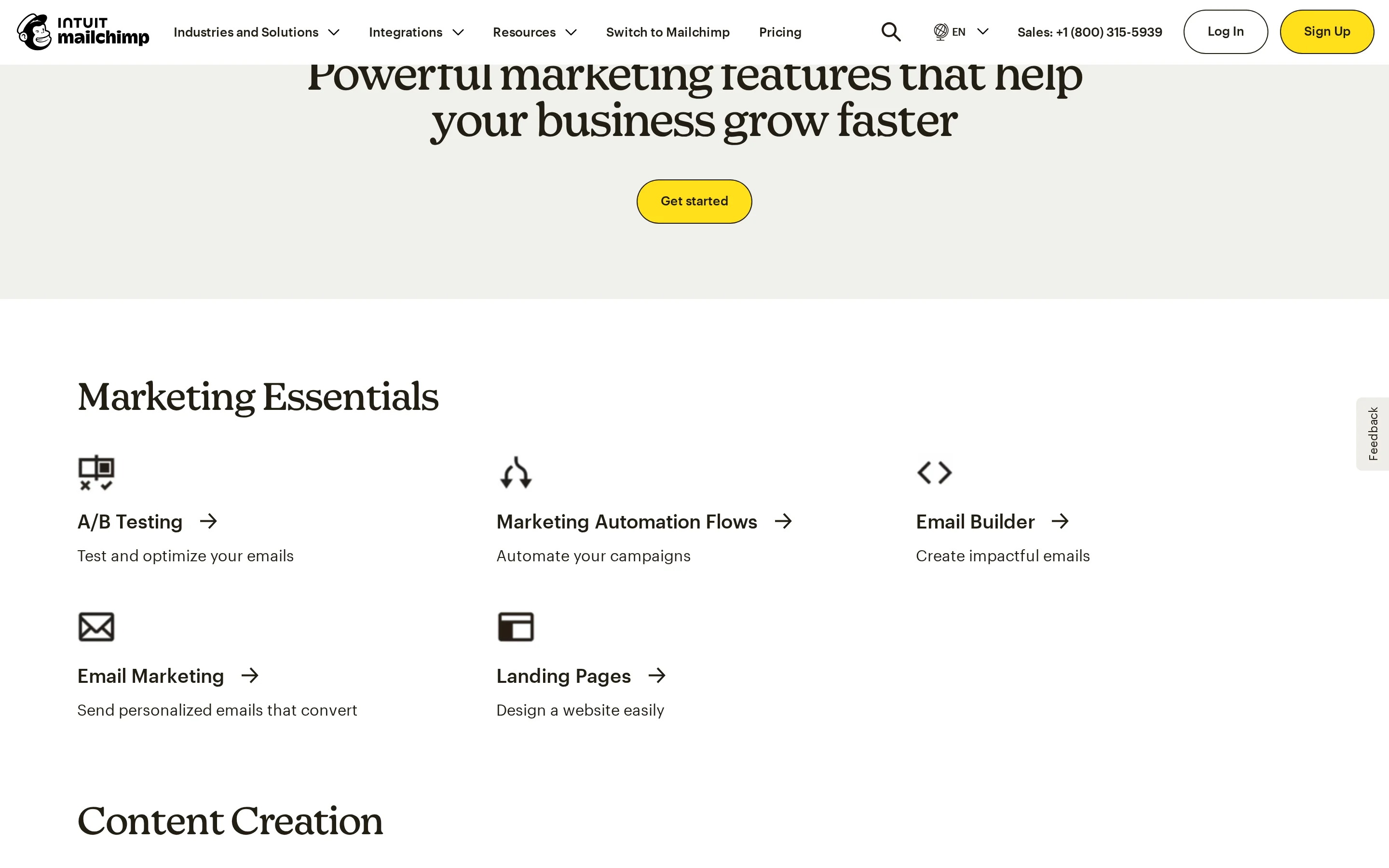 Full resolution
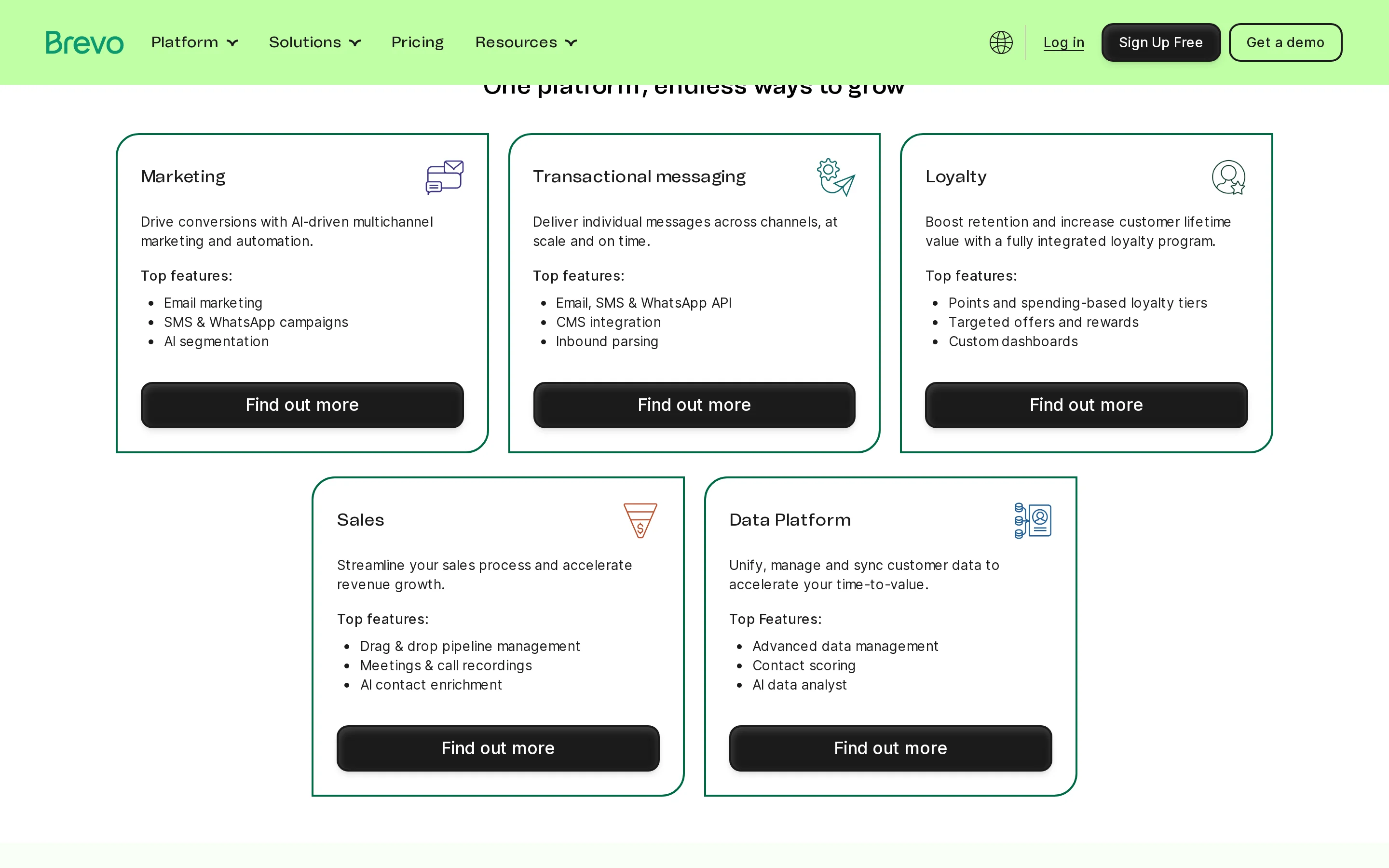 Full resolution
Sales Pipeline & CRM Depth: Dedicated Sales Suite vs. Marketing-Centric Automation
Architecture & Data Layer: Brevo distinguishes itself by offering a native 'Sales' module that functions as a lightweight CRM. This includes drag-and-drop pipeline management, deal tracking, and meeting/call recording capabilities directly within the platform. In contrast, MailChimp is fundamentally a marketing automation tool. While it offers audience segmentation and behavioral triggers, it lacks a dedicated object model for 'Deals' or 'Pipelines.' Users requiring complex B2B sales cycle tracking must integrate MailChimp with external CRMs like HubSpot or Salesforce, adding friction and data sync latency.
Execution & Workflow: For outbound sales teams, Brevo allows reps to move leads through stages (e.g., 'Contacted', 'Demo Scheduled', 'Closed Won') without leaving the interface. The AI Sales Assistant further automates deal creation and contact enrichment. MailChimp’s workflow is optimized for nurturing large audiences via email sequences rather than managing individual sales opportunities. Its strength lies in broad-reach campaigns, not one-to-one sales relationship management.
Tradeoffs & Ruling: If your primary goal is closing individual B2B deals with tracked revenue attribution per rep, Brevo is the clear winner due to its integrated CRM. MailChimp remains superior if your 'sales' process is entirely automated via e-commerce funnels where human intervention is minimal.
Multi-Channel Outreach Execution: Unified SMS/WhatsApp API vs. Email-First Ecosystem
Core Execution: Brevo provides a unified infrastructure for Email, SMS, and WhatsApp messaging. This means transactional alerts, marketing blasts, and conversational threads can be managed under a single API key and dashboard. MailChimp is primarily an email-centric platform. While it supports social media scheduling and ad integrations, it does not natively host SMS or WhatsApp sending infrastructure. To achieve multi-channel outreach with MailChimp, users must rely on third-party integrations or separate subscriptions, leading to fragmented data silos.
Daily Operational Realities: A sales team using Brevo can trigger an email sequence, followed by an SMS reminder, and then a WhatsApp message—all based on real-time engagement data within the same automation flow. With MailChimp, coordinating these channels requires manual synchronization or complex Zapier workflows, increasing the risk of inconsistent messaging timing and disjointed customer experiences.
Tradeoffs & Ruling: Brevo wins decisively for teams executing true omnichannel outbound strategies. MailChimp is sufficient for businesses where email is the sole or dominant communication channel, particularly in e-commerce contexts where visual email templates drive conversions.
AI Implementation Strategy: Action-Oriented Agents vs. Generative Content Tools
Ecosystem & Data Hygiene: MailChimp’s AI strategy focuses on 'Generative' assistance—helping users write subject lines, draft body copy, and predict optimal send times. It acts as a co-pilot for content creation. Brevo has evolved into an 'Agentic' AI model. Its Aura AI agents don't just suggest text; they execute tasks such as segmenting audiences based on behavior, enriching contact data automatically, and acting as a data analyst that answers natural language queries about campaign performance.
Automation & Extensibility: Brevo’s MCP (Model Context Protocol) server allows external AI tools (like ChatGPT or Claude) to interact directly with Brevo’s database to create campaigns or update contacts. This creates a programmable AI layer. MailChimp integrates with Intuit Intelligence for financial insights but lacks this deep, executable API-level AI agent architecture for general sales operations.
Tradeoffs & Ruling: For teams wanting AI to automate operational heavy lifting (data cleaning, segmentation logic, reporting), Brevo’s action-oriented agents provide higher leverage. MailChimp’s AI is better suited for creative professionals who need help generating high-quality copy quickly.
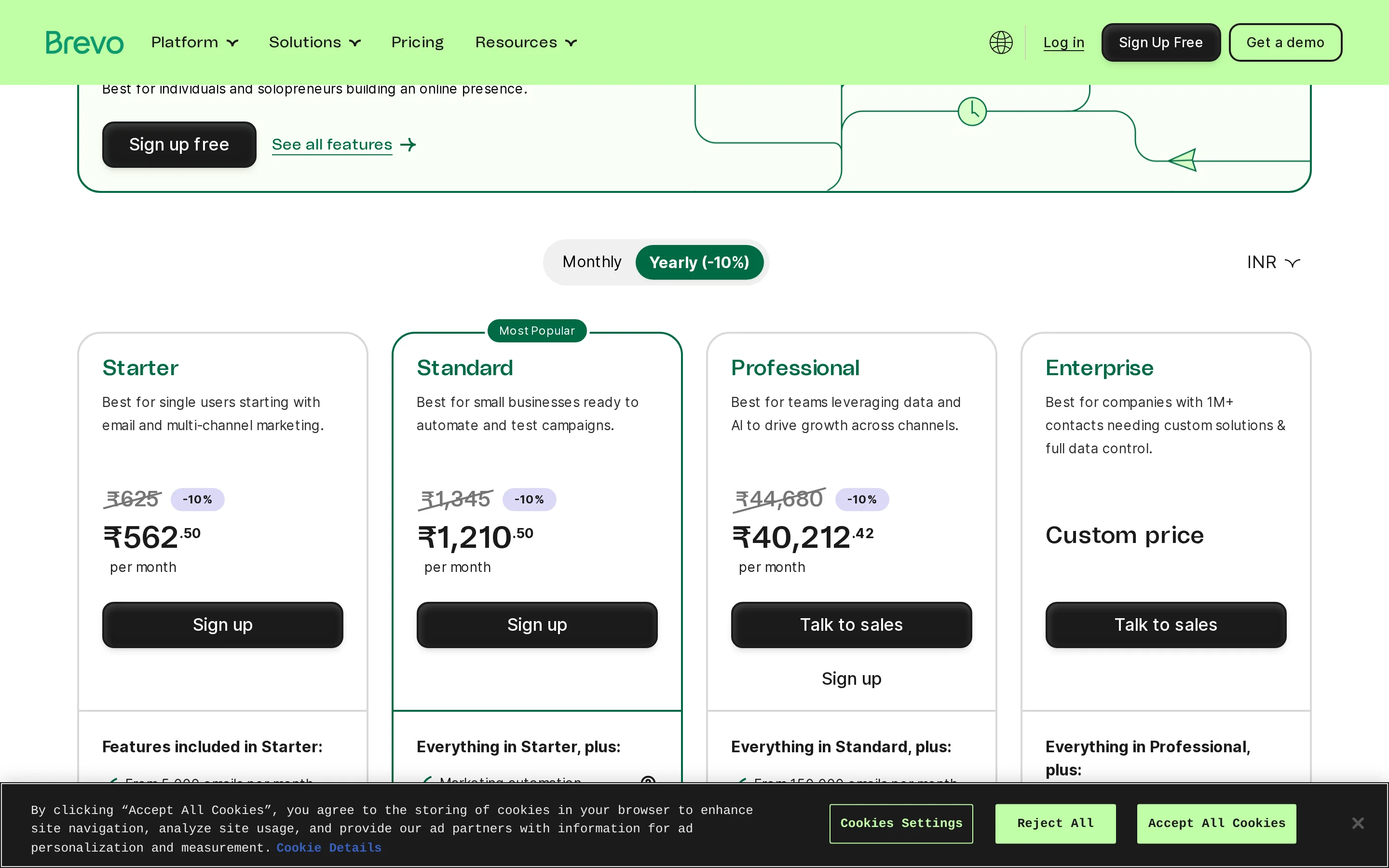
Pricing & true cost
Published tier structures, credit scaling mechanics, and total outbound cost.
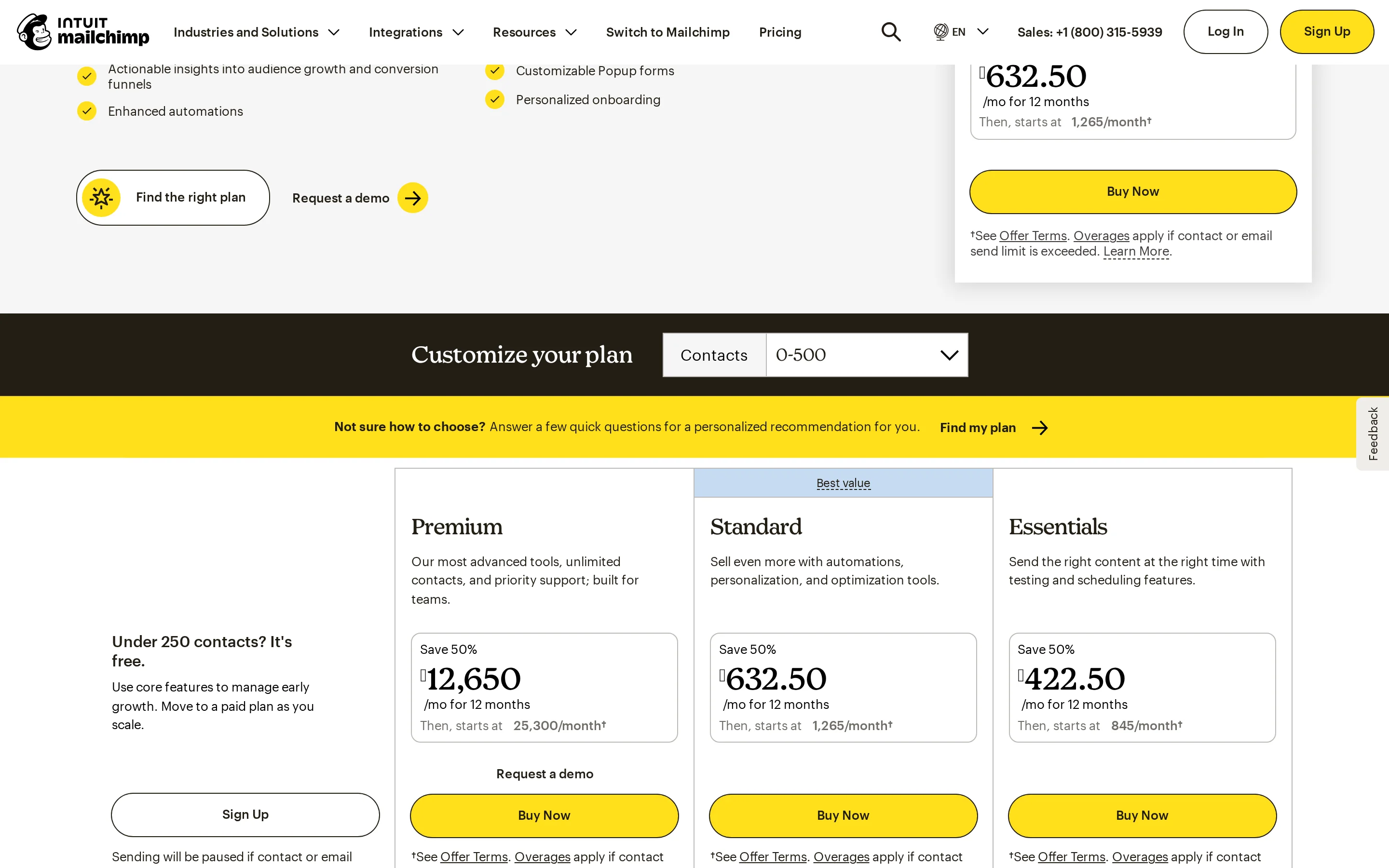 Full resolution
 Full resolution
MailChimp plans
- Free: $0/mo (Up to 500 contacts, 1,000 emails/mo)
- Essentials: Starts at $13/mo (Up to 500 contacts, 5,000 emails/mo)
- Standard: Starts at $99/mo (Up to 500 contacts, 6,000 emails/mo)
- Premium: Custom Pricing (Contact Sales)
Brevo plans
- Free: $0/mo (Unlimited contacts, 300 emails/day)
- Starter: From $25/mo (Includes 5,000 emails)
- Standard: From $45/mo (Includes 5,000 emails)
- Professional: From $175/mo (Includes 150,000 emails)
- Enterprise: Custom Pricing (Contact Sales)
MailChimp employs a traditional SaaS tiered model where price increases significantly with contact volume and feature access. The jump from Essentials to Standard is substantial ($13 to $99 base), often forcing small teams to overpay for features they don't fully utilize immediately. Brevo uses a hybrid model: lower entry prices for basic automation ($25-$45) but relies heavily on usage-based pricing for email volume. For high-volume senders, Brevo’s Professional plan ($175/mo) offers a much higher email cap (150k) compared to MailChimp’s Standard tier, providing better economies of scale for outbound-heavy teams.
of Ownership Analysis
For a 5-person sales team sending 10,000 emails/month to 2,000 contacts:
MailChimp: Requires the Standard plan. Base cost is ~$99/mo. However, exceeding the included email limit (typically tied to contact count) may incur overages. Total estimated: $100 - $120/mo. Note: No native CRM seats are included; you would need to add a separate CRM subscription (e.g., HubSpot Starter ~$15/user/mo = $75). Total Stack Cost: ~$185/mo.
Brevo: Requires the Standard plan. Base cost is ~$45/mo. Includes 5,000 emails. Sending 10,000 emails requires purchasing additional credits (~$10-$15). The native CRM is included. Total estimated: $60 - $70/mo.
Verdict: Brevo is approximately 60% cheaper for this specific use case because it bundles the CRM functionality that MailChimp lacks, eliminating the need for a second software subscription.
Which fits your outbound model?
Match your team size, deal complexity, and lead volume to the right engine.
High-Volume Cold Outbound
Brevo is built for this. Its flexible credit system, native CRM for tracking replies, and multi-channel fallback (SMS/WhatsApp) allow for sophisticated cadences. MailChimp’s strict contact limits and lack of deal tracking make cold outbound cumbersome.
E-commerce Drip Campaigns
MailChimp excels here due to deep Shopify/WooCommerce integrations, predictive analytics for purchase behavior, and highly polished template designs. Brevo is capable but lacks the specialized e-commerce depth of MailChimp.
Developer API Data Pipelines
Brevo offers a more robust developer ecosystem with open APIs for transactional email, SMS, and WhatsApp, plus SDKs and code recipes. MailChimp’s API is powerful but primarily focused on marketing lists and campaigns, less so on raw transactional data flows.
Small Business All-in-One
Brevo provides a better value proposition for solopreneurs needing email, simple CRM, and landing pages in one low-cost package. MailChimp’s free plan is great for starting, but scaling requires significant budget jumps.
Where each platform falls short
Constructive limitations and architectural trade-offs to weigh before signing.
Where MailChimp falls short
- No Native Sales CRM: Cannot track deals, pipelines, or individual sales rep performance natively.
- Strict Contact Limits: Pricing scales aggressively with contact count, penalizing list growth even if engagement is low.
- Limited Multi-Channel: Lacks native SMS and WhatsApp infrastructure, requiring third-party tools for omnichannel outreach.
- Complex Migration: Moving large datasets out of MailChimp can be difficult due to proprietary segmentation structures.
Where Brevo falls short
- Interface Clutter: Combining Marketing, Sales, and Transactional tools can create a steeper learning curve for new users.
- Template Design: Email templates are functional but generally considered less visually polished than MailChimp’s library.
- Support Tiers: Phone support is reserved for Professional/Enterprise plans; lower tiers rely on email/chat.
- Overage Costs: While base prices are low, exceeding email credits can lead to unexpected bills if not monitored closely.
The switching playbook
What you gain and give up when migrating across platforms.
- Superior E-commerce Integrations
- More Polished Drag-and-Drop Editor
- Stronger Brand Recognition & Trust
- Better Predictive Analytics for Retail
- Loss of Native CRM/Pipeline Tracking
- Higher Cost for Large Contact Lists
- Need for Separate SMS/WhatsApp Tools
- Integrated Sales CRM & Deal Tracking
- Native SMS and WhatsApp Support
- Lower Entry Cost for Scaling Contacts
- Action-Oriented AI Agents
- Less Specialized E-commerce Features
- Slightly Steeper Learning Curve for UI
- Fewer Pre-built Visual Templates
Frequently asked questions
Direct technical answers about MailChimp and Brevo.
Which platform has better data accuracy?
Both platforms rely on user-provided data. However, Brevo offers native contact enrichment features and AI-driven data hygiene checks that can identify invalid emails or duplicate records more proactively than MailChimp’s standard validation.
How do their starting costs compare?
MailChimp’s paid plans start around $13/mo (Essentials) but quickly jump to $99/mo (Standard) for advanced features. Brevo starts at $25/mo (Starter) and $45/mo (Standard), offering a more gradual price increase for growing teams.
Can I connect unlimited mailboxes?
Neither platform is designed as a shared inbox tool like Front or Help Scout. They are marketing/sales automation platforms. You send from a verified domain, but you do not 'connect' multiple personal IMAP mailboxes for collaborative reading.
Which tool is easier to learn?
MailChimp is generally easier for beginners focused solely on email design. Brevo has a steeper learning curve due to its broader feature set (CRM, SMS, API), but offers more long-term flexibility for power users.
Does Brevo replace a CRM like HubSpot?
For small to mid-sized teams, yes. Brevo’s native CRM covers pipelines, deals, and activities. For large enterprises with complex sales hierarchies, a dedicated CRM like HubSpot or Salesforce is still recommended alongside Brevo.
Sources & methodology
Every claim is grounded in official vendor documentation and live audits.
Compare with sendroAI
See how sendroAI replaces manual research, credit limits, and deliverability traps with full autonomous execution.