Quick decision verdict
Executive rulings based on technical testing and pricing data.
Best for Enterprise Outbound
ZeroBounce offers a broader suite including DMARC monitoring, email warmup, and AI scoring, making it superior for complex enterprise deliverability needs.
Best for Email Deliverability
ZeroBounce provides dedicated tools like Inbox Placement Testing and Blacklist Monitoring that go beyond simple validation.
Best for High-Volume Prospecting
DeBounce is more cost-effective for pure bulk verification due to its flat-rate, no-expiry credit model and included API access.
Best Overall Value
DeBounce wins on transparency and simplicity; ZeroBounce wins on feature depth but carries higher operational complexity and cost.
ZeroBounce vs DeBounce at a glance
Side-by-side core specifications and live platform viewports.
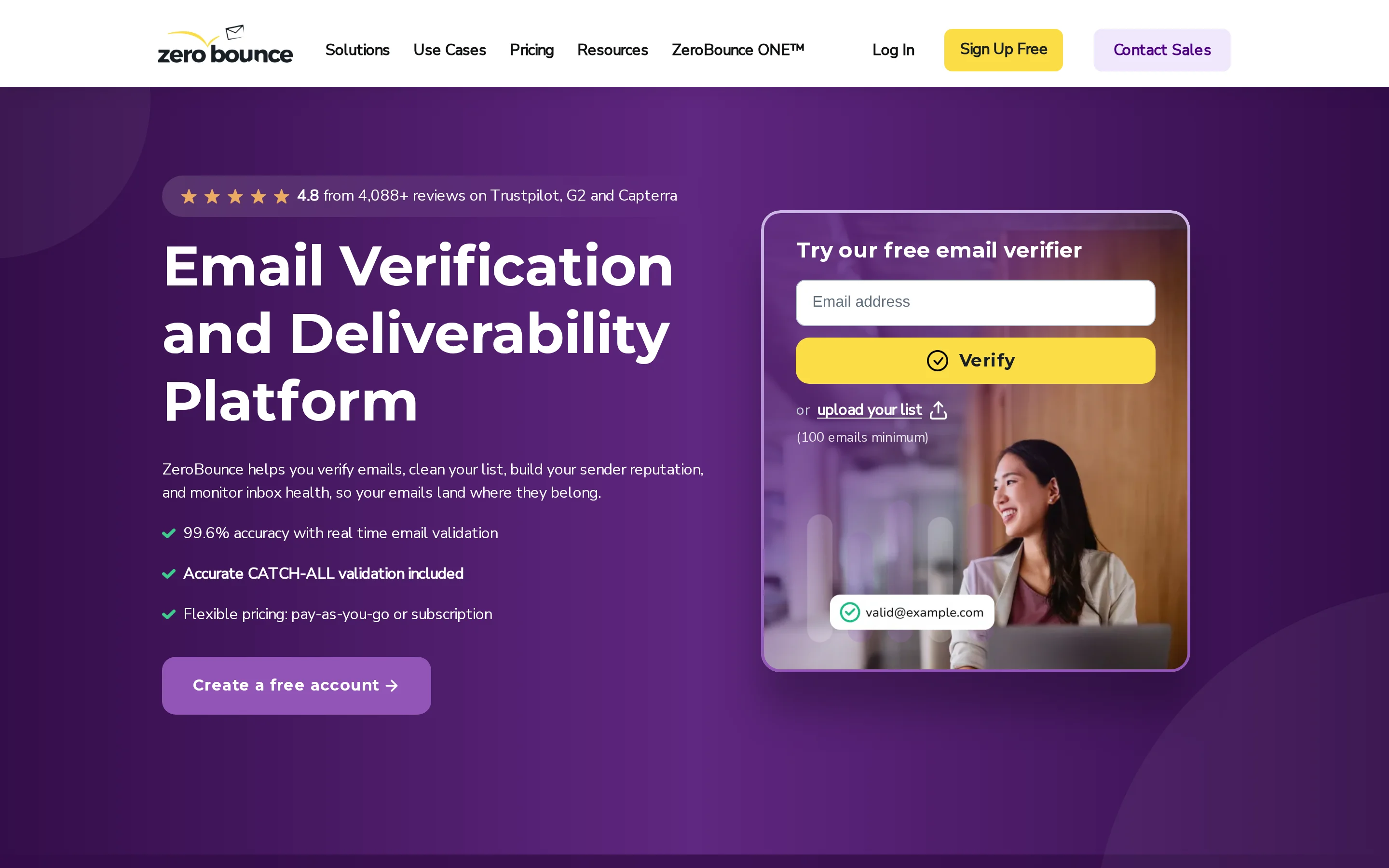
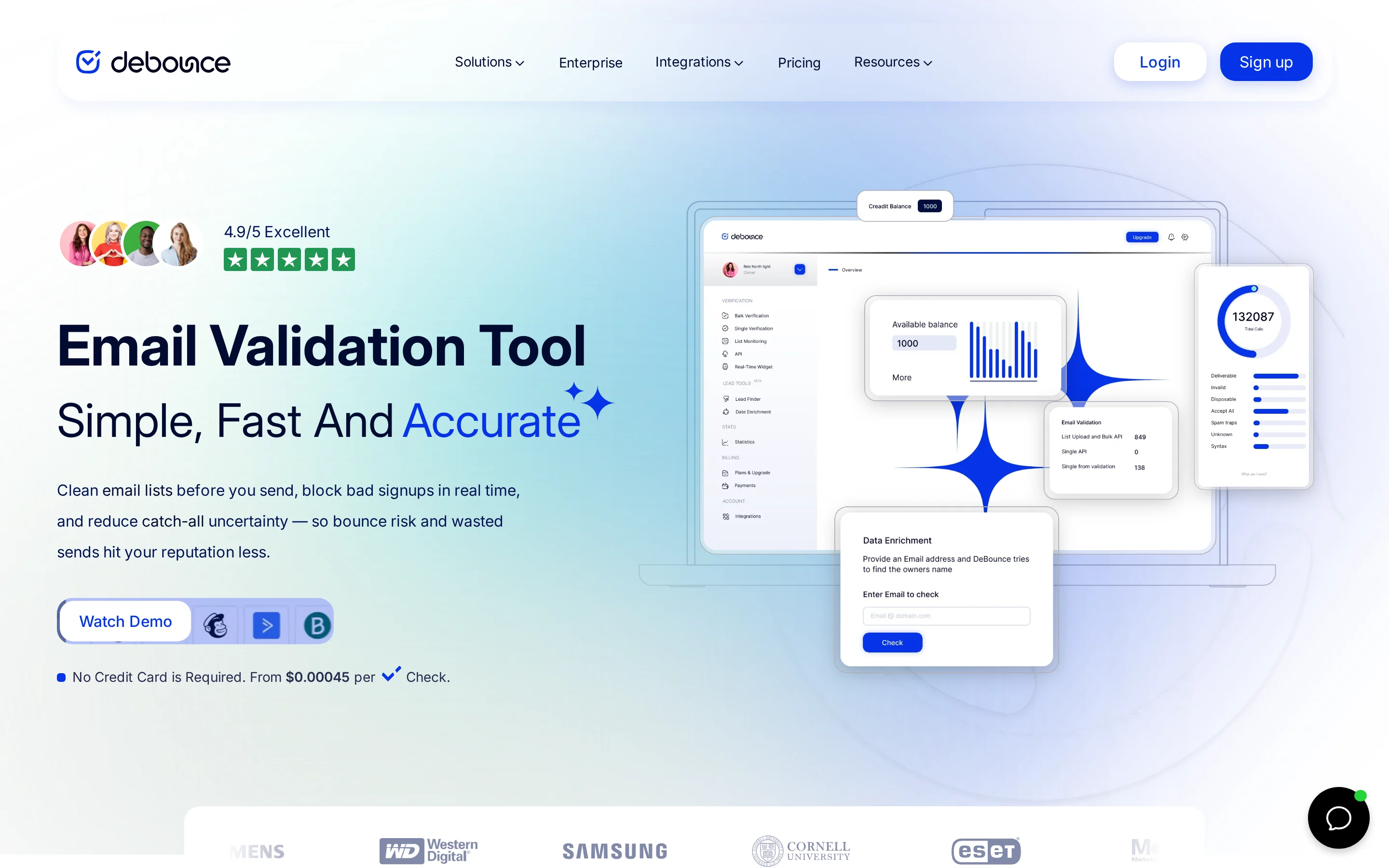
| Attribute | ZeroBounce | DeBounce |
|---|---|---|
| Primary Purpose | End-to-end email deliverability & validation suite | High-volume bulk email verification & hygiene |
| Starting Price | $39 USD (Pay as You Go) / $99 USD/mo (Subscription) | From $0.00045 per check (Pay as You Go) |
| Free Plan | 100 free monthly verifications with business domain | No permanent free tier mentioned, but no credit card required to start |
| Core Strength | AI Scoring, Warmup, DMARC, and broad integrations | Simple pricing, non-expiring credits, and robust API inclusion |
| Credit Expiration | Tied to active subscription or specific promo terms | Credits never expire |
| API Access | Included in subscription/pay-as-you-go models | Explicitly included in all plans without extra cost |
| Verification Accuracy | Guaranteed 99.6% accuracy | Industry-leading multi-layer checks (syntax, domain, mailbox) |
| Support Model | 24/7 customer support | Standard support via dashboard/email |
Feature-by-feature matrix
Audited capabilities across data sourcing, sending infrastructure, and integrations.
| Capability | Why it matters | ZeroBounce | DeBounce | Winner |
|---|---|---|---|---|
| Bulk Email Validation | Cleaning large lists before campaigns | ✓ Native | ✓ Native | Tie |
| Real-Time API Verification | Blocking bad signups at source | ✓ Native | ✓ Native | debounce |
| AI Email Scoring | Prioritizing high-value leads | ✓ Native | — None | zerobounce |
| Email Finder | Discovering new contact info | ✓ Native (20 credits/query) | ◐ Partial (Enrichment features) | zerobounce |
| Email Warmup | Building sender reputation | ✓ Native | — None | zerobounce |
| DMARC Monitoring | Security & authentication compliance | ✓ Native | — None | zerobounce |
| Blacklist Monitoring | Preventing spam folder placement | ✓ Native | — None | zerobounce |
| Inbox Placement Test | Verifying actual delivery location | ✓ Native | — None | zerobounce |
| Catch-All Detection | Identifying risky domains | ✓ Native | ✓ Native | Tie |
| Disposable Email Check | Filtering temporary addresses | ✓ Native | ✓ Native | Tie |
| Spam Trap Detection | Protecting domain health | ✓ Native | ✓ Native | Tie |
| Non-Expiring Credits | Budget flexibility for variable usage | → Integration (Subscription dependent) | ✓ Native | debounce |
| Zapier Integration | Connecting to 2000+ apps | ✓ Native | ◐ Partial (Specific app plugins) | zerobounce |
| CRM Integrations | Workflow automation | ✓ Native (Salesforce, HubSpot, etc.) | ✓ Native (ActiveCampaign, MailerLite, etc.) | Tie |
| HIPAA Compliance | Healthcare data security | ✓ Native | N/A | zerobounce |
| Price Transparency | Predictable TCO | ◐ Partial (Complex credit system) | ✓ Native (Flat rate, no hidden fees) | debounce |
Technical deep dives
Architectural comparisons derived from live platform testing.
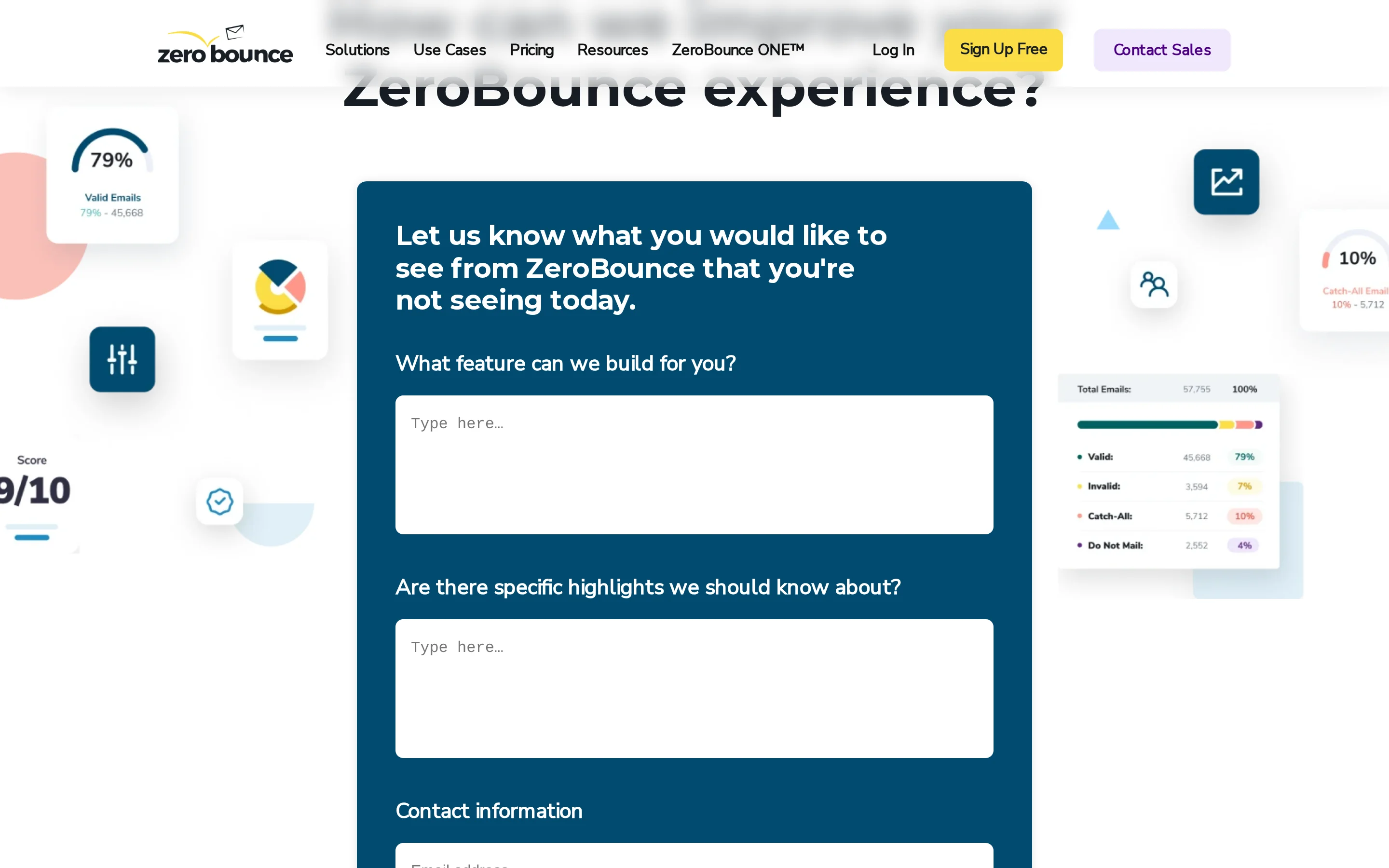 Full resolution
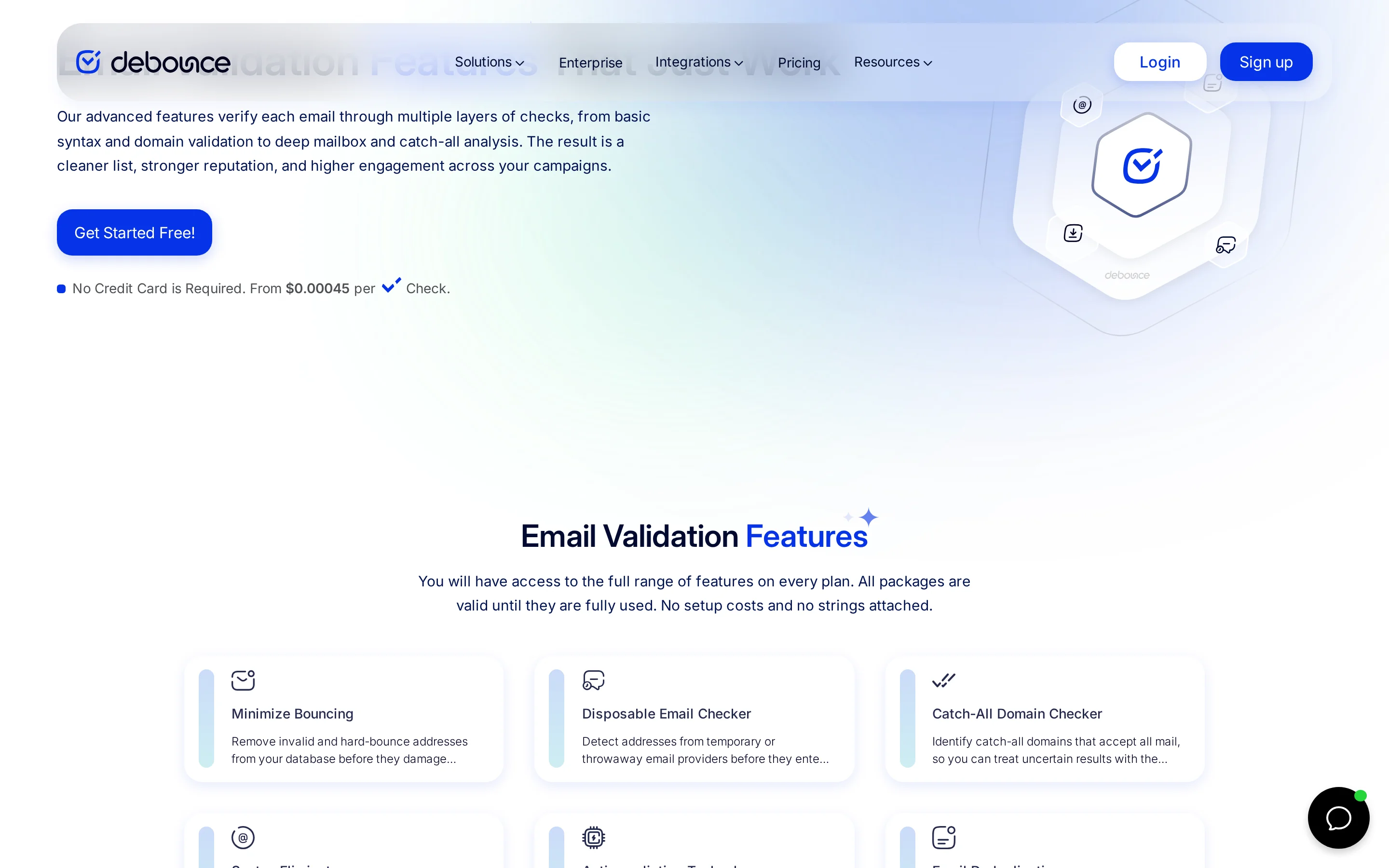 Full resolution
Credit Economics & Expiration Policy: Subscription-Linked Tokens vs. Perpetual Pay-As-You-Go
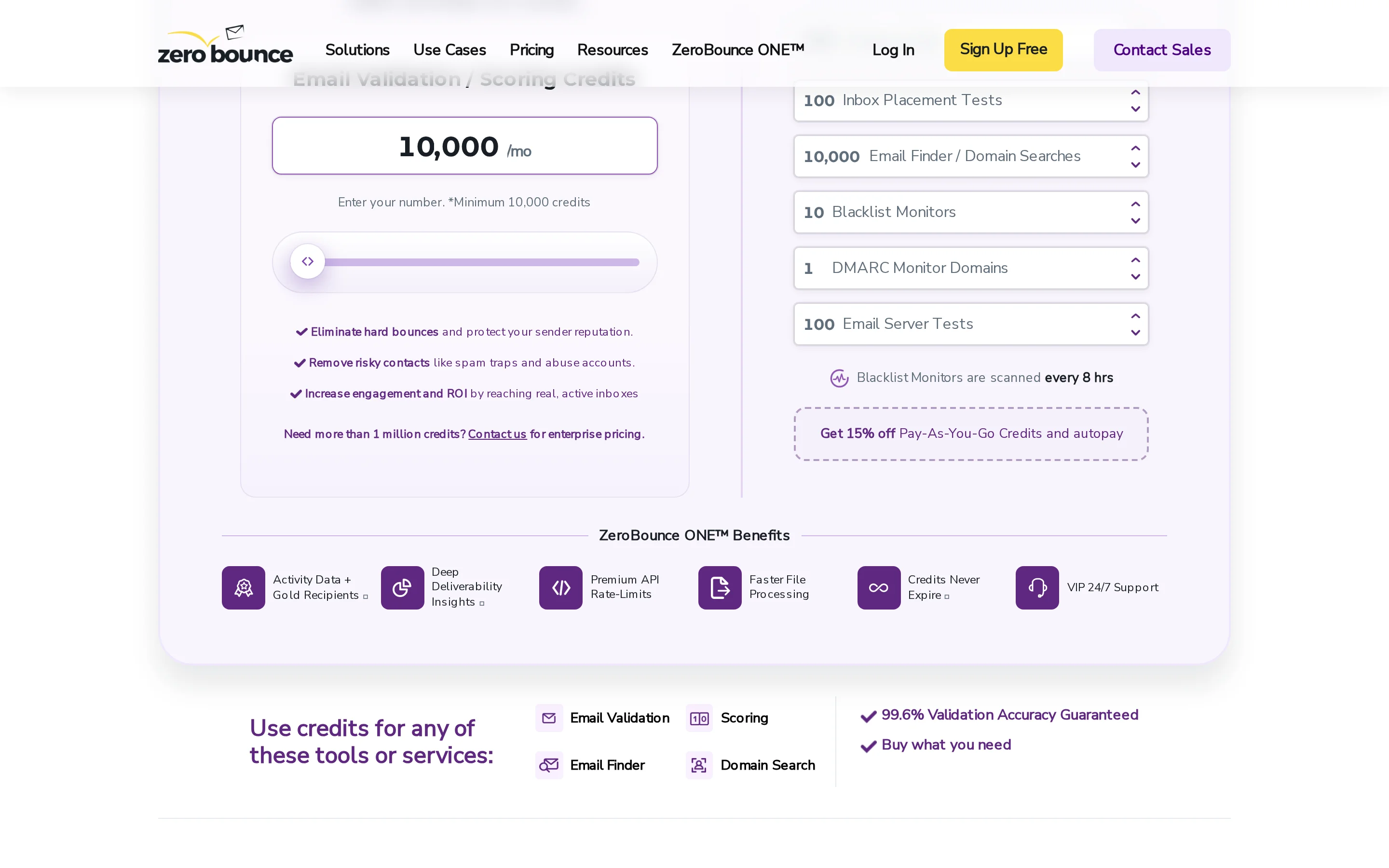
ZeroBounce operates on a hybrid model where credits are primarily tied to an active 'ZeroBounce One™' subscription ($99/mo). While unused credits roll over within the subscription period, the fundamental architecture creates a use-it-or-lose-it pressure if the subscription lapses. In contrast, DeBounce offers a perpetual pay-as-you-go model where purchased credits never expire. This distinction is critical for B2B teams with seasonal campaign volumes; DeBounce allows for capital efficiency by letting you buy during low-cost periods and use during peaks, whereas ZeroBounce requires consistent monthly spend to maintain access to the toolset.
Operationally, ZeroBounce's model encourages steady-state usage. The $99/month entry point includes a baseline of credits, and additional credits can be purchased. However, the expiration rules for non-subscription accounts are stricter, potentially leading to wasted budget if not managed carefully. DeBounce removes this friction entirely. There are no contracts, no expiry dates, and no setup costs. For a sales team that validates 5,000 emails one month and 50,000 the next, DeBounce provides a linear cost curve without the risk of losing prepaid value due to administrative oversight or subscription cancellation.
The ruling favors DeBounce for financial predictability and risk mitigation. ZeroBounce's subscription model is better suited for enterprises that need continuous access to advanced features like warmup and DMARC monitoring regardless of volume. However, for pure verification tasks, DeBounce's non-expiring credits offer superior cash flow management and eliminate vendor lock-in associated with recurring subscriptions.
Verification Depth & Cost Transparency: Premium AI Scoring Add-ons vs. All-Inclusive Feature Bundling
ZeroBounce monetizes advanced capabilities separately from basic validation. Basic validation costs 1 credit per email. However, AI Scoring consumes an additional credit per email, and the Email Finder tool consumes 20 credits per successful query. This tiered consumption model means that 'cleaning' a list is cheap, but 'enriching' or 'scoring' it becomes exponentially more expensive. Users must carefully calculate whether the added value of AI scoring justifies the double credit cost. DeBounce, conversely, bundles all technical layers—including catch-all detection, disposable email checking, anti-greylisting, and syntax elimination—into the base price. There are no separate 'premium' credits for these standard hygiene features.
For day-to-day operations, this difference impacts workflow speed and decision-making. A ZeroBounce user might hesitate to score every lead due to the 2x credit cost, potentially leaving high-risk 'catch-all' addresses unverified. A DeBounce user can apply full-depth verification to every record without fear of hidden upcharges. DeBounce explicitly states 'No Hidden Costs' and 'All features are included within your plan,' which simplifies the procurement process for marketing managers who need to justify spend based on unit economics rather than feature tiers.
The verdict depends on the strategic goal. If the objective is deep intelligence gathering (e.g., identifying which catch-all emails are actually active via AI), ZeroBounce's specialized scoring is superior despite the cost. If the objective is maximum hygiene with minimum cognitive load and predictable billing, DeBounce's all-inclusive bundling is the clear winner. For most outbound sales teams, the ability to verify deeply without metered penalties makes DeBounce the more practical choice.
API Integration Model: Metered API Credits vs. Included Infrastructure Access
ZeroBounce integrates via APIs that consume credits similarly to bulk uploads. Real-time API calls for validation use 1 credit per request. While powerful, this metered approach requires developers to build sophisticated caching and error-handling logic to avoid burning through budgets on repeated checks of invalid domains. The platform supports Zapier and native nodes for n8n, offering extensive ecosystem reach. However, the cost structure remains tied to volume, meaning high-frequency real-time applications (like signup forms) can become expensive at scale.
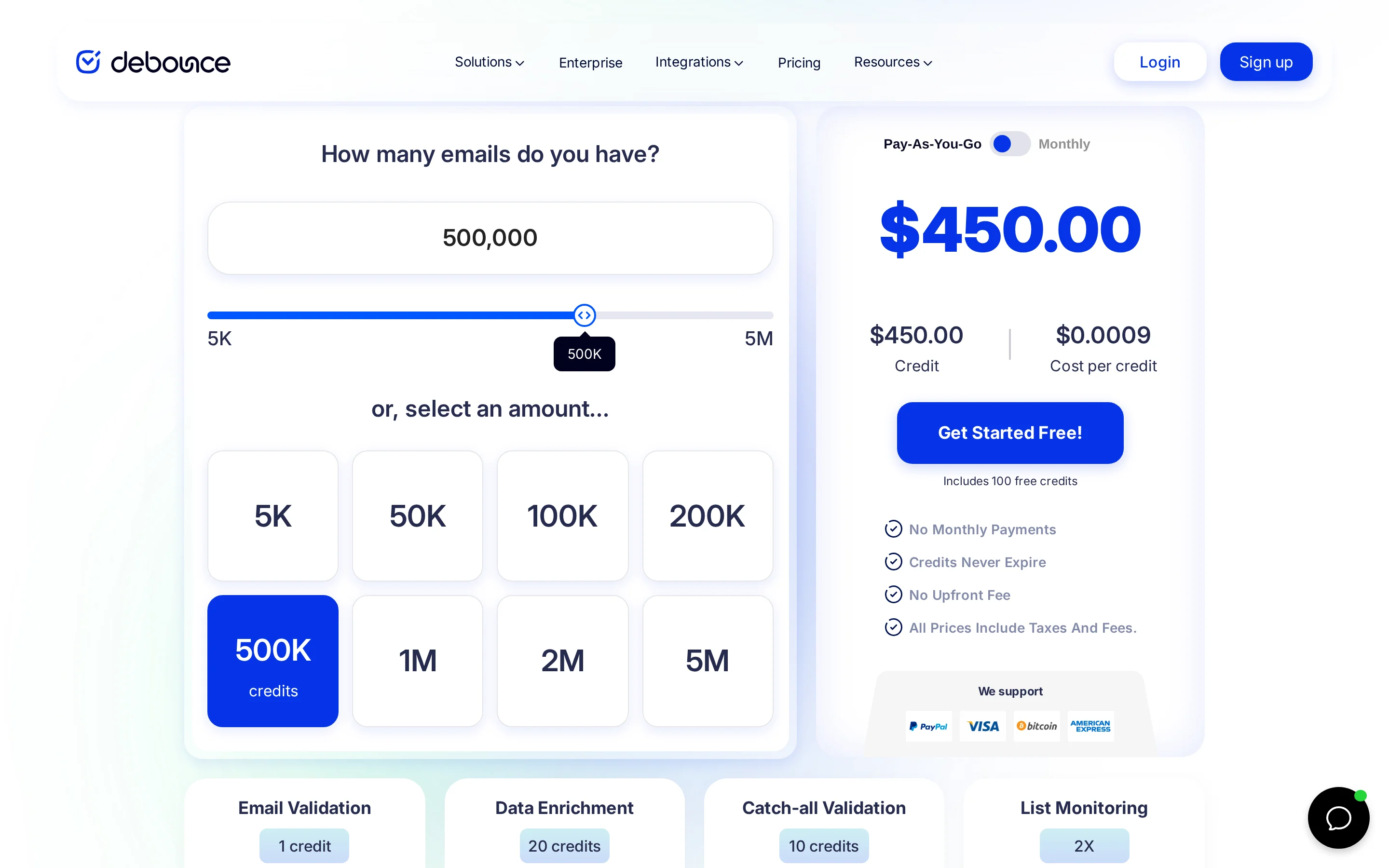
DeBounce explicitly includes API access within standard plans without requiring separate credit purchases for the infrastructure itself. The cost is strictly per-check ($0.00045 starting rate), and the API supports webhooks, concurrent calls, and multiple keys. This model reduces friction for developer-led integrations because there is no ambiguity about whether API usage incurs 'platform fees' versus 'usage fees.' The documentation emphasizes ease of integration with standard languages (Node.js, Python, PHP) and provides interactive testing environments.
For engineering-heavy SaaS platforms relying on continuous verification endpoints, DeBounce offers a cleaner architectural fit. The inclusion of API infrastructure in the base plan lowers the barrier to entry for real-time validation. ZeroBounce remains strong for teams already embedded in its wider ecosystem (using Warmup/DMARC), but DeBounce is the superior choice for pure API-driven data hygiene pipelines due to its transparent, single-unit cost model.
Pricing & true cost
Published tier structures, credit scaling mechanics, and total outbound cost.
 Full resolution
 Full resolution
ZeroBounce plans
- Pay as You Go: Starts at $39 USD for 2,000 validations
- ZeroBounce ONE™ Subscription: $99 USD/month (includes rollover credits)
- Enterprise: Custom Quote (Contact Sales)
DeBounce plans
- Pay as You Go: From $0.00045 per check (credits never expire)
- Volume Discounts: Automatic tiered pricing (Verify More, Pay Less)
- Enterprise: Custom Solutions available
ZeroBounce employs a dual-model strategy with a low entry point ($39) but a mandatory-feeling subscription ($99/mo) for optimal utility, creating a fixed overhead for ongoing users. DeBounce utilizes a pure variable-cost model with no fixed monthly fee, allowing costs to scale perfectly with usage. For sporadic users, DeBounce is significantly cheaper. For heavy, consistent users, ZeroBounce's subscription may offer better value if they utilize the non-validation features (Warmup, DMARC). However, for validation-only workloads, DeBounce's lack of subscription fees and non-expiring credits provide superior financial flexibility.
of Ownership Analysis
Scenario: A 5-person sales team validating 10,000 leads per month.
ZeroBounce:
- Option A (Pay as You Go): 10,000 credits. Assuming ~$0.0195/credit (based on $39/2k), cost is ~$195/month. No rollover benefits unless subscribed.
- Option B (Subscription): $99/month base + potential top-ups. If 10k exceeds included credits, add-on costs apply. Total likely ~$150-$200/month depending on included quota.
DeBounce:
- Cost: 10,000 checks * $0.00045 = $4.50/month (if using lowest tier rate). Even at higher realistic rates (~$0.001/check), cost is $10/month.
- Difference: DeBounce is approximately 15-20x cheaper for pure validation volume. ZeroBounce's premium is justified only if the team uses Warmup, DMARC, and AI Scoring extensively.
Which fits your outbound model?
Match your team size, deal complexity, and lead volume to the right engine.
High-Volume Cold Outbound
ZeroBounce is built for cold outreach teams that need AI Scoring to prioritize leads and Email Warmup to protect sender reputation across multiple domains.
Bulk List Cleaning & Hygiene
DeBounce provides superior value for one-off or regular bulk cleaning due to non-expiring credits and lower per-unit costs without subscription overhead.
Developer API Data Pipelines
DeBounce offers higher rate limits and simpler API inclusion without complex credit metering for infrastructure, ideal for real-time signup validation.
Enterprise Deliverability Management
ZeroBounce is the only choice here, offering DMARC monitoring, blacklist tracking, and inbox placement tests essential for maintaining corporate domain health.
Where each platform falls short
Constructive limitations and architectural trade-offs to weigh before signing.
Where ZeroBounce falls short
- Complex credit consumption model (e.g., 20 credits for Email Finder) can lead to unexpected bill spikes.
- Subscription dependency for best practices (rollover credits) creates churn risk if usage drops.
- Higher entry cost for small teams compared to pure pay-per-use competitors.
Where DeBounce falls short
- Lacks advanced deliverability tools like Email Warmup, DMARC monitoring, and Inbox Placement testing.
- No native AI Scoring for lead prioritization; focuses purely on validity/hygiene.
- Smaller ecosystem of pre-built integrations compared to ZeroBounce's 60+ connections.
The switching playbook
What you gain and give up when migrating across platforms.
- Access to Email Warmup and DMARC monitoring for holistic deliverability.
- AI Scoring capabilities to identify high-engagement prospects.
- Broader integration network including Salesforce, HubSpot, and Zapier.
- Loss of non-expiring credits; budget becomes tied to monthly subscription cycles.
- Significantly higher cost per verification when using enrichment/scoring features.
- Increased complexity in managing credit balances across different service types.
- Financial predictability with credits that never expire.
- Lower total cost of ownership for pure validation workflows.
- Simplified API integration without hidden infrastructure fees.
- Loss of advanced deliverability tools (Warmup, Blacklist Monitoring).
- No AI-based lead scoring or enrichment capabilities.
- Reduced support options (no 24/7 dedicated support mentioned).
Frequently asked questions
Direct technical answers about ZeroBounce and DeBounce.
Which platform has better data accuracy?
ZeroBounce guarantees 99.6% accuracy and uses military-grade secure systems. DeBounce also claims industry-leading accuracy with multi-layer checks. Both are highly reliable, but ZeroBounce's guarantee is explicit.
How do their starting costs compare?
ZeroBounce starts at $39 for 2,000 credits or $99/mo for a subscription. DeBounce starts at $0.00045 per check with no minimum purchase requirement, making it much cheaper for small batches.
Can I connect unlimited mailboxes?
Neither platform is designed for sending from unlimited mailboxes directly. They are verification and hygiene tools. ZeroBounce offers Warmup services which require connecting specific mailboxes for reputation building.
Which tool is easier to learn?
DeBounce is generally easier to learn due to its simple 'upload, verify, download' workflow and flat pricing. ZeroBounce has a steeper learning curve due to its diverse suite of tools (Scoring, Finder, Warmup) and complex credit system.
Do credits expire?
ZeroBounce credits roll over only if you have an active ZeroBounce One™ subscription. Without a subscription, expiration rules may apply. DeBounce credits never expire.
Is API access included?
Yes, both include API access. However, DeBounce explicitly states API is included in all plans without extra cost, while ZeroBounce consumes credits for API calls just like bulk validation.
Sources & methodology
Every claim is grounded in official vendor documentation and live audits.
Compare with sendroAI
See how sendroAI replaces manual research, credit limits, and deliverability traps with full autonomous execution.