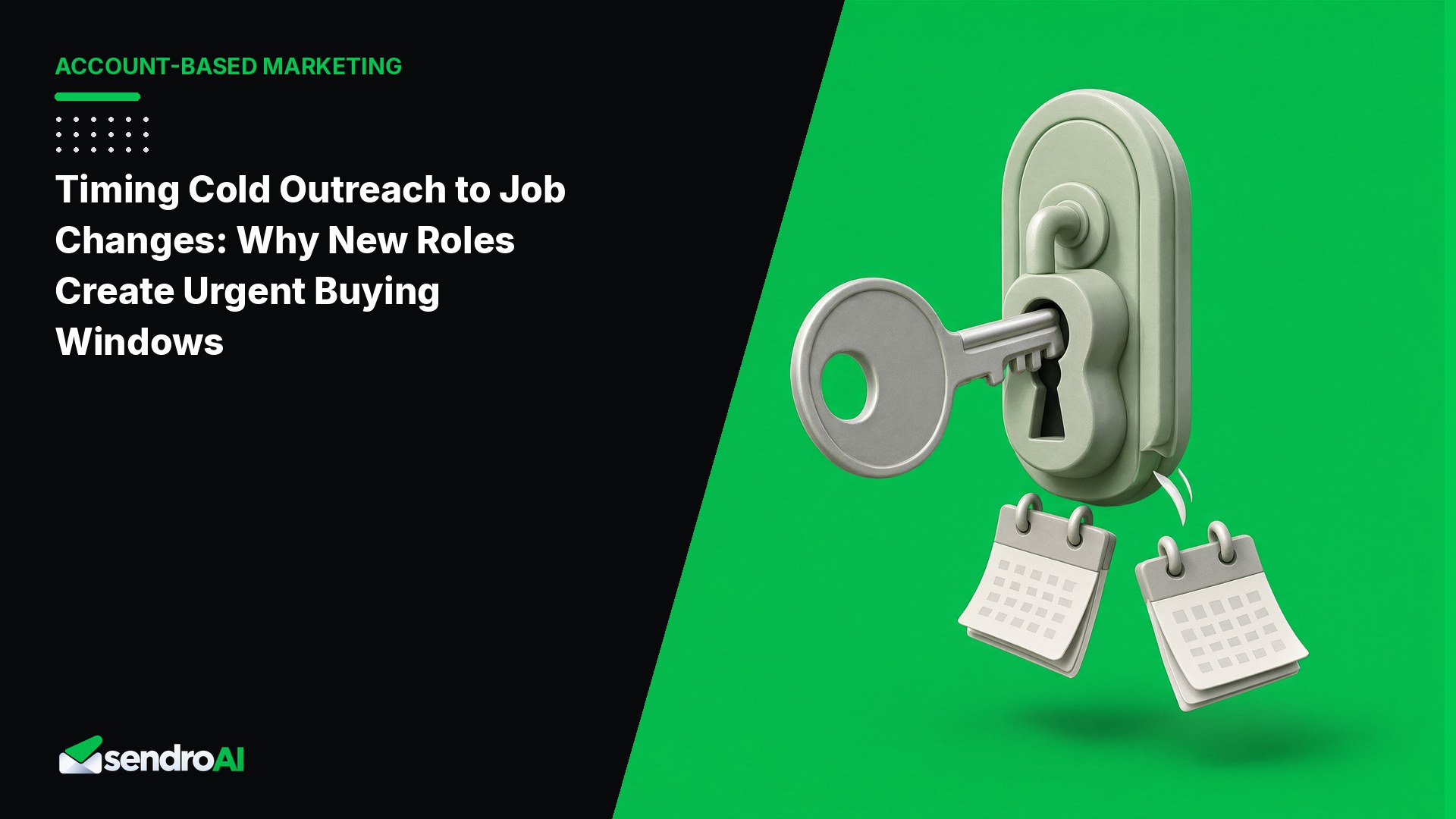
Learn how to leverage job change alerts for B2B cold email. Discover why new hires are more receptive and how to personalize outreach without being spammy.
Why the First 90 Days of a New Role Are the Highest-Intent Window for Cold Email
You know the feeling: you send a cold email to a promising prospect, and it vanishes into the void. The timing was wrong, or perhaps the message didn't align with their immediate priorities. Most B2B outreach fails because it ignores the human element of decision-making.
Job changes create urgent buying windows that most sellers miss. When a new leader steps into a role, they face intense pressure to prove value quickly. This period is not just a transition; it is a high-stakes sprint for results.
The Pressure Cooker Effect in New Roles
New hires operate under a microscope during their first quarter. They need quick wins to establish credibility with their team and leadership. Your solution can be the shortcut they are desperately looking for.
This urgency transforms passive prospects into active buyers. A contact who ignored your previous emails might now have the budget and authority to act. The shift in power dynamics is real and measurable.
- Identify recent job changes using LinkedIn Sales Navigator alerts.
- Research the new role's specific KPIs and challenges.
- Craft messaging that addresses their immediate 90-day goals.
- Send personalized outreach within two weeks of the start date.
Timing is everything in this window. Reaching out too early can feel intrusive, while reaching out too late means missing the budget allocation phase. The sweet spot lies in the first few weeks after the announcement.
Illustrative Example: Hypothetical: A VP of Sales joins a mid-sized SaaS company. She announces her move on LinkedIn on Monday.
Result: By Wednesday, she receives an email from a vendor offering a tool that solves a specific bottleneck mentioned in her new company's public earnings call. She replies because the offer aligns with her immediate need to improve pipeline visibility.
This scenario illustrates how relevance beats volume. Generic pitches get deleted. Specific offers that solve immediate problems get read.
You must do the homework before hitting send.
Many sellers hesitate because they fear being seen as opportunistic. However, helping a new leader succeed is not opportunism; it is partnership. Frame your outreach as support rather than a sales pitch.
Use the phrase 'congratulations on the new role' sparingly. Instead, reference a specific challenge associated with that role to show genuine insight.
| Outreach Timing | Likely Response Rate | Reasoning |
|---|---|---|
| Day 1-7 | Low | Overwhelmed by internal onboarding and introductions. |
| Week 2-4 | High | Starting to define strategy and identify gaps. |
| Month 2+ | Medium | Priorities may have shifted or budgets allocated elsewhere. |
Data suggests that engagement peaks when new leaders begin shaping their strategy. They are actively seeking tools and partners to execute their vision. This is when your message resonates most deeply.
You don't need to guess what they want. Look at their past interviews, social posts, or the company's recent news. These signals reveal their likely pain points and priorities.
Q: Is it creepy to reach out right after someone starts a new job?
No, if the message is helpful and relevant. Avoid generic praise and focus on solving a problem they likely face in their new context.
Consider the psychological state of a new hire. They are eager to demonstrate competence and often look for external validation through successful projects. Your product can provide that proof point.
However, you must respect their bandwidth. Keep emails short, clear, and focused on one specific benefit. Don't ask for a meeting; offer a resource or insight first.
Personalization goes beyond using their name. It requires understanding their new environment. Who are their competitors?
What are their current bottlenecks?
Tools like How to Operationalize Buying Signals for High-Intent Cold Email Outreach help automate some of this research. But the human touch remains critical.
When you combine timely outreach with deep relevance, you become a trusted advisor rather than a spammer. This distinction defines successful cold email campaigns.
Act Fast, But Act Smart
Target new roles within the first 30 days. Focus on strategic alignment over generic compliments. Prioritize solving immediate pain points to build trust.
The first 90 days are a golden opportunity for B2B sellers. Ignore them at your peril. Leverage them correctly, and you unlock faster sales cycles and higher conversion rates.
Start tracking job changes today. Set up alerts for key personas in your target accounts. Prepare templates that address common new-role challenges.
Remember, every new hire is a potential buyer with fresh eyes and open budgets. Treat them with the respect and insight they deserve. Your next big deal might be waiting in their inbox.
Knowing a prospect changed jobs is only half the battle. The real challenge is timing your outreach to hit that narrow window where urgency peaks without triggering skepticism about how you found them. Most sellers fail here because they treat every job change as identical, sending generic "congrats" emails that get ignored. You need a tiered approach that matches message intensity to signal strength and relationship history.
Segment job changes by signal strength
Not all moves carry equal buying intent. A lateral move within the same company rarely creates new budget or tooling needs, whereas a promotion to a VP role often does. Categorize your alerts into three tiers so you don't waste effort on low-intent noise. This segmentation ensures you reserve high-touch personalization for opportunities with actual revenue potential.
- Tier 1 (High Intent): New hires in decision-making roles at companies actively hiring for your solution category. These prospects are likely evaluating vendors now.
- Tier 2 (Medium Intent): Promotions within existing accounts or moves to adjacent departments. They have authority but may not have immediate budget.
- Tier 3 (Low Intent): Lateral moves or exits from key champions. Use these for relationship maintenance rather than direct sales pitches.
The 7-day rule for first contact
Speed matters, but too much speed looks like stalking. If you email someone two hours after their LinkedIn update, it feels automated and invasive. Wait until the initial wave of congratulations dies down—typically around day 5 to 7. At this point, the prospect has settled into their inbox routine and is beginning to assess their new responsibilities. Your message arrives when they're thinking about execution, not just celebration.
| Timing Window | Prospect Mindset | Recommended Action |
|---|---|---|
| Day 0–3 | Overwhelmed by social notifications; focused on logistics/onboarding. | Do nothing. Let the noise settle. |
| Day 4–7 | Starting to define quick wins; assessing gaps in current stack. | Send value-led outreach referencing specific new-role challenges. |
| Day 8–14 | Deep in strategy mode; budgets being allocated. | Follow up with case studies relevant to their new industry/role. |
Illustrative Example: A Director of Marketing moves from Retail to SaaS. On Day 6, you send an email: 'Congrats on the new role. I noticed [Company] is scaling its enterprise segment. We helped [Similar Company] reduce CAC by 20% during their SaaS pivot. Worth a brief chat on how we approached their tech stack migration?'
Result: This works because it acknowledges the transition without making it the sole focus, ties the offer to a specific business outcome relevant to the new context, and provides social proof from a comparable scenario.
Handling champion departures
When a key contact leaves your account, the instinct is often to chase them to their new company. While valid, this ignores the risk left behind in the original account. Before reaching out to the ex-champion, secure the remaining stakeholders. Send a separate note to the team acknowledging the departure and offering support during the transition. This positions you as a partner, not just a vendor trying to exploit a gap.
Always verify the new role's scope before crafting your message. A 'Head of Sales' title can mean managing five reps or five hundred. Check recent press releases or earnings calls for clues about growth targets to tailor your pain-point assumptions accurately.
Execution Checklist
- Wait 5–7 days post-announcement to avoid looking intrusive.
- Prioritize promotions and new-hire decisions over lateral moves.
- Reference specific business outcomes tied to the new role, not just the job change itself.
- Secure existing accounts before pursuing departed champions.
Crafting Role-Specific Messaging That Resonates with New Decision-Makers
Generic cold emails fail because they ignore the specific anxiety and ambition of a new role. Your prospect isn't just a job title; they are a person trying to prove their worth in a high-stakes environment. When you craft messaging that speaks directly to the immediate pressures of their first ninety days, you shift from being an interruption to being a resource.
Map the First Ninety Days to Specific Pain Points
New decision-makers operate on a compressed timeline where early wins define their tenure. They are not looking for long-term strategic shifts yet; they need quick validation and operational stability. Your message must acknowledge this urgency by addressing the specific hurdles they face during onboarding.
- Identify the primary metric their predecessor failed to hit or the gap they were hired to close.
- Highlight how your solution reduces the time-to-value for their initial team assessments.
- Offer a low-friction way to demonstrate ROI without requiring a full budget cycle immediately.
Reference the 'honeymoon period' explicitly in your subject line or opening sentence to show you understand the unique pressure of starting fresh.
Tailor Tone to Seniority and Function
A VP of Sales cares about pipeline velocity and quota attainment, while a CTO cares about technical debt and integration speed. Using the same template for both roles signals laziness and irrelevance. You must adjust your vocabulary and value proposition to match the functional priorities of the new hire.
| Role Type | Primary Anxiety | Messaging Hook |
|---|---|---|
| Executive (C-Level) | Strategic alignment with board expectations | Focus on risk mitigation and high-level efficiency gains |
| Manager (Director/VP) | Team adoption and quarterly targets | Emphasize ease of implementation and immediate team impact |
| Individual Contributor | Personal productivity and skill visibility | Highlight automation of manual tasks and data accuracy |
Notice how the hook changes based on who is reading. Executives want safety and strategy; managers want execution and numbers. If you send a strategy-heavy email to a manager who needs to hit next week's quota, you will be ignored.
Leverage Contextual Triggers Beyond the Job Title
The job change itself is only one signal. Look at what else changed when they moved. Did they join a company that recently raised funding?
Did they leave a competitor known for slow processes?
Illustrative Example: A Director of Engineering moves from a legacy bank to a fintech startup.
Result: Your outreach focuses on scaling infrastructure quickly to meet investor growth expectations, rather than generic software features.
This context proves you did more than scrape LinkedIn. It shows you understand the business implications of their move. This level of detail builds trust faster than any generic compliment about their new role.
Avoid the 'Congrats' Trap
Most sales reps start with "Congratulations on your new role!" This is noise. The prospect has likely received dozens of these messages.
It adds zero value and wastes their attention span.
Instead, skip the pleasantries and dive straight into relevance. Acknowledge the change implicitly by referencing the new context. For example, mention a specific challenge common to companies hiring for that role right now.
- Replace "Congrats" with a statement about the current market pressure they are facing.
- Use the second sentence to bridge their new role to your solution's capability.
- End with a question that invites them to share their top priority for Q1.
By removing the fluff, you respect their time. New hires are drowning in internal meetings and external congratulations. Be the email that offers a shortcut, not another task.
Segment Your Outreach by Account Maturity
Not all job changes happen in the same type of company. A new hire at a Series B startup faces different challenges than one at a Fortune 500 enterprise. Your messaging must reflect the organizational maturity.
| Company Stage | Buyer Mindset | Recommended Angle |
|---|---|---|
| Early Stage (Seed/Series A) | Survival and product-market fit | Focus on cost-efficiency and rapid deployment |
| Growth Stage (Series B/C) | Scaling processes and teams | Highlight scalability and integration capabilities |
| Mature Enterprise | Compliance and incremental improvement | Emphasize security, governance, and proven ROI |
Aligning your angle with the company stage prevents mismatched expectations. You don't want to pitch a complex, multi-year transformation to a startup needing a quick fix today.
Create a Feedback Loop for Refinement
Even well-crafted messages miss the mark sometimes. Track which role-specific angles generate replies. If VPs respond to "time-to-value" but Directors ignore it, adjust your copy.
Use real-time buying signals to trigger these tailored sequences automatically. As noted in our guide on How to Trigger Cold Email Outreach Using Real-Time Buying Signals, timing is critical. But content is king.
Operationalizing these insights ensures your messaging stays sharp as market conditions change. You can learn more about integrating these workflows in our article on How to Operationalize Buying Signals for High-Intent Cold Email Outreach.
Key Principles for Role-Specific Messaging
- Address the first 90-day anxiety, not just the job title.
- Match tone and vocabulary to the functional seniority of the buyer.
- Skip generic congratulations in favor of contextual relevance.
- Align value propositions with the company's current growth stage.
Final Recommendation
Stop sending static templates to dynamic buyers. Treat every job change as a unique narrative arc with its own climax and resolution. By mapping your message to the specific pressures of their new role, you transform cold outreach into helpful consultation.
Balancing Personalization Depth with Send Volume to Protect Sender Reputation
You cannot maximize personalization depth and send volume simultaneously without risking your sender reputation. The moment you try to hand-craft unique, high-context messages for hundreds of new hires in a day, you either slow down enough to miss the buying window or rush through templates that look like spam. This tension is not a problem of effort; it is a problem of architecture.
New roles create urgent buying windows because decision-makers are actively seeking solutions to prove their value. However, this urgency does not grant you permission to blast generic emails. Inbox providers like Google and Yahoo increasingly penalize high-volume campaigns that lack engagement signals, even if the content is technically compliant. If your open rates drop below industry norms because recipients recognize a mass-mail pattern, your domain authority degrades, and future emails land in spam folders regardless of how personalized they were.
The 80/20 Rule of Personalization Depth
Stop trying to personalize every line of every email. Instead, adopt a tiered approach where the majority of your outreach uses modular, data-driven personalization, while only the highest-value targets receive deep, manual customization. This protects your sending infrastructure by maintaining consistent metadata patterns that inbox algorithms recognize as legitimate business communication rather than erratic spam bursts.
- Tier 1 (High Volume): Use dynamic fields for role, company, and recent job change timing. Keep copy concise and focused on one specific pain point relevant to the new position.
- Tier 2 (Mid Volume): Add one sentence referencing a public announcement, such as a LinkedIn post about a new initiative or a press release. This increases relevance without requiring extensive research time.
- Tier 3 (Low Volume/High Value): Hand-write the entire message after reviewing the prospect's background and current challenges. Reserve this strictly for accounts with significant contract potential.
Most sales teams fail here because they treat Tier 3 as the default standard. When you attempt to apply deep personalization to a broad list of new hires, you inevitably run out of time. The result is often a mix of rushed, low-quality notes or delayed sends that miss the critical first 30 days of a new role.
By capping Tier 3 efforts, you ensure that when you do send highly personalized emails, they are actually thoughtful and effective, rather than just superficially different from the template.
Technical Constraints That Limit Send Volume
Your ability to scale personalization is bounded by technical limits imposed by mailbox providers. These limits are not arbitrary; they are designed to prevent abuse. Exceeding them triggers rate limiting or temporary blocks, which disrupts your campaign flow and damages trust scores.
| Constraint | Impact on Personalization | Mitigation Strategy |
|---|---|---|
| Daily Send Limits | Prevents rapid testing of new personalization angles on large segments. | Rotate sending domains and use multiple mailboxes per domain, ensuring each stays within safe thresholds. |
| Spam Complaint Rate | High-volume generic blasts increase complaints, hurting domain reputation. | Use verified opt-in lists and monitor bounce/complaint rates daily; pause any segment exceeding 0.1% complaints. |
| Engagement Metrics | Low opens/clicks signal to providers that content is irrelevant. | A/B test subject lines and preview text frequently; prioritize clear value propositions over clever hooks. |
Note that these constraints apply differently based on your domain age and history. A newly registered domain has stricter limits than an established corporate domain. Trying to push high volumes of complex, personalized emails from a cold domain is a recipe for failure. You must warm up your domains gradually, increasing volume only as engagement metrics remain healthy. For a deeper dive into managing this technical balance, see How to Protect Domain Reputation and Brand Equity When Scaling Cold Outreach.
Behavioral Personalization Beats Static Data
To maintain high volume without sacrificing relevance, shift from static personalization (name, title) to behavioral personalization. This involves using real-time signals to trigger messages that feel timely and context-aware. Unlike manual research, behavioral triggers can be automated at scale, allowing you to reach thousands of prospects with messages that still feel individually relevant.
Illustrative Example: Hypothetical: A prospect changes jobs and posts on LinkedIn about 'building a new team.' Your system detects this keyword and triggers a sequence focusing on hiring tools or onboarding processes, rather than a generic intro.
Result: The message arrives within hours of the signal, feeling responsive rather than intrusive. Open rates typically improve because the recipient perceives the outreach as aligned with their immediate activity.
This approach allows you to keep your send volume high because the personalization logic is handled by your platform’s rules engine, not by a human SDR writing each note. It reduces the cognitive load on your team and ensures consistency across campaigns. For more on implementing this strategy, refer to Beyond First-Name Inserts: The 2026 Framework for Behavioral Personalization in B2B Cold Outreach.
Set strict caps on Tier 3 (manual) personalization—no more than 5-10% of your total daily sends—to preserve time for strategic follow-ups on engaged leads.
Monitoring Reputation During Scale
Scaling volume requires constant vigilance. You cannot simply set it and forget it. Monitor your key deliverability metrics weekly.
If open rates dip, check if your personalization tokens are failing or if your subject lines have become stale. If click-through rates fall, your body copy may no longer resonate with the new-role audience.
Q: Does higher personalization always lead to better deliverability?
No. While personalization improves engagement, excessive variability in message structure can sometimes trigger spam filters if the underlying authentication (SPF/DKIM) is weak or if the volume spikes abruptly. Consistency in technical setup matters more than unique phrasing for deliverability.
Prioritize Consistency Over Uniqueness
Protect your sender reputation by automating moderate personalization for the bulk of your list and reserving deep customization for top-tier accounts. This balances the need for speed in catching job changes with the necessity of maintaining clean, reliable email infrastructure.
What sendroAI Does
sendroAI is a B2B cold email outreach and inside sales platform. It automates prospect research and personalized email generation through six core capabilities:
- AI Research Engine — researches each company and prospect, then writes a unique, hand-written-feeling cold email per prospect with no templates or pattern detection.
- Automated Sequencing — generates every follow-up uniquely from context and engagement, stopping instantly when a prospect replies.
- A/Z Email Testing — optimizes content, personalization, timing, and deliverability simultaneously instead of one-variable A/B tests.
- Inbox Rotation — rotates sends across verified mailboxes with warm, human-like behavior to protect domain reputation and scale volume.
- Multilingual Campaigns — creates native-sounding cold email campaigns in 50+ languages without relying on machine translation.
- Performance Analytics — delivers campaign-level analytics and mailbox-level deliverability insights focused on reply-driven outcomes.
Conclusion
New roles create urgent buying windows because decision-makers need quick wins to prove their value. When someone changes jobs, they face a 90-day sprint to deliver results. This pressure transforms your cold outreach from an interruption into a helpful resource, provided you align your message with their immediate priorities.
- Monitor job changes in real-time using Job Changes as Buying Signals?
- Personalize emails around the specific challenges of their new role within the first week
- Operationalize these signals into your workflow via How to Operationalize Buying Signals for High-Intent Cold Email Outreach
Start Tracking Today
Stop guessing when prospects are ready to buy. Begin by identifying recent hires in your target accounts and crafting messages that address their onboarding goals. This simple shift turns timing into your strongest competitive advantage.