Quick decision verdict
Executive rulings based on technical testing and pricing data.
Best for Enterprise Outbound
Lusha. Its aggregated database with intent signals and phone numbers supports complex multi-channel sales cycles better than email-only tools.
Best for Email Deliverability
Hunter.io. The transparent web-crawling architecture and built-in verification engine ensure higher accuracy for cold email campaigns.
Best for High-Volume Prospecting
Hunter.io. Unlimited users on all plans and a flat credit system make scaling large-scale email discovery more cost-effective.
Best Overall Value
Tie. Hunter offers lower entry costs for email teams; Lusha offers higher ROI for teams requiring direct mobile access despite higher per-contact costs.
Hunter.io vs Lusha at a glance
Side-by-side core specifications and live platform viewports.
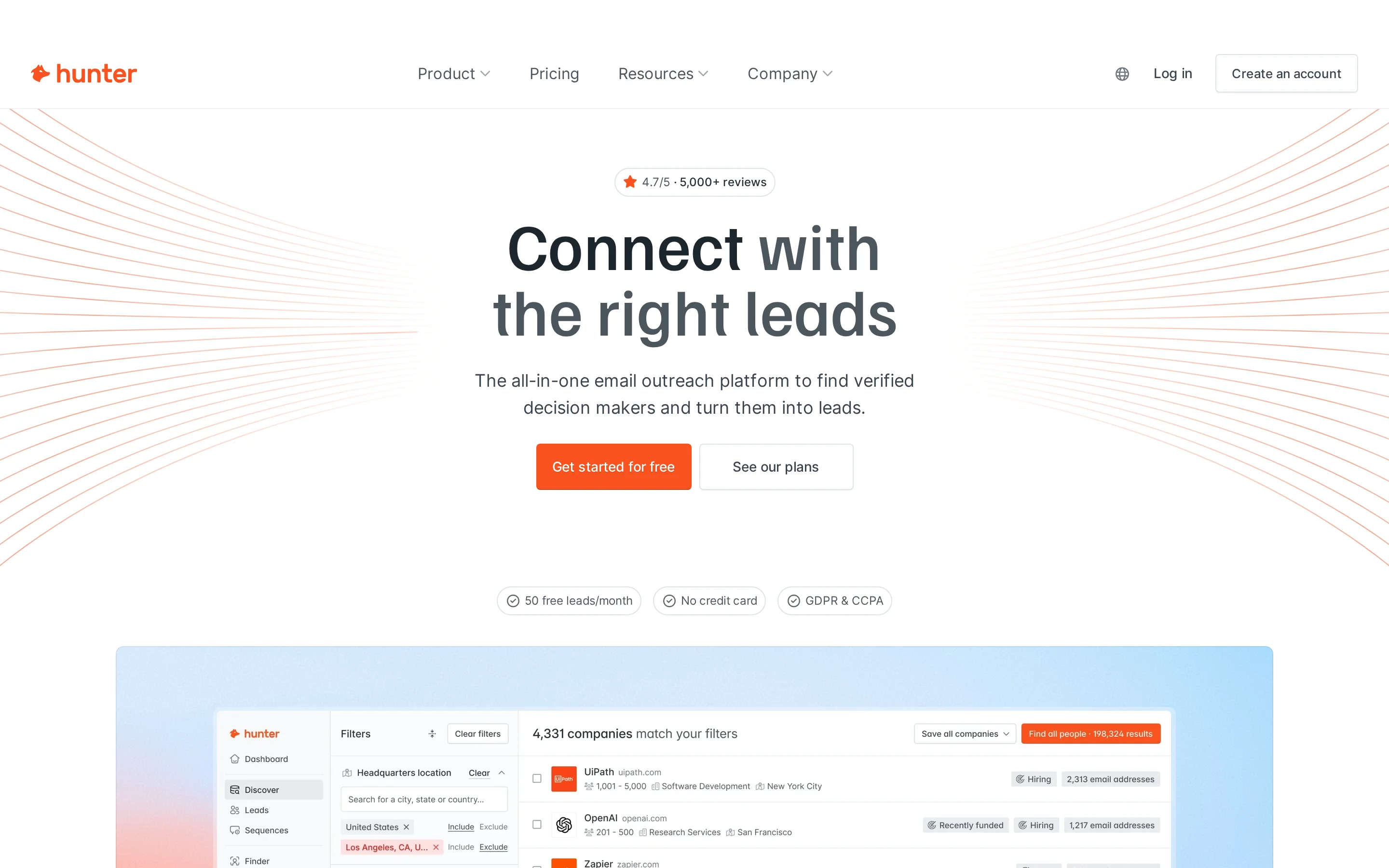
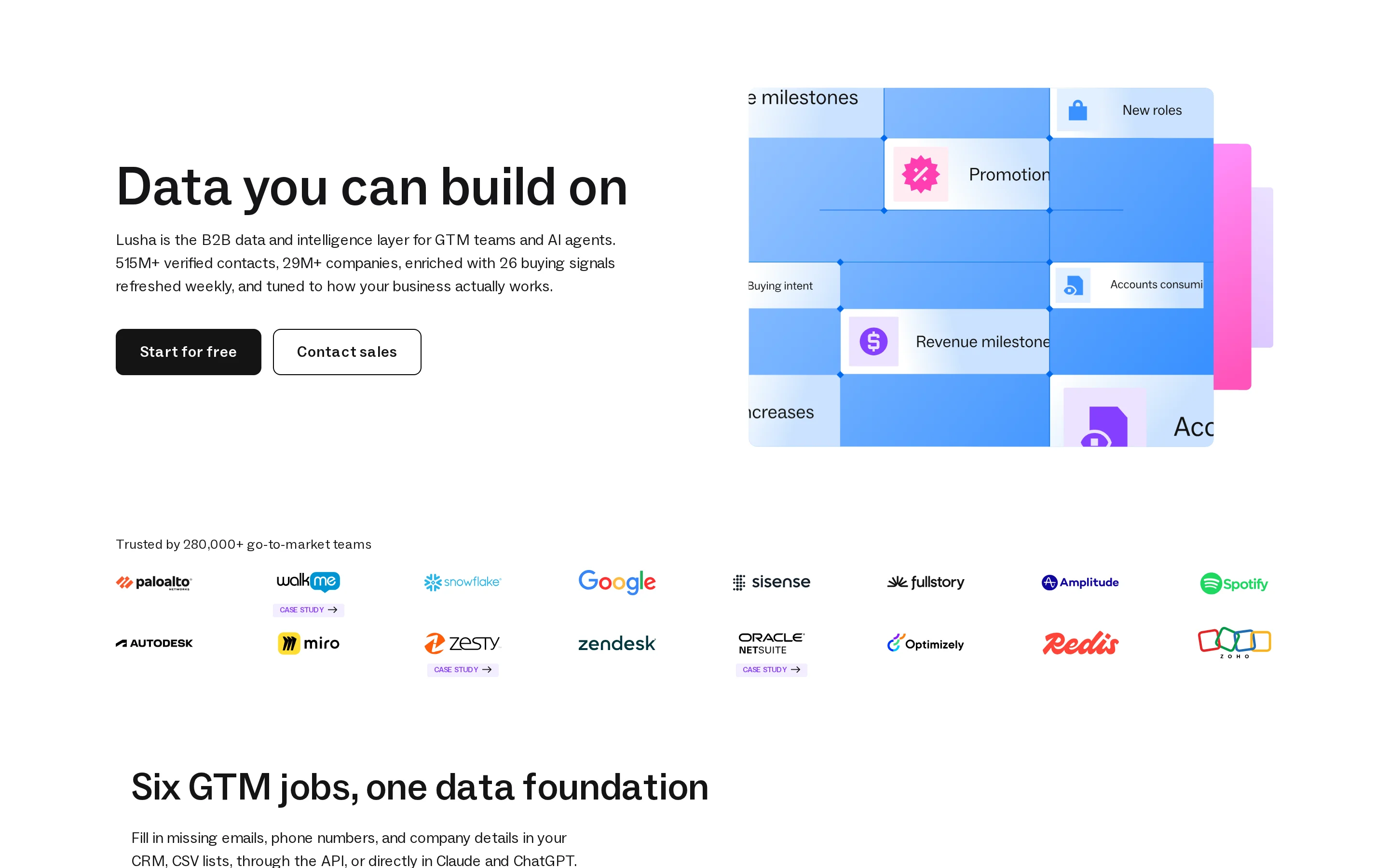
| Attribute | Hunter.io | Lusha |
|---|---|---|
| Primary Purpose | Email Discovery & Verification | Sales Intelligence & Contact Data |
| Starting Price | $34/mo (Starter) | Free Plan / Custom Paid Tiers |
| Free Plan | Yes (50 credits/month) | Yes (40 credits/month) |
| Core Strength | Transparent Web Crawling & Auto-Verification | Direct Mobile Numbers & Intent Signals |
| User Model | Unlimited Users | Per Seat (implied by 'teams larger than 5 users' note) |
| Data Source | Public Web Pages | Aggregated Database (515M+ contacts) |
| Outreach Tool | Native Sequences | None (CRM/Extension focused) |
| API Access | Robust Bulk & API Plans | Standard API for Enrichment |
Feature-by-feature matrix
Audited capabilities across data sourcing, sending infrastructure, and integrations.
| Capability | Why it matters | Hunter.io | Lusha | Winner |
|---|---|---|---|---|
| B2B Contact Database | Access to net-new leads | ✓ Native | ✓ Native | lusha |
| Email Finder | Discovering verified addresses | ✓ Native | ✓ Native | Tie |
| Email Verification | Preserving domain health | ✓ Native | ◐ Partial | hunter |
| Mobile Phone Numbers | Direct voice outreach | — None | ✓ Native | lusha |
| Intent/Buying Signals | Timing the outreach | ◐ Partial (Signals feature) | ✓ Native | lusha |
| Cold Email Sequencing | Automating follow-ups | ✓ Native | — None | hunter |
| Browser Extension | Workflow integration | ✓ Native | ✓ Native | Tie |
| CRM Integration | Syncing lead data | → Integration | → Integration | Tie |
| Bulk CSV Enrichment | Scaling list hygiene | ✓ Native | ✓ Native | Tie |
| API for Developers | Embedding data in apps | ✓ Native | ✓ Native | hunter |
| GDPR Compliance Transparency | Legal safety | ✓ Native (Removal rights) | ✓ Native | Tie |
| AI Writing Assistant | Personalizing outreach | ✓ Native (Sequences) | N/A | hunter |
| Territory Planning | Account segmentation | — None | ✓ Native | lusha |
| Job Change Detection | Warm re-engagement | — None | ✓ Native | lusha |
| Technographic Data | Tech stack targeting | — None | ✓ Native | lusha |
| Unlimited Seats | Team scalability cost | ✓ Native | — None | hunter |
Technical deep dives
Architectural comparisons derived from live platform testing.
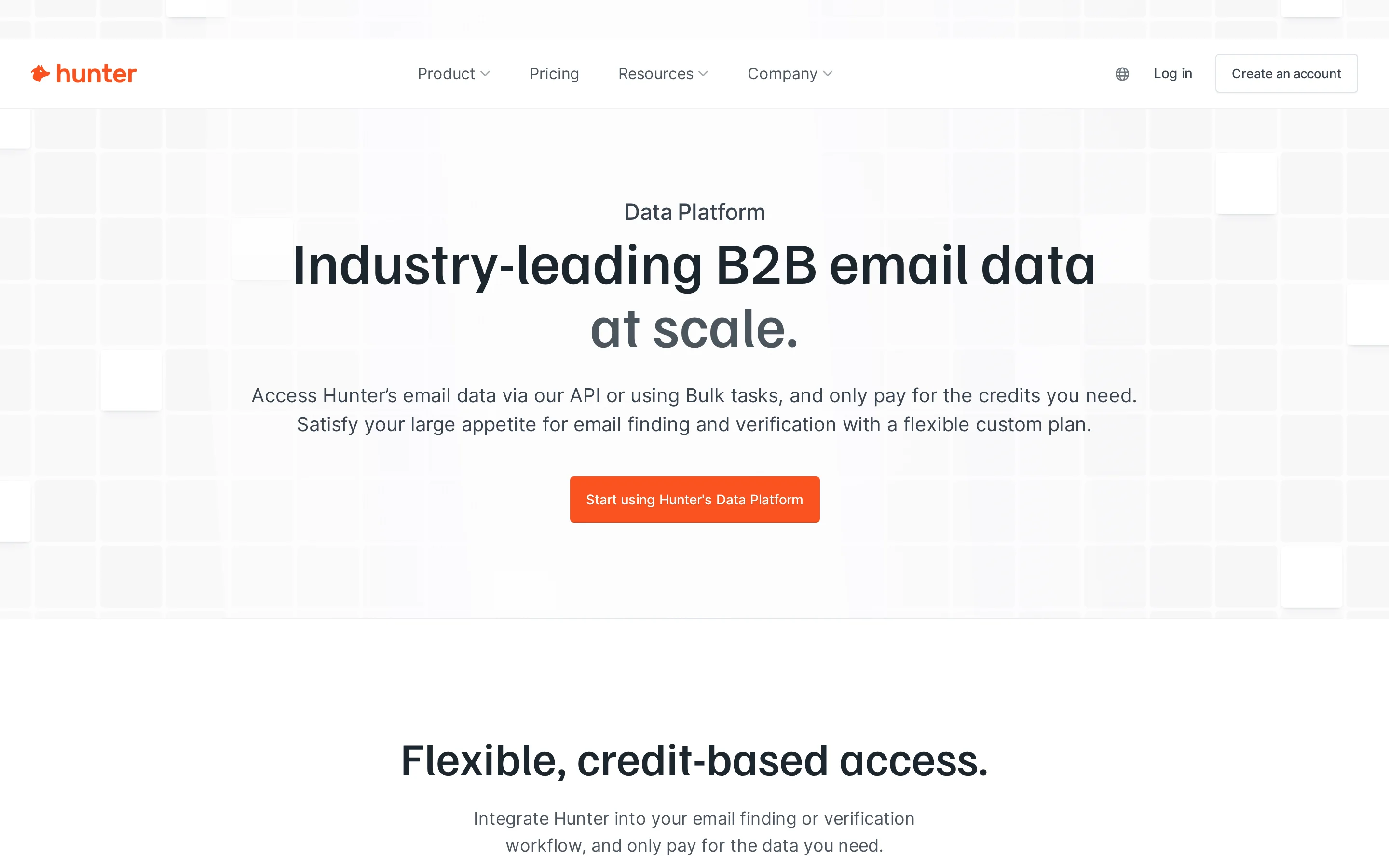 Full resolution
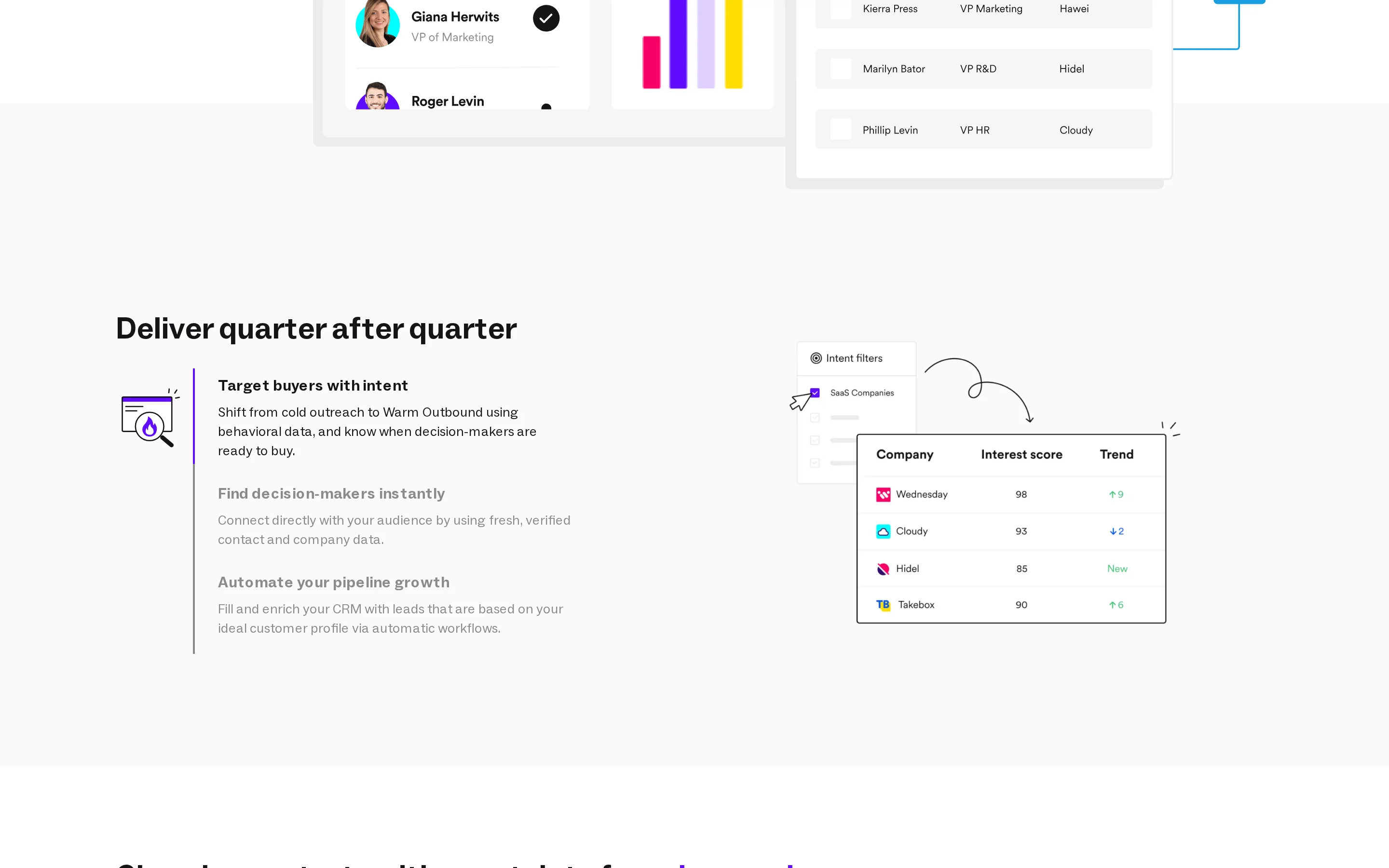 Full resolution
Data Acquisition & Verification Architecture: Transparent Web Crawling vs. Aggregated Contact Database
Hunter.io operates on a proprietary, transparent web-crawling engine that visits millions of public web pages daily to discover contact information. This architecture allows Hunter to provide auto-verified email data directly from source websites, offering data subjects the right to request removal. In contrast, Lusha functions as an aggregated Sales Intelligence platform, maintaining a database of over 515 million contacts enriched with firmographics, technographics, and real-time buying signals. While Hunter focuses on the *existence* and *validity* of an email address found publicly, Lusha focuses on the *context* and *accessibility* of a decision-maker, including private mobile numbers not typically found via public crawling.
Operationally, this means Hunter is superior for building clean, compliant email lists where deliverability is paramount. The 'Domain Search' and 'Email Finder' tools are designed to minimize bounce rates by verifying emails against SMTP servers before export. Lusha’s approach is broader; it provides a 'Market Mapping' capability that scores accounts against closed-won profiles and layers intent data (e.g., hiring surges, funding events). For a BDR using Lusha, the value isn't just finding an email, but knowing *when* to call based on signal triggers, which Hunter’s crawler-based model does not inherently support at the same depth.
The tradeoff is clear: Hunter offers higher confidence in email validity due to its verification-first architecture, while Lusha offers higher confidence in reaching the right person through multiple channels (phone/email) and timing. If your strategy relies heavily on cold email volume, Hunter’s transparency and verification are critical. If your strategy relies on high-touch, multi-channel engagement with specific ICPs, Lusha’s aggregated intelligence is more valuable.
Credit Economics & Multi-Channel Access: Flat Email-Centric Credits vs. Weighted Phone/Email Tiers
Hunter.io utilizes a unified credit system where one credit covers Email Finding, Domain Searching, or Email Verification (with verifications costing 0.5 credits). This simplifies budgeting for teams whose primary channel is email. Whether you find an email or verify an existing one, the cost structure remains predictable and low-friction. There is no distinction between 'premium' and 'standard' data types within the core credit pool, making it ideal for high-volume prospecting where cost-per-lead must be minimized.
Lusha employs a weighted credit model that reflects the scarcity and value of different data points. Revealing a verified email address costs 1 credit, whereas revealing a direct mobile phone number costs 5 credits. This structure forces sales teams to strategically prioritize their outreach efforts. It acknowledges that phone numbers are harder to acquire and maintain, thus pricing them accordingly. For teams running mixed-channel campaigns, this creates a variable cost model where the total spend depends heavily on the ratio of email-to-phone outreach.
From a financial perspective, Hunter’s flat rate favors mass email campaigns. A team sending 10,000 emails pays roughly the same regardless of whether they used the finder or verifier. Lusha’s model penalizes heavy phone usage; a team calling 2,000 prospects would consume 10,000 credits, equivalent to finding 10,000 emails. However, if those 2,000 calls yield significantly higher conversion rates than 10,000 emails, the ROI may still favor Lusha. The choice depends on whether your bottleneck is lead volume (Hunter) or lead quality/access (Lusha).
Integration Depth & API Flexibility: Bulk Data Enrichment for Apps vs. Browser Extension Workflow Integration
Hunter.io positions itself strongly as a developer-friendly tool with robust API capabilities and bulk task processing. Its 'Data Platform' allows businesses to embed verified email finding and verification directly into SaaS products or internal applications. The API is designed for scale, supporting large volumes of requests with clear documentation for MCP (Model Context Protocol) integrations, allowing AI agents to access Hunter’s data. This makes Hunter ideal for companies that need to automate data hygiene pipelines or power their own contact enrichment features.
Lusha, conversely, emphasizes seamless workflow integration for sales representatives rather than deep backend development. Its primary strength lies in its browser extension, which overlays onto LinkedIn Sales Navigator and other platforms, allowing reps to enrich leads with one click without leaving their current context. While Lusha offers an API for n8n and CRM integrations, the user experience is optimized for non-technical sales teams who want instant access to data within their existing dashboard. The focus is on reducing 'admin work' and 'platform switching' for BDRs.
The ruling here depends on the user persona. If you are a RevOps engineer building a custom tech stack or a SaaS company needing to offer email validation to your users, Hunter’s API and bulk capabilities are superior. If you are a sales manager looking to equip your reps with a tool that fits naturally into their LinkedIn-heavy workflow without requiring IT intervention, Lusha’s extension-first approach is more effective. Hunter integrates into your *system*; Lusha integrates into your *workflow*.
Pricing & true cost
Published tier structures, credit scaling mechanics, and total outbound cost.
 Full resolution
 Full resolution
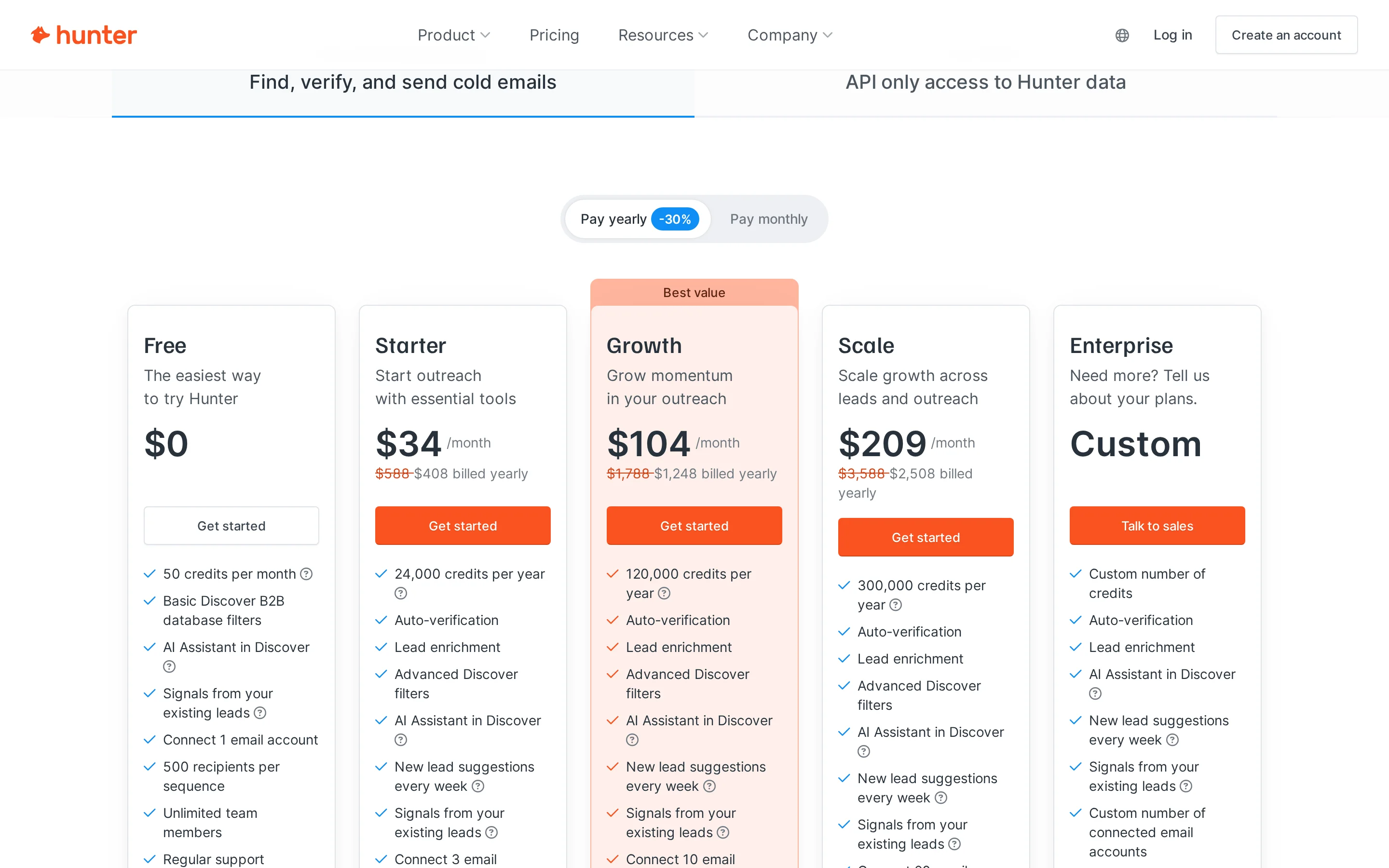
Hunter.io plans
- Free: $0/mo (50 credits/month)
- Starter: $34/mo billed yearly ($49/mo monthly) - 2,000 credits/month
- Growth: $104/mo billed yearly ($149/mo monthly) - 10,000 credits/month
- Scale: $209/mo billed yearly ($299/mo monthly) - 25,000 credits/month
- Enterprise: Custom Pricing
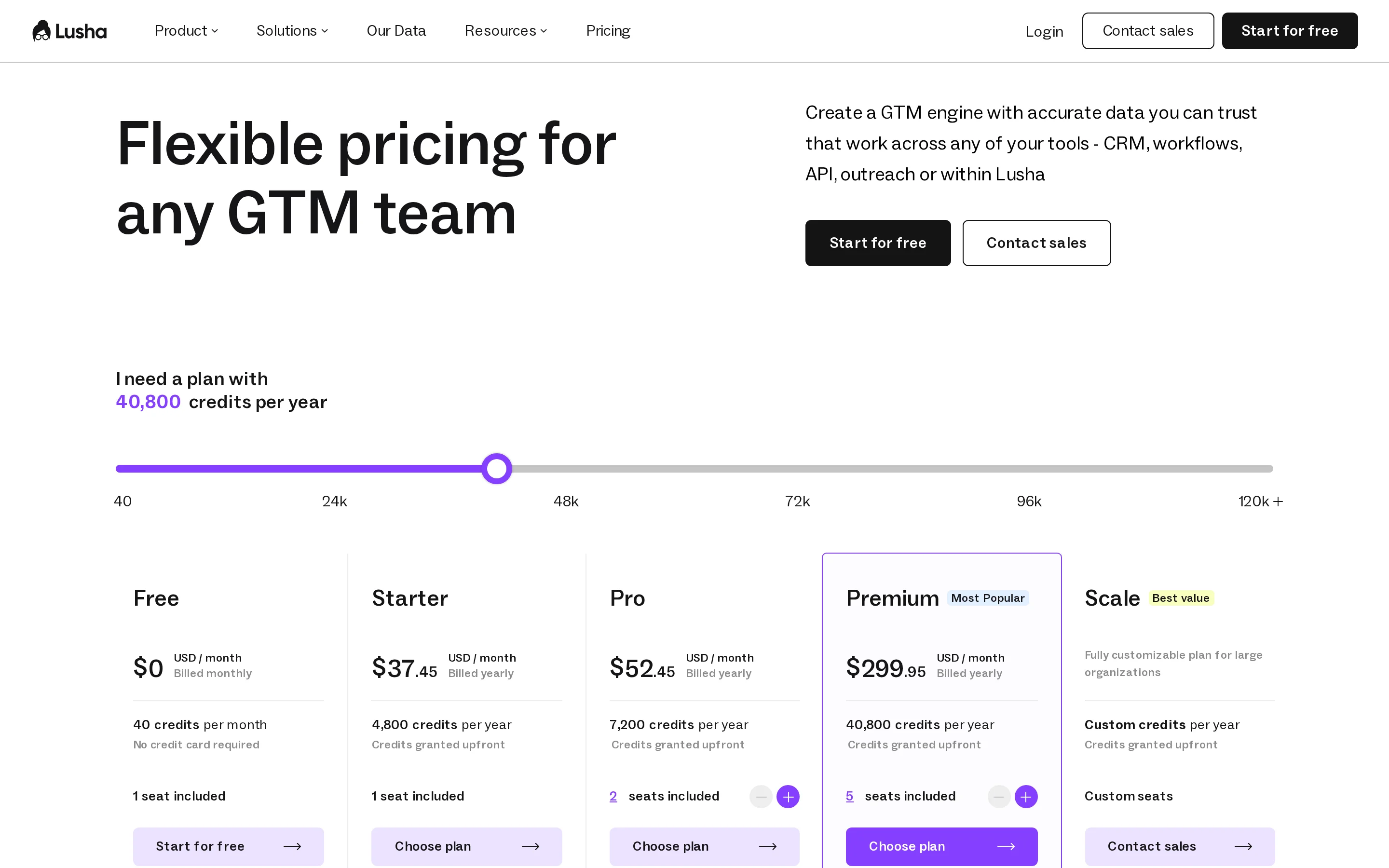
Lusha plans
- Free: $0/mo (40 credits/month)
- Paid Plans: Quote-Based / Custom Credit Packages
- Note: Specific dollar amounts for paid tiers are not publicly listed; requires contacting sales for team size >5 users.
Hunter.io offers transparent, tiered pricing with unlimited users, making it highly predictable for growing teams. You pay for credits, not seats. Lusha uses a hybrid model where pricing is often tied to seat count and credit volume, with enterprise tiers requiring custom quotes. For small to mid-sized teams, Hunter’s published rates allow for immediate budgeting, whereas Lusha requires a sales conversation to determine final costs, especially for phone-heavy strategies.
of Ownership Analysis
For a 5-person team needing 10,000 verified leads per month:
Hunter.io:
The 'Growth' plan provides 10,000 credits/month for $104/mo (billed yearly). Since users are unlimited, the cost is simply $104/month total.
Lusha:
Assuming the team needs 10,000 email reveals (1 credit each), they need 10,000 credits. Lusha does not publish exact dollar prices for this volume, but typical market rates for such databases range from $0.05 to $0.10 per contact depending on package size. Additionally, if any phone numbers are needed (5 credits each), costs escalate rapidly. Without a public price list, we estimate a comparable package might range $300-$600/month plus potential seat fees, though this is an estimate based on industry standards for similar volume. If the team only needs emails, Hunter is likely 3-5x cheaper. If they need phones, Lusha’s value proposition shifts.
Which fits your outbound model?
Match your team size, deal complexity, and lead volume to the right engine.
High-Volume Cold Outbound
Hunter.io is built for this. Unlimited users and flat email-centric credits allow for massive list generation without exploding costs.
Multi-Channel Sales (Phone + Email)
Lusha excels here. Direct mobile numbers and intent signals enable warm calling strategies that Hunter cannot support.
Developer API Data Pipelines
Hunter.io offers superior bulk tasks and API flexibility for embedding verification into SaaS products or internal tools.
LinkedIn-Native Prospecting
Lusha’s browser extension integrates seamlessly with Sales Navigator, allowing reps to enrich leads without leaving their workflow.
Where each platform falls short
Constructive limitations and architectural trade-offs to weigh before signing.
Where Hunter.io falls short
- No native mobile phone number data.
- Limited intent/buying signal depth compared to dedicated SI platforms.
- Credits do not roll over on monthly plans (unless annual upfront option chosen).
Where Lusha falls short
- Opaque pricing for paid tiers (requires sales contact).
- Higher cost per contact for phone numbers (5x email cost).
- No native cold email sequencing tool (relies on external CRMs/Send tools).
The switching playbook
What you gain and give up when migrating across platforms.
- Lower cost for email-heavy teams.
- Unlimited user seats.
- Stronger email verification and deliverability controls.
- Loss of direct mobile phone access.
- Reduced visibility into buyer intent signals.
- Less integrated territory planning features.
- Access to direct mobile numbers.
- Real-time buying signals and intent data.
- Better fit for LinkedIn-centric workflows.
- Significantly higher cost for phone data.
- Potential seat-based pricing increases.
- Need to integrate separate email sequencing tools.
Frequently asked questions
Direct technical answers about Hunter.io and Lusha.
Which platform has better data accuracy?
Hunter.io generally has higher accuracy for *email existence* due to its SMTP verification process. Lusha claims 90-95% accuracy across regions but includes phone data which is harder to verify dynamically. For pure email campaigns, Hunter is safer for deliverability.
How do their starting costs compare?
Both offer free plans (Hunter: 50 credits, Lusha: 40 credits). Hunter’s first paid tier is $34/mo (annual) for 2,000 credits. Lusha’s paid pricing is not publicly listed and requires a quote, often resulting in higher initial commitments for teams.
Can I connect unlimited mailboxes?
Hunter.io allows connecting up to 20 email accounts on the Scale plan (more via add-ons). Lusha does not have a native email sending feature, so mailbox connection limits are irrelevant; you use your own CRM or sending tool.
Which tool is easier to learn?
Lusha is often considered easier for individual reps due to its simple browser extension overlay. Hunter requires understanding credit usage and sequence setup, which can be slightly more complex for beginners but offers more control for power users.
Sources & methodology
Every claim is grounded in official vendor documentation and live audits.
Compare with sendroAI
See how sendroAI replaces manual research, credit limits, and deliverability traps with full autonomous execution.