Quick decision verdict
Executive rulings based on technical testing and pricing data.
Best for Enterprise Outbound
Odoo. Its unified ERP architecture allows sales teams to see inventory levels and credit limits in real-time during the pipeline stage, preventing unfulfillable deals.
Best for Email Deliverability
Insightly. While neither is a dedicated deliverability tool, Insightly's native email integration with Gmail/Outlook is more streamlined for pure-play sales reps than Odoo's complex SMTP configuration.
Best for High-Volume Prospecting
Neither. Both are CRMs, not prospecting databases. However, Insightly's AppConnect makes it easier to ingest external lead lists via Zapier-style connectors than Odoo's API-heavy approach.
Best Overall Value
Odoo. The 'One App Free' plan provides a fully functional CRM for unlimited users at $0, whereas Insightly requires paid tiers for advanced features like automation and reporting.
Insightly vs Odoo at a glance
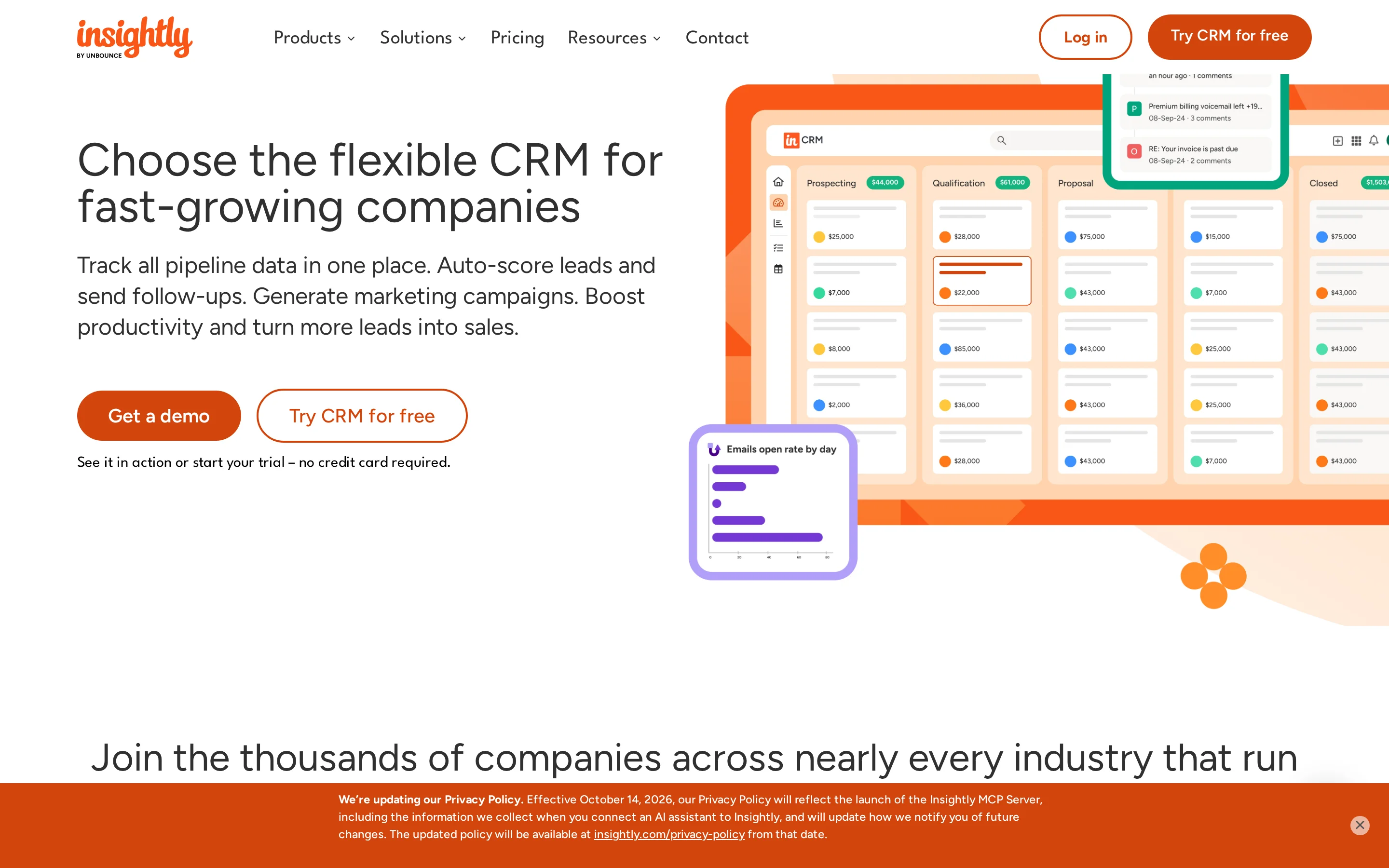
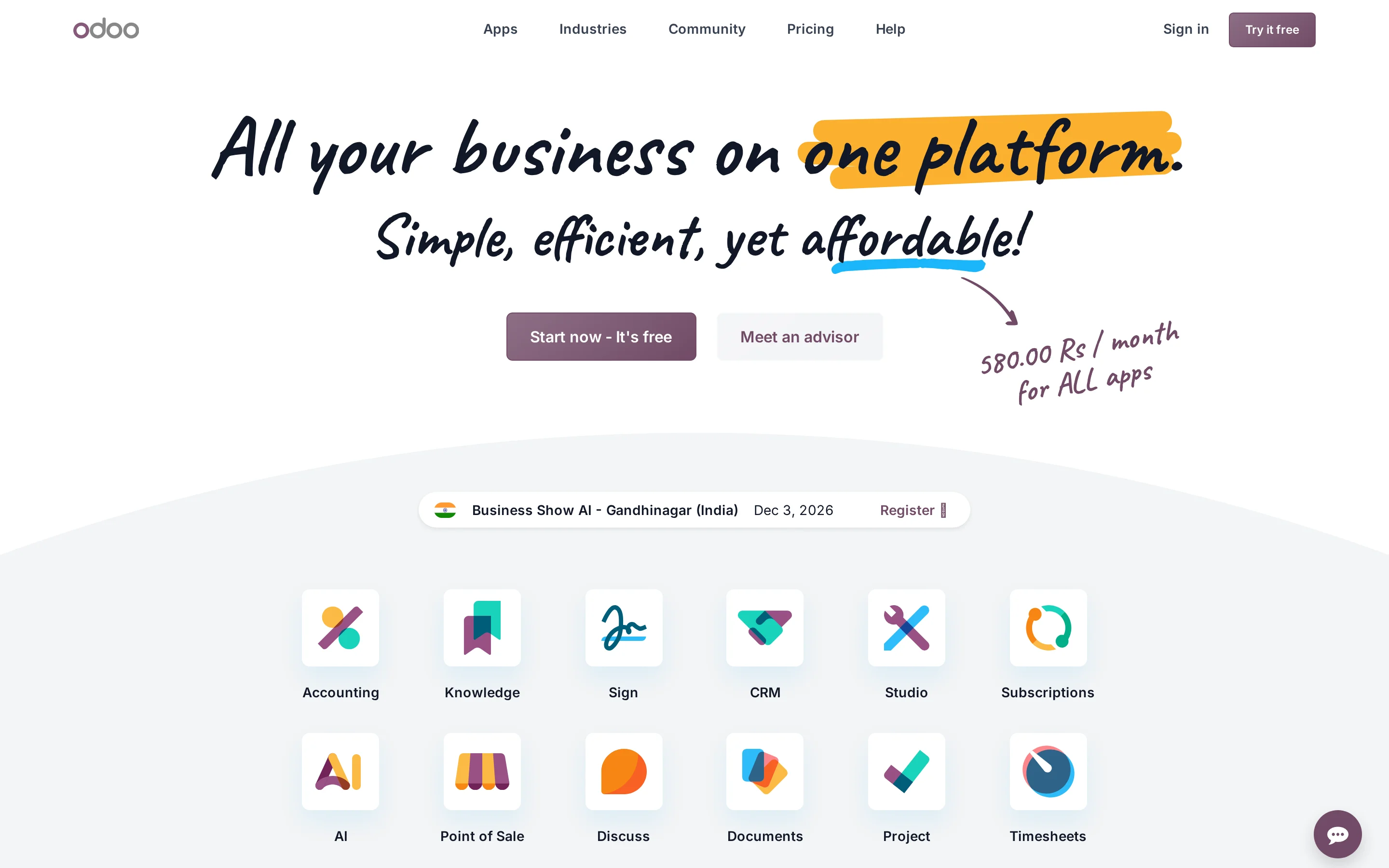
Side-by-side core specifications and live platform viewports.
| Attribute | Insightly | Odoo |
|---|---|---|
| Primary Purpose | Specialized B2B/B2C CRM & Project Management | Modular ERP Suite with integrated CRM |
| Starting Price | Quote-Based / Custom Enterprise Pricing | $0 (One App Free) / Quote-Based for Standard/Custom |
| Free Plan | No (14-day trial only) | Yes (Unlimited users, one app) |
| Core Strength | Ease of adoption and low-code integrations (AppConnect) | Deep operational visibility across Finance, Inventory, and HR |
| AI Capabilities | Insightly AI Copilot (Summarization, Automation) | Agentic AI (in Custom Plan) & Studio Automation |
| Support Model | Email/Phone (Mon-Fri); Premier Support available | Unlimited Email Support (24/5); Community-driven |
| Implementation Effort | Low (Guided Onboarding available) | High (Requires configuration or partner services) |
| Data Architecture | Relational CRM Database | Unified ERP Database (All modules share records) |
Feature-by-feature matrix
Audited capabilities across data sourcing, sending infrastructure, and integrations.
| Capability | Why it matters | Insightly | Odoo | Winner |
|---|---|---|---|---|
| Visual Pipeline Management | Essential for tracking deal stages | ✓ Native | ✓ Native | Tie |
| Lead-to-Opportunity Conversion | Automating handoffs between marketing and sales | ✓ Native | ✓ Native | Tie |
| Pre-built Third-Party Connectors | Speed of integration with existing stack | ✓ Native (AppConnect) | → Integration (API/Studio) | insightly |
| Inventory Visibility in Deals | Preventing overselling during negotiation | — None | ✓ Native | odoo |
| Accounting Sync | Real-time revenue recognition | → Integration | ✓ Native | odoo |
| Project Management Post-Sale | Seamless transition from closed-won to delivery | ✓ Native | ✓ Native | Tie |
| Mobile App Experience | Sales reps on the go | ✓ Native | ✓ Native | Tie |
| Custom Field Creation | Adapting CRM to unique business processes | ✓ Native | ✓ Native (Studio) | Tie |
| Workflow Automation Engine | Reducing manual admin tasks | ✓ Native | ◐ Partial (Requires Studio/Code) | insightly |
| Multi-Company Support | Managing subsidiaries or franchises | ◐ Partial | ✓ Native (Custom Plan) | odoo |
| Onboarding Assistance | Time-to-value for new teams | ✓ Native (Paid Service) | → Integration (Partner Service) | insightly |
| Reporting & Dashboards | Managerial oversight | ✓ Native | ✓ Native | Tie |
| Email Tracking | Knowing when prospects open/click | ✓ Native | ◐ Partial (Via Integrations) | insightly |
| Quote Generation | Closing deals faster | ✓ Native | ✓ Native | Tie |
| Price Books | Standardizing product costs | ✓ Native | ✓ Native | Tie |
| Community Forum | Peer-to-peer troubleshooting | ◐ Partial | ✓ Native | odoo |
| Open Source Code Access | Ultimate customization control | — None | ✓ Native (Community Edition) | odoo |
| AI Summarization | Quick context on long threads | ✓ Native (Copilot) | ✓ Native (Agentic AI) | Tie |
Technical deep dives
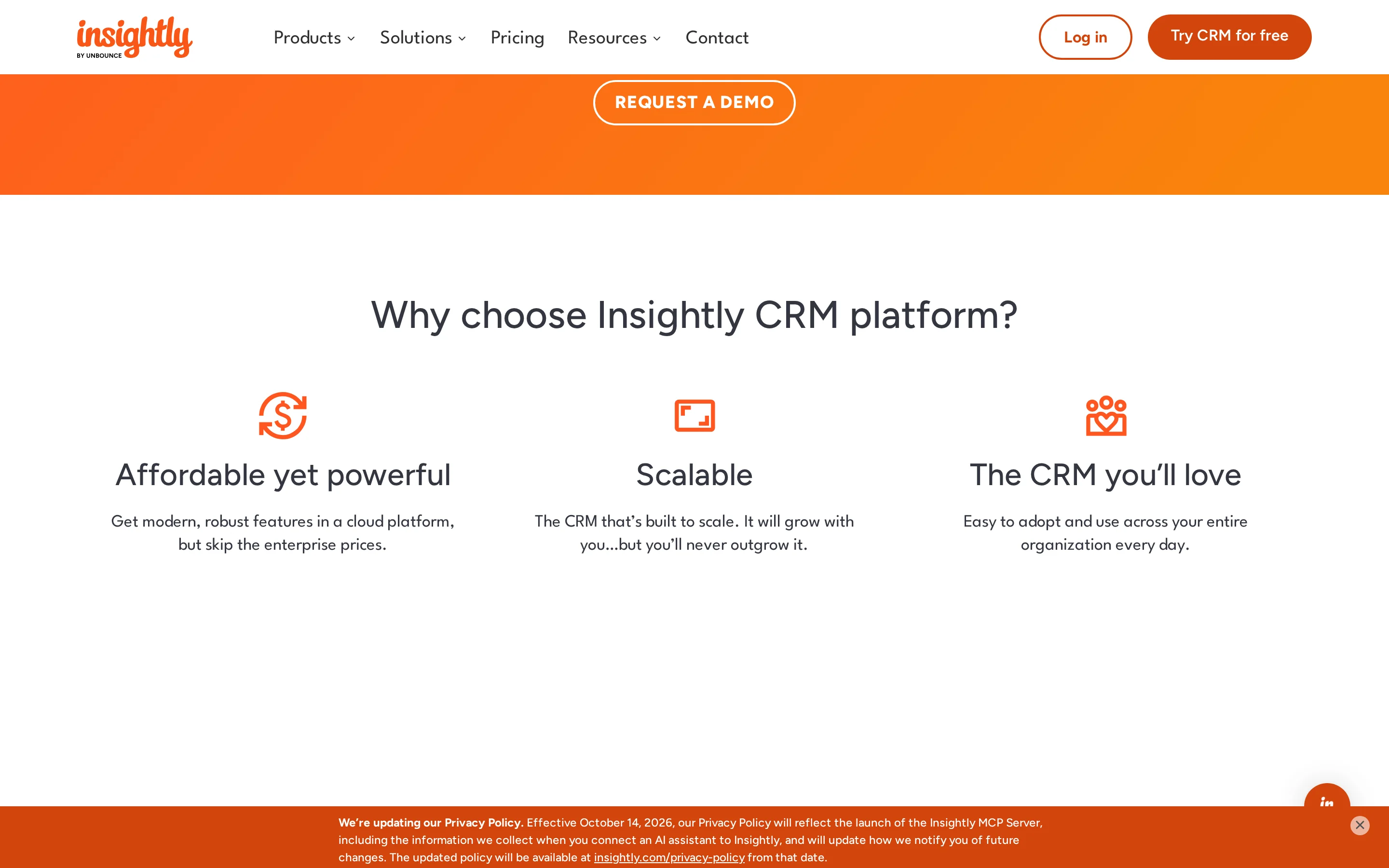
Architectural comparisons derived from live platform testing.
 Full resolution
 Full resolution
Sales Pipeline Architecture: Dedicated CRM Workflow Engine vs. Modular ERP-Integrated Sales Suite
Insightly operates as a specialized, out-of-the-box sales pipeline designed specifically for revenue teams. Its architecture prioritizes the 'Lead-to-Cash' journey within the CRM boundary, offering visual stage management and native conversion logic that requires minimal setup. In contrast, Odoo treats the CRM as one module within a broader ERP ecosystem. This means that while Insightly focuses on speed of deployment for sales activities, Odoo offers deeper operational visibility by linking sales stages directly to inventory, accounting, and procurement workflows. For a pure-play sales team, Insightly’s dedicated engine reduces friction; for an operations-heavy company, Odoo’s integrated suite prevents silos but demands higher initial configuration complexity.
Day-to-day execution differs significantly. Insightly users interact with a clean, focused interface where opportunities move through customizable pipelines with built-in validation rules and permissions. The system is designed to guide customer relationships through the lifecycle without overwhelming the user with non-sales data. Odoo’s CRM interface is embedded within a larger dashboard that may include manufacturing orders or helpdesk tickets. While this provides context, it can introduce cognitive load for sales reps who do not need to see supply chain metrics. Odoo requires configuring 'actions' to link CRM stages to other modules, whereas Insightly uses simple drag-and-drop pipeline settings.
The tradeoff is clear: Insightly wins on time-to-value for standalone sales functions, allowing teams to start tracking deals immediately. Odoo wins on data integrity across departments, ensuring that a 'Closed Won' deal automatically triggers correct invoicing and stock deductions. If your primary goal is rapid outbound lead generation and pipeline hygiene, Insightly’s dedicated architecture is superior. If you need to align sales performance with fulfillment capabilities, Odoo’s modular approach is essential.
Integration & Automation Strategy: Low-Code AppConnect Hub vs. Unified Data Model & Studio Customization
Insightly relies on 'AppConnect,' a low-code integration hub that comes with hundreds of pre-built connectors for apps like Zoom, 8x8, and various marketing tools. This strategy prioritizes ease of adoption, allowing non-technical users to build sophisticated workflows and exchange data between systems using clicks rather than code. Odoo leverages its unified database architecture, where all apps share data natively without needing traditional 'integrations.' For external connections, Odoo relies on 'Odoo Studio' for custom field/workflow creation and a robust External API. This allows for deep internal automation across departments but typically requires more technical expertise or developer resources to build external integrations compared to Insightly’s plug-and-play connectors.
In daily operations, Insightly’s AppConnect enables rapid deployment of third-party tools. A sales manager can connect a new email marketing platform in minutes. Odoo’s strength lies in internal consistency; because the CRM, Accounting, and Inventory share the same backend, there is no data sync lag or mapping errors between these core modules. However, connecting Odoo to a niche third-party SaaS often involves writing Python scripts or using middleware, which creates a barrier for smaller teams without IT support. Insightly’s model is better for companies with a diverse, best-of-breed tech stack; Odoo’s model is better for companies consolidating onto a single platform.
The ruling favors Insightly for breadth of connectivity and ease of use, particularly for mid-market companies that rely on multiple specialized tools. Odoo wins for depth of integration within its own ecosystem. If your strategy depends on keeping data synchronized across finance, HR, and sales without manual entry, Odoo’s unified model is unmatched. If your strategy depends on quickly plugging in new sales enablement tools, Insightly’s AppConnect is the more agile solution.
Support & Onboarding Model: Premium Human-Led Success Services vs. Unlimited Self-Service & Community Support
Insightly differentiates itself through paid 'Guided Onboarding' and 'Premier Support' tiers, positioning human-led implementation and strategic success coaching as critical value-adds. This model appeals to mid-market companies that lack internal CRM administrators and need hands-on assistance to maximize their investment. All users have access to phone/email support during business hours, but the premium tier offers extended hours and personalized training. Odoo, conversely, includes unlimited email support and free eLearning in all plans, emphasizing self-sufficiency. Odoo relies heavily on a massive community forum and documentation, appealing to technically capable teams willing to manage their own configuration and upgrades.
The ecosystem impact is distinct. Insightly’s guided onboarding ensures that data hygiene and process alignment are established early, reducing the risk of 'shelfware.' Their support team actively helps configure validation rules and permissions. Odoo’s support is reactive rather than proactive; they will fix bugs or answer questions, but they generally do not design your workflow for you unless you purchase separate 'Success Packs' or hire a partner. This makes Odoo’s Total Cost of Ownership (TCO) lower if you have internal expertise, but potentially higher if you underestimate the learning curve.
For companies prioritizing speed and certainty in adoption, Insightly’s premium human-led services provide a safer path. For companies prioritizing budget flexibility and having in-house technical resources, Odoo’s unlimited self-service support model offers significant savings. The choice depends on whether you view support as a service to buy (Insightly) or a resource to leverage (Odoo).
Pricing & true cost
Published tier structures, credit scaling mechanics, and total outbound cost.
 Full resolution
 Full resolution
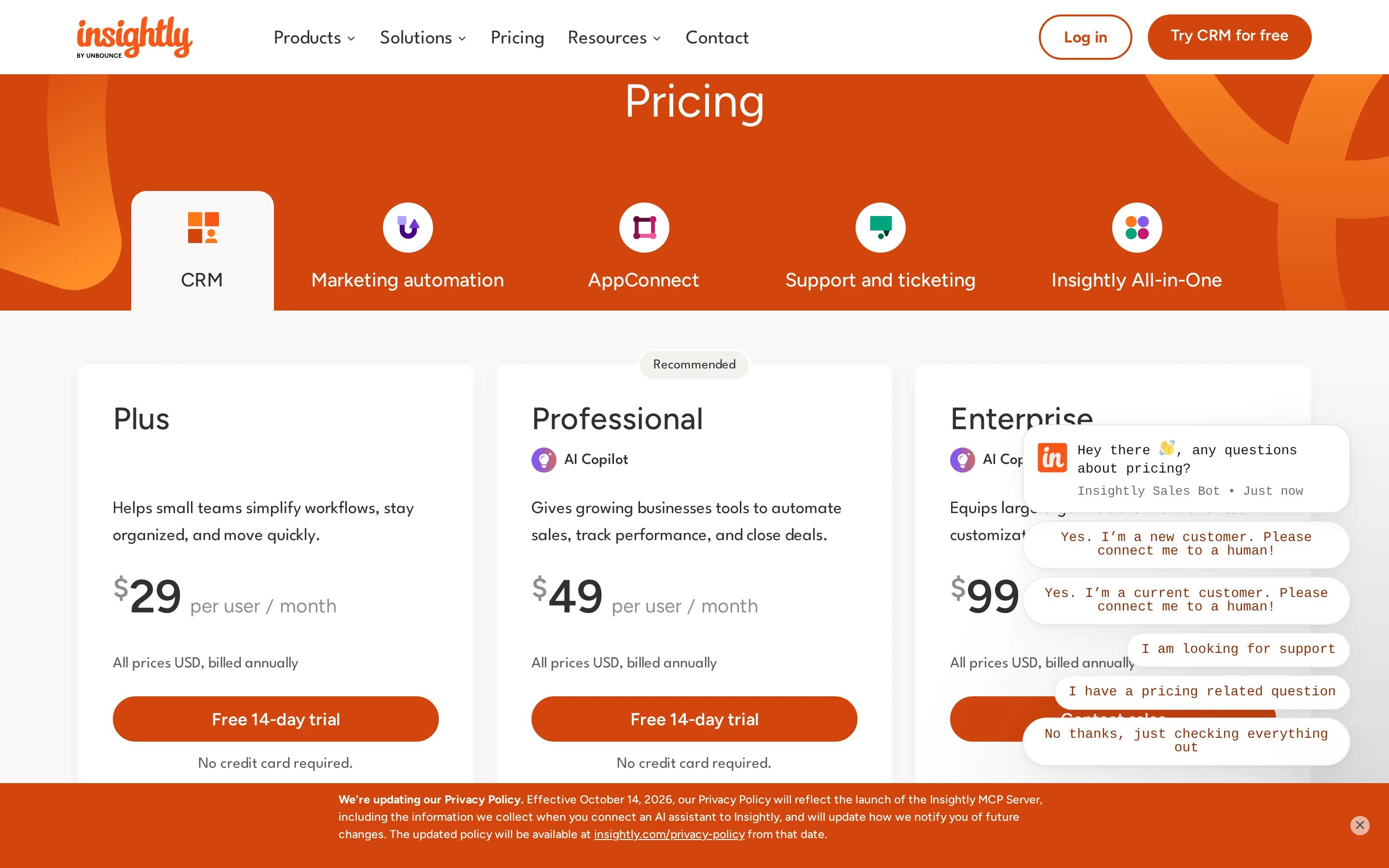
Insightly plans
- Plus: Quote-Based (Contact Sales)
- Professional: Quote-Based (Contact Sales)
- Enterprise: Quote-Based (Contact Sales)
- Premier Support & Success: Add-on Service (Quote-Based)
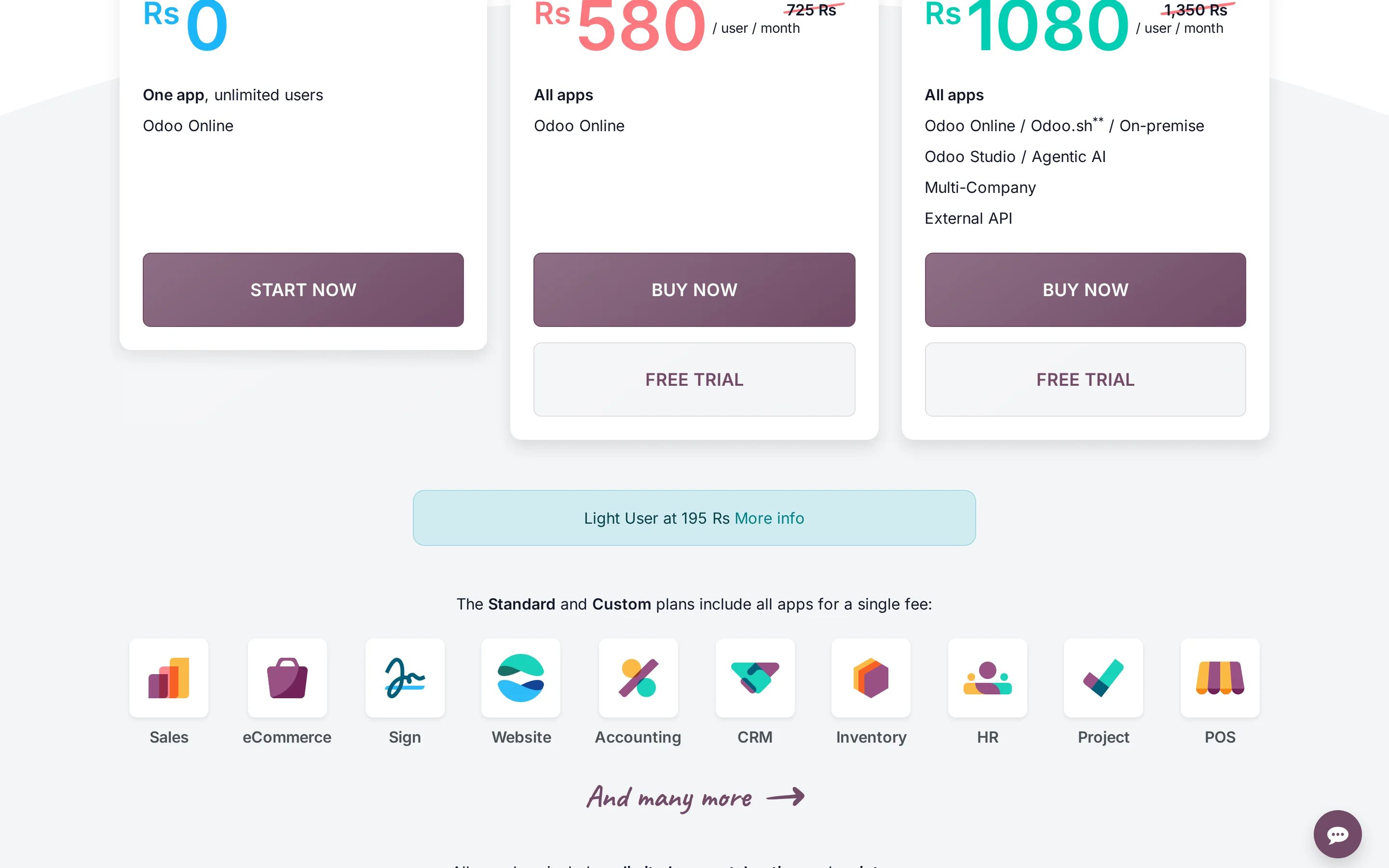
Odoo plans
- One App Free: $0/mo (Unlimited Users)
- Standard: Quote-Based (Includes all apps, hosted on Odoo Online)
- Custom: Quote-Based (Includes Studio, Multi-Company, API access)
- Odoo.sh Hosting: Additional Cost (Not included in Standard/Custom base price)
Odoo presents a disruptive pricing model with its 'One App Free' plan, allowing unlimited users to use the CRM module at zero cost, provided they stay within the standard feature set and host on Odoo Online. This makes it exceptionally attractive for startups or small businesses testing the waters. However, once you require multi-company support, custom development via Studio, or hosting on Odoo.sh, you must upgrade to the 'Custom' plan, which is quote-based and typically priced per user. Insightly does not publish public self-serve dollar prices for its current tiers, operating on a 'Quote-Based' model that likely scales with user count and feature depth. While Insightly lacks a permanent free tier, its pricing is generally transparent upon contact, whereas Odoo’s final cost can vary significantly based on hosting choices and implementation partner fees.
of Ownership Analysis
For a 5-person sales team requiring 10,000 verified leads/month (assuming leads are imported, not generated by the CRM):
Insightly:
Since Insightly uses quote-based pricing, we estimate based on market averages for similar mid-tier CRMs. Assume ~$30-$50/user/month for a Professional tier with automation.
* Software: 5 users * $40 = $200/month.
* Implementation: Guided Onboarding might add $1,000-$2,000 one-time fee.
* Total Year 1 Estimate: ~$2,400 - $4,400.
Odoo:
* Scenario A (CRM Only): $0/month (One App Free). No additional software cost.
* Scenario B (Full Suite/Custom): Assume ~$25-$35/user/month for Custom plan + Odoo.sh hosting (~$20-$50/month).
* Software: 5 users * $30 = $150/month + $30 hosting = $180/month.
* Implementation: Likely requires a partner or internal dev time. Assume $2,000-$5,000 one-time setup.
* Total Year 1 Estimate (Scenario B): ~$2,160 - $7,160.
Verdict: Odoo is cheaper if you stick to the free CRM tier. Insightly offers predictable costs for a dedicated sales tool, while Odoo’s costs escalate with complexity.
Which fits your outbound model?
Match your team size, deal complexity, and lead volume to the right engine.
High-Volume Cold Outbound
Insightly is built for sales velocity. Its native email tracking, click-to-call, and simplified pipeline management allow reps to churn through leads faster without navigating ERP complexities.
Bulk List Cleaning & Hygiene
Odoo provides superior data integrity controls via its unified database. Validation rules and cross-module checks ensure that imported leads don't create duplicate accounts linked to wrong invoices or contacts.
Developer API Data Pipelines
Odoo offers higher rate limits and deeper programmatic control via its External API and Python-based backend, making it ideal for engineering-heavy teams building custom data flows.
Post-Sale Project Delivery
Insightly has a dedicated 'Projects' module that converts opportunities to projects seamlessly. Odoo also handles this well but integrates it into a broader 'Services' app which may feel less tailored for pure sales-to-delivery handoffs.
Where each platform falls short
Constructive limitations and architectural trade-offs to weigh before signing.
Where Insightly falls short
- No permanent free plan; requires paid subscription for full functionality.
- Pricing is opaque (quote-based), making budget forecasting difficult for procurement.
- Lacks native financial/accounting integration depth compared to ERPs; relies on connectors.
- Advanced customization beyond fields/pipelines may require professional services.
Where Odoo falls short
- Steep learning curve due to the sheer number of modules and configuration options.
- 'One App Free' plan restricts usage to a single app; adding a second app forces an upgrade to paid tiers.
- Hosting on Odoo.sh incurs additional costs not included in the base license.
- Support is primarily email/community-based; immediate phone support is not standard for all tiers.
The switching playbook
What you gain and give up when migrating across platforms.
- Simplified user interface focused exclusively on sales and project management.
- Access to low-code AppConnect for rapid third-party integrations.
- Dedicated human-led onboarding and premier support options.
- Loss of native accounting, inventory, and HR synchronization.
- Higher recurring costs compared to Odoo's free tier.
- Less granular control over underlying data structures and code.
- Significant cost savings with the 'One App Free' CRM plan.
- Unified data model eliminating silos between sales, finance, and ops.
- Extensive customization potential via Odoo Studio and open-source code.
- Increased administrative burden and configuration complexity.
- Potential need for external developers or partners for implementation.
- Less intuitive experience for pure-play sales reps unfamiliar with ERP concepts.
Frequently asked questions
Direct technical answers about Insightly and Odoo.
Which platform has better data accuracy?
Odoo generally offers better data accuracy due to its unified database structure, which enforces referential integrity across modules (e.g., a contact cannot exist without being linked to a valid company record). Insightly relies on validation rules and AppConnect mappings, which are effective but prone to sync errors if third-party integrations fail.
How do their starting costs compare?
Odoo starts at $0/month for the 'One App Free' plan (unlimited users, CRM only). Insightly does not offer a free plan and uses quote-based pricing, typically starting around $30-$50/user/month for basic tiers, though exact figures require contacting sales.
Can I connect unlimited mailboxes?
Both platforms allow connecting multiple email accounts (Gmail, Outlook, etc.). Insightly’s AppConnect simplifies this for sales reps. Odoo requires configuring outgoing/incoming mail servers, which can be done for multiple domains but may require technical setup or partner assistance to avoid spam filter issues.
Which tool is easier to learn?
Insightly is significantly easier to learn for sales teams due to its focused UI and guided onboarding. Odoo has a steeper learning curve because users must understand how the CRM interacts with other ERP modules, even if they only use the CRM initially.
Does Odoo CRM include AI features?
Yes, Odoo includes 'Agentic AI' in its Custom plan, which can automate tasks and summarize records. Insightly also offers 'AI Copilot' for summarizing records and surfacing information instantly. Both are competitive in AI-assisted productivity.
Is Odoo suitable for large enterprises?
Yes, Odoo is scalable and used by large enterprises, especially those wanting to consolidate multiple software vendors into one ERP. However, large implementations usually require hiring Odoo Partners for project management and custom development, unlike Insightly which is often managed internally by mid-sized teams.
Sources & methodology
Every claim is grounded in official vendor documentation and live audits.
Compare with sendroAI
See how sendroAI replaces manual research, credit limits, and deliverability traps with full autonomous execution.