Quick decision verdict
Executive rulings based on technical testing and pricing data.
Best for Enterprise Outbound & Scale
Klaviyo. Its 'B2C CRM' architecture and unlimited contact tiers on Premium plans support high-volume, complex segmentation better than MailChimp's tiered limits.
Best for Integrated Customer Service
Klaviyo. Native Helpdesk and Customer Agent features allow seamless handoffs between marketing sends and support tickets, unlike MailChimp which requires external integrations.
Best for Small Business Simplicity
MailChimp. The Free plan (up to 500 contacts) and intuitive drag-and-drop interface make it easier for non-technical teams to launch basic campaigns quickly.
Best Overall Value for Growth
Tie/Contextual. MailChimp offers a lower entry point for small lists, but Klaviyo provides higher ROI through advanced predictive analytics and autonomous AI agents for mid-to-large ecommerce brands.
MailChimp vs Klaviyo at a glance
Side-by-side core specifications and live platform viewports.
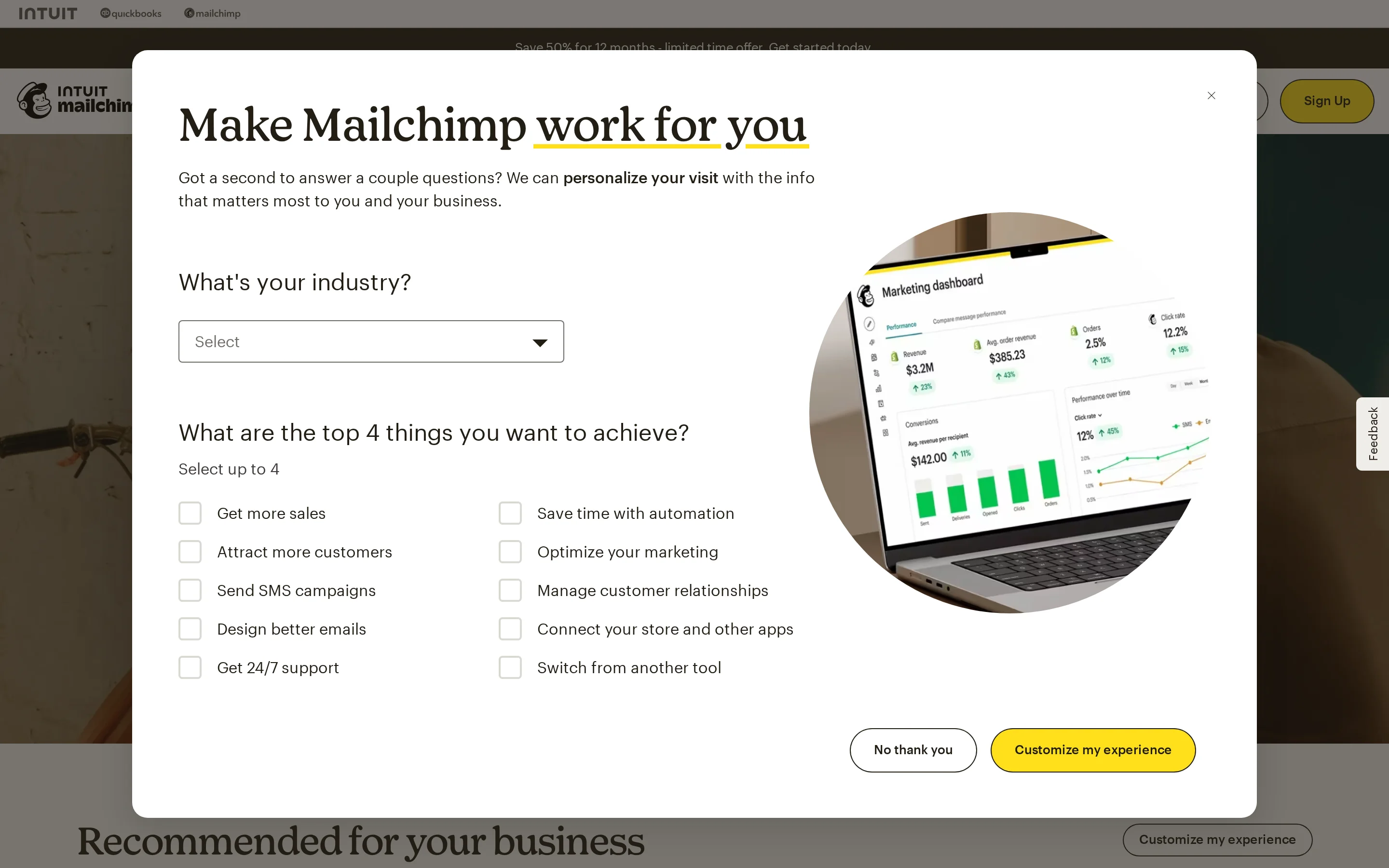
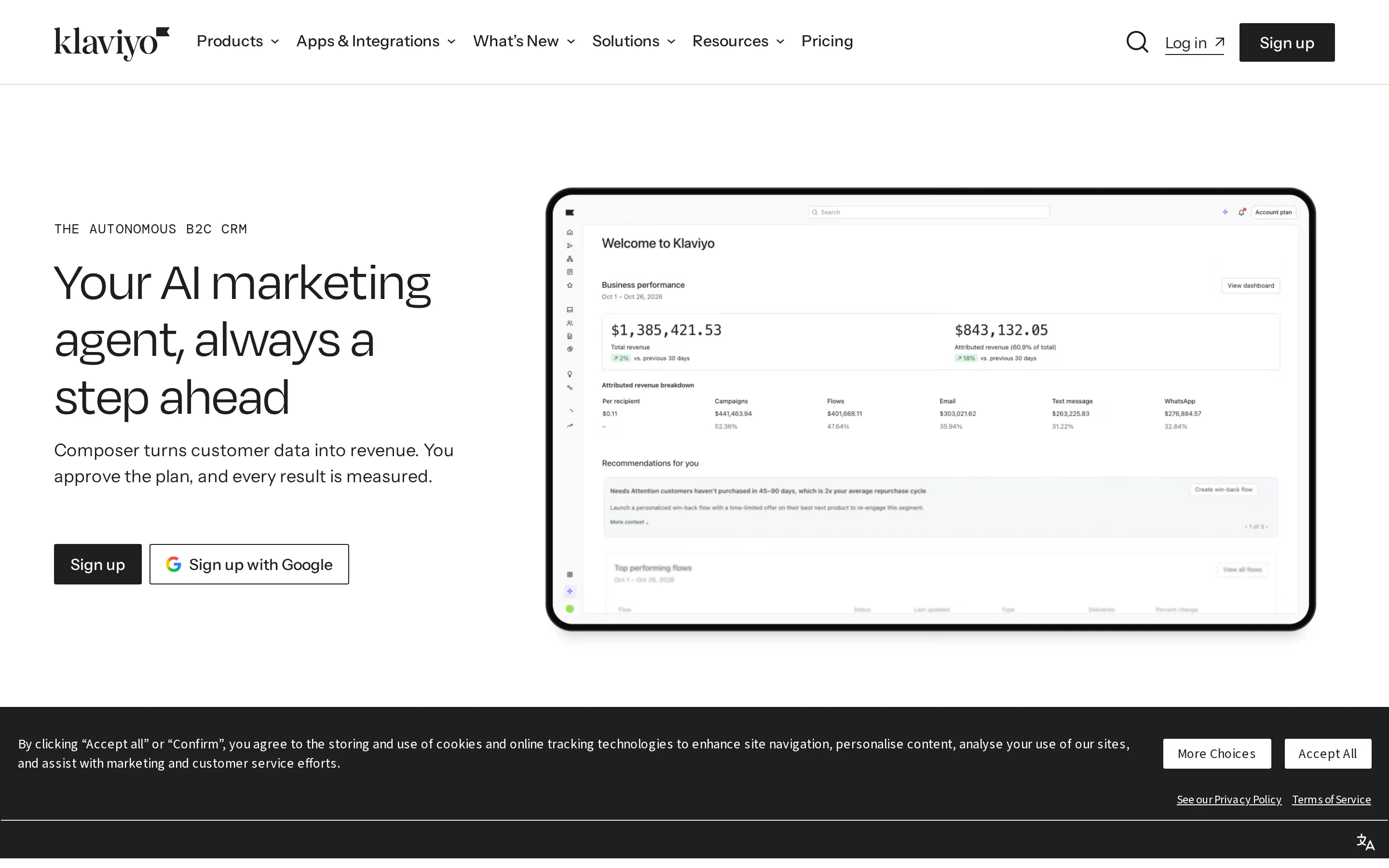
| Attribute | MailChimp | Klaviyo |
|---|---|---|
| Primary Purpose | All-in-one Marketing Platform (Email, Social, Ads) | Autonomous B2C CRM & Data Platform |
| Starting Price | $0/mo (Free Plan up to 500 contacts) | $0/mo (Free Plan up to 250 profiles) |
| Free Plan Limits | 500 emails/month, 1 Audience, Basic Automation | 500 emails/month, 250 Profiles, $10 Composer usage |
| Core Strength | Ease of use, broad channel coverage (Social/Ads), Intuit Intelligence | Real-time behavioral personalization, unified customer view, AI Agents |
| AI Capabilities | Generative copy, Send Time Optimization, Predictive Segmentation | Composer (Marketing Agent), Customer Agent (Service/Sales), Real-time Personalization |
| Support Integration | External Integrations only (e.g., Zendesk via API) | Native Helpdesk & Customer Hub included |
Feature-by-feature matrix
Audited capabilities across data sourcing, sending infrastructure, and integrations.
| Capability | Why it matters | MailChimp | Klaviyo | Winner |
|---|---|---|---|---|
| Contact Database Management | Centralizing lead data is critical for outbound consistency. | ✓ Native | ✓ Native | Tie |
| Real-Time Behavioral Triggers | Sending messages based on live site activity increases conversion rates. | ◐ Partial | ✓ Native | klaviyo |
| Autonomous AI Marketing Agents | Reduces manual campaign setup time by automating strategy execution. | — None | ✓ Native | klaviyo |
| Integrated Customer Support (Helpdesk) | Aligns service interactions with marketing context for a unified CX. | → Integration | ✓ Native | klaviyo |
| SMS/Mobile Messaging | Multi-channel outreach improves deliverability and engagement. | ✓ Native | ✓ Native | Tie |
| WhatsApp Marketing | Essential for global or mobile-first audiences. | — None | ✓ Native | klaviyo |
| Predictive Analytics (RFM/LTV) | Identifies high-value prospects before they churn or buy. | ✓ Native | ✓ Native | Tie |
| Custom Coded Templates | Allows brand-specific design flexibility beyond drag-and-drop. | ✓ Native | ✓ Native | Tie |
| Enterprise SSO | Security compliance for large organizations. | ✓ Native (Premium) | N/A | mailchimp |
| Multivariate Testing | Optimizes subject lines and content for maximum open/click rates. | ✓ Native (Premium) | ◐ Partial | mailchimp |
| Social Media Scheduling | Consolidates organic social efforts with email campaigns. | ✓ Native | → Integration | mailchimp |
| Paid Ad Management | Retargeting email subscribers on Facebook/Google directly from platform. | ✓ Native | — None | mailchimp |
| Landing Page Builder | Captures leads without needing a separate website tool. | ✓ Native | ✓ Native | Tie |
| API Rate Limits & Flexibility | Critical for developers building custom data pipelines. | ◐ Partial | ✓ Native | klaviyo |
| Data Unification (POS/Ecom) | Ensures accurate inventory and purchase history across channels. | ✓ Native | ✓ Native | Tie |
| Voice Channel Support | Emerging channel for high-touch customer interactions. | — None | ✓ Native | klaviyo |
Technical deep dives
Architectural comparisons derived from live platform testing.
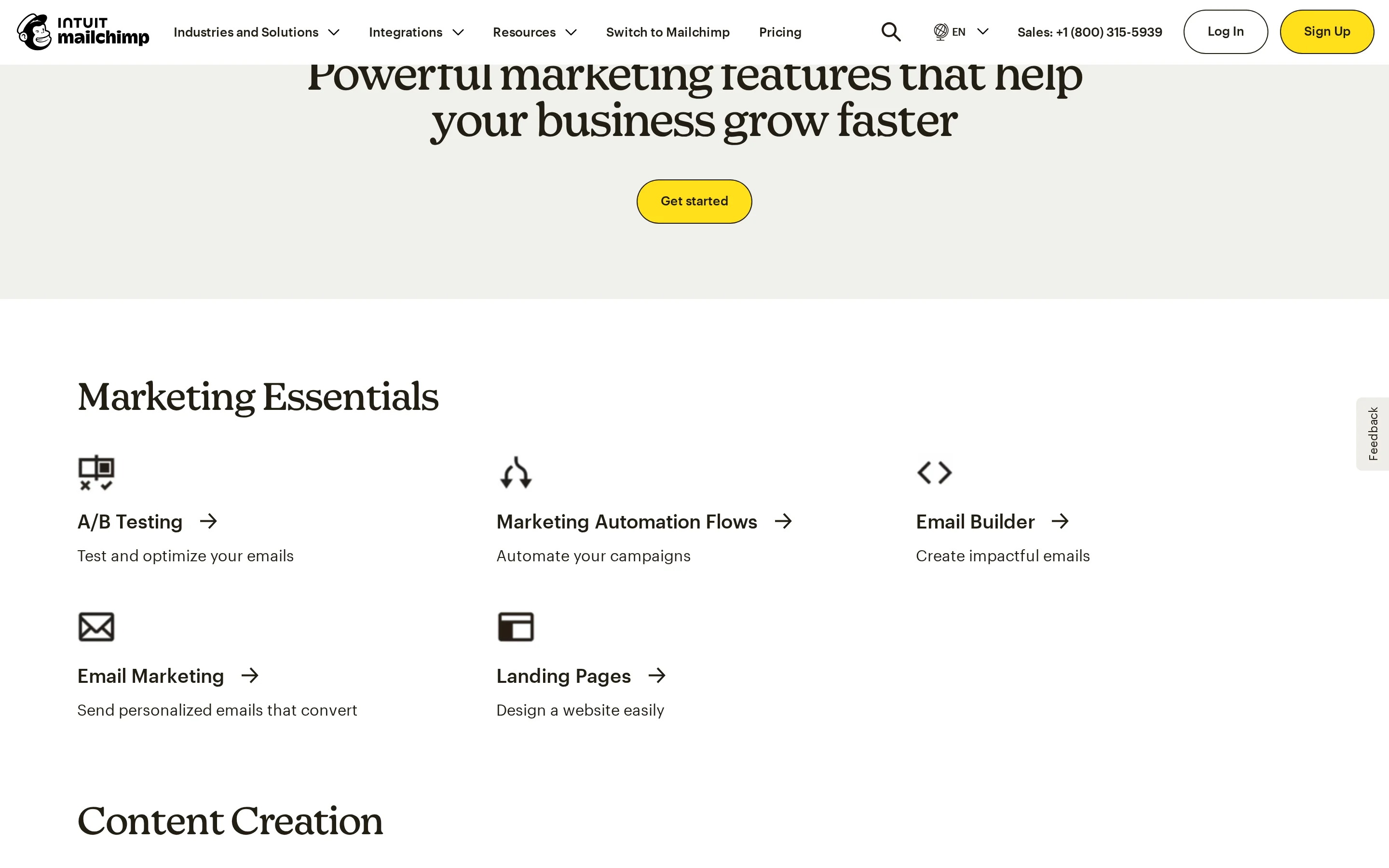 Full resolution
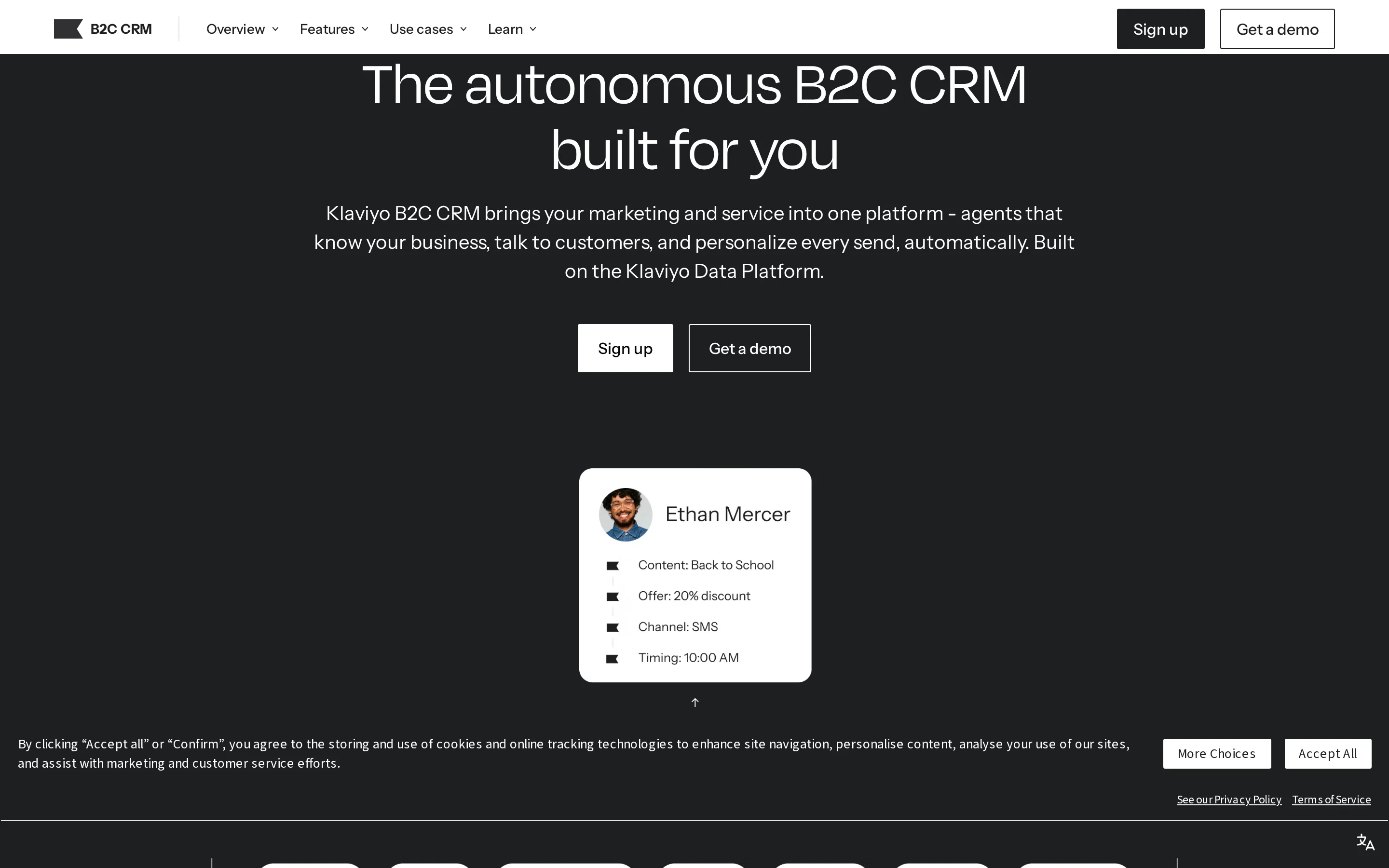 Full resolution
Data Architecture & Personalization Engine: Static Audience Segmentation vs. Real-Time Behavioral CRM
MailChimp operates primarily as a list-based marketing platform. While it has evolved to include audience growth metrics and basic behavioral triggers, its core architecture relies on static segments that update periodically. This approach works well for broadcast-style campaigns where timing precision is less critical than volume. In contrast, Klaviyo is built on the 'Klaviyo Data Platform,' functioning as an autonomous B2C CRM. It ingests data in any shape without predefined schemas, resolving it into unified real-time profiles. This allows Klaviyo to trigger actions based on instantaneous events (e.g., a user viewing a specific product page) rather than batch-updated lists.
The operational difference is stark in personalization depth. MailChimp uses 'Predictive Segmentation' to estimate future behavior based on historical data, offering recommendations like 'likely to buy.' Klaviyo goes further with 'Personalization' that decides who, what, and when to send in real-time for every single customer interaction. For example, if a customer abandons a cart, Klaviyo can instantly adjust the subsequent email content based on the exact items left behind and the customer's current browsing session, whereas MailChimp might send a generic abandoned cart template unless heavily customized with dynamic blocks.
For outbound sales automation, Klaviyo’s architecture provides a superior foundation for hyper-personalized sequences. The ability to treat every customer as unique in real-time reduces the 'spray and pray' effect common in traditional email marketing. However, this power comes with complexity; setting up these real-time flows requires more initial configuration than MailChimp’s simpler, rule-based automations. If your team lacks data engineering resources, MailChimp’s static model may be easier to manage, but Klaviyo offers significantly higher potential ROI through precise targeting.
Automation Logic & Execution: Rule-Based Marketing Workflows vs. Autonomous AI Agents
MailChimp’s automation engine is robust but fundamentally reactive and rule-based. Users define triggers (e.g., 'When someone joins list X') and actions (e.g., 'Send email Y'). Recent updates have introduced 'Enhanced Automations' and Generative AI for content creation, helping users draft copy faster. However, the strategic decision-making—what to send, to whom, and when—remains largely manual. The AI assists in execution (writing text, optimizing send times) but does not autonomously identify new opportunities or fix underperforming campaigns without human intervention.
Klaviyo introduces 'Composer,' an always-on marketing agent that proactively identifies issues such as overlapping audiences or declining campaign performance. It doesn't just wait for a trigger; it analyzes the entire account state to recommend actions. For instance, Composer might detect that a specific segment is fatigued and suggest a new creative angle or pause a flow automatically. This shifts the paradigm from 'reactive automation' (doing what you told it to do) to 'proactive AI-driven decision support' (telling you what you should do next).
In a sales-automation context, Klaviyo’s autonomous agents reduce the cognitive load on marketing teams. Instead of manually auditing hundreds of flows, the AI surfaces the highest-impact revenue opportunities. MailChimp remains a powerful tool for executing predefined strategies efficiently, making it ideal for teams with established playbooks. Klaviyo is better suited for teams looking to discover new revenue streams through AI-led experimentation and optimization, particularly in fast-moving ecommerce environments where market conditions change daily.
Platform Scope & Service Integration: Multi-Channel Marketing Suite vs. Integrated Customer Support Hub
MailChimp positions itself as a broad marketing suite, integrating social media scheduling, paid ad management (Facebook/Instagram/Google), and landing pages alongside email. This makes it a convenient 'all-in-one' for small businesses wanting to manage multiple channels from one dashboard. However, it lacks native customer service tools. To handle support tickets generated by marketing campaigns, users must rely on third-party integrations (like Zendesk or Freshdesk), creating data silos between marketing and service teams.
Klaviyo has expanded its scope to include 'Klaviyo Service,' featuring a native Helpdesk and 'Customer Agent.' This allows companies to resolve customer inquiries directly within the same profile view used for marketing. When a customer replies to an SMS campaign asking about order status, the Customer Agent can answer using real-time data, or route it to a human agent in the Helpdesk with full context. This unification ensures that marketing messages are informed by recent support interactions and vice versa.
For outbound sales, this integration is critical for trust and efficiency. A sales sequence that ignores a recent support complaint can damage brand reputation. Klaviyo’s unified view prevents this by ensuring all touchpoints are aware of each other. MailChimp’s strength lies in its breadth of *acquisition* channels (ads/social), while Klaviyo’s strength lies in the depth of *retention* and *service* integration. If your primary goal is net-new lead acquisition via ads, MailChimp is stronger. If your goal is maximizing lifetime value through seamless post-purchase and support experiences, Klaviyo is superior.
Pricing & true cost
Published tier structures, credit scaling mechanics, and total outbound cost.
 Full resolution
 Full resolution
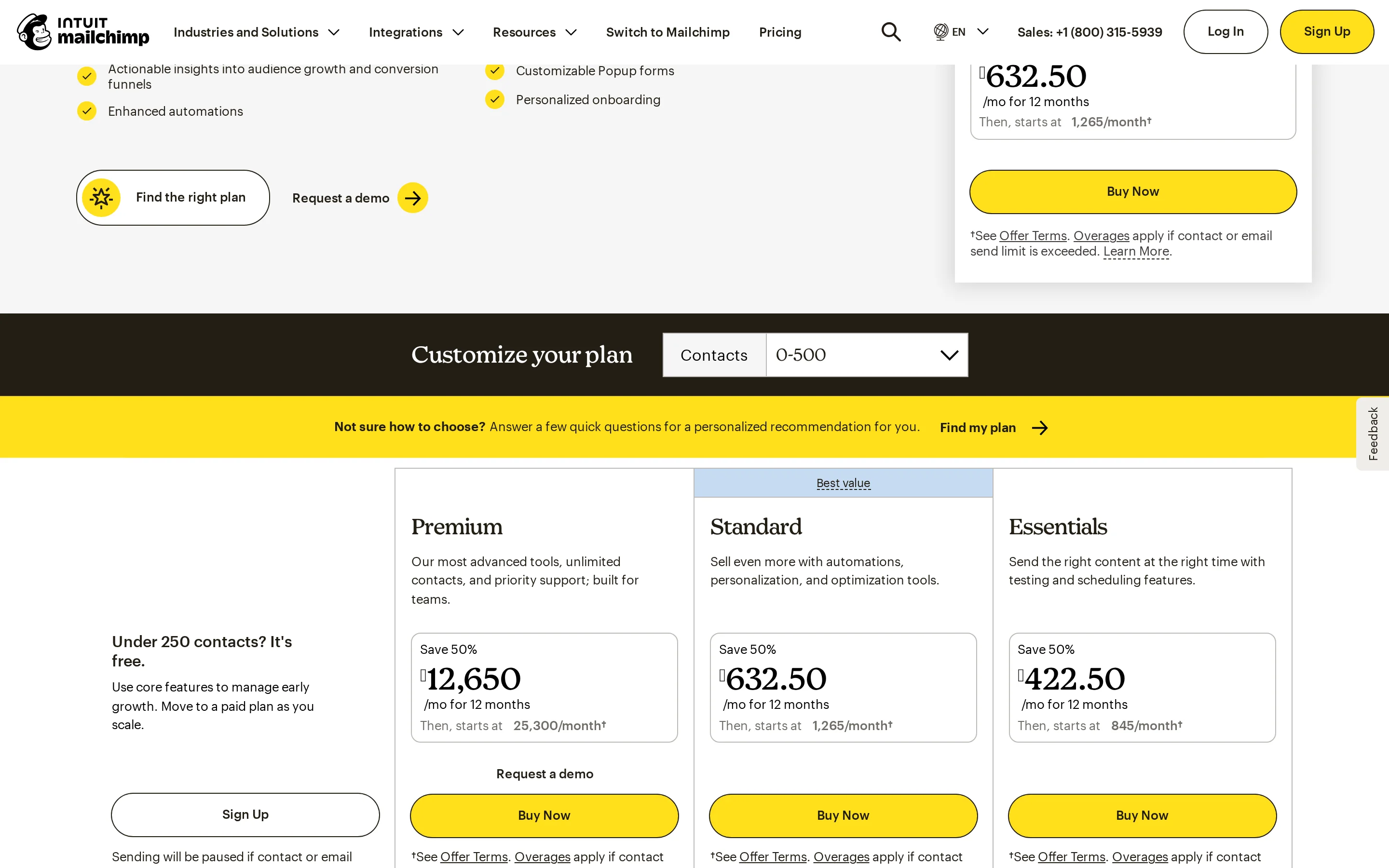
MailChimp plans
- Free: $0/mo (Up to 500 contacts, 500 emails/mo)
- Essentials: Starts at ~$13/mo (varies by contact count, 10x contacts sends)
- Standard: Starts at ~$20/mo (varies by contact count, 12x contacts sends, Advanced Automation)
- Premium: Custom Pricing (Starts higher, 15x contacts sends, Unlimited Contacts option, Priority Support)
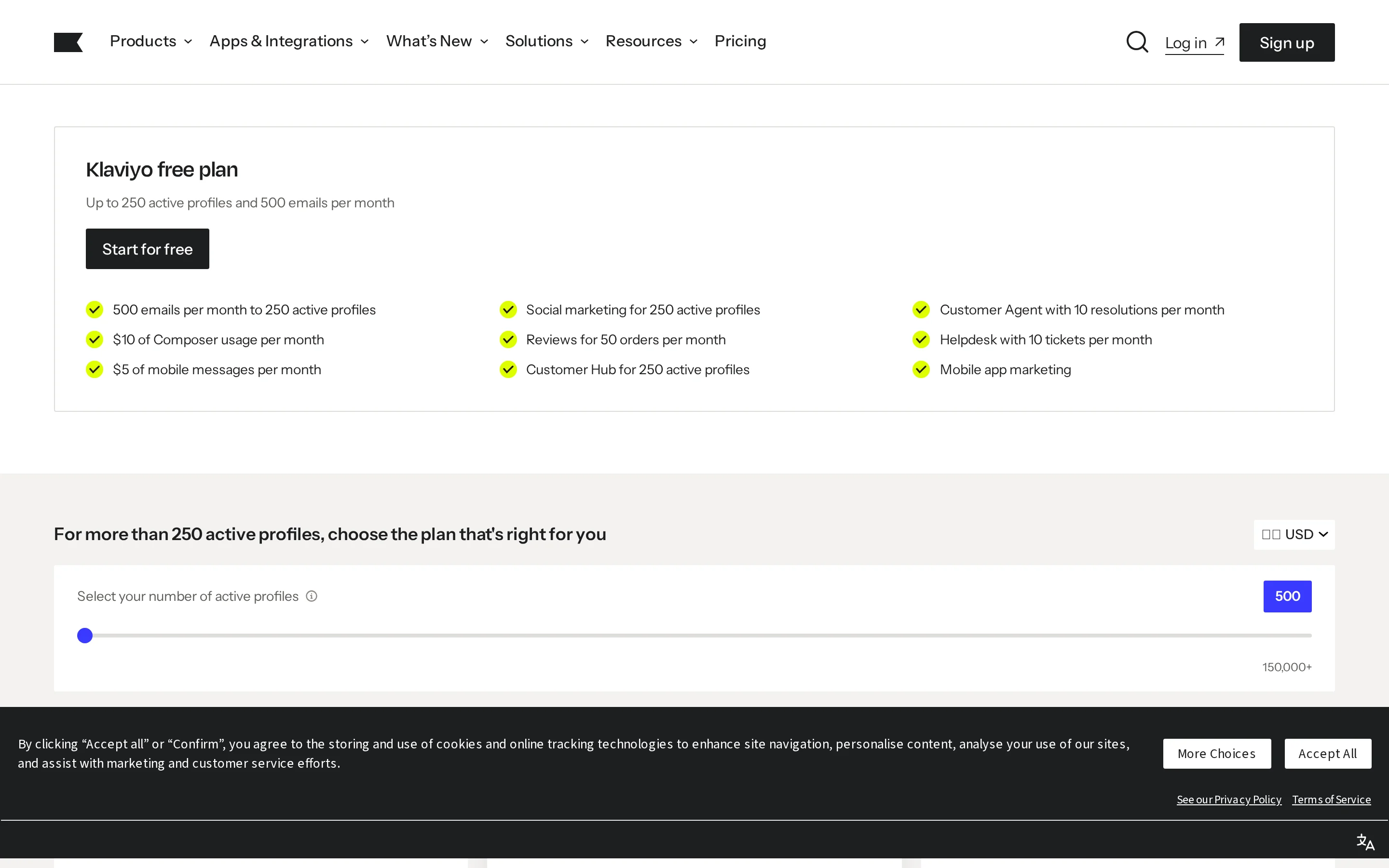
Klaviyo plans
- Free: $0/mo (Up to 250 profiles, 500 emails/mo)
- Email Only: Starts at ~$20/mo (for 251-500 profiles)
- Email + SMS: Starts at ~$45/mo (for 251-500 profiles)
- Enterprise: Custom Quote (Unlimited profiles, dedicated success manager, advanced security)
MailChimp generally offers a lower barrier to entry for very small lists due to its generous free tier (500 contacts vs Klaviyo's 250). However, as contact counts grow, Klaviyo's pricing becomes competitive because it bundles advanced features like predictive analytics and multi-channel messaging (SMS/WhatsApp) into standard tiers, whereas MailChimp often requires upgrading to Premium for similar depth. Klaviyo charges per profile, which can become expensive for large databases with low engagement, while MailChimp charges per active subscriber, penalizing inactive lists less severely if cleaned regularly.
of Ownership Analysis
For a 5-person sales/marketing team managing 10,000 contacts:
MailChimp Standard: Approx. $95-$110/mo (depending on region/tax). Includes 120k sends. Total Annual: ~$1,200.
Klaviyo Email+SMS: Approx. $150-$180/mo for 10k profiles. Includes SMS credits. Total Annual: ~$1,800-$2,160.
While Klaviyo is ~50% more expensive annually, it includes native SMS and advanced AI agents that would require additional subscriptions (e.g., Twilio + AI tools) for MailChimp, potentially equalizing the TCO when factoring in software consolidation benefits.
Which fits your outbound model?
Match your team size, deal complexity, and lead volume to the right engine.
High-Volume Cold Outbound
Neither is ideal for pure cold outbound (spam risk). MailChimp is slightly better tolerated for opt-in newsletters, but both enforce strict consent policies. Use specialized tools like Instantly.ai for cold email.
Ecommerce Lifecycle Marketing
Klaviyo is the industry standard for DTC ecommerce due to deep Shopify/WooCommerce integration and real-time cart abandonment flows.
Small Business All-in-One Marketing
MailChimp wins here for simplicity, combining social, ads, and email in one affordable package for non-technical SMB owners.
Developer-Led Data Pipelines
Klaviyo’s flexible data ingestion (any shape) and robust API make it superior for engineering teams building custom CDP implementations.
Where each platform falls short
Constructive limitations and architectural trade-offs to weigh before signing.
Where MailChimp falls short
- Limited real-time behavioral triggers compared to dedicated CRMs.
- Advanced features (SSO, Multivariate testing) locked behind expensive Premium tier.
- No native customer support/helpdesk functionality.
- Pricing scales steeply with contact count, punishing large inactive lists.
Where Klaviyo falls short
- Steeper learning curve due to complex data architecture and segmentation logic.
- Higher starting cost for SMS/Multi-channel features compared to MailChimp.
- Overkill for simple newsletter-only businesses.
- Strict enforcement of GDPR/CCPA can complicate international outbound campaigns.
The switching playbook
What you gain and give up when migrating across platforms.
- Simpler UI for non-technical marketers.
- Built-in social media and ad management tools.
- Lower entry price for small contact lists (<500).
- Loss of real-time behavioral personalization.
- Removal of native helpdesk and customer service integration.
- Reduced depth of predictive analytics and AI agents.
- Access to autonomous AI marketing agents (Composer).
- Unified customer view including support tickets and chat.
- Superior ecommerce data integration and real-time triggers.
- Higher monthly costs as contact lists grow.
- Increased complexity requiring more training.
- Loss of native social media scheduling and ad buying interfaces.
Frequently asked questions
Direct technical answers about MailChimp and Klaviyo.
Which platform has better data accuracy?
Klaviyo generally offers higher data accuracy for ecommerce because it resolves identities across devices and sessions in real-time. MailChimp relies more on explicit sign-ups and imported lists, which can contain stale data.
How do their starting costs compare?
Both offer free plans. MailChimp’s free plan supports up to 500 contacts, while Klaviyo’s supports 250 profiles. Paid plans start around $13/mo for MailChimp Essentials and $20/mo for Klaviyo Email, making MailChimp cheaper for very small lists.
Can I connect unlimited mailboxes?
No. Both platforms are designed for bulk sending from a single authenticated domain/IP pool. They do not function as individual inbox providers like Gmail or Outlook for 1:1 sales conversations.
Which tool is easier to learn?
MailChimp is significantly easier to learn due to its drag-and-drop interface and guided workflows. Klaviyo requires understanding data models, segments, and flow logic, which has a steeper learning curve.
Does Klaviyo replace a CRM like Salesforce?
Klaviyo calls itself a 'B2C CRM' because it manages customer relationships and data. However, it is not a replacement for B2B sales CRMs like Salesforce or HubSpot, which focus on pipeline management and rep activities.
Sources & methodology
Every claim is grounded in official vendor documentation and live audits.
Compare with sendroAI
See how sendroAI replaces manual research, credit limits, and deliverability traps with full autonomous execution.