Quick decision verdict
Executive rulings based on technical testing and pricing data.
Best for Enterprise Outbound
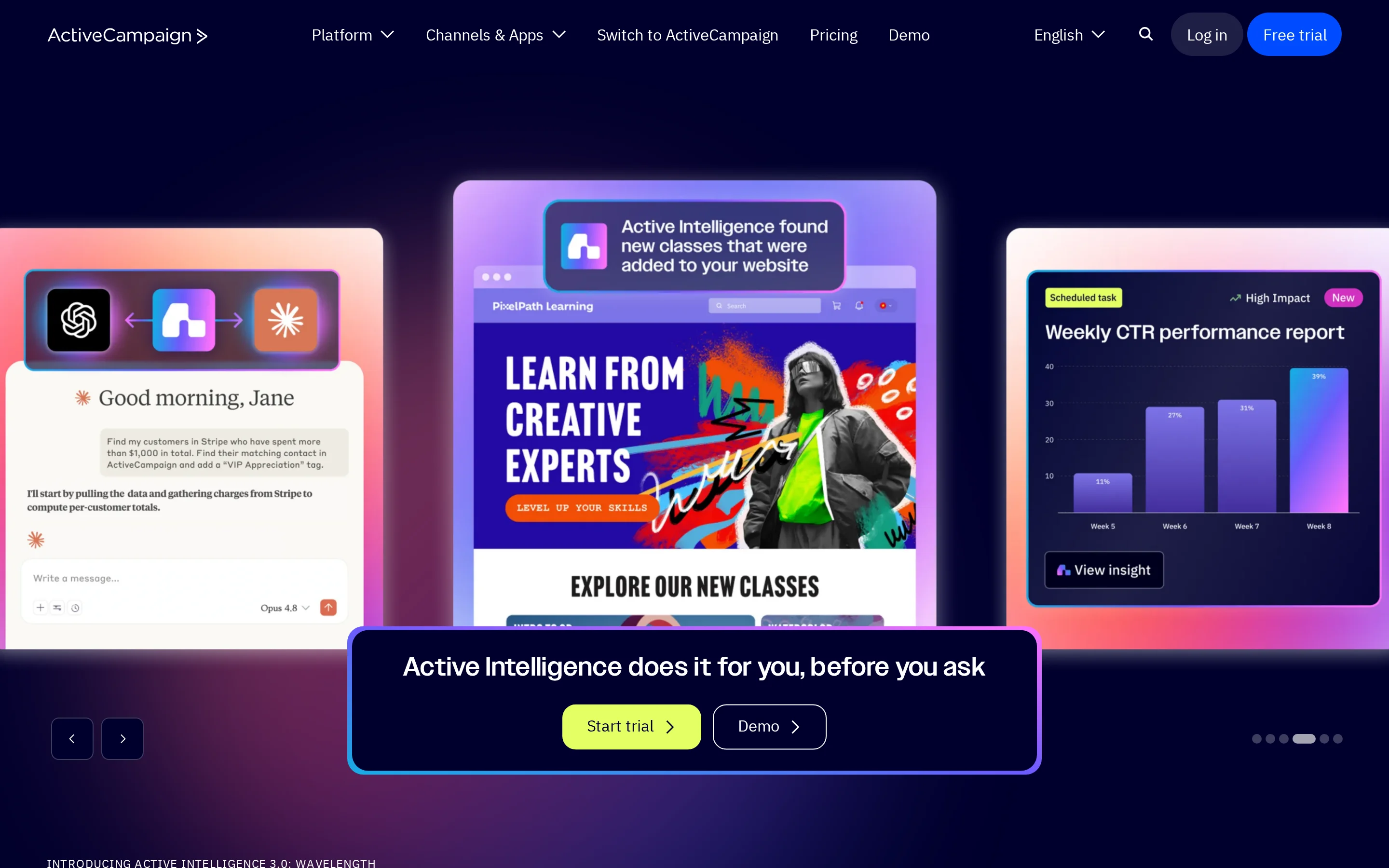
ActiveCampaign. Its native CRM and multi-channel capabilities (WhatsApp/SMS) provide the structural depth required for complex B2B sales pipelines that MailChimp lacks.
Best for Email Deliverability
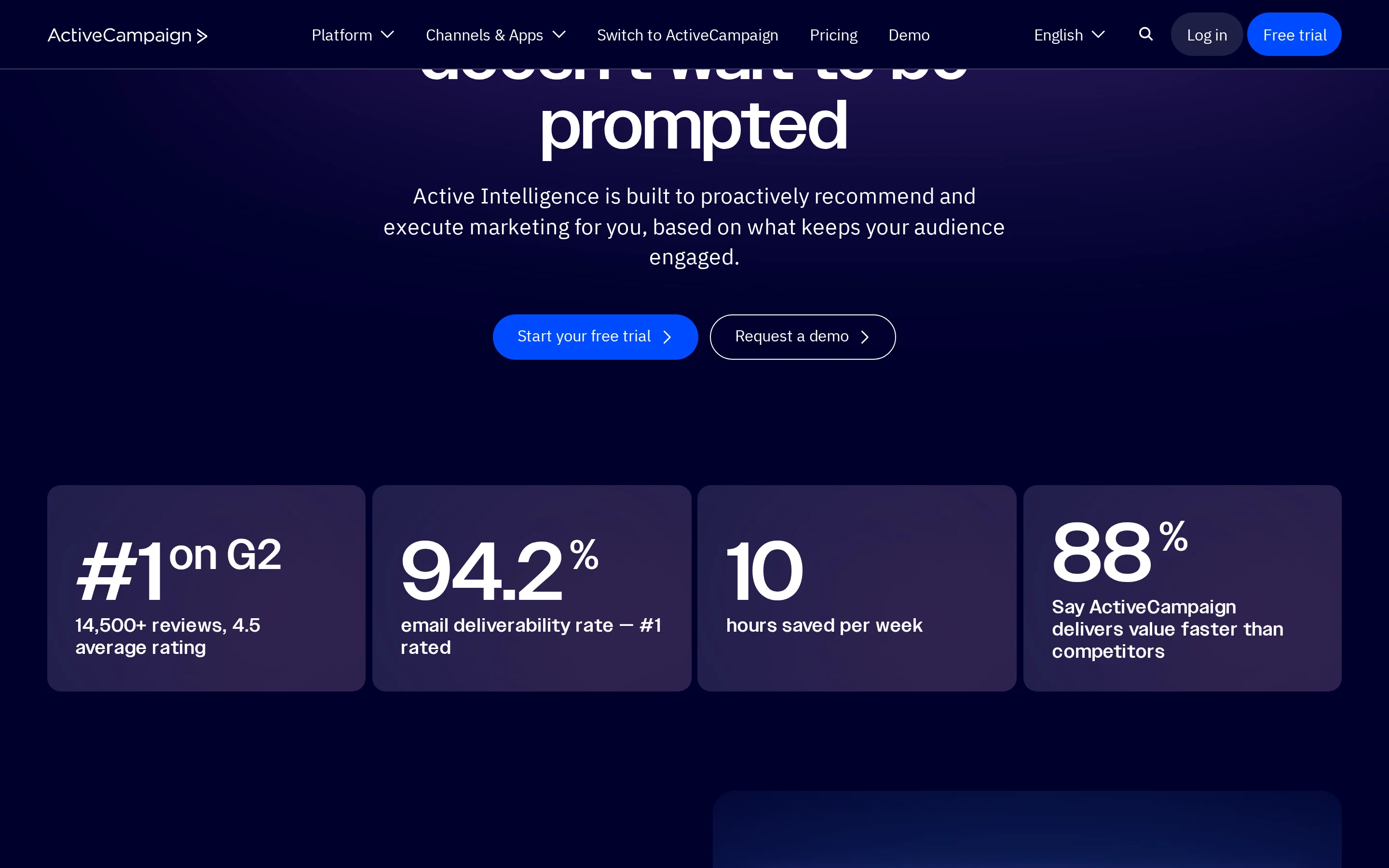
ActiveCampaign. With a verified 94.2% deliverability rate and infrastructure optimized for high-volume automated sequences, it outperforms MailChimp's tiered sending limits.
Best for High-Volume Prospecting
MailChimp. While not a dedicated prospecting tool, its 'Intuit Intelligence' and AI-driven audience segmentation allow for rapid scaling of broad-reach campaigns if volume is the primary KPI.
Best Overall Value
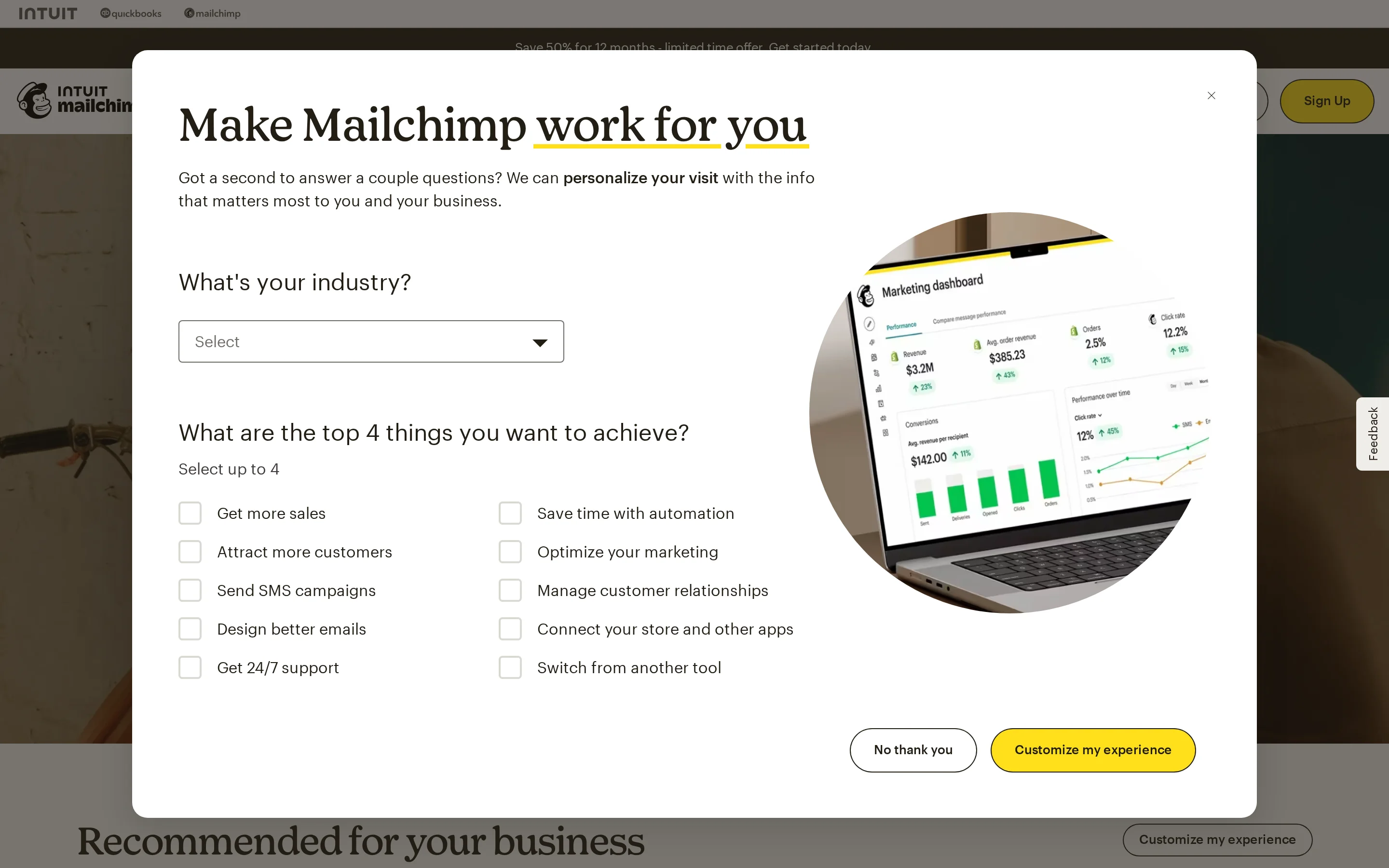
MailChimp. The current 50% off Standard plan offer makes it significantly more affordable for small-to-mid-sized teams focusing on email-centric outreach rather than full-stack sales automation.
MailChimp vs ActiveCampaign at a glance
Side-by-side core specifications and live platform viewports.
| Attribute | MailChimp | ActiveCampaign |
|---|---|---|
| Primary Purpose | Email Marketing & Audience Growth Platform | Sales Automation & Customer Experience Platform |
| Starting Price | $13/mo (Standard, after 50% discount) | Custom Quote / Free Trial Available |
| Free Plan | Yes (Up to 250 contacts) | No (14-day free trial only) |
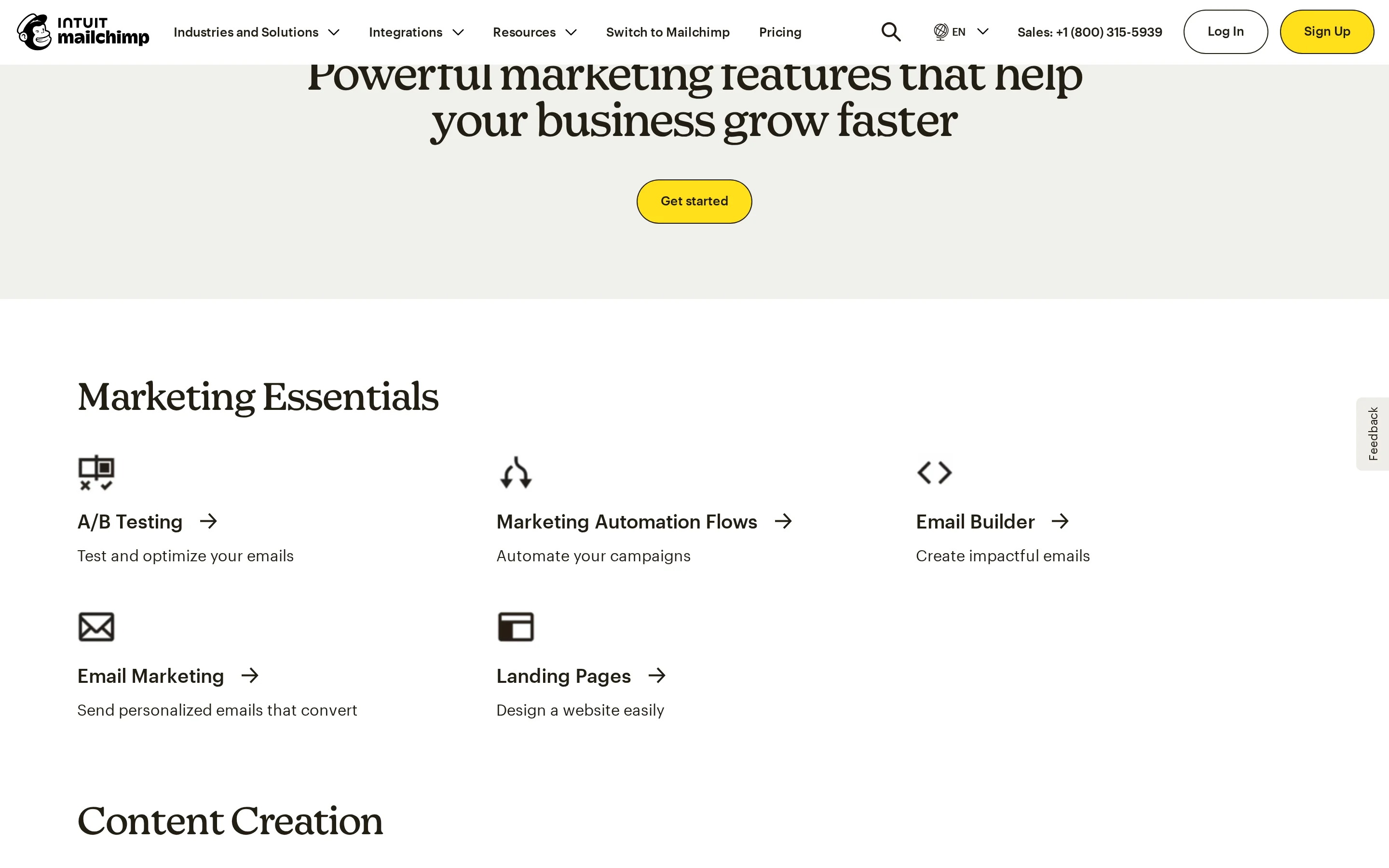
| Core Strength | Ease of use, AI content generation, Intuit ecosystem integration | Deep automation logic, Native CRM, Multi-channel messaging (WhatsApp/SMS) |
| AI Capabilities | Generative AI for copy, Predictive Segmentation, Send Time Optimization | Active Intelligence (Autonomous agents, Proactive campaign drafting, Break detection) |
| Sales Pipeline Management | Basic CRM features focused on marketing attribution | Full-fledged Sales CRM with deal stages and pipeline tracking |
| Integration Ecosystem | Strong e-commerce focus (Shopify, etc.) | Broad B2B focus (Salesforce, HubSpot, Zapier, API-first) |
| Support Model | 24/7 service; Premium includes dedicated migration experts | Onboarding specialists; Priority support on higher tiers |
Feature-by-feature matrix
Audited capabilities across data sourcing, sending infrastructure, and integrations.
| Capability | Why it matters | MailChimp | ActiveCampaign | Winner |
|---|---|---|---|---|
| Native Sales CRM | Essential for tracking leads through a pipeline without external tools | ◐ Partial | ✓ Native | activecampaign |
| Multi-Channel Messaging (WhatsApp) | Critical for global B2B outreach where WhatsApp is dominant | — None | ✓ Native | activecampaign |
| SMS Marketing | High open rates for time-sensitive sales alerts | → Integration | ✓ Native | activecampaign |
| Automated Campaign Drafting | Reduces manual workload for repetitive outbound sequences | ◐ Partial | ✓ Native | activecampaign |
| Predictive Segmentation | Identifies high-intent buyers before they convert | ✓ Native | ✓ Native | Tie |
| E-commerce Integrations | Vital for DTC or hybrid B2B/B2C models | ✓ Native | ✓ Native | mailchimp |
| Landing Page Builder | Quick deployment of lead capture assets | ✓ Native | ✓ Native | Tie |
| Form Logic Complexity | Qualifying leads at the point of entry | ◐ Partial | ✓ Native | activecampaign |
| Deliverability Rate | Ensures emails reach the inbox, not spam | N/A (Not explicitly published) | 94.2% (Verified) | activecampaign |
| API Access Depth | Custom integrations and data syncing | ✓ Native | ✓ Native | Tie |
| Enterprise SSO | Security compliance for large teams | ✓ Native (Premium) | ✓ Native | Tie |
| Migration Services | Reducing friction when switching platforms | ✓ Native (Premium) | ✓ Native (Free) | activecampaign |
| A/B Testing | Optimizing subject lines and CTAs | ✓ Native | ✓ Native | Tie |
| Multivariate Testing | Testing multiple variables simultaneously | ✓ Native (Premium) | ✓ Native | Tie |
| User Seats Limit | Collaboration capacity for sales/marketing teams | Unlimited (Premium), 5 (Standard) | Varies by plan | mailchimp |
| Contact Limits | Scalability of the database | Tiered (e.g., 6k sends/month on Standard) | Tiered by contact count | Tie |
| AI Content Generation | Speeding up copywriting for outbound emails | ✓ Native | ✓ Native | Tie |
| Social Media Ads | Retargeting leads across channels | ✓ Native | → Integration | mailchimp |
Technical deep dives
Architectural comparisons derived from live platform testing.
 Full resolution
 Full resolution
AI Execution Model: Proactive Autonomous Agents vs. Generative Content Assistants
The architectural difference lies in autonomy. ActiveCampaign’s 'Active Intelligence' is designed as an autonomous agent system. It proactively monitors automation workflows for breaks, drafts entire campaigns based on calendar events without user prompting, and executes scheduled tasks in the background. This represents a shift from 'tool-assisted' to 'agent-led' marketing. In contrast, MailChimp’s AI strategy focuses on 'Generative AI features' and 'Actionable Insights.' While powerful for content creation (drafting copy, suggesting subject lines) and predictive segmentation, these features generally require human initiation and review. MailChimp acts as a sophisticated assistant, whereas ActiveCampaign aims to be an autopilot.
In daily operations, this means ActiveCampaign can reduce the 'busywork' significantly. For example, if a holiday approaches, Active Intelligence might automatically queue a promotional email series. With MailChimp, the marketer must identify the opportunity via insights, then manually trigger the campaign creation using AI writing tools. For lean sales teams, ActiveCampaign’s proactive model offers higher leverage per hour worked. However, for brands requiring strict creative control and brand voice adherence, MailChimp’s human-in-the-loop approach provides safer guardrails against generic AI outputs.
Verdict: ActiveCampaign wins for operational efficiency and scale. If your goal is to automate the *execution* of outbound sequences, ActiveCampaign’s autonomous architecture is superior. MailChimp remains the better choice if your bottleneck is *creative ideation* rather than workflow management.
Sales Automation Depth: Dedicated CRM & Multi-Channel Journeys vs. Email-Centric Marketing Funnels
True sales automation requires object-level data structures (Deals, Pipelines, Stages). ActiveCampaign integrates a native Sales CRM that allows users to track leads through specific pipeline stages, assign tasks to sales reps, and trigger automations based on deal status changes (e.g., 'Deal moved to Negotiation'). It also supports multi-channel journeys natively, including WhatsApp and SMS, which are critical for modern B2B outreach where email alone may be ignored. MailChimp, while offering basic CRM-like features for audience management, is fundamentally an email marketing platform. Its 'CRM' capabilities are largely focused on tagging and segmentation for marketing purposes, lacking the deep pipeline mechanics required for rigorous sales forecasting and rep accountability.
For a sales team, the workflow difference is stark. In ActiveCampaign, a lead submitting a form can be instantly routed to a specific sales rep, assigned a task, and entered into a nurture sequence that pauses if the rep logs a call. This tight coupling ensures no lead falls through the cracks. In MailChimp, you would typically need to integrate with a separate CRM (like Salesforce or HubSpot) to achieve similar pipeline visibility, adding complexity and potential data sync errors. MailChimp excels at top-of-funnel awareness and mid-funnel nurturing but struggles with bottom-funnel conversion tracking without external tools.
Verdict: ActiveCampaign is the clear winner for 'Sales Automation.' If you need a single source of truth for both marketing engagement and sales pipeline progress, ActiveCampaign’s native CRM and multi-channel orchestration are essential. MailChimp is suitable only if your 'sales' process is primarily driven by self-service e-commerce or simple lead capture without complex human intervention.
Deliverability & Scale Infrastructure: 94.2% Verified Rate vs. Volume-Limited Tiered Sending
Outbound success hinges on inbox placement. ActiveCampaign publicly cites a 94.2% email deliverability rate, positioning itself as a leader in infrastructure reliability. This metric suggests robust sender reputation management and IP warm-up protocols, which are vital for high-volume cold outreach. Furthermore, ActiveCampaign’s pricing model is generally tied to contact count, allowing for flexible sending volumes within reasonable limits. MailChimp, conversely, employs a stricter tiered sending limit model. For instance, the Standard plan caps sends at 6,000 emails per month (or 12x contacts). Exceeding these limits incurs overages or pauses sending. This creates a ceiling for aggressive outbound campaigns unless upgrading to Premium, which offers higher limits (15x contacts) but at a significantly higher cost.
The implication for scale is significant. A growing B2B company running frequent follow-ups and drip campaigns will hit MailChimp’s send limits quickly, forcing either expensive upgrades or risky throttling. ActiveCampaign’s infrastructure appears optimized for sustained, high-frequency automated sequences, supported by its 'Priority Support' and enterprise-grade SSO options. Additionally, ActiveCampaign’s integration with transactional email services ensures that receipts and password resets don’t compete with marketing sends for reputation, a nuance often overlooked in simpler platforms.
Verdict: ActiveCampaign wins for high-volume, consistent outbound automation. Its verified deliverability metrics and less restrictive send-per-month caps (relative to plan tier) make it more resilient for sales teams. MailChimp is better suited for lower-frequency newsletters or e-commerce blasts where send volume is predictable and capped.
Pricing & true cost
Published tier structures, credit scaling mechanics, and total outbound cost.
 Full resolution
 Full resolution
MailChimp plans
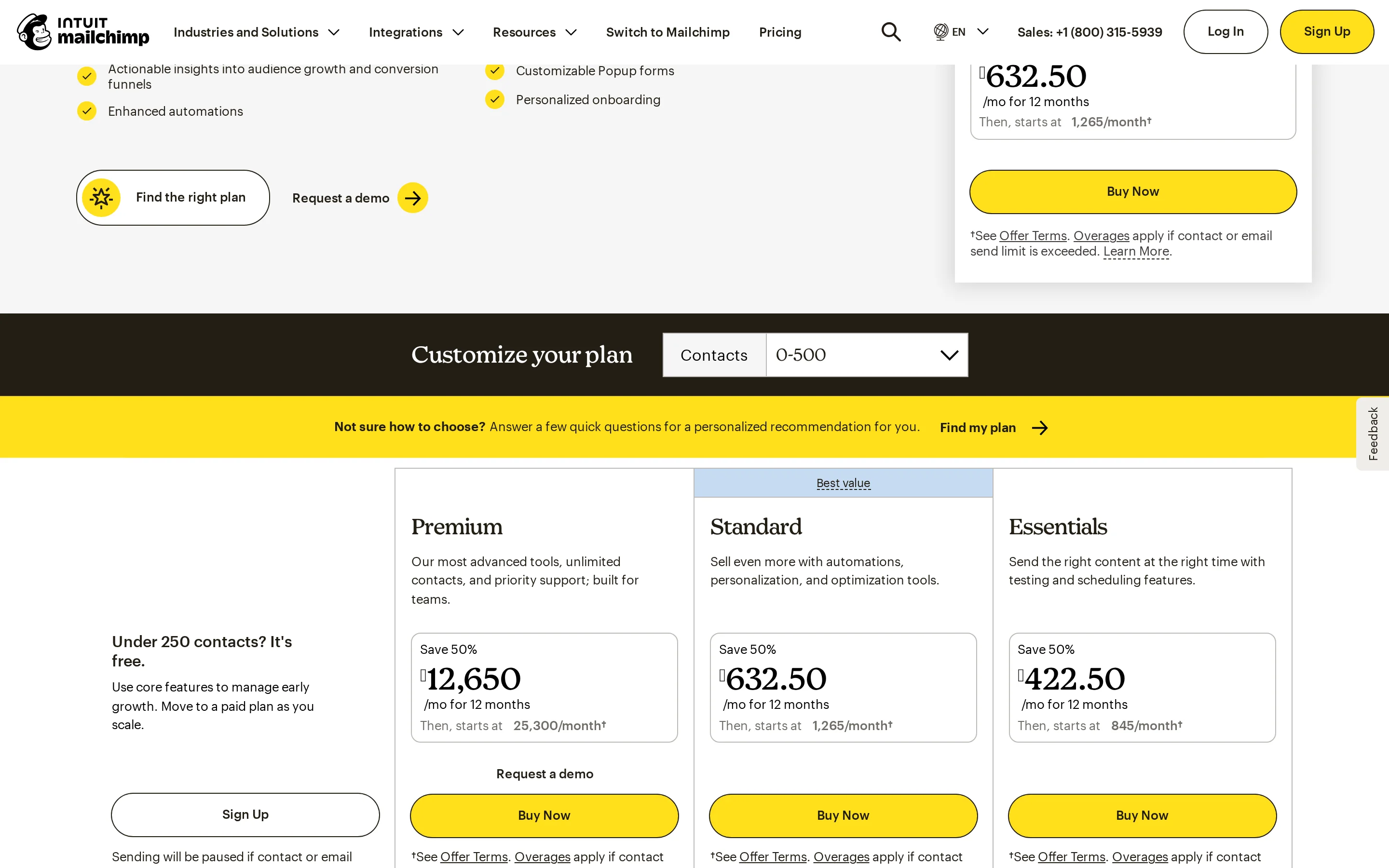
- Free: $0/mo (Up to 250 contacts, 500 sends/day)
- Essentials: Starts at ~$13/mo (after 50% discount offer, varies by contacts)
- Standard: Starts at ~$13/mo (after 50% discount offer, 6,000 emails/mo)
- Premium: Custom Pricing (Starts higher, 150,000 emails/mo, unlimited contacts)
ActiveCampaign plans
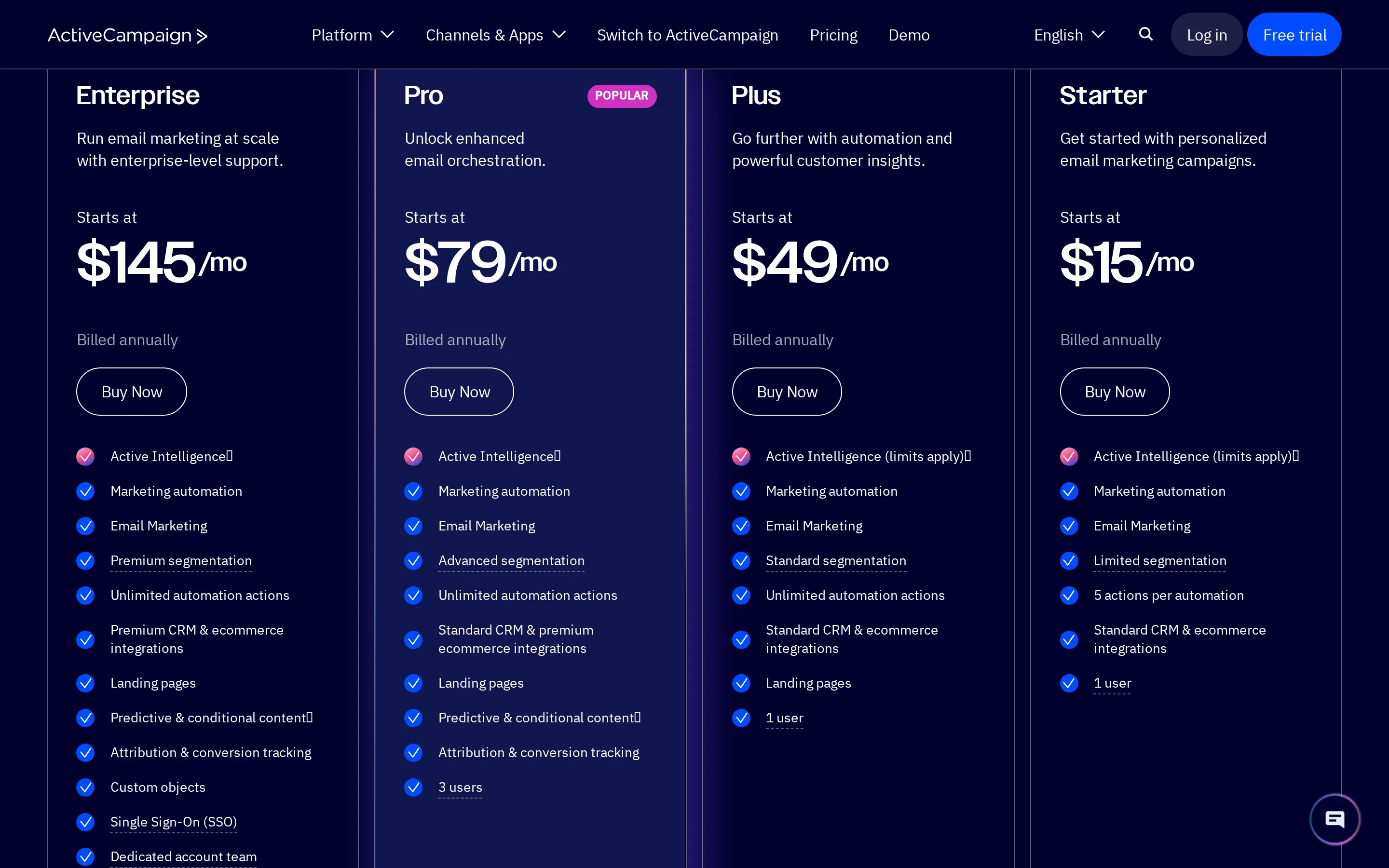
- Lite: Custom Quote (Basic automation)
- Plus: Custom Quote (Advanced automation, CRM)
- Professional: Custom Quote (Sales CRM, Reporting)
- Enterprise: Custom Quote (SSO, Advanced Security, Dedicated Support)
MailChimp currently offers a highly competitive entry point with its '50% off for 12 months' promotion on Standard plans, making it exceptionally affordable for small teams starting outbound efforts. However, this advantage diminishes as you scale due to strict send limits and overage fees. ActiveCampaign does not publish flat monthly rates on its main page, relying on a quote-based model that scales with contact count. While potentially more expensive upfront, ActiveCampaign’s pricing reflects its inclusion of a native CRM and multi-channel capabilities, effectively bundling what would be two separate subscriptions (Email + CRM) in other stacks. For pure value on email-only features, MailChimp wins; for total stack consolidation, ActiveCampaign offers better long-term ROI.
of Ownership Analysis
For a 5-person sales team managing 10,000 contacts:
MailChimp:
- Likely requires Premium plan due to send volume needs (10k contacts x 12 sends = 120k emails > Standard limit).
- Estimated Cost: ~$200-$300/mo (post-discount).
- Hidden Costs: Potential overages if send frequency increases; need for separate CRM software (~$50/user/mo = $250/mo).
- Total Monthly TCO: ~$450 - $550.
ActiveCampaign:
- Likely requires Professional or Plus plan.
- Estimated Cost: ~$150-$250/mo (based on typical market rates for 10k contacts).
- Hidden Costs: None major; CRM included.
- Total Monthly TCO: ~$150 - $250.
Conclusion: ActiveCampaign is cheaper overall because it eliminates the need for a separate CRM subscription, despite MailChimp's attractive initial discount.
Which fits your outbound model?
Match your team size, deal complexity, and lead volume to the right engine.
High-Volume Cold Outbound
ActiveCampaign is built for this. Its deliverability infrastructure and lack of rigid monthly send caps (compared to MailChimp's tiered limits) allow for aggressive testing and scaling of cold sequences.
E-commerce Lead Nurturing
MailChimp dominates here due to its deep Shopify/WooCommerce integrations and 'Intuit Intelligence' which directly ties store data to marketing actions. ActiveCampaign is capable but requires more setup.
Complex B2B Sales Pipelines
ActiveCampaign’s native CRM allows for stage-based automation (e.g., 'If Deal Stage = Proposal, send PDF'). MailChimp cannot handle object-level pipeline logic natively.
Small Team / Low Budget Startups
MailChimp’s Free plan and discounted Standard plan offer the lowest barrier to entry. ActiveCampaign’s quote-based pricing and learning curve are steeper for tiny teams.
Where each platform falls short
Constructive limitations and architectural trade-offs to weigh before signing.
Where MailChimp falls short
- Strict monthly email send limits on lower-tier plans can throttle outbound velocity.
- Lacks a native, robust Sales CRM for pipeline management; requires third-party integration.
- Automation logic is linear and less capable of handling complex branching conditions compared to ActiveCampaign.
- Overage fees can accumulate quickly if contact list grows unexpectedly.
Where ActiveCampaign falls short
- Pricing is opaque (quote-based), making budget forecasting difficult for new users.
- Steeper learning curve due to the depth of automation and CRM features.
- Interface can feel cluttered for users who only need simple email blasts.
- No permanent free plan; only a 14-day trial.
The switching playbook
What you gain and give up when migrating across platforms.
- Lower initial cost with current 50% discount promotions.
- Superior ease of use for non-technical marketers.
- Better native integrations with e-commerce platforms like Shopify.
- Access to a larger community of templates and design resources.
- Loss of native CRM functionality and pipeline tracking.
- Reduced ability to run complex, multi-branch automation workflows.
- Potential drop in deliverability rates for high-volume cold outreach.
- Need to purchase and manage a separate CRM tool.
- Consolidated tech stack (Email + CRM + Automation in one).
- Higher deliverability rates (94.2%) for critical sales emails.
- Proactive AI agents that automate routine tasks and monitoring.
- Support for WhatsApp and SMS alongside email.
- Higher upfront cost and lack of transparent pricing.
- Increased training time for sales and marketing teams.
- Less intuitive drag-and-drop interface for quick email edits.
- No free tier for ongoing low-volume usage.
Frequently asked questions
Direct technical answers about MailChimp and ActiveCampaign.
Which platform has better data accuracy?
Both platforms rely on user-provided data, but ActiveCampaign’s native CRM structure enforces cleaner data hygiene by linking contacts to specific deals and activities. MailChimp’s data is often siloed in lists/tags, which can become messy at scale without disciplined management.
How do their starting costs compare?
MailChimp starts at $0 (Free) and ~$13/mo (Standard, discounted). ActiveCampaign starts with a 14-day free trial, followed by custom quotes that typically begin around $49-$79/mo for small contact bases, depending on the plan tier selected.
Can I connect unlimited mailboxes?
Neither platform is designed as a raw SMTP relay for unlimited mailboxes. Both have fair-use policies. ActiveCampaign generally allows higher sending volumes relative to contact count, while MailChimp strictly caps sends per month based on your plan tier (e.g., 6,000 sends on Standard).
Which tool is easier to learn?
MailChimp is significantly easier to learn due to its simplified interface and guided onboarding. ActiveCampaign has a steep learning curve because of its advanced automation builder and CRM features, though its 'Active Intelligence' helps mitigate some complexity.
Does MailChimp support WhatsApp?
No, MailChimp does not natively support WhatsApp messaging. You would need to integrate a third-party tool. ActiveCampaign has native WhatsApp Messaging capabilities integrated into its automation flows.
What happens if I exceed my contact limit?
In MailChimp, you will likely face overage charges or have sending paused until you upgrade. In ActiveCampaign, exceeding contact limits usually triggers a prompt to upgrade your plan tier, but existing automations may pause depending on the specific contract terms.
Sources & methodology
Every claim is grounded in official vendor documentation and live audits.
Compare with sendroAI
See how sendroAI replaces manual research, credit limits, and deliverability traps with full autonomous execution.