
If you’re a B2B salesperson and you feel like it’s getting harder, you’re not imagining it.
A Gartner study found that 77% of B2B buyers say their last purchase was complex or difficult. That’s not a niche finding — Gartner surveyed thousands of buyers across industries, company sizes, and geographies. Almost four out of five people who buy things for a living described the process as harder than it should be.
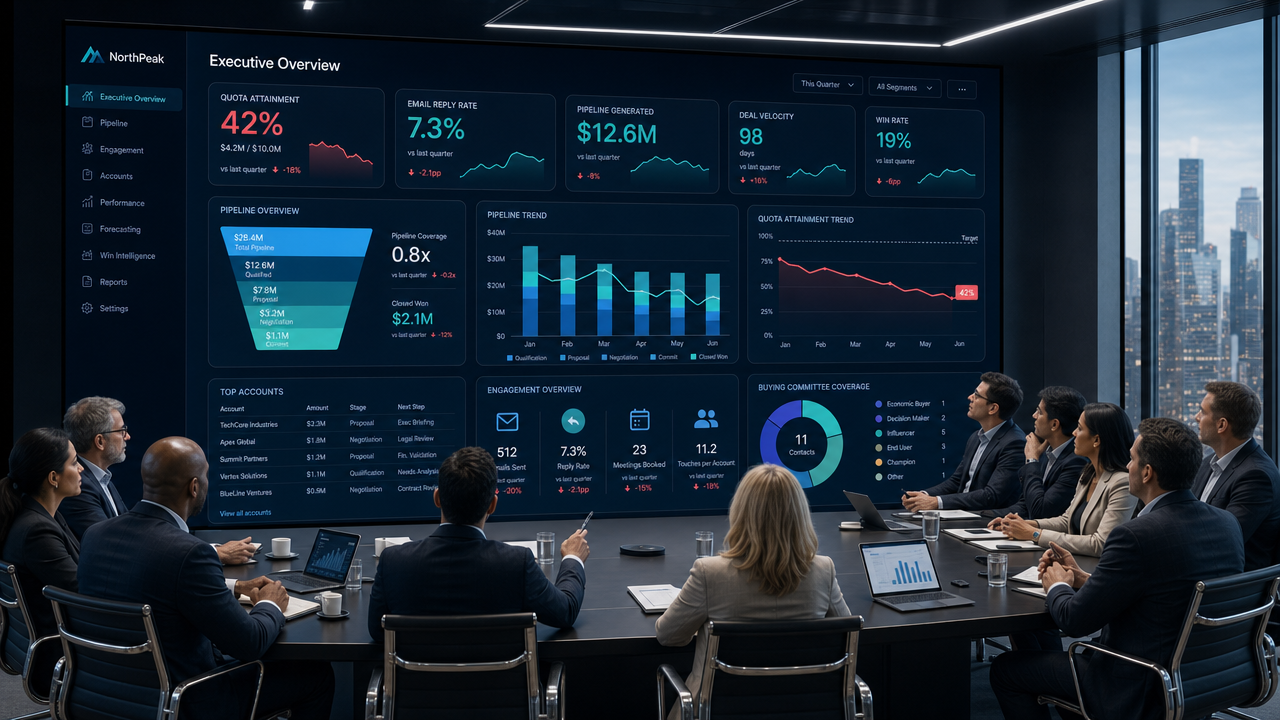
Now take that buyer-side data and layer on the seller perspective. Venli Consulting analyzed 7.1 million opportunities across Gong, Gartner, and RepVue to produce the definitive State of B2B Sales report for 2026. The headline: quota attainment has been stuck at 42.69% for eight consecutive quarters. Fewer than half of sales professionals are hitting their numbers, and that number hasn’t budged in two years.
This post compiles the raw data from all 17 authoritative sources consulted for this analysis — Venli, Sellerity, Gartner, Challenger Inc, Martal Group, Instantly, Leadriver, Forrester, and more — to answer one question honestly: is B2B sales actually getting harder, and what do the teams that are still winning do differently?
The Quota Attainment Crisis
Let’s start with the number that should alarm every sales leader reading this. Quota attainment across cloud and SaaS sales organizations has fallen from 53% in Q1 2022 to 42.69% today, and it has flatlined at that level for two full years. The top-line numbers from the research paint a stark picture:
| Metric | Value | Source |
|---|---|---|
| Quota attainment (cloud sales, 2026) | 42.69% | Venli Consulting (Gong 7.1M opps) |
| Quota attainment Q1 2022 (baseline) | 53% | Venli |
| Sellers who missed quota in 2025 | 78% | Pavilion + Ebsta |
| SDRs missing quota per quarter | 83% | Leadriver |
| Sales leaders saying closing is harder | 74% | Venli (Gong) |
| Revenue growth (annual avg, 2025) | 16% | Venli |
| Sales pros meeting/exceeding quota | 24.3% | Searchlab 2026 |
| Top 20% generate % of all revenue | 53% | Searchlab |
Searchlab’s 2026 survey adds more texture: only 24.3% of sales professionals across all roles meet or exceed quota, and the top 20% of performers now generate 53% of all revenue. The gap between the top and the median has never been wider. If you’re an average performer in 2026, the data suggests you are not hitting your number — and your competitors in the top quintile are taking more than half the market.
Buying Committee Explosion
The second structural shift is the growth of the buying committee. In 2017, a typical B2B purchase involved 5-6 stakeholders. By 2026, that number has more than doubled.
| Metric | Value | Source |
|---|---|---|
| Buyers saying purchase was complex/difficult | 77% | Gartner |
| Average buying committee size (enterprise) | 11.2 stakeholders | Sellerity / Forrester / 6sense |
| Typical buying group range | 6-10 stakeholders | Gartner |
| Enterprise deals | 15-17 stakeholders | Gartner |
| CFO holds final decision power | 79% of the time | Venli (Gong data) |
| Procurement involved in buying cycles | 53% | Forrester |
| Top 10% reps engage by Stage 2 | 4.2 stakeholders | Sellerity |
| Top 10% identify internal champion | 89% (avg 45%) | Sellerity |
Sellerity’s analysis of 100,000 AI-scored mock sales calls reveals why this kills average performance. The top 10% of reps engage 4.2 stakeholders by Stage 2 of the deal — compared to just 1.4 for the average rep. They identify an internal champion 89% of the time versus 45% for the median. This isn’t about working harder; it’s about working differently. A deal with 11 stakeholders cannot be won by talking to the one person who answered the phone.
Sales Cycles Lengthening
Longer buying committees naturally produce longer sales cycles, and the data confirms it. According to Venli’s analysis of Gong’s 7.1 million opportunities, average sales cycles have increased 22% since 2022.
| Metric | Value | Source |
|---|---|---|
| Sales cycle increase since 2022 | +22% | Venli (Gong) |
| Average sales cycle (2026) | 84 days | Venli |
| Deals over $200K | 230+ days | Venli |
| B2B cycle length range | 121-218 days | Digital Applied |
| AEs handling Tier 1 tech questions without SE | 15% shorter cycle | Sellerity |
An 84-day average cycle means a rep who needs to close four deals per quarter needs their pipeline to be 12 months deep at all times. For deals over $200K, the cycle stretches past 230 days — nearly eight months. This compression effect means that any slowdown early in the funnel (poor prospecting, weak discovery, slow follow-up) is amplified across the full cycle length.
Cold Outreach Benchmarks 2026
Outbound effectiveness has been declining steadily, and 2026 represents a new low. Instantly’s 2026 Cold Email Benchmark Report, based on billions of emails sent through their platform, reports a platform-wide average reply rate of just 3.43%. For context, that rate was approximately 7% in 2023 and roughly 5% in 2024.
| Metric | Value | Source |
|---|---|---|
| Cold email avg reply rate (2026) | 3.43% | Instantly (billions of emails) |
| Cold email avg open rate | 27.7% | Instantly / Infraforge |
| Cold email failure rate | ~95% | GMass / Martal |
| Emails never reaching inbox | ~17% | Infraforge |
| Cold reply rate (2024 baseline) | 5.1% | Infraforge |
| Cold reply rate (2023 baseline) | ~7% | Salesmotion |
| Cold calling success rate | ~2.3% | Gradient / Challenger |
| Send-to-deal conversion | 0.2-2% | Focus Digital / Infraforge |
| Follow-ups generate % of replies | 42% | Instantly / HubSpot |
| Reps who never send a second email | 48% | Instantly |
| 80% of sales need 5+ follow-ups | after initial contact | HubSpot |
A few critical takeaways from this data. First, 42% of all replies come from follow-up emails, yet nearly half of all senders never send a second touch. The biggest gap in cold outreach isn’t technique — it’s persistence. Second, the open rate of 27.7% is partially inflated by Apple’s Mail Privacy Protection (MPP), which automatically opens emails in the background. Autobound and Leadriver estimate that 30-50% of measured opens are MPP-related noise. Real human open rates are likely closer to 15-18%.
Third, and perhaps most importantly, personalization still works. The research shows that advanced personalization (beyond first name) produces 2-3x the reply rate of generic templates — approximately 18% versus 9% in controlled tests by Martal Group and Infraforge. A GrowthList study pegs the reply-rate increase from personalization at 142%. But here’s the kicker: Mailshake reports that only 5% of senders personalize every email. The competitive advantage is sitting there, untouched by 95% of the market.
Why B2B Sales Has Gotten Harder
The numbers explain what is happening, but they don’t explain why. Based on the research, six root causes stand out.
The Buyer Has Changed Fundamentally
Seventy percent of the buyer journey now happens before a prospect ever speaks to a salesperson (Venli/Gong). Ninety-one percent arrive at the first meeting already knowing the vendor. Seventy-five percent of B2B buyers prefer a rep-free buying experience (Gartner). Buyers access 12-14 sources on average before engaging a vendor. Only 17% of the buying process is spent meeting with potential suppliers.
The old sales playbook assumed you would guide the buyer from unaware to aware to interested to committed. Today’s buyer arrives already aware, already educated, and already skeptical. They don’t need information; they need a reason to choose your option over the seven others they’ve already evaluated.
The Information Paradox
Challenger Inc’s June 2026 report, “Why B2B Sales Feels Harder Than Ever,” identifies what they call the Information Paradox. Buyers are more informed than ever — but more overwhelmed, not less. They respond to information overload by delaying decisions, adding stakeholders (safety in numbers), and defaulting to the status quo.
Sellers respond to buyer information overload by providing more information — more data sheets, more case studies, more product demos. This increases the noise in the funnel rather than cutting through it. As one survey respondent told Challenger: “Buyers engage with us after they have already researched multiple vendors and our reps are getting surprised at renewal.”
Sellers Haven’t Changed Their Approach
Most sellers still lead with discovery questions the buyer already answered online. They position solutions too early instead of challenging the buyer’s thinking. They respond to requests rather than proactively guiding decisions. Geoff Hendricks of Richardson Sales Executive Training put it bluntly: “Some sellers share a little bit of information, but as soon as they get somebody on the line, they Evil Knievel over the chasm and just talk about their own products.”
AI Has Raised the Bar
In 2026, 96% of revenue leaders expect their teams to be using AI (Venli). Eighty-seven percent of US organizations now use AI in sales in some capacity. Leadriver reports a 54% increase in AI adoption inside outbound teams this year alone. However, only 6% of sales job descriptions mention AI-related skills (Gartner), and only 1 in 10 CEOs believe their Chief Sales Officers are AI-savvy (Venli).
The result is a strange asymmetry: buyers are using AI to research and filter vendors more effectively, while many sellers are using AI to generate more generic outreach at higher volume. After 6-8 weeks, AI-generated email content produces a reply-rate regression as recipients pattern-match and filter the templates (Leaddriver). The technology is raising the bar on both sides, but the seller side is largely using it the wrong way.
The Overcapacity Problem
Too many quota-carrying reps are competing for essentially flat demand. The number of sales hires has increased while win rates have declined. Revenue growth is down to 16% annual average, and traditional volume-based playbooks no longer produce results. For the first time ever, productivity is ranked as the #1 priority for revenue leaders in 2026.
The SDR Productivity Crisis
The average SDR spends only 18-30% of their workday on actual selling (Leaddriver). The rest goes to data entry, prospect research, tool-switching, and administrative overhead. New SDRs need 4-6 months to reach full productivity, and the average SDR tenure is just 14-18 months. The cost of SDR churn ranges from $78,000 to $149,000 per departure.
This means organizations are investing heavily in hiring and training SDRs who spend 70% of their time on non-revenue activities and leave before they reach full productivity. The math doesn’t work, and it explains why 83% of SDRs miss quota every quarter.
What Winning Sellers Do Differently
The picture so far is sobering, but it’s not hopeless. The same research identifies clear patterns that separate top performers from the rest. Here is what works in 2026.
The Challenger Framework
Challenger Inc’s research, updated with 2026 data from Richardson, identifies four behaviors that distinguish high-performing sellers:
- Teach: Reveal an unknown problem that only your solution can address. Commercial teaching — not product pitching — is the differentiator.
- Tailor: Deliver the right message to the right stakeholder at the right time. One message for the champion, a different one for the CFO.
- Take control: Discuss money early, press on commitments, and use customer verifiers to validate your positioning.
- Constructive tension: Push buyers to think differently, even when it’s uncomfortable. The ARC framework — Acknowledge, Reframe, Confirm — is the tactical tool for this.
The ARC framework is especially useful. When a prospect says “the price is too high,” a top performer responds: “When you say the price is too high, are you comparing it to a specific budget, or is there a gap between the perceived value and the investment required?” Sellerity found that reps who use the Reframe technique score 62% higher on sentiment — the conversation stays constructive even around objections.
The Multichannel Imperative
Single-channel outreach is dying. The data is unambiguous: omnichannel outreach (email + LinkedIn + calls in coordinated cadences) produces a 287% lift in reply rates over email-only (Infraforge, cited by Martal Group). SalesHandy reports that multichannel approaches deliver 40-60% more qualified meetings than single-channel. UpLead found that multi-threaded outreach (engaging 5+ stakeholders at the same account) produces 6x higher close rates.
Yet most sellers still default to email-only sequences and wonder why response rates are dropping. The top 10% treat every account as a multichannel, multi-stakeholder operation from day one.
Personalization Beyond First Name
The personalization data is clear enough that it deserves its own section. Subject line personalization with the prospect’s first name produces up to a 43.4% reply rate in some studies (SmartLead). Company name in the subject line boosts opens by 22%. Questions in subject lines lift opens by 21%. Subject lines with 36-50 characters produce the best response rates (GrowthList).
But personalization at depth — referencing a specific recent event, a mutual connection, a strategic initiative the prospect’s company announced — is where the real leverage sits. Infraforge reports 2-3x reply rates for advanced personalization versus generic templates. The challenge, of course, is doing this at scale. This is exactly where AI-powered research engines change the game: they surface the specific signal that makes personalization credible without requiring hours of manual research per prospect.
Data-Informed Selling
Leaddriver’s State of B2B Outbound 2026 report identifies the practices of top-decile outbound teams. They treat their ICP as a working hypothesis refined quarterly, not a fixed segment. They run cohort analysis comparing which closed-won customers became reference accounts versus which became cost-to-serve disasters, and feed those findings back into prospecting — often shrinking their target list rather than expanding it. They treat deliverability as a discrete project before changing messaging. And they use 7-12 day sequences with 4-6 blended touches, not the 20-email spray pattern that defined the 2022 era.
Performance analytics platforms that surface which channels, messages, and sequences drive actual pipeline — not just opens and clicks — are the infrastructure that makes data-informed selling possible.
Real-World Example: SaaS Company Turnaround
A mid-market SaaS company selling to enterprise HR teams came to us after their outbound pipeline had collapsed. They had 12 SDRs, all hitting quota in 2023, but by Q3 2025 only 3 of 12 were hitting their numbers. The symptoms were classic: low reply rates (under 2%), long ramp time for new hires (5+ months), and single-threaded deals that died when the one champion left the company.
The diagnosis revealed three problems. First, their sequences were email-only, following up six times over three weeks with no variation in channel. Second, their personalization was limited to first-name tokens against a spray of generic value propositions. Third, their deliverability was quietly killing them — over 22% of their emails were never reaching the inbox because they had scaled sending without proper inbox rotation or authentication hygiene.
Within 60 days of implementing multichannel automated sequencing that combined personalized emails with LinkedIn touches, inbox rotation to protect sender reputation, and AI-driven research for account-specific personalization, the team saw their reply rates climb from under 2% to over 7%. Their warm pipeline re-emerged within one quarter. The key wasn’t a single silver bullet — it was fixing all three broken layers simultaneously.
Common Mistakes Teams Still Make
Despite the data being publicly available, most teams repeat the same errors. Here are the four most common mistakes that the research clearly identifies:
- Email-only outreach. Despite overwhelming evidence that multichannel produces 287% more replies, most outbound teams still rely on email alone. Linkedin messages, personalized video, and triggered calls are table stakes in 2026.
- Quota math denial. Teams design pipeline targets assuming 53% quota attainment from 2022. With real attainment stuck at 42.69%, the required top-of-funnel volume is 25% higher than most teams plan for. Budgeting for 2022-era conversion rates guarantees a miss.
- Single-threaded deal progression. With 11.2 average stakeholders per enterprise deal, a rep who has contact with one person at an account has touched less than 10% of the buying committee. Winning deals require multi-stakeholder engagement from Stage 1.
- Ignoring deliverability. Seventeen percent of cold emails never reach the inbox. Teams pour budget into more SDRs, better copy, and more tools, while ignoring that one in six messages is invisible to the recipient. Email testing and deliverability infrastructure is not a nice-to-have; it is the foundation every other investment sits on.
Key Takeaway: The Equation Has Changed
B2B sales in 2026 is objectively harder than it was in 2020, but the difficulty is not distributed evenly. The top 20% of performers generate 53% of all revenue because they have adapted to the new environment. They multi-thread. They multichannel. They personalize at depth. They treat deliverability as infrastructure.
The teams that are struggling are not necessarily selling worse than they did five years ago. They are selling the same way while the market has changed around them. The playbook that worked in 2021 does not work in 2026. That is not a judgment — it is a factual statement supported by $7.1 million opportunities worth of data.
The good news is that the adaptation path is clear. The Challenger framework tells you how to sell. The multichannel and personalization data tells you where to sell. The deliverability benchmarks tell you where leaks are hiding. The tools to execute all three — research-driven personalization, multichannel sequencing, deliverability infrastructure, and performance analytics — are available and proven. The question is not whether the new playbook works; the question is whether your team has adopted it yet.
How SendroAI Rewrites the Equation
Every root cause identified in this post has a corresponding solution, and SendroAI is built to address them as an integrated system rather than a collection of point fixes.
The multichannel imperative requires a platform that can orchestrate email, LinkedIn, and calls in coordinated sequences without manual switching. Deliverability infrastructure needs to be proactive — email testing and inbox rotation that protect sender reputation automatically rather than reactively. Personalization at scale demands research capabilities that surface account-specific signals without hours of manual work per prospect — exactly what AI research engines provide. And data-informed selling requires analytics that tie outreach activity to pipeline outcomes, not just open and click rates.
The teams that win in 2026 are not the ones with the biggest budgets or the largest teams. They are the ones that have aligned their sales approach with the way modern buyers actually make decisions. That means multichannel outreach instead of single-channel volume, personalization at depth instead of first-name tokens, deliverability-first infrastructure instead of spray-and-pray, and analytics that measure what matters instead of what is easy to count.
The data from 17 research reports across Gong, Gartner, Forrester, Sellerity, Challenger Inc, and others agrees on the problem and the solution. B2B sales has gotten harder, but the winning playbook is not a secret. It is published, measured, and proven. The only remaining variable is whether your team will adopt it before your competitors do.