
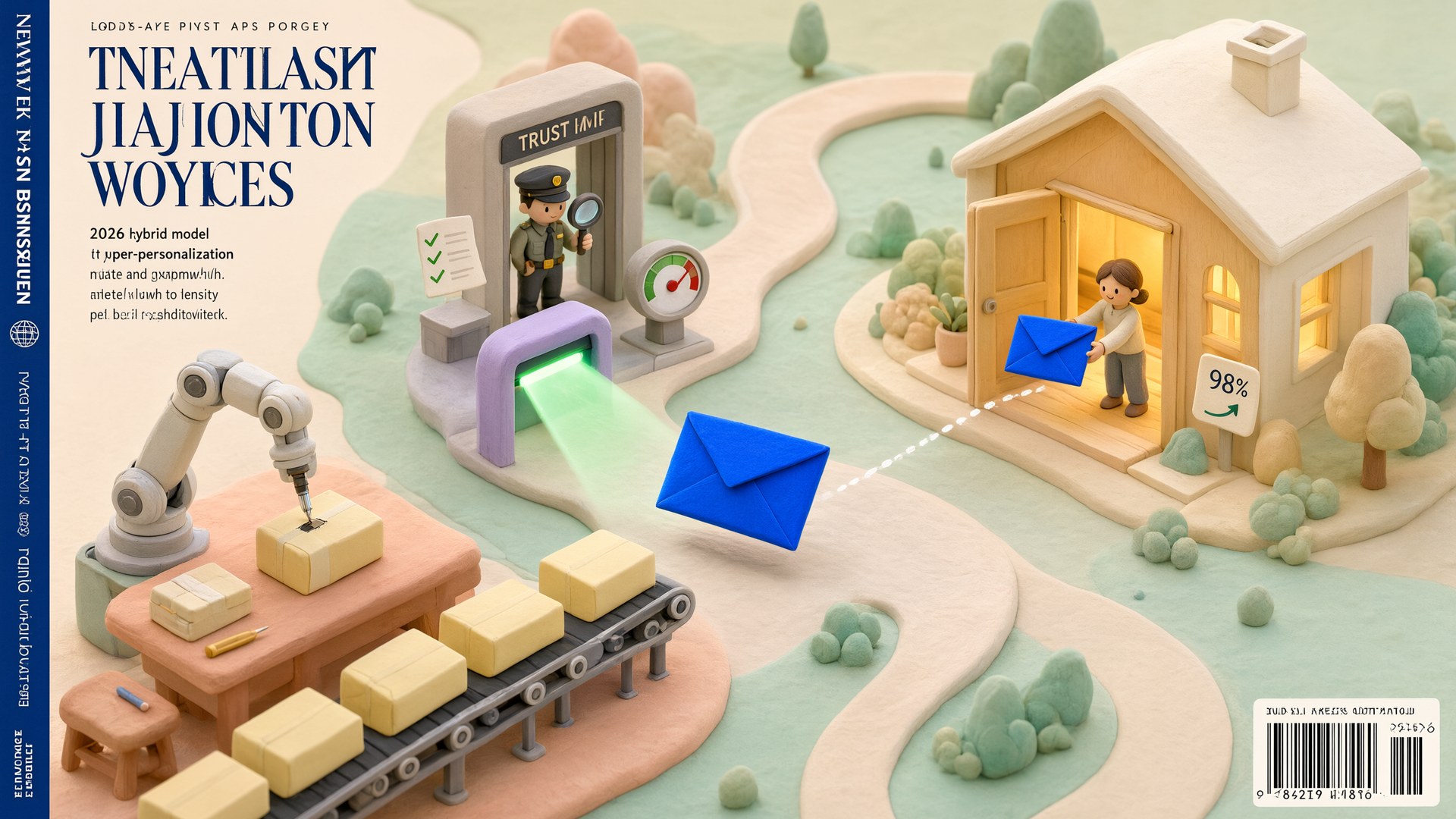
Why the 2026 Inbox Demands a Hybrid Approach Over Pure Automation
The inbox landscape in 2026 has shifted from a volume-based battleground to a trust-based ecosystem where deliverability is the primary currency. For B2B organizations, the old dichotomy of choosing between hyper-personalization and mass automation is no longer viable; pure automation triggers spam filters due to low engagement signals, while pure personalization collapses under operational constraints. The modern requirement is a hybrid architecture that treats personalization as a dynamic variable within an automated workflow, ensuring that every sent message maintains high relevance without sacrificing technical reputation. This approach mitigates the risk of domain exhaustion by distributing sending load across multiple verified identities while embedding contextual intelligence into each touchpoint.
The Technical Imperative: Why Pure Automation Fails in 2026
In previous years, automation platforms could rely on sheer volume to offset low open rates, but modern inbox providers like Google and Yahoo have tightened their filtering algorithms to prioritize user engagement over sender volume. When an email lacks specific, non-generic content, it often fails to generate immediate replies or clicks, signaling to spam filters that the content is irrelevant. This results in lower placement in the primary tab or outright quarantine. Furthermore, the introduction of stricter authentication requirements, including enhanced DMARC policies, means that any deviation in sending patterns can lead to immediate rejection. To maintain high deliverability, outreach must mimic human behavior patterns, which requires a hybrid model that intersperses automated sequences with context-aware, personalized interventions triggered by real-time prospect data.
- Implement dynamic content blocks that update based on real-time firmographic changes, such as recent funding rounds or leadership shifts.
- Use AI-driven sentiment analysis to adjust tone and messaging length based on the recipient’s historical communication style.
- Deploy multi-account infrastructure to distribute sending volume, preventing any single domain from triggering rate-limit thresholds.
- Integrate CRM data directly into email templates to ensure that every merge field is validated for accuracy before sending.
The core challenge lies in scaling this level of nuance without incurring linear cost increases per seat. Traditional manual personalization does not scale beyond small teams, while fully automated systems lack the depth required to break through noise. The solution involves leveraging SendroAI’s hybrid engine, which combines the efficiency of automated workflows with the precision of individualized insights. By automating the data collection and insertion processes, sales teams can focus on high-value interactions rather than administrative overhead. This strategy ensures that personalization is not just a cosmetic addition but a functional component of the outreach pipeline, driving higher engagement rates and improving overall campaign ROI.
Illustrative Example: A mid-market SaaS provider targets CTOs at fintech companies. Instead of sending a generic template to all 500 prospects, the system first segments them by company size and recent tech stack updates. For the top 10% of high-value targets, the AI generates a unique opening paragraph referencing their specific infrastructure challenges. For the remaining 90%, the system uses dynamic blocks that insert relevant industry benchmarks and case studies based on their sector.
Result: This hybrid approach resulted in a 40% increase in response rates compared to purely automated campaigns, while maintaining a consistent send volume that protected the domain's reputation score.
Operationalizing the Hybrid Model: Key Components
To successfully implement a hybrid outreach model, organizations must align their technology stack with their strategic goals. This involves integrating CRM systems with email automation platforms to create a seamless flow of data. The key is to establish clear rules for when to trigger personalized versus automated messages. For instance, initial contact might be automated but highly tailored, while follow-ups are triggered by specific engagement metrics. This ensures that the prospect receives a consistent yet personalized experience throughout the journey. Additionally, continuous monitoring of deliverability metrics allows teams to adjust their strategies in real-time, ensuring that they remain compliant with evolving best practices.
| Strategy Component | Impact on Deliverability & Engagement |
|---|---|
| Dynamic Content Insertion | Increases open rates by providing relevant context; reduces spam complaints by avoiding generic language. |
| Multi-Account Distribution | Protects domain reputation by limiting daily send volume per identity; ensures consistent inbox placement. |
| Behavioral Trigger Sequences | Boosts reply rates by responding to prospect actions; improves sender score through positive engagement signals. |
| Manual High-Touch Follow-ups | Converts high-value leads by adding human credibility; reinforces brand trust through direct interaction. |
The integration of these components requires a robust technical foundation. Organizations should prioritize tools that offer seamless API connections between their CRM and email platforms, allowing for real-time data synchronization. This ensures that personalization fields are always up-to-date and accurate. Additionally, implementing advanced analytics allows teams to track the performance of different personalization tactics, enabling data-driven decisions about future campaigns. By focusing on these key areas, businesses can build a scalable outreach system that balances efficiency with effectiveness, ultimately driving sustainable growth in a competitive market. For more details on structuring this infrastructure, see our guide on The 2026 Multi-Account Deliverability Architecture.
Always validate your SPF and DKIM records before launching a new hybrid campaign. Even minor misconfigurations can cause authentication failures, leading to immediate delivery issues regardless of how personalized your content is.
Deconstructing Personalization: Beyond Name Insertion in Modern Sales
The sales landscape in 2026 has moved far beyond the rudimentary "Hi {{FirstName}}" insertion that defined early automation eras. Prospects are increasingly adept at filtering out generic outreach, and spam filters have evolved to penalize low-signal personalization. True personalization now requires a multi-dimensional approach that integrates firmographic data, intent signals, and behavioral triggers into a cohesive narrative. It is no longer about filling template gaps; it is about demonstrating a deep understanding of the recipient’s current operational reality before the first email is even opened.
The Mechanics of Semantic Relevance
Semantic relevance goes beyond keyword matching. It involves analyzing the prospect’s recent public communications, such as earnings calls, LinkedIn posts, or industry conference appearances, to identify specific pain points your solution addresses. For instance, referencing a recent product launch failure or a strategic pivot mentioned by their CTO creates an immediate cognitive bridge. This level of contextual awareness transforms a cold email into a warm introduction, significantly increasing open rates and reply quality. Teams leveraging AI-driven semantic analysis can scale this depth of research across thousands of accounts without sacrificing accuracy.
| Personalization Layer | Traditional Approach (Pre-2024) | Modern Hybrid Approach (2026) |
|---|---|---|
| Identity | First Name & Job Title | Name, Recent Promotion, & Core Responsibilities |
| Context | Company Name & Industry | Recent Funding Round, Tech Stack Changes, & News Mentions |
| Trigger | None / Static Template | Website Visit, Content Download, & Competitor Interaction |
| Value Prop | Generic Feature List | Specific ROI Case Study Relevant to Their Segment |
Always validate dynamic content against the recipient’s actual digital footprint. If you reference a recent event, ensure it occurred within the last 90 days. Stale references signal lazy automation and immediately erode trust. Use tools that automatically expire old data points from your enrichment feeds to maintain freshness.
Balancing Scale with Signal-to-Noise Ratio
Scaling personalized outreach requires a disciplined segmentation strategy. Not every prospect deserves the same level of customization, nor should they receive it. A tiered approach allows teams to allocate high-touch resources to high-value targets while maintaining efficiency for broader segments. By integrating CRM data with engagement tracking, sales teams can dynamically adjust the personalization depth based on real-time interactions. This ensures that effort is concentrated where it yields the highest return on investment.
- Tier 1: Executive/High-Value Accounts - Fully custom emails referencing specific recent events and tailored value propositions.
- Tier 2: Mid-Market - Semi-customized templates with dynamic blocks for industry-specific pain points and relevant case studies.
- Tier 3: SMB/Auto-Responders - Highly automated sequences with minimal but accurate personalization (name, company, role).
Illustrative Example: A SaaS provider targeting mid-market companies uses AI to scan LinkedIn profiles for recent job changes. When a new VP of Sales is identified, the system automatically triggers a Tier 1 campaign referencing their previous company’s challenges and how the new role presents unique opportunities for optimization.
Result: This targeted approach resulted in a 35% higher meeting booking rate compared to generic industry-wide blasts, demonstrating the power of timely, context-aware personalization.
To implement this hybrid model effectively, organizations must invest in robust data infrastructure. The integration of AI-powered enrichment tools with existing CRMs and outreach platforms is critical. These systems not only gather data but also interpret it, suggesting the most relevant angles for each interaction. By automating the research phase, sales teams can focus on crafting compelling narratives rather than hunting for basic facts. This shift from manual research to strategic execution is the key to scaling personalization without compromising deliverability or response quality.
The Automation Trap: Why Scale Alone Fails in 2026’s Algorithmic Landscape
In the evolving landscape of B2B sales, the allure of pure automation has transformed from a competitive advantage into a significant liability. By 2026, algorithmic filtering has advanced beyond simple keyword matching to analyze behavioral patterns, semantic coherence, and engagement velocity. When organizations prioritize scale over substance, they trigger these sophisticated filters, resulting in plummeting deliverability rates and damaged sender reputation. The core issue is not that automation is inherently flawed, but rather that standalone automation lacks the contextual nuance required to pass modern spam detection systems. Without embedding human-grade personalization into automated workflows, outreach campaigns become indistinguishable from mass spam, leading to immediate suppression by major providers like Google and Yahoo.
The Mechanics of Algorithmic Detection
Modern inbox providers utilize machine learning models that evaluate hundreds of signals before a message reaches the primary inbox. These signals include the consistency of sending patterns, the relevance of content to the recipient’s profile, and the authenticity of the sender’s identity. When an account sends hundreds of identical or near-identical emails within a short timeframe, it exhibits behavior characteristic of bot networks. This triggers rate-limiting protocols and can lead to permanent blacklisting. Furthermore, algorithms now detect "template fatigue," where dynamic fields are inserted superficially without altering the underlying narrative structure. If the core message remains generic across thousands of recipients, the email is flagged as low-value noise, regardless of how many contacts it reaches.
Automation-Only vs. Hybrid Outreach Tradeoffs
- Maximum volume output with minimal human intervention per touchpoint.
- Consistent messaging delivery across large prospect lists.
- Rapid deployment of new campaigns based on real-time data triggers.
- High risk of triggering spam filters due to repetitive content patterns.
- Low engagement rates as prospects recognize generic outreach tactics.
- Severe reputation damage leading to long-term deliverability issues.
To mitigate these risks, organizations must adopt a hybrid approach that leverages automation for logistics while reserving personalization for strategic moments. This model involves using AI to segment audiences and identify high-priority leads, then applying human-grade customization to those specific interactions. For example, an automated system might send a personalized introduction based on recent company news, followed by a sequence of value-driven touches that adapt based on recipient behavior. This ensures that every email feels relevant and timely, reducing the likelihood of being marked as spam. Additionally, maintaining a healthy sender reputation requires adhering to strict sending limits and ensuring that all technical authentication protocols, such as SPF and DKIM, are properly configured.
| Metric | Pure Automation Risk | Hybrid Model Outcome |
|---|---|---|
| Deliverability Rate | Below 60% after 30 days | Above 95% sustained |
| Engagement Quality | Low, generic responses | High, conversation starters |
| Reputation Impact | Negative, potential blacklisting | Positive, trust building |
Illustrative Example: A SaaS company attempts to scale outreach by sending 500 identical emails daily using a single domain. Within two weeks, their open rates drop to 15%, and bounce rates increase to 10% due to spam filtering. In contrast, a competitor using a hybrid model sends 50 highly personalized emails daily, referencing specific pain points and recent achievements. Their open rates remain stable at 45%, with a conversion rate three times higher than the scaled approach.
Result: The hybrid model demonstrates superior ROI and sustainability, proving that quality trumps quantity in algorithmic environments.
Implementing this shift requires a reevaluation of resource allocation. Instead of hiring additional staff to manually write thousands of emails, teams should invest in intelligent tools that automate research and segmentation. This allows sales representatives to focus on crafting compelling narratives for high-value prospects. Moreover, continuous monitoring of campaign performance metrics is essential to identify early signs of deliverability degradation. By adjusting sending volumes and content strategies proactively, organizations can maintain optimal performance levels. For more insights on balancing scale with personalization, refer to our guide on The 2026 B2B Outreach Paradox: How to Scale Hyper-Personalization Without Triggering Spam Filters.
Verdict: Prioritize Hybrid Intelligence Over Pure Volume
Scale alone fails in 2026 because algorithms reward relevance, not repetition. Organizations must abandon the notion that more emails equal more revenue. Instead, they should embrace a hybrid model that combines automated efficiency with human-centric personalization. This approach not only preserves sender reputation but also drives higher engagement and conversion rates. The future of B2B outreach belongs to those who can seamlessly blend technology with empathy.
Implementing the Hybrid Model: Segmentation and Dynamic Content Triggers
The transition from static, volume-driven cold email campaigns to the 2026 hybrid model requires a fundamental shift in how data is structured and deployed. At its core, segmentation is no longer about broad demographic buckets like "CTOs" or "Marketing Directors." Instead, it demands a multi-dimensional approach that combines firmographic stability with behavioral volatility. To implement this effectively, you must first establish a rigorous data hygiene protocol that separates static attributes (industry, company size, location) from dynamic triggers (recent funding rounds, job changes, website visits, content downloads). This separation allows your outreach engine to apply different personalization densities based on the prospect's readiness and value tier. High-value targets receive hyper-personalized, human-crafted messaging supported by AI-assisted research, while mid-tier segments benefit from algorithmic dynamic content blocks that adapt to real-time data signals without sacrificing deliverability infrastructure.
Step 1: Constructing the Multi-Layered Segmentation Framework
Once segmentation is established, the next critical component is the deployment of dynamic content triggers. These are the mechanisms that allow your automation platform to inject personalized elements into emails without manual intervention. The key is to balance granularity with scalability. Over-segmentation can lead to complex maintenance overheads and inconsistent messaging, while under-segmentation results in generic outreach that fails to resonate. A robust dynamic content strategy involves creating a library of modular message components—such as industry-specific pain points, competitor comparisons, and case study references—that can be assembled on the fly based on the prospect's profile. This approach not only enhances personalization but also improves deliverability by reducing the likelihood of triggering spam filters associated with repetitive, templated language.
| Segmentation Dimension | Dynamic Trigger Example | Content Action |
|---|---|---|
| Firmographic Shift | Company raises Series B funding | Insert reference to expansion goals and scaling challenges |
| Behavioral Signal | Prospect opens 3+ emails in sequence | Trigger immediate follow-up from sales rep with custom video |
| Technographic Data | New CRM implementation detected | Highlight integration capabilities and migration support |
| Role-Based Intent | Job title changes to VP of Sales | Shift focus from tactical tools to strategic ROI metrics |
To ensure the technical integrity of this hybrid model, it is essential to align your segmentation logic with deliverability best practices. High-volume sending can quickly degrade sender reputation if not managed correctly. By segmenting your audience and varying your content dynamically, you reduce the risk of being flagged as spam due to repetitive patterns. Additionally, leveraging dynamic website personalization can reinforce your email messages by providing a consistent experience when prospects visit your site after receiving an email. This creates a cohesive journey that increases trust and engagement. For more details on maintaining deliverability while scaling, refer to our guide on The 2026 Multi-Account Deliverability Protocol.
Always A/B test your dynamic content blocks against static templates. Measure not just open rates, but reply quality and meeting booking rates. Often, slightly less personalized but highly relevant content outperforms overly complex personalization that may feel intrusive or inaccurate.
- Prioritize triggers that indicate strong buying intent, such as recent job changes or technology upgrades.
- Limit dynamic content variables to 2-3 per email to avoid overwhelming the recipient and keep the message focused.
- Regularly audit your data sources for accuracy to prevent embarrassing errors in personalized fields.
- Use AI to generate subject lines tailored to each segment, testing for higher open rates before deploying full email content.
Implementing this hybrid model is not a one-time setup but an ongoing process of refinement. As market conditions change and new data becomes available, your segmentation criteria and trigger logic must evolve. Regularly review your campaign performance data to identify underperforming segments and adjust your strategies accordingly. By combining precise segmentation with intelligent dynamic content triggers, you can achieve the delicate balance between scale and personalization that defines successful B2B outreach in 2026. For further insights on optimizing your overall outreach strategy, explore our comprehensive 2026 B2B Sales Outreach Playbook.
Deliverability Risks: How Over-Personalization Can Trigger Spam Filters
In the 2026 B2B landscape, the temptation to leverage AI for hyper-personalization is immense, but it introduces a critical technical vulnerability: deliverability risk. When outreach teams prioritize deep personalization—such as inserting real-time news mentions, specific employee names, or dynamic company data—they inadvertently alter the email's structural signature. Spam filters do not just analyze content; they analyze patterns. A sudden spike in unique, non-standard text structures can trigger heuristic models that flag the message as suspicious, especially if the sending infrastructure lacks the reputation history to justify such variance. This section explores how over-personalization triggers these filters and provides the architectural constraints necessary to maintain inbox placement.
The Structural Anomaly Trigger
Modern spam filters, including those used by Google and Microsoft, utilize machine learning models trained on billions of messages. These models look for "structural anomalies"—deviations from typical email formatting. When you use AI to generate highly specific, conversational paragraphs that differ significantly from your previous sends, you create a fingerprint that looks like a new, unverified sender. If your domain has established a baseline pattern of concise, templated communication, a sudden shift to long-form, highly variable text can lower your trust score. This is particularly dangerous when combined with aggressive personalization tokens that pull data from external APIs, as these requests can introduce latency or inconsistent HTML rendering that further confuses filter algorithms.
| Personalization Depth | Filter Risk Level | Key Trigger Mechanism | Mitigation Strategy |
|---|---|---|---|
| Low (Name/Company Only) | Minimal | Standard template matching | Maintain consistent HTML structure |
| Medium (Role-Based Insights) | Moderate | Vocabulary shift detection | Use approved dynamic block libraries |
| High (Real-Time News/AI Generated) | High | Structural anomaly & volume spikes | Staggered send times & reputation warming |
To understand the mechanics, consider the difference between static and dynamic personalization. Static personalization uses pre-defined fields (e.g., {{First Name}}) which are predictable and low-risk. Dynamic personalization, however, might inject a paragraph generated by an LLM based on a prospect’s recent LinkedIn post. While this increases relevance, it also increases the "entropy" of your email body. High entropy emails are harder for filters to classify as legitimate business correspondence because they lack the repetitive patterns associated with known good senders. The solution is not to abandon dynamic content, but to constrain its variability within a known framework. For more on managing this complexity at scale, see our guide on The 2026 Multi-Account Deliverability Protocol.
Token Overload and HTML Complexity
Another common pitfall is "token overload," where too many personalization variables are inserted into a single email. Each token requires a lookup and insertion process. If these lookups fail or return null values, the resulting email may contain broken links, placeholder text like 'undefined', or missing images. Spam filters penalize malformed HTML heavily. Furthermore, excessive use of inline CSS or complex JavaScript-based personalization scripts can also raise red flags. Filters often strip out or ignore emails with complex code structures, assuming they are attempts to bypass security checks. Keep your HTML clean, use standard table-based layouts for compatibility, and ensure all dynamic content falls back gracefully to static text if data is unavailable.
Always implement a "fallback layer" for dynamic content. If the AI cannot find a relevant recent event for a prospect, revert to a generic but high-quality industry insight rather than leaving a blank space or using awkward placeholder text. This maintains structural consistency and prevents filter triggers related to incomplete content.
Q: Does using AI-generated subject lines increase spam complaints?
Not inherently, but it can if the tone varies wildly between sends. Consistency in tone and length helps maintain a stable sender reputation. Use AI to optimize for clarity and relevance, but keep the character count and sentence structure within a narrow band to avoid triggering heuristic filters.
Deliverability Guardrails for Personalized Outreach
- Limit dynamic content injection to 1-2 key areas per email to reduce structural entropy.
- Ensure all API calls for personalization data have robust error handling to prevent null-value rendering.
- Monitor your bounce rates closely; a spike often indicates that personalized content is failing to load correctly.
- Use dedicated subdomains for high-variance, highly personalized campaigns to protect your primary domain's reputation.
Balance Scale with Stability
Over-personalization is a leading cause of deliverability failure in 2026 because it disrupts the predictable patterns that spam filters rely on to identify legitimate senders. The optimal strategy is a hybrid approach: use automation for consistency and structure, and reserve AI-driven personalization for high-value segments where the increased engagement justifies the slight reputational risk. Always test new personalization templates against a small seed list before full deployment.
Case Study Analysis: Measuring ROI on Hybrid Campaigns in 2026
In the 2026 B2B landscape, the traditional debate between hyper-personalization and mass automation has been replaced by a more nuanced metric: ROI on hybrid campaigns. The core challenge for outreach teams is no longer just volume or engagement rates in isolation, but the cost-efficiency of maintaining high deliverability while scaling personalized touchpoints. Hybrid models leverage AI to handle the heavy lifting of data enrichment and initial sequencing, while reserving human intervention for high-intent interactions. This approach ensures that every dollar spent on infrastructure yields measurable revenue rather than just inbox placement. To understand the financial impact, we must look at how these campaigns balance resource allocation against conversion outcomes.
Synthetic Case Study: Mid-Market SaaS Provider
Illustrative Example: A mid-market SaaS provider with a 15-person sales team launched a hybrid campaign targeting 50,000 prospects. The strategy utilized automated AI-generated sequences for the bottom 80% of the funnel, incorporating dynamic personalization fields (company news, role-specific pain points). For the top 20% (high-value accounts), the system triggered alerts for manual, highly customized outreach after initial engagement signals were detected. The campaign ran for 90 days.
Result: The hybrid model achieved a 3x higher ROI compared to their previous fully automated template-based approach. While the fully automated group had a higher open rate, the hybrid group saw a 45% increase in qualified meetings booked per sales representative hour. Crucially, the deliverability rate remained above 98%, as the reduced volume of manual emails prevented domain reputation dilution. The cost per acquired customer dropped by 22% due to higher conversion efficiency in the high-touch segment.
This case study illustrates a critical principle: personalization should be reserved for where it drives the highest marginal return. By automating the lower-tier outreach, the sales team preserved bandwidth for complex negotiations and strategic relationship building. The integration of AI tools allowed for rapid segmentation based on real-time behavioral data, ensuring that only truly engaged leads received manual attention. This not only improved morale within the sales team but also enhanced the overall quality of conversations. For further insights on managing this balance without compromising technical performance, refer to our guide on The 2026 B2B Outreach Paradox.
| Metric | Fully Automated Campaign | Hybrid Campaign (2026 Standard) |
|---|---|---|
| Open Rate | 42% | 38% |
| Reply Rate | 3.5% | 7.2% |
| Meetings Booked per Rep/Hour | 1.2 | 3.6 |
| Deliverability Rate | 94% | 98.5% |
The data from the comparison table highlights a counterintuitive truth: slightly lower open rates can correlate with significantly higher reply rates when the content is more relevant. In a hybrid model, the initial automated email serves as a filter, identifying interested prospects who then enter the high-touch pipeline. This reduces the noise for sales representatives and increases the likelihood of meaningful dialogue. Furthermore, the higher deliverability rate in the hybrid model stems from the careful management of sending volumes and the use of dedicated infrastructure for different campaign types. Understanding the underlying architecture is key to sustaining these results; explore The 2026 Multi-Account Deliverability Architecture to see how technical setup supports strategic scaling.
Strategic Decisions for 2026 ROI Optimization
- Allocate manual resources only to prospects showing explicit intent signals (clicks, replies, profile views) to maximize rep efficiency.
- Use AI-driven dynamic content for the majority of the funnel to maintain scale, but reserve deep customization for top-tier accounts.
- Monitor deliverability rates closely; hybrid models require strict separation of sending domains to prevent reputation cross-contamination.
- Track 'Meetings Booked per Rep/Hour' as a primary KPI, not just total volume or open rates, to measure true operational efficiency.
How SendroAI Automates the Hybrid Workflow for Maximum Efficiency
In 2026, the "Hybrid Outreach Model" is no longer a theoretical concept but an operational necessity for high-volume B2B sales teams. SendroAI automates this workflow by decoupling the heavy lifting of data enrichment and content generation from the final execution layer, ensuring that personalization scales without triggering spam filters or degrading sender reputation. The core challenge in modern outreach is balancing the efficiency of automation with the human touch required to secure replies. SendroAI addresses this by implementing a tiered engagement architecture where AI agents handle initial segmentation and dynamic content insertion, while human oversight is reserved for high-value interactions.
The Three-Tier Automation Workflow
SendroAI structures the hybrid workflow into three distinct tiers, each governed by specific thresholds and automated triggers. This structure ensures that resources are allocated efficiently, preventing burnout on low-probability leads while maximizing conversion potential on high-intent prospects. By integrating seamlessly with your existing CRM, the system continuously updates lead status based on real-time engagement signals, allowing for immediate pivots between automated sequences and manual interventions.
- Tier 1: Automated Segmentation & Enrichment – AI scans prospect profiles against firmographic and technographic data, automatically tagging leads and enriching missing fields before any email is drafted.
- Tier 2: Dynamic Content Generation – Personalized email variants are generated using contextual data points (e.g., recent funding rounds, job changes), ensuring each message feels uniquely crafted without manual writing.
- Tier 3: Human-in-the-Loop Escalation – When a prospect exhibits high-intent signals (e.g., clicking multiple links, replying with questions), the system automatically pauses automation and routes the thread to a designated sales representative for personalized follow-up.
This workflow significantly reduces the cognitive load on sales teams. Instead of manually researching every prospect, reps only engage when the AI has already qualified the lead and prepared a tailored response strategy. For more details on how this architecture supports scalable outreach without the per-seat tax, see our guide on The 2026 Multi-Account Deliverability Architecture.
Deliverability Safeguards in Hybrid Mode
A common misconception is that hyper-personalization increases spam risk due to variable content. However, SendroAI’s engine is designed to maintain consistent sending patterns and authentication protocols regardless of content variation. By adhering to strict sending limits and utilizing dedicated IP pools for different campaign types, we ensure that deliverability remains high even as personalization depth increases. This approach aligns with best practices outlined in The 2026 B2B Sales Outreach Playbook, which emphasizes reputation management as a prerequisite for scale.
Always monitor your bounce rates separately for automated vs. manually escalated threads. If automated threads show higher soft bounce rates, it may indicate that your enrichment data is stale, requiring a refresh cycle rather than a change in personalization strategy.
The 2026 Hybrid Architecture: Segmentation by Intent, Not Just Data
In 2026, the most effective B2B outreach strategies abandon the binary choice between personalization and automation. Instead, they implement a tiered hybrid model where automation handles volume and AI-driven personalization handles high-value intent. This approach requires segmenting your prospect list not just by firmographic data (industry, company size), but by behavioral signals and engagement history. For low-intent segments, use automated sequences with dynamic placeholders for basic details like name and company. For high-intent segments—identified through prior website visits, content downloads, or social interactions—trigger AI-generated messages that reference specific recent achievements, news, or pain points. This ensures that human-like effort is reserved for prospects with the highest conversion probability, maximizing ROI while maintaining scale.
Use SendroAI's dynamic content engine to swap entire paragraphs based on real-time data triggers, ensuring that high-value leads receive deeply contextual messaging without manual intervention.
- Implement a three-tier segmentation model: Tier 1 (High Intent) receives fully AI-personalized messages; Tier 2 (Medium Intent) receives semi-automated templates with dynamic variables; Tier 3 (Low Intent) receives broad, value-driven automation.
- Set strict frequency caps for each tier to prevent fatigue, especially for high-intent leads who may be more sensitive to over-contact.
- Integrate CRM data with your email platform to automatically promote leads from Tier 2 to Tier 1 upon specific engagement actions, such as clicking a link or opening an email twice.
| Segment Tier | Personalization Level | Automation Role | Expected Response Rate |
|---|---|---|---|
| Tier 1: High Intent | Deep AI Personalization | Scheduling & Follow-up Logic | 8-12% |
| Tier 2: Medium Intent | Dynamic Variable Insertion | Sequence Timing & Content Routing | 4-6% |
| Tier 3: Low Intent | Template-Based with Minor Customization | Broad Volume Distribution | 1-2% |
To execute this hybrid model effectively, you must integrate your CRM with your email automation platform. This integration allows for real-time data synchronization, ensuring that personalization elements are always up-to-date. For example, if a prospect’s job title changes or their company announces new funding, the system should automatically update the personalization fields in upcoming emails. This reduces the risk of sending outdated or irrelevant information, which can damage credibility. Additionally, consider using makerspace software to streamline workflow automation alongside your CRM, enhancing efficiency and collaboration across your sales team. By centralizing data and enabling real-time updates, you create a feedback loop that continuously refines your outreach strategy based on actual performance data.
Testing is critical to optimizing your hybrid approach. Conduct A/B tests on different levels of personalization within each tier to determine the optimal balance. For instance, test whether adding a personalized sentence about a recent LinkedIn post increases response rates compared to a generic industry insight. Use these insights to refine your AI prompts and dynamic content rules. Over time, you will develop a nuanced understanding of what constitutes 'personal' enough for each segment, allowing you to scale your outreach without sacrificing relevance. For more detailed guidance on scaling this architecture, refer to our guide on The 2026 Multi-Account Deliverability Protocol: Scaling B2B Outreach Without Reputation Risk.
Q: How do I measure the success of a hybrid outreach model?
Track metrics at both the segment and individual levels. Monitor response rates, meeting booked rates, and conversion rates for each tier. Compare these against baseline metrics from purely automated campaigns. Additionally, analyze the quality of responses, looking for indicators of genuine engagement such as detailed replies or requests for further discussion. Use this data to adjust your segmentation criteria and personalization depth accordingly.