
Parsley.id vs Vizaye

A technical comparison of data scale, outbound sequencing, and true cost of ownership.

Last updated: •Verified Technical Data

Quick Decision Verdict

Decisive executive rulings based on technical testing and pricing data.

Decision CategoryExecutive Ruling
Best for Enterprise OutboundNeither is a traditional enterprise outbound platform; Parsley.id serves as an AI presales agent for LinkedIn/email intent capture, while Vizaye targets surface material retail workflows.
Best for Email DeliverabilityN/A. Neither tool focuses on email infrastructure or deliverability management; they are front-end engagement tools.
Best for High-Volume ProspectingParsley.id offers unlimited team seats with a flat usage-based model ($0.25/conversation), making it more scalable for high-volume digital interactions than Vizaye's tiered SKU/user limits.
Best Overall ValueParsley.id provides a free profile and transparent per-conversation pricing without monthly fees, offering lower barrier-to-entry for solo sellers compared to Vizaye's feature-gated tiers.

Parsley.id vs Vizaye at a Glance

Side-by-side core specifications and live platform viewports.

AttributeParsley.idVizaye
Primary PurposeAI Presales Agent for LinkedIn/Email Intent CaptureDigital Showroom & Catalog Visualization for Surface Materials
Starting Price$0.00 (Free Profile) + $0.25 per conversation$0.00 (Free Plan) / Starter Tier available via trial
Free PlanYes (10 free conversations, no card required)Yes (First 5 businesses/month get free setup; Free plan includes 25 SKUs)
Core StrengthReal-time buyer intent sync to CRM via LinkedIn chat cardsRoom visualization and WhatsApp lead qualification for physical products
Target IndustryB2B SaaS, Services, AgenciesRetail, Manufacturing, Distributors (Tiles, Marble, Flooring)
Integration ModelNative CRM Sync (HubSpot, Salesforce, etc.) + WebhooksStandalone Micro-site + WhatsApp API + QR Codes
Scalability LimitUnlimited team seats; cost scales linearly with conversation volumeTiered by SKU count, user seats, and location limits
Data OwnershipIntent signals synced directly to existing CRM recordsLeads captured in proprietary Quote Request Inbox and Analytics Dashboard

Feature-by-Feature Matrix

Audited capabilities across data sourcing, sending infrastructure, and integrations.

CapabilityWhy It MattersParsley.idVizayeWinner
LinkedIn IntegrationDirect access to professional network traffic✓ Native— Noneparsley-id
CRM SyncAutomating lead routing and data hygiene✓ Native→ Integrationparsley-id
WhatsApp AutomationCritical for mobile-first retail sales— None✓ Nativevizaye
Product VisualizationEnhancing buyer confidence for physical goods— None✓ Nativevizaye
QR Code GenerationBridging offline showroom visits to digital leads— None✓ Nativevizaye
AI ChatbotQualifying leads 24/7✓ Native✓ NativeTie
Custom DomainBrand consistency and trust◐ Partial✓ Nativevizaye
White-labelingAgency reselling capabilities— None✓ Nativevizaye
Multi-location SupportManaging distributed sales teams✓ Native✓ NativeTie
Analytics DashboardTracking conversion performance✓ Native✓ NativeTie
API AccessCustom workflow automation→ Integration✓ Nativevizaye
Showroom Kiosk ModeSelf-service browsing for walk-ins— None✓ Nativevizaye
Pre-call BriefsEquipping reps with context before meetings✓ Native— Noneparsley-id
MEDDIC Signal CaptureAdvanced B2B qualification framework✓ Native— Noneparsley-id
Price Estimator ToolInstant quoting for complex projects— None✓ Nativevizaye
No Credit Card RequiredReducing friction for initial testing✓ Native✓ NativeTie

Technical Deep Dives

Architectural comparisons derived directly from live platform testing.

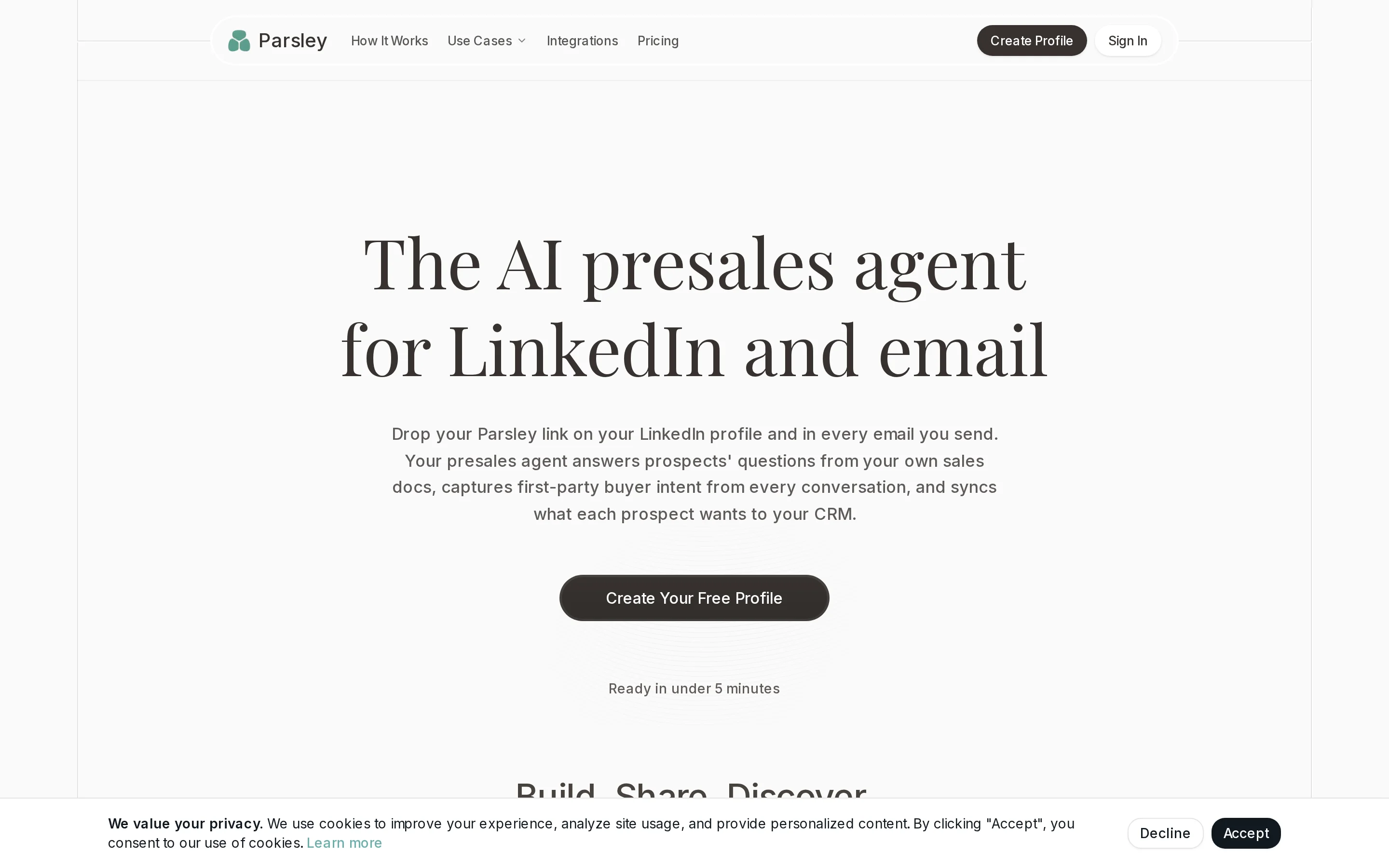
Parsley.id workspace view
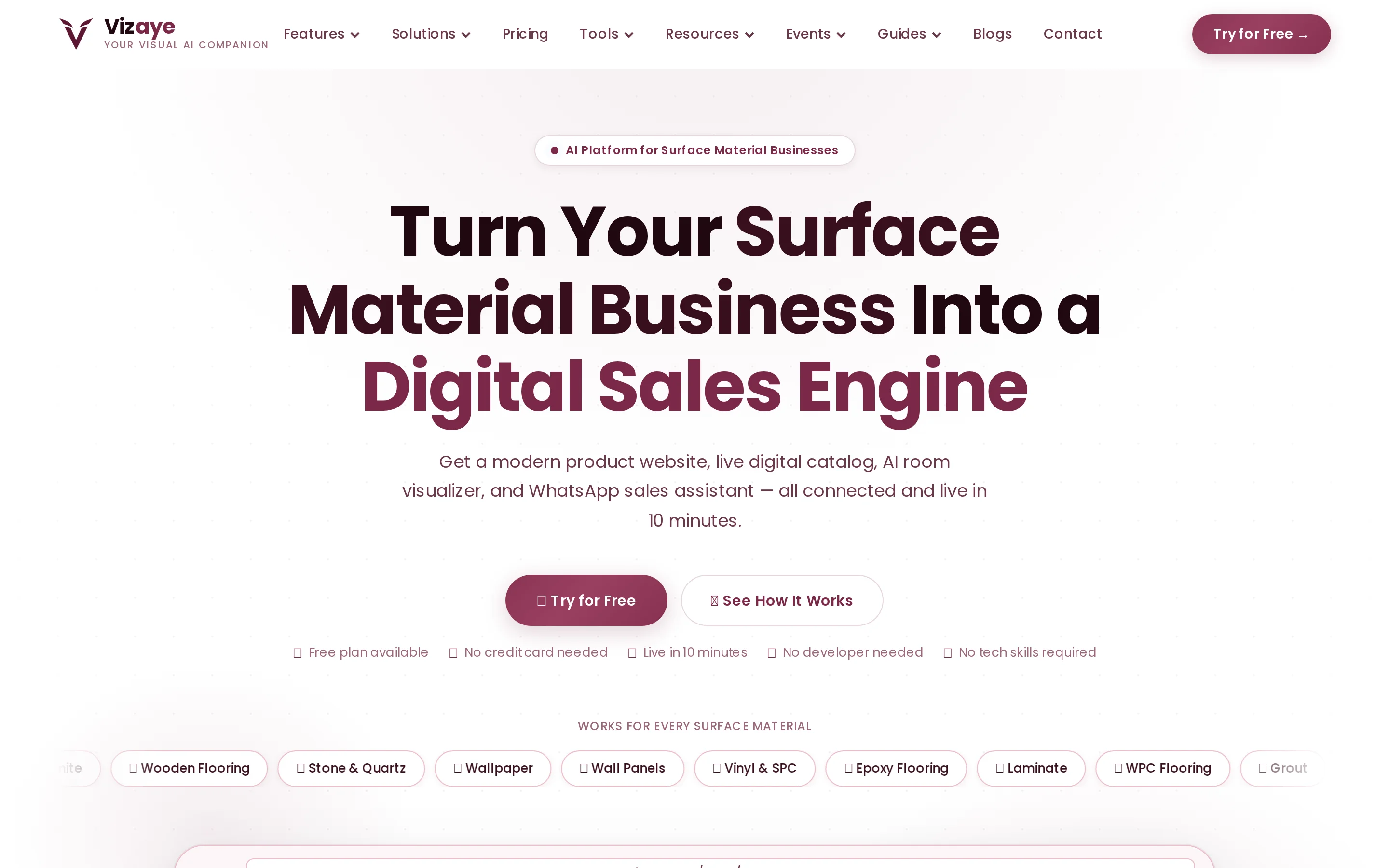
Vizaye workspace view

Core Value Proposition & Market Fit: Inbound Intent Capture vs. Outbound Catalog Visualization

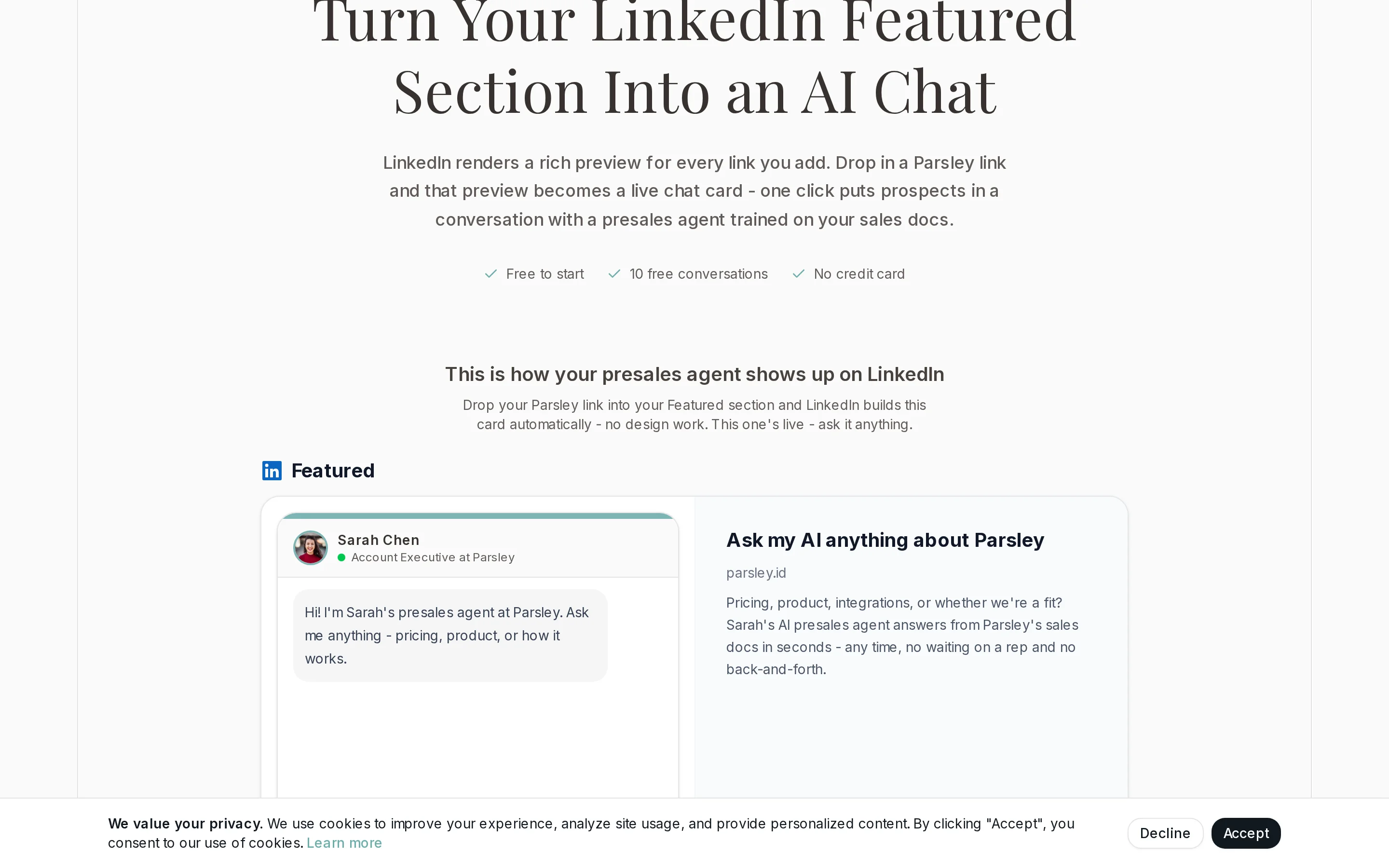
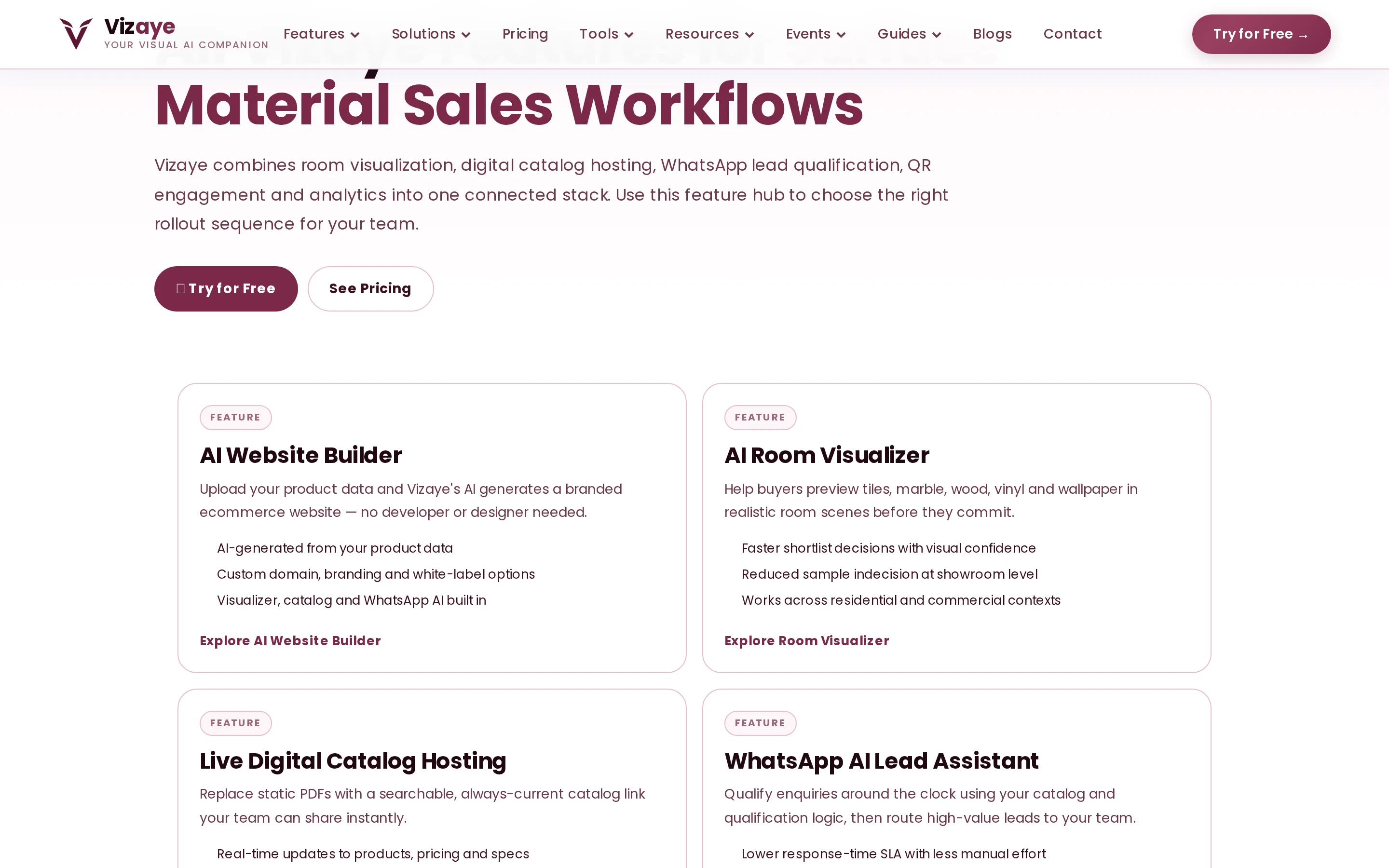
Parsley.id operates as a passive, inbound 'presales agent' triggered by LinkedIn profile clicks, focusing on immediate buyer intent capture and CRM sync for service/SaaS sales. Its architecture relies on rendering rich preview cards on LinkedIn that open a live chat interface trained on the seller's documents. This creates a zero-friction entry point for prospects already engaging with the seller's digital footprint. Conversely, Vizaye functions as an active, outbound 'digital showroom' tool, focusing on visualizing physical products (room scenes) and generating leads via QR codes and WhatsApp for retail/material sales. Vizaye requires the business to upload a catalog and actively drive traffic through in-store signage or digital links, creating new engagement surfaces rather than intercepting existing ones.

The critical differentiator is the fundamental sales motion: Parsley intercepts existing traffic from professional networks, converting curiosity into structured intent data (MEDDIC signals, topic tags) that flows directly into CRMs like HubSpot or Salesforce. Vizaye creates new engagement surfaces by transforming static product catalogs into interactive visualizers. For a B2B SaaS founder, Parsley reduces the time spent answering repetitive questions during the early funnel. For a tile distributor, Vizaye reduces the need for staff to manually guide customers through physical samples, allowing self-service exploration that captures leads even when staff are unavailable.

In terms of market fit, Parsley is optimized for knowledge-based economies where the 'product' is information or service capability, requiring deep contextual understanding from AI agents. Vizaye is optimized for tangible goods economies where spatial context (how a floor looks in a room) drives purchase decisions. While both use AI, Parsley's AI is conversational and analytical (intent scoring), whereas Vizaye's AI is generative and visual (image creation, room simulation). The ruling here depends entirely on whether your sales cycle benefits more from automated qualification of abstract concepts (Parsley) or visual proof of physical application (Vizaye).
Integration Depth & Data Flow: Native CRM Sync vs. Standalone Micro-Site Ecosystem

Parsley emphasizes deep integration with existing GTM stacks, automatically syncing buyer intent data to CRMs to enrich pipeline records without manual entry. It supports native connections to Attio, Folk, Twenty, Copper, HubSpot, Salesforce, Pipedrive, Zoho, Salesflare, Close, Freshsales, Nimble, and Capsule. Furthermore, it integrates with automation platforms like Zapier, Make, n8n, and Clay, allowing intent signals to trigger downstream workflows such as enrichment or personalized outreach sequences. This positions Parsley as an augmentation layer that enhances the efficiency of the current tech stack rather than replacing it.

Vizaye operates more as a standalone micro-site platform with limited native CRM integrations mentioned in public documentation. It relies instead on its own 'Quote request inbox' and analytics dashboard, potentially creating data silos unless custom webhooks or manual exports are used. While Vizaye offers API access in the Enterprise tier, the default experience is a closed loop where customer interactions (visualizations, chat logs) remain within the Vizaye ecosystem. This approach simplifies setup for non-technical retail owners but complicates unified reporting for companies that rely on a central CRM for all customer touchpoints.

The key technical contention is whether the tool augments the existing sales stack (Parsley) or replaces parts of it with a proprietary frontend (Vizaye). For organizations with mature RevOps practices, Parsley's ability to push first-party buyer intent directly into CRM fields (like lead score, MEDDIC status, and conversation summaries) ensures data hygiene and visibility across departments. Vizaye's strength is in vertical-specific functionality (room visualization, stone price estimation) that generic CRMs cannot provide, but it lacks the seamless bidirectional data flow required for complex B2B attribution models. Therefore, Parsley wins on integration depth for generalist sales teams, while Vizaye wins on specialized vertical utility for retail-focused businesses willing to manage separate data streams.

Pricing & True Cost of Ownership

Published tier structures, credit scaling mechanics, and total outbound cost.

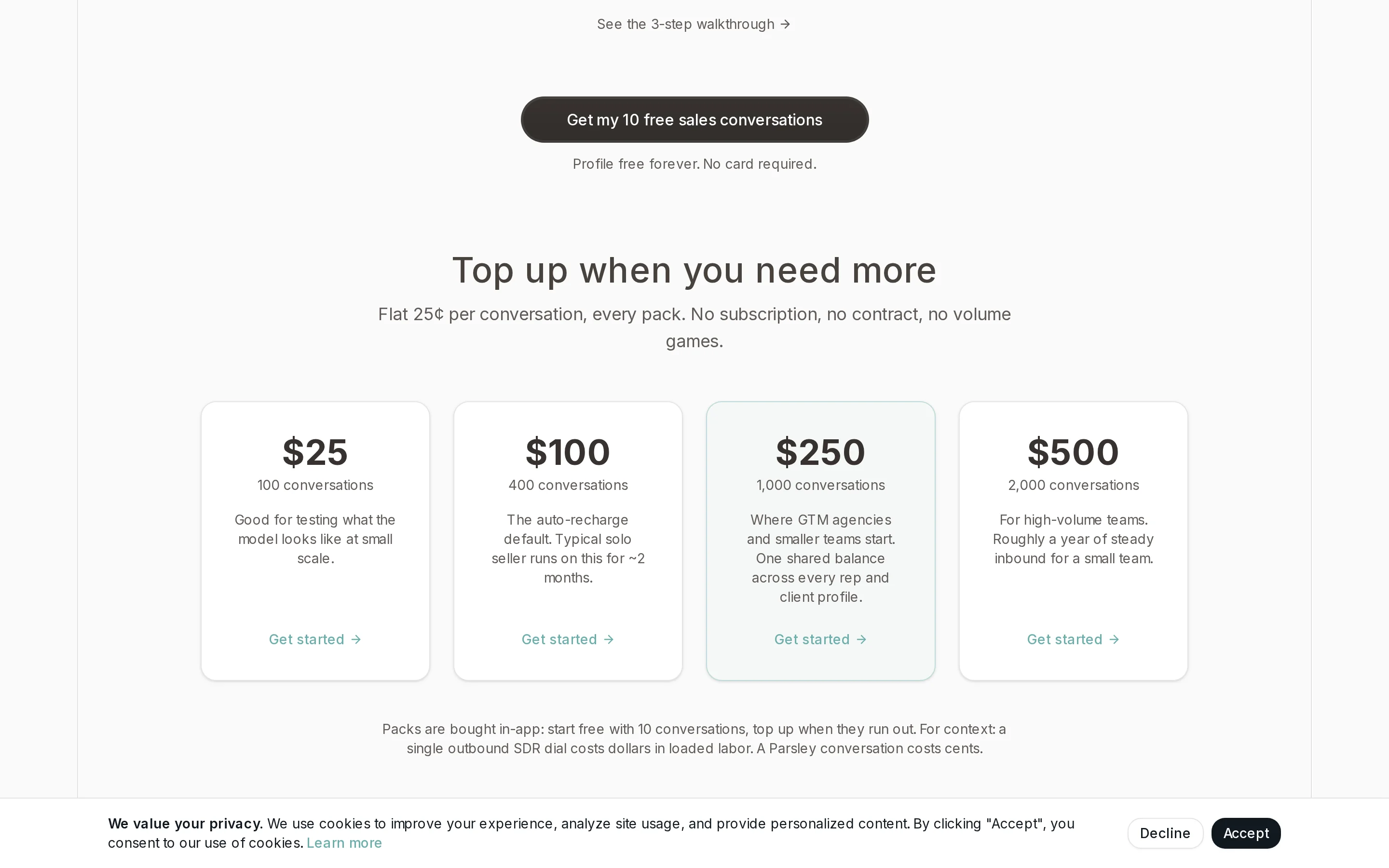
Parsley.id published pricing cards
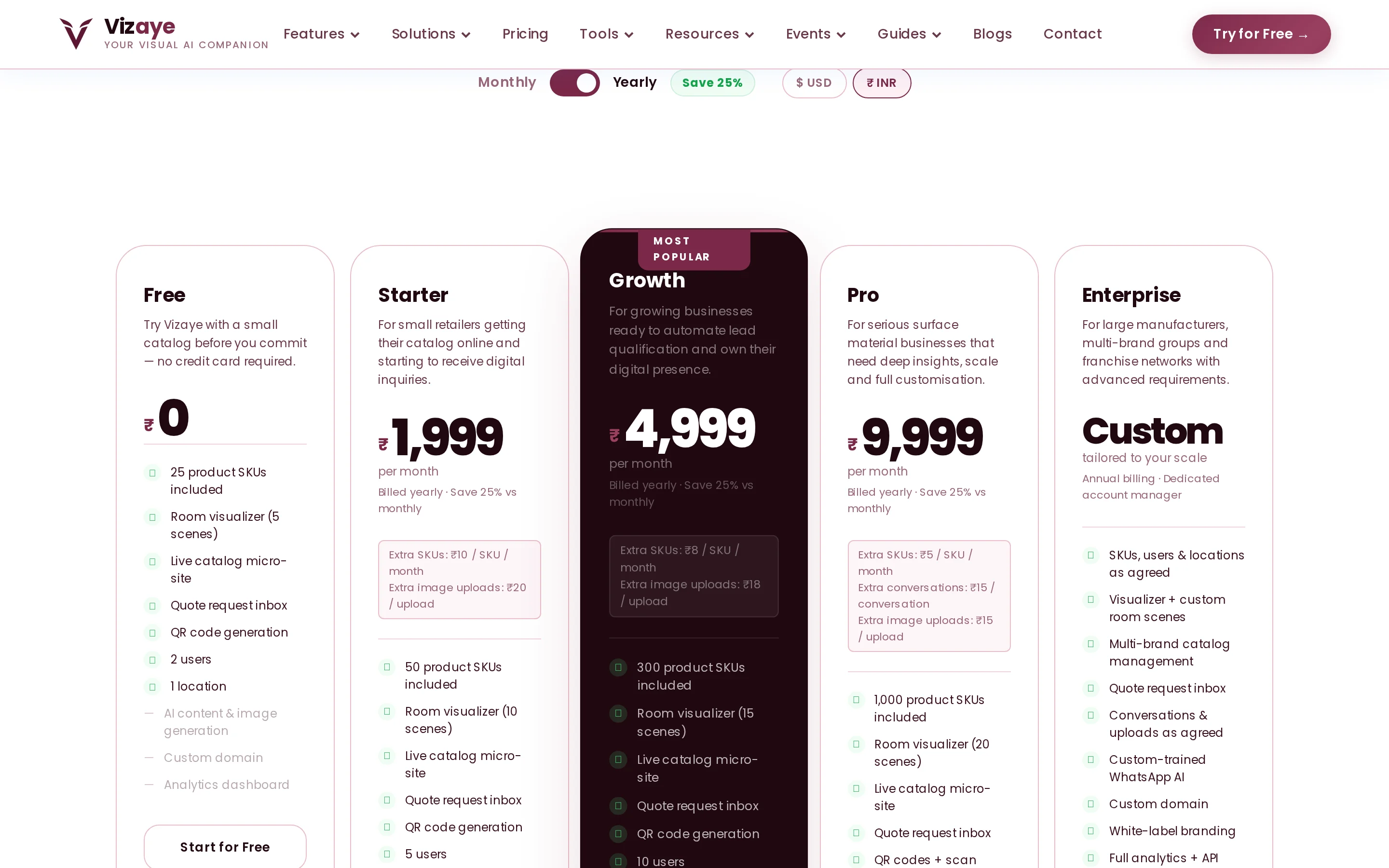
Vizaye published pricing cards
Parsley.id Plans
  • Free Profile: $0.00 (Includes 10 free conversations, no credit card required)
  • Pay-As-You-Go: $0.25 per conversation (Flat rate, no monthly fee, no contract)
  • Auto-Recharge Default: Typical solo seller runs on ~$100-$250/month balance (configurable ceiling)
  • Team Packs: Shared balance across unlimited seats (e.g., $250 pack = 1,000 conversations)
  • Enterprise/High Volume: Custom packs available upon request
Vizaye Plans
  • Free Plan: $0.00 (25 SKUs, 2 Users, 1 Location, Community Support)
  • Starter: Pricing not explicitly listed in USD (Trial available); Includes 50 SKUs, 5 Users, WhatsApp AI
  • Growth: Pricing not explicitly listed in USD (Trial available); Includes 300 SKUs, 10 Users, 2 Locations, Custom Domain
  • Pro: Pricing not explicitly listed in USD (Trial available); Includes 1,000 SKUs, 20 Users, 3 Locations, Showroom Kiosk
  • Enterprise: Custom Enterprise Pricing (Contact Sales); Unlimited SKUs/Users, White-label, API Access
Total Cost Analysis & Verdict

Parsley.id offers a radically transparent, low-risk pricing model ideal for startups and agencies. By charging a flat $0.25 per conversation with no monthly minimums, it eliminates the fear of wasted spend during slow periods. The unlimited free team seats further reduce overhead, making it highly scalable for collaborative sales environments. In contrast, Vizaye follows a conventional SaaS tiering structure common in vertical-specific software. While it offers a free plan, the jump to paid tiers involves significant feature gating (e.g., WhatsApp AI and Custom Domains are locked behind higher tiers). This makes Vizaye more suitable for established businesses with predictable budgets who value bundled features over granular cost control. For a new user, Parsley is cheaper to start; for a large retailer, Vizaye's tiered bundles may offer better perceived value despite higher fixed costs.

True Cost Calculation:

of Ownership Analysis

For a 5-person sales team generating 10,000 qualified conversations per month:

Parsley.id:

Cost = 10,000 conversations * $0.25 = $2,500/month.

Note: Team seats are free. No additional licensing fees.

Vizaye:

Assuming the team needs the 'Pro' tier to handle 1,000+ SKUs and 20 users (covering the 5-person team comfortably):

Base Cost: Not publicly listed in USD, but typically ranges $150-$300/month for Pro-tier equivalents in similar vertical SaaS.

Extra Conversations: If exceeding included limits (Pro includes 500/mo), 9,500 extra * ₹15 (~$0.18) = ~$1,710.

Total Estimated: ~$1,860 - $2,000/month (depending on exact base tier price).

*Analysis:* Parsley is slightly more expensive per unit at high volume but offers superior CRM integration value. Vizaye becomes competitive at scale due to bulk conversation rates but incurs hidden costs in data export/manual entry if CRM sync is missing.

Which Fits Your Outbound Model?

Match your team size, deal complexity, and lead volume to the right engine.

Use CaseParsley.idVizayeRecommendation
B2B SaaS Founder Qualifying Leads⭐⭐⭐⭐⭐⭐Parsley.id is built for this. It captures intent from LinkedIn clicks and syncs directly to HubSpot/Salesforce, saving hours of manual qualification.
Tile/Marble Retailer Digital Showroom⭐⭐⭐⭐⭐⭐Vizaye is the clear winner. Its room visualizer and WhatsApp integration allow customers to see how materials look in their homes, driving higher conversion for physical goods.
GTM Agency Managing Multiple Clients⭐⭐⭐⭐⭐⭐Parsley.id allows agencies to deploy unique AI agents for each client profile with shared balances, offering a scalable way to demonstrate ROI through intent data.
Walk-in Customer Engagement in Physical Stores⭐⭐⭐⭐⭐⭐Vizaye's kiosk mode and QR code generation transform passive store visitors into active digital leads, capturing shortlists and sending them to WhatsApp for follow-up.

Where Each Platform Falls Short

Constructive limitations and architectural trade-offs to weigh before signing.

Where Parsley.id Falls Short
  • Not suitable for visual-heavy industries (retail/manufacturing) where product appearance drives sales.
  • Relies heavily on LinkedIn traffic; less effective if the primary channel is cold email or phone.
  • Usage-based cost can spike unexpectedly if bot traffic or low-intent queries are not filtered effectively.
Where Vizaye Falls Short
  • Limited native CRM integrations compared to Parsley, potentially leading to data silos.
  • Feature gating restricts essential tools (like WhatsApp AI) to higher-priced tiers.
  • Specific to surface materials; not adaptable for service-based or digital product sales.

The Switching Playbook

What you gain and give up when migrating across platforms.

Switching to Parsley.id
You Gain
  • Seamless CRM synchroni
Switching to Vizaye
You Gain
  • Powerful AI-driven room visuali

Frequently Asked Questions

Direct technical answers about Parsley.id and Vizaye.

Does Parsley.id require a credit card to start?

No. You can create a free profile and receive 10 free conversations without entering any payment details.

Can Vizaye integrate with my existing CRM?

Vizaye primarily uses its own Quote Request Inbox. While it offers API access in the Enterprise tier, it does not list native one-click syncs for major CRMs like HubSpot or Salesforce in its standard plans.

What happens if I run out of Parsley conversations?

Your chatbot gracefully switches to a 'contact directly' CTA (email or scheduling link). Visitors never see a paywall, and your brand remains intact. You can top up anytime.

Is Vizaye suitable for selling software services?

No. Vizaye is specifically designed for surface material businesses (tiles, marble, flooring) that require visual product demonstrations and physical inventory management.

How does Parsley calculate a 'conversation'?

One visitor talking to your AI agent from start to finish counts as one conversation, regardless of how many messages are exchanged. Testing your own agent while signed in is free and unmetered.

Does Vizaye offer white-labeling?

Yes, but only in the Enterprise tier. Lower tiers display Vizaye branding on the catalog and visualizer interfaces.

Final Verdict & Recommendation
Choose Parsley.id if: Choose Parsley.id if you are a B2B service provider, SaaS founder, or agency looking to automate lead qualification and capture buyer intent directly from your LinkedIn presence. Its transparent, usage-based pricing and deep CRM integrations make it the superior choice for augmenting an existing sales stack without adding fixed overhead.
Choose Vizaye if: Choose Vizaye if you operate in the surface materials industry (tiles, stone, flooring) and need a specialized digital showroom. Its room visualization, WhatsApp automation, and QR code capabilities are unmatched for converting physical product interest into qualified leads, particularly for businesses with brick-and-mortar locations.

Sources & Methodology

Every claim on this page is grounded in official vendor documentation and live audits.

Looking for an Autonomous Alternative? Compare with SendroAI

See how SendroAI replaces manual research, credit limits, and deliverability traps with full autonomous execution.

Ready to Automate Your Cold Email Outreach?

SendroAI conducts deep prospect research, crafts tailored 1:1 emails, and protects deliverability across unlimited mailboxes automatically.