
DeBounce vs Kickbox

A technical comparison of data scale, outbound sequencing, and true cost of ownership.

Quick Decision Verdict

Decisive executive rulings based on technical testing and pricing data.

Decision CategoryExecutive Ruling
Best for Enterprise OutboundKickbox
Best for Email DeliverabilityKickbox
Best for High-Volume ProspectingDeBounce
Best Overall ValueDeBounce

DeBounce vs Kickbox at a Glance

Side-by-side core specifications and live platform viewports.

AttributeDeBounceKickbox
Primary PurposeEmail Verification & List HygieneEmail Verification & Threat Scoring
Database ScaleN/A (Verification Only)N/A (Verification Only)
Starting Price$450/mo (Pay-as-you-go)Custom Pricing (Enterprise Focus)
Free PlanYes (No credit card required)Yes (100 free verifications)
Verification AccuracyHigh (Anti-greylisting tech)Very High (Definitive results)
Core StrengthCost efficiency & API flexibilitySecurity compliance & consulting

Feature-by-Feature Matrix

Audited capabilities across data sourcing, sending infrastructure, and integrations.

CapabilityWhy It MattersDeBounceKickboxWinner
Email VerificationPreserving domain health✓ Native✓ NativeTie
Real-Time Validation WidgetInstant form checks✓ Native— Nonedebounce
Catch-All Domain DetectionFiltering risky domains✓ Native✓ NativeTie
Disposable Email CheckerPreventing fake signups✓ Native✓ NativeTie
Data EnrichmentEnhancing lead profiles✓ Native— Nonedebounce
Email Threat ScoreIdentifying malicious emails— None✓ Nativekickbox
Deliverability ConsultingInfrastructure optimization— None✓ Nativekickbox
API AccessDeveloper integration✓ Native✓ NativeTie
Zapier IntegrationNo-code automation✓ Native✓ NativeTie
HubSpot IntegrationCRM sync✓ Native✓ NativeTie
Mailchimp IntegrationESP sync✓ Native✓ NativeTie
Klaviyo IntegrationE-commerce sync✓ Native✓ NativeTie
Google Sheets IntegrationSpreadsheet workflow✓ Native— Nonedebounce
WordPress PluginWebsite form validation✓ Native— Nonedebounce
SOC II CertificationEnterprise security compliance— None✓ Nativekickbox
GDPR ComplianceData privacy adherence✓ Native✓ NativeTie
Credit ExpirationCost managementNever expireRefund on unknowndebounce

Technical Deep Dives

Architectural comparisons derived directly from live platform testing.

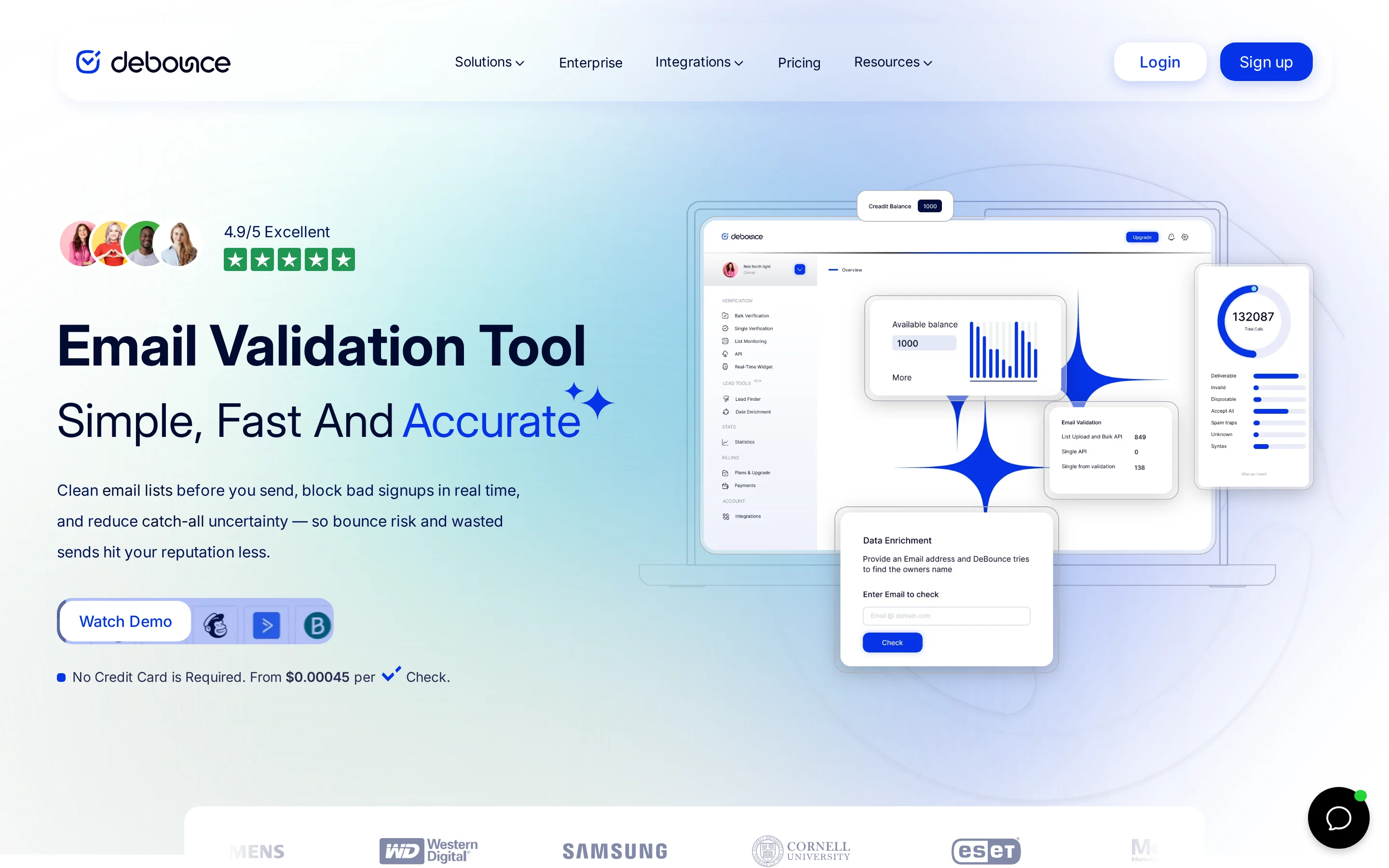
DeBounce workspace view
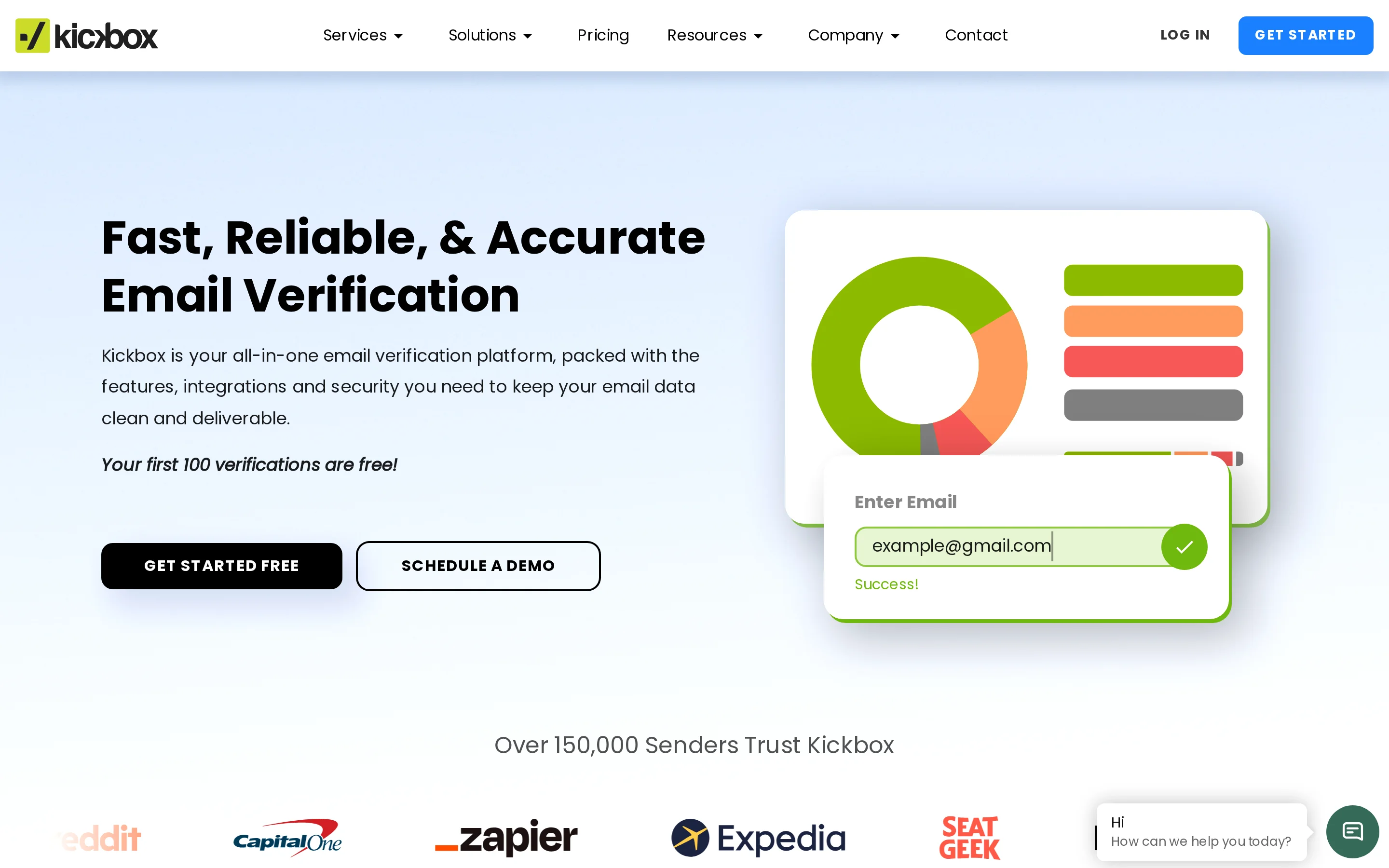
Kickbox workspace view

Verification Methodology: Anti-Greylisting & Catch-All Heuristics vs. Definitive Result Guarantees

DeBounce employs a sophisticated anti-greylisting technology that retries mailbox checks after temporary deferrals from mail servers. This approach minimizes inconclusive 'unknown' results by persistently attempting verification through SMTP handshakes. Additionally, DeBounce provides detailed catch-all domain analysis, allowing users to apply specific risk policies to domains that accept all incoming mail. This heuristic-based model is designed to maximize the number of definitive 'valid' or 'invalid' results processed per credit.

In contrast, Kickbox focuses on providing definitive result guarantees. If Kickbox cannot provide a definitive answer due to server restrictions or greylisting, they refund the credit used for that verification. This 'unknown is free' model shifts the financial risk away from the user, ensuring that you only pay for confirmed outcomes. Kickbox’s methodology prioritizes accuracy over volume, leveraging extensive infrastructure to resolve ambiguous states where possible.
Data Enrichment Architecture: Native Profile Enhancement vs. Standalone Threat Scoring

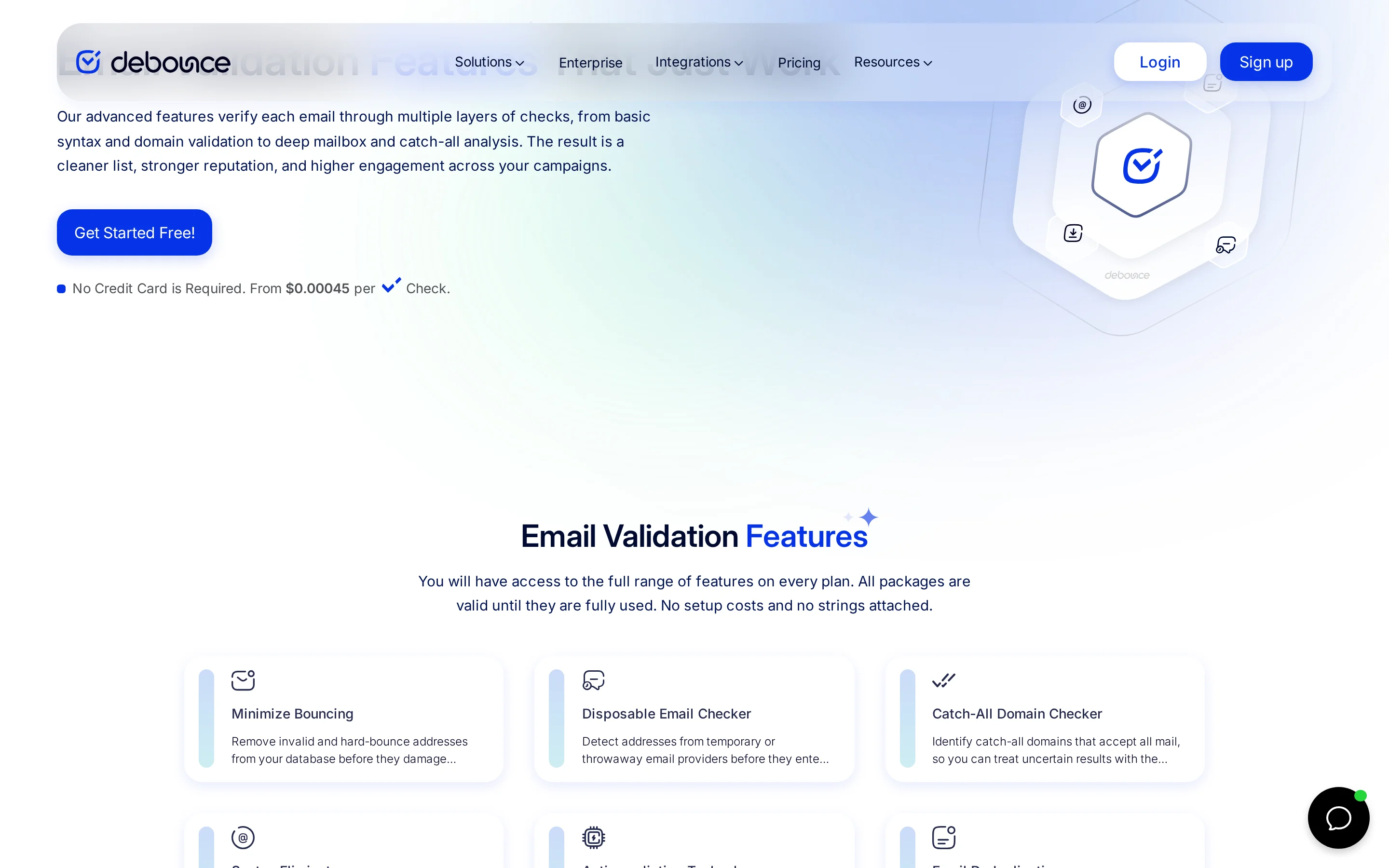
DeBounce integrates data enrichment directly into its verification stack. Beyond simple syntax and domain checks, DeBounce offers tools to enhance data with names, photos, and social profiles, alongside an email finder feature. This architecture supports lead generation workflows by allowing users to not only clean lists but also actively discover and verify new leads within the same platform, creating a unified prospecting environment.

Kickbox takes a modular approach, offering a standalone 'Email Threat Score' product. This service identifies malicious or high-risk emails, focusing on security rather than profile enhancement. While Kickbox does not offer native name/photo enrichment, its threat scoring adds a layer of security hygiene that is critical for enterprises concerned about phishing or spam traps. This separation allows Kickbox to specialize in deliverability and security consulting, catering to organizations that prioritize infrastructure integrity over lead enrichment.

Integration Ecosystem: Real-Time Widget/API Latency vs. Enterprise Deliverability Consulting

DeBounce emphasizes real-time validation through its JavaScript widget and robust API endpoints, designed for low-latency integration into signup forms and custom applications. The platform supports bulk list validation via dashboard uploads and offers seamless integrations with major ESPs like Mailchimp, HubSpot, and Klaviyo. Its focus is on ease of use for developers and marketers who need immediate feedback loops during data entry or campaign preparation.

Kickbox caters to enterprise needs with specialized deliverability consulting services. While it also offers API access and native integrations with platforms like Salesforce, Marketo, and SendGrid, its value proposition extends beyond software to include expert guidance on email infrastructure optimization. Kickbox’s ecosystem is built for high-volume senders who require not just verification, but strategic advice on maintaining sender reputation at scale, making it a partner rather than just a tool.

Pricing & True Cost of Ownership

Published tier structures, credit scaling mechanics, and total outbound cost.

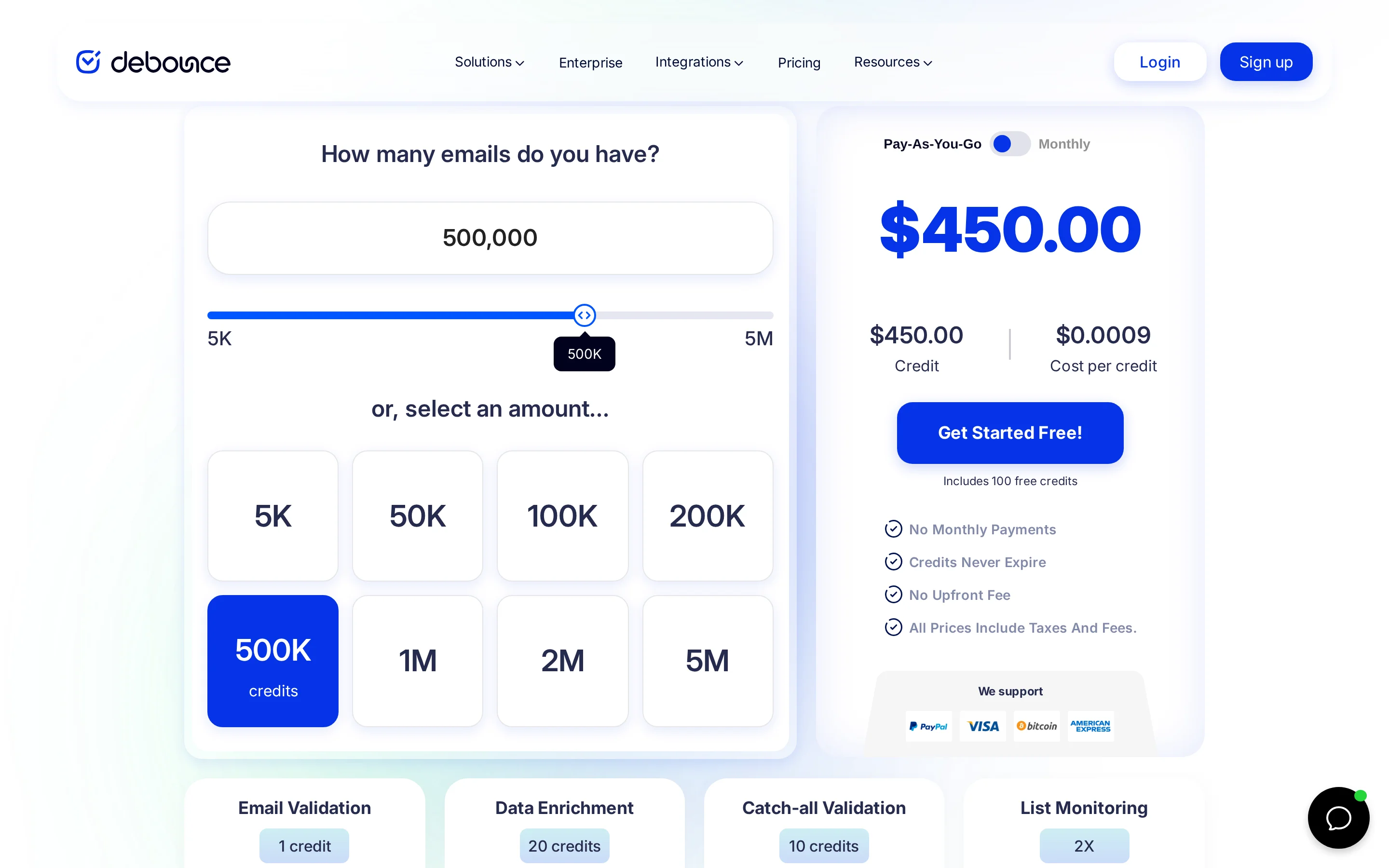
DeBounce published pricing cards
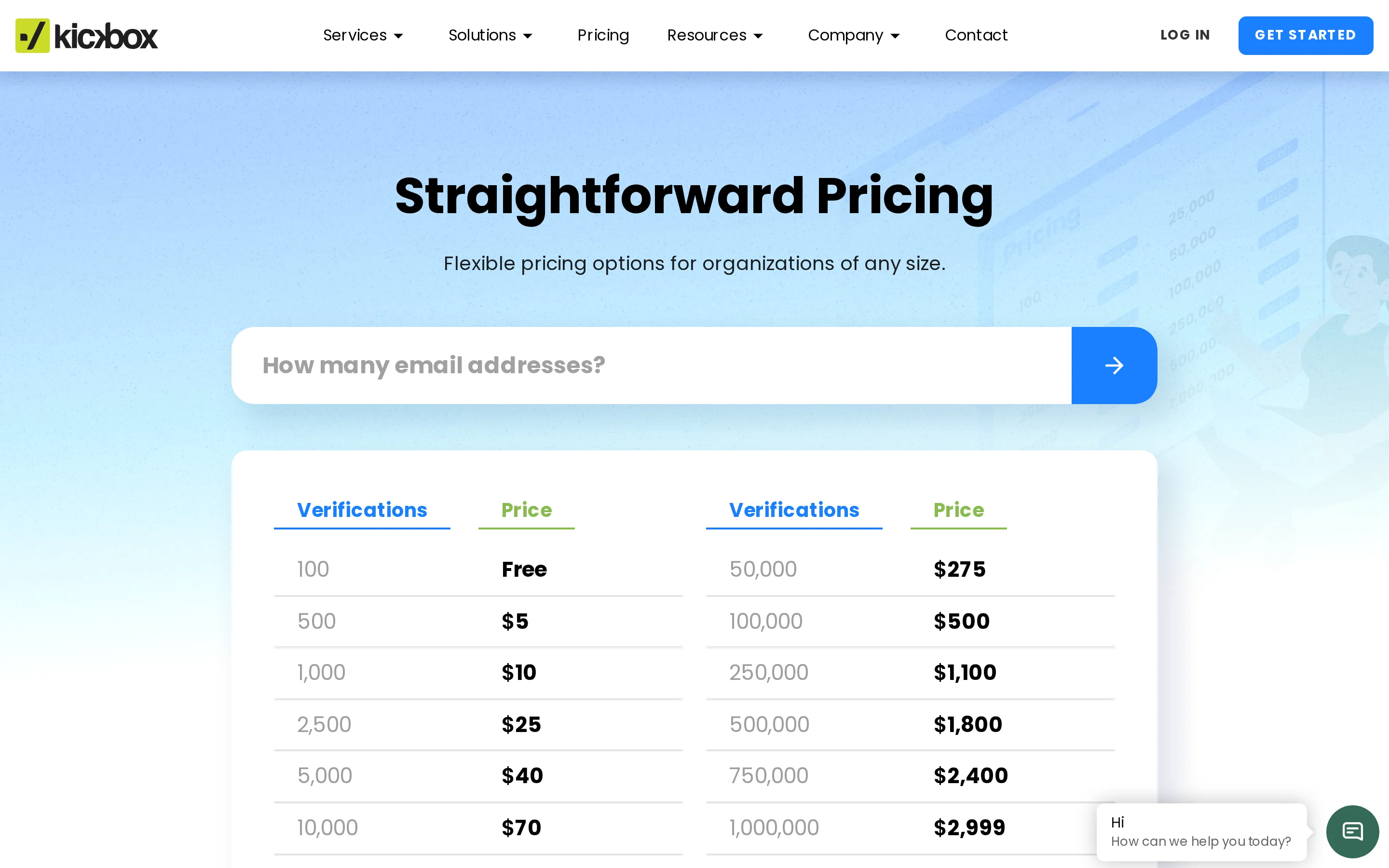
Kickbox published pricing cards
DeBounce Plans
  • Pay-As-You-Go: $450/month for 500K credits ($0.0009/credit)
  • Bulk Credits: Custom pricing starting from $0.00045/credit
Kickbox Plans
  • Starter: $5 for 500 verifications
  • Growth: $10 for 1,000 verifications
  • Scale: $25 for 2,500 verifications
  • Enterprise: Custom pricing for 50,000+ verifications
Total Cost Analysis & Verdict

DeBounce operates on a pure pay-as-you-go model with no monthly subscription fees, requiring a minimum purchase of $450 for 500K credits. This structure favors high-volume users who can absorb the upfront cost but benefit from non-expiring credits and lower per-check rates at higher volumes. Kickbox uses a tiered credit purchasing system with no mandatory monthly spend, allowing for granular budget control. However, Kickbox’s per-verification cost is significantly higher at lower tiers, making it more suitable for enterprises that prioritize security features and consulting support over raw cost efficiency.

True Cost Calculation:

of Ownership Analysis

For a 5-person sales team needing 10,000 verified leads per month, DeBounce would cost approximately $9.00 if purchased at the bulk rate of $0.0009/credit (based on the $450/500K baseline). In contrast, Kickbox’s equivalent volume would cost around $100-$200 depending on the tier applied, as their base rates are higher. DeBounce offers a clear cost advantage for high-volume verification, while Kickbox’s pricing reflects the added value of threat scoring and enterprise support.

Which Fits Your Outbound Model?

Match your team size, deal complexity, and lead volume to the right engine.

Use CaseDeBounceKickboxRecommendation
High-Volume Cold Outbound⭐⭐⭐⭐⭐⭐⭐⭐DeBounce is built for high-volume processing with cost-effective bulk credits and non-expiring balances, making it ideal for teams sending thousands of emails daily.
Bulk List Cleaning & Hygiene⭐⭐⭐⭐⭐⭐⭐⭐⭐Kickbox provides superior list cleaning for enterprises due to its definitive result guarantees and SOC II compliance, ensuring maximum data integrity for sensitive campaigns.
Developer API Data Pipelines⭐⭐⭐⭐⭐⭐⭐⭐⭐DeBounce offers excellent API latency and real-time widget capabilities, perfect for developers integrating validation into custom apps or forms with minimal friction.
Enterprise Security & Compliance⭐⭐⭐⭐⭐⭐⭐Kickbox is the clear winner for enterprises requiring SOC II certification, GDPR compliance, and advanced threat scoring to protect against malicious email activity.

Where Each Platform Falls Short

Constructive limitations and architectural trade-offs to weigh before signing.

Where DeBounce Falls Short
  • No native B2B contact database or email finder for discovering new leads outside of existing lists.
  • Higher minimum spend requirement ($450) may be prohibitive for small startups or solo practitioners.
  • Lacks dedicated deliverability consulting services, relying solely on software functionality.
Where Kickbox Falls Short
  • Significantly higher per-verification costs compared to DeBounce at comparable volumes.
  • No native data enrichment features (names, photos) integrated into the verification process.
  • Limited free tier (100 verifications) may not be sufficient for initial testing without immediate payment.

The Switching Playbook

What you gain and give up when migrating across platforms.

Switching to DeBounce
You Gain
  • Lower cost per verification for high-volume workflows.
  • Access to real-time validation widgets and Google Sheets integration.
  • Non-expiring credits allow for flexible usage without time pressure.
Switching to Kickbox
You Gain
  • Enhanced security with Email Threat Score and SOC II compliance.
  • Access to expert deliverability consulting for infrastructure optimi

Frequently Asked Questions

Direct technical answers about DeBounce and Kickbox.

Which platform has better data accuracy?

Both platforms offer high accuracy, but Kickbox’s definitive result guarantee and SOC II compliance make it slightly more reliable for enterprise-grade data integrity, while DeBounce’s anti-greylisting technology ensures high throughput with minimal unknowns.

How do their starting costs compare?

DeBounce requires a $450 minimum purchase for 500K credits, while Kickbox starts at $5 for 500 verifications. Kickbox is more accessible for low-volume users, but DeBounce offers better economies of scale.

Can I connect unlimited mailboxes?

Both platforms integrate with major ESPs like Mailchimp, HubSpot, and Klaviyo. DeBounce also offers direct WordPress and Google Sheets integrations, while Kickbox focuses on CRM and marketing automation platforms.

Which tool is easier to learn?

DeBounce is generally easier for quick list cleaning and API integration due to its straightforward dashboard and real-time widget. Kickbox requires more setup for enterprise features but offers comprehensive support and documentation.

Final Verdict & Recommendation
Choose DeBounce if: Choose DeBounce if you need an end-to-end outbound workspace with unified prospecting and dialing.
Choose Kickbox if: Choose Kickbox if you primarily need high-accuracy email discovery, verification, and API access.

Sources & Methodology

Every claim on this page is grounded in official vendor documentation and live audits.

Looking for an Autonomous Alternative? Compare with SendroAI

See how SendroAI replaces manual research, credit limits, and deliverability traps with full autonomous execution.

Ready to Automate Your Cold Email Outreach?

SendroAI conducts deep prospect research, crafts tailored 1:1 emails, and protects deliverability across unlimited mailboxes automatically.