
Kickbox vs ZeroBounce

A technical comparison of data scale, outbound sequencing, and true cost of ownership.

Quick Decision Verdict

Decisive executive rulings based on technical testing and pricing data.

Decision CategoryExecutive Ruling
Best for Enterprise OutboundKickbox
Best for Email DeliverabilityZeroBounce
Best for High-Volume ProspectingKickbox
Best Overall ValueZeroBounce

Kickbox vs ZeroBounce at a Glance

Side-by-side core specifications and live platform viewports.

AttributeKickboxZeroBounce
Primary PurposeEmail Verification & Threat ScoreUnified Deliverability Suite (ONE™)
Database ScaleN/A (Verification Focus)24 Billion Emails Validated
Starting Price$5/mo (500 credits)$99/mo (10k credits)
Free Plan100 Free Verifications100 Free Monthly Credits
Verification AccuracyHigh (SMTP Handshake)99.6% Guaranteed
Core StrengthDirect SMTP Validation & GDPR ComplianceAll-in-One Platform with Warmup & Finder

Feature-by-Feature Matrix

Audited capabilities across data sourcing, sending infrastructure, and integrations.

CapabilityWhy It MattersKickboxZeroBounceWinner
Email Verification APICore functionality for list hygiene✓ Native✓ NativeTie
Email FinderDiscovering verified addresses— None✓ Nativezerobounce
Email WarmupBuilding sender reputation— None✓ Nativezerobounce
Blacklist MonitoringDetecting deliverability issues— None✓ Nativezerobounce
DMARC MonitorSecurity and authentication tracking— None✓ Nativezerobounce
Inbox Placement TestPre-send testing— None✓ Nativezerobounce
AI ScoringAssessing engagement potential◐ Partial✓ Nativezerobounce
GDPR/SOC II ComplianceEnterprise security standards✓ Native✓ NativeTie
Native CRM IntegrationsWorkflow automation✓ Native✓ NativeTie
Zapier IntegrationConnecting to non-native apps✓ Native✓ NativeTie
Volume DiscountsCost efficiency at scale✓ Native✓ NativeTie
Unknown Result RefundCredit protection✓ Native✓ NativeTie
Deliverability ConsultingExpert guidance✓ Native✓ NativeTie
Email Threat ScoreIdentifying risky contacts✓ Native◐ Partialkickbox
Pay-As-You-GoFlexibility without subscription✓ Native✓ NativeTie
Mobile AppOn-the-go management— None✓ Nativezerobounce
API WrappersEase of developer integration— None✓ Nativezerobounce
Custom ReportingTailored insights◐ Partial✓ Nativezerobounce

Technical Deep Dives

Architectural comparisons derived directly from live platform testing.

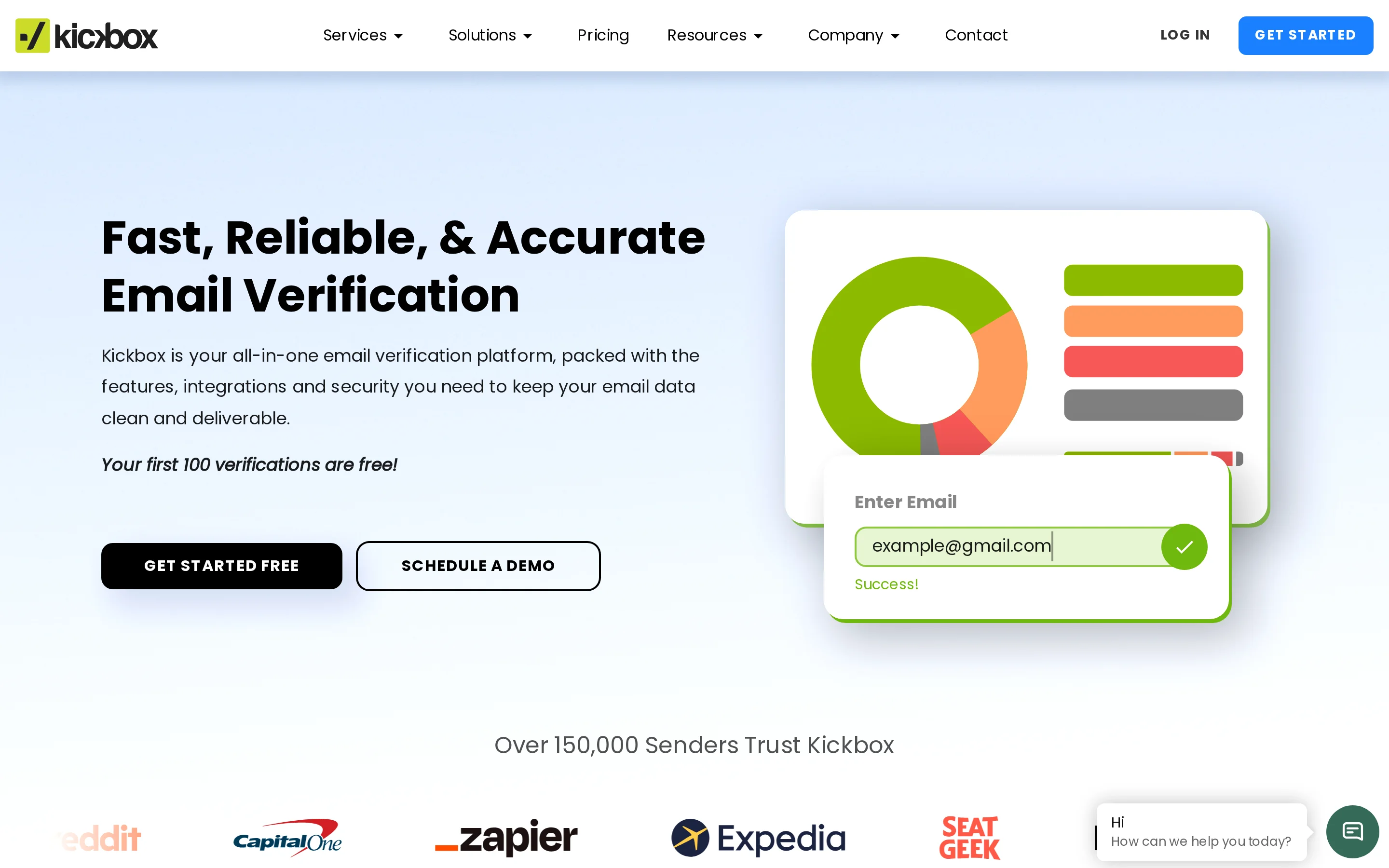
Kickbox workspace view
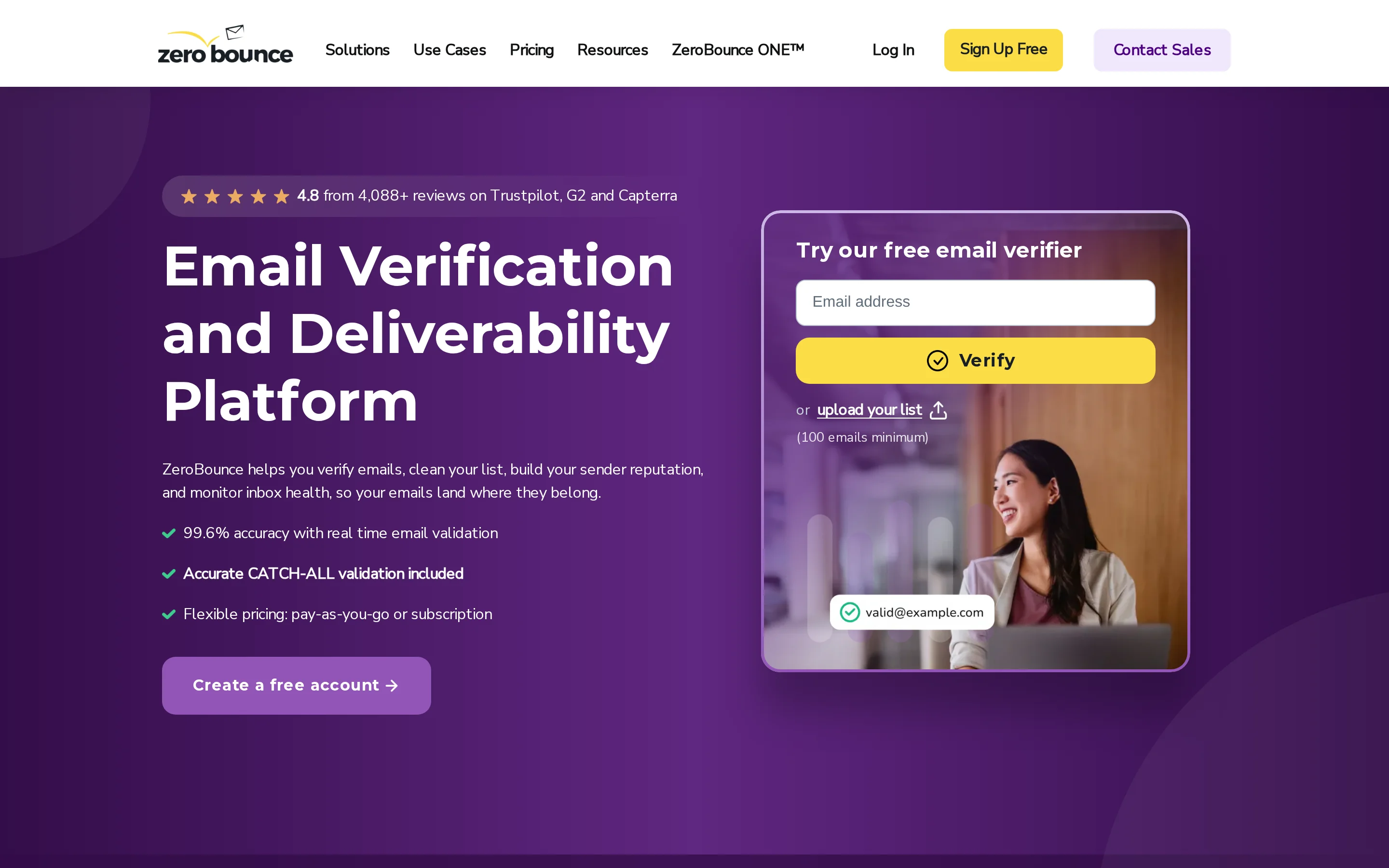
ZeroBounce workspace view

Verification Methodology: Real-Time SMTP Handshake vs. AI-Enriched Scoring Heuristics

Kickbox relies heavily on direct SMTP handshakes and syntax validation to determine definitive 'valid' or 'invalid' states. This approach is rigorous and provides high confidence in the binary status of an email address, making it ideal for compliance-heavy environments where accuracy is paramount. Their Email Threat Score adds a layer of risk assessment by analyzing the domain and mailbox behavior, but the core verification remains rooted in traditional protocol checks.

ZeroBounce employs a hybrid approach that combines standard validation with AI-driven scoring heuristics to assess inbox activity and engagement potential. By leveraging their database of 24 billion emails, ZeroBounce can infer the likelihood of an email being active even if direct SMTP responses are ambiguous. This method allows them to identify 'risky' contacts like spam traps and abuse accounts more effectively, providing a richer dataset for sales teams focused on engagement rather than just deliverability.

The architectural winner depends on your priority: Kickbox offers superior clarity for strict deliverability needs, while ZeroBounce provides deeper insights into lead quality and engagement potential. For outbound teams, ZeroBounce’s AI-enriched scoring offers a competitive edge in identifying high-potential leads, whereas Kickbox is better suited for ensuring that every sent email lands safely.
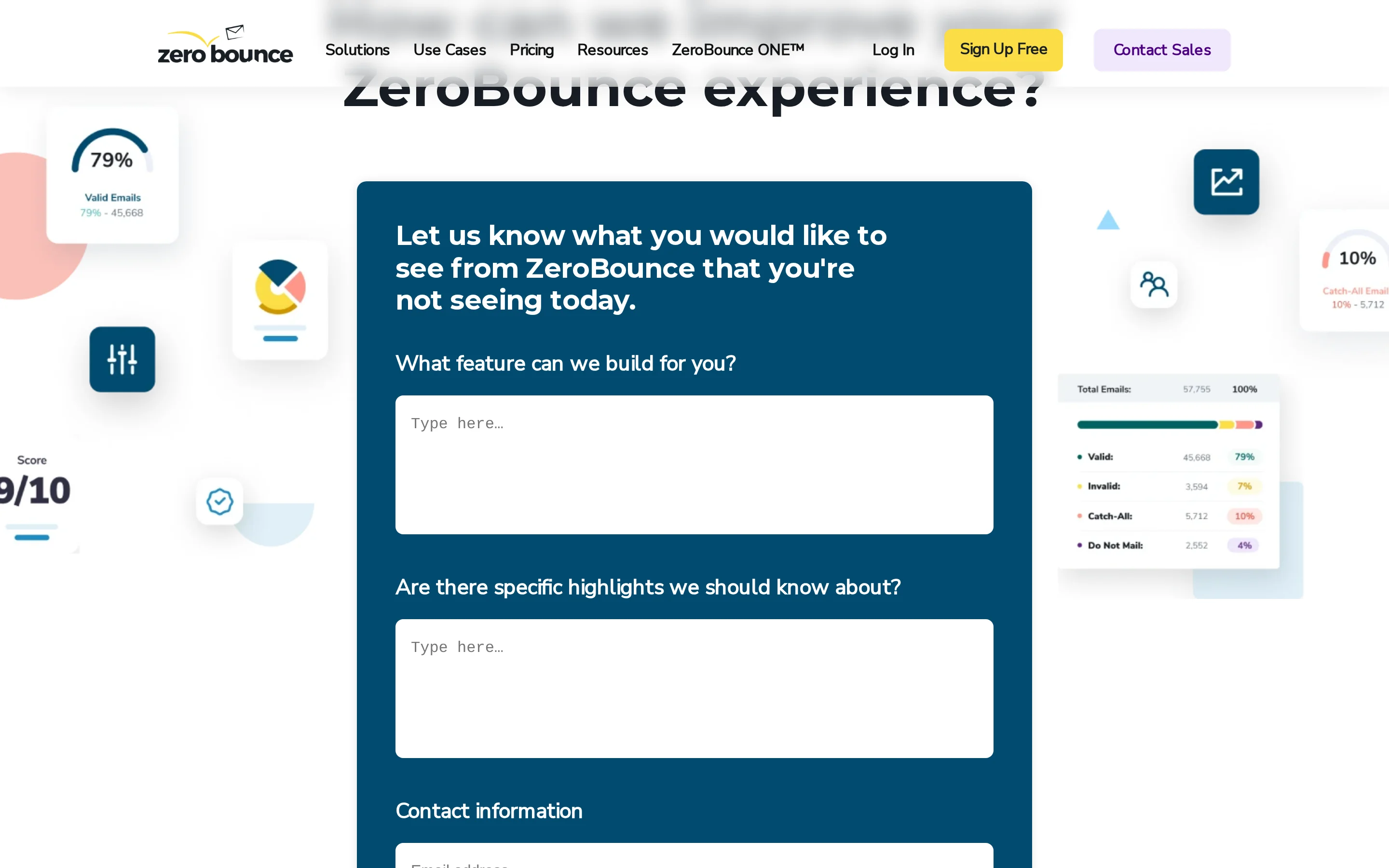
Ecosystem Architecture: Standalone Verification Engine vs. Unified Deliverability Suite (ZeroBounce ONE™)

Kickbox operates as a focused product stack, offering Email List Verification, Email Verification API, Email Threat Score, and Deliverability Consulting. This streamlined architecture allows users to access specialized tools without the bloat of unrelated features. It is designed for organizations that want best-in-class verification and threat detection without needing additional deliverability tools.

ZeroBounce has consolidated its platform into the ZEROBOUNCE ONE™ subscription model, which bundles verification credits with auxiliary tools like Email Finder, Warmup Seeds, Blacklist Monitoring, DMARC Tracking, and Inbox Placement Tests. This unified suite eliminates the need for multiple vendors, providing a comprehensive solution for all email deliverability needs under one roof.

For teams looking to simplify their tech stack, ZeroBounce’s unified approach is the clear winner. It reduces vendor management overhead and provides a holistic view of email health. However, Kickbox’s focused approach may be preferable for enterprises that already have best-of-breed tools for warmup and monitoring and only need a top-tier verification engine.

Commercial Flexibility: Credit-Based Refund Logic vs. Subscription Bundling with Non-Validation Inclusions

Kickbox offers volume-tiered pricing with a generous refund policy for undetermined results. If they cannot provide a definitive result, the credit is refunded, allowing users to re-verify later or use it elsewhere. This model is highly flexible for high-volume senders who encounter many ambiguous addresses, ensuring they only pay for confirmed valid/invalid outcomes.

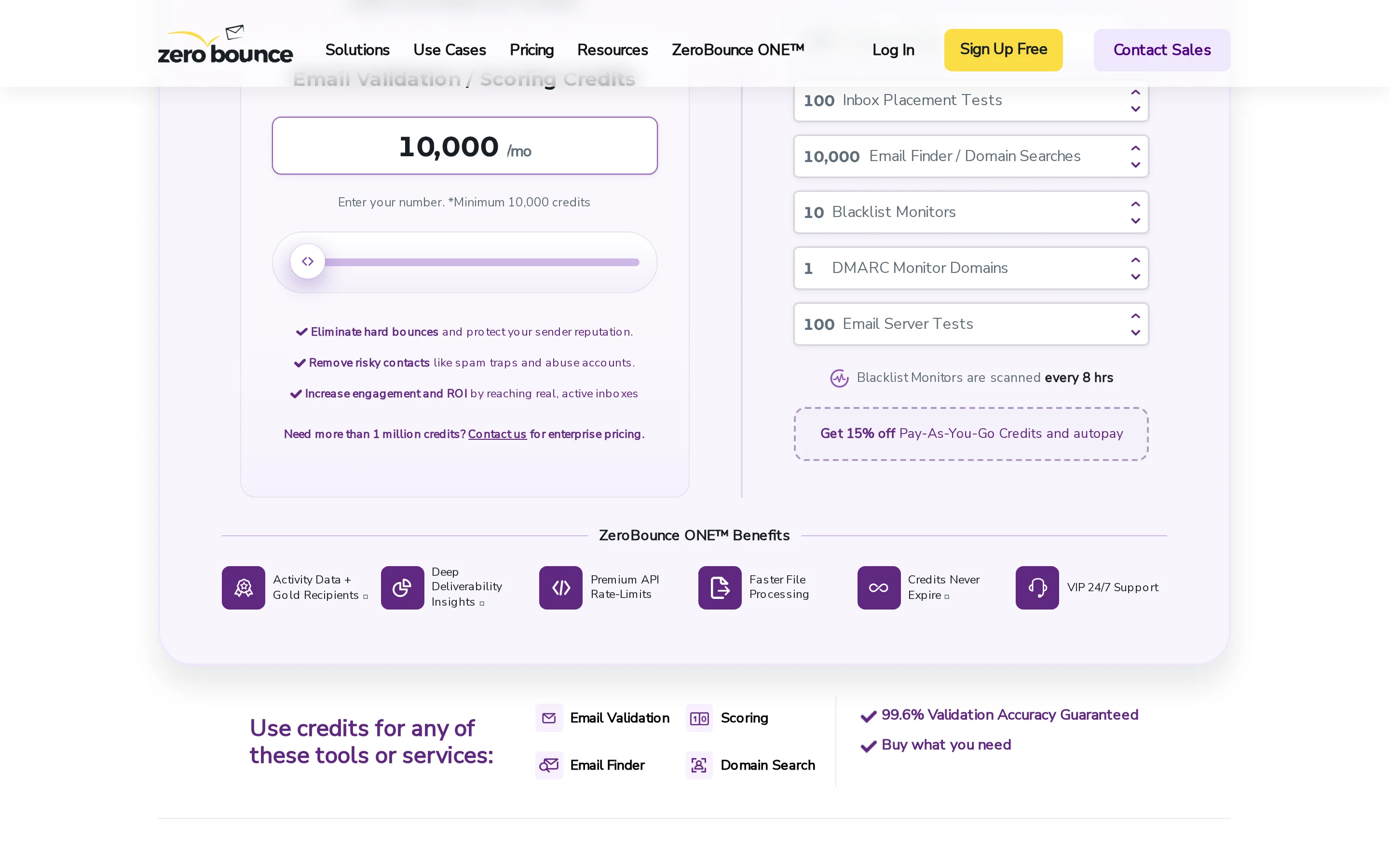
ZeroBounce uses a tiered monthly subscription model starting at $99/mo for 10k credits, bundled with non-validation inclusions like inbox placement tests and domain searches. While this provides significant value through added tools, the entry price is higher than Kickbox’s lowest tier. ZeroBounce also guarantees that unknown results are free, similar to Kickbox, but the overall cost structure is geared towards long-term subscribers seeking a full suite.

Kickbox wins on pure flexibility for variable usage patterns, especially for teams that don’t need the extra tools included in ZeroBounce’s plan. ZeroBounce wins on value for teams that will utilize the entire suite, as the bundled tools justify the higher starting price. For small teams or those with unpredictable verification volumes, Kickbox’s lower entry point and refund logic offer better financial control.

Pricing & True Cost of Ownership

Published tier structures, credit scaling mechanics, and total outbound cost.

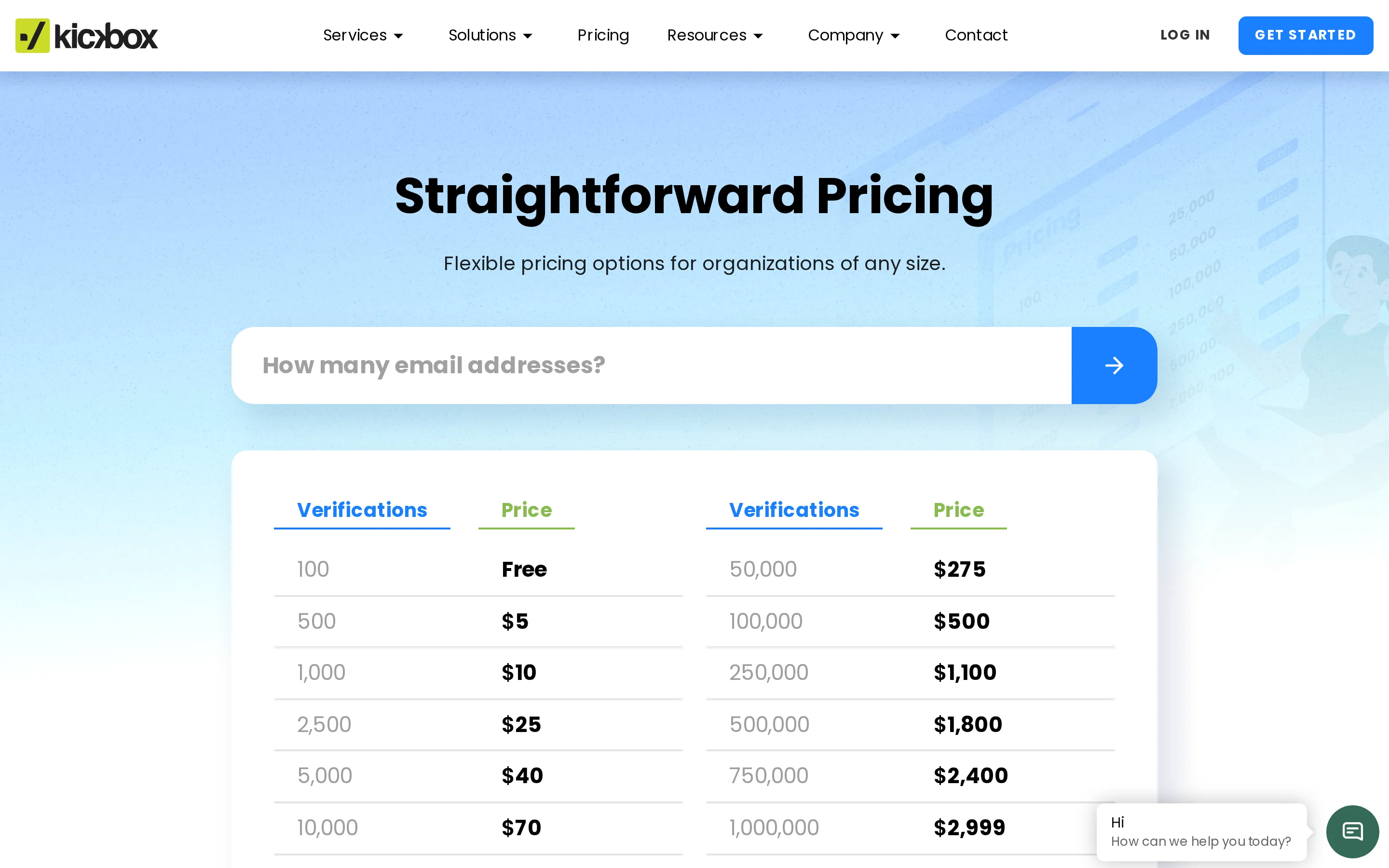
Kickbox published pricing cards
ZeroBounce published pricing cards
Kickbox Plans
  • Starter: $5/mo (500 credits)
  • Basic: $10/mo (1,000 credits)
  • Pro: $25/mo (2,500 credits)
  • Business: $40/mo (5,000 credits)
  • Enterprise: Custom Pricing
ZeroBounce Plans
  • Freemium: $0/mo (100 credits)
  • ZEROBOUNCE ONE™ Starter: $99/mo (10,000 credits)
  • ZEROBOUNCE ONE™ Pro: Custom Pricing (Higher Tiers Available)
  • Pay-As-You-Go: Starts at $39 (2,000 credits)
Total Cost Analysis & Verdict

Kickbox offers a lower barrier to entry with plans starting at $5/mo, making it accessible for small teams or those with low verification volumes. Its credit-based model allows for precise cost control, especially with refunds for unknown results. ZeroBounce’s ZEROBOUNCE ONE™ starts at $99/mo, which is significantly higher but includes a broader suite of deliverability tools. For teams that will use Email Finder, Warmup, and Blacklist Monitoring, ZeroBounce’s subscription model offers better overall value despite the higher initial cost.

True Cost Calculation:

of Ownership Analysis

For a 5-person sales team needing 10,000 verified leads per month: Kickbox would cost approximately $40/mo for the Business plan (5,000 credits) plus another $40/mo for a second batch, totaling $80/mo. ZeroBounce’s ZEROBOUNCE ONE™ Starter plan costs $99/mo for 10,000 credits. While Kickbox appears cheaper on paper, ZeroBounce includes additional tools worth hundreds of dollars separately. If the team utilizes Email Finder or Warmup, ZeroBounce becomes the more cost-effective option. Without those tools, Kickbox saves ~$19/mo.

Which Fits Your Outbound Model?

Match your team size, deal complexity, and lead volume to the right engine.

Use CaseKickboxZeroBounceRecommendation
High-Volume Cold Outbound⭐⭐⭐⭐⭐⭐⭐⭐Kickbox is built for high-volume verification with robust API support and refund logic for unknowns, ensuring maximum efficiency for large-scale campaigns.
Bulk List Cleaning & Hygiene⭐⭐⭐⭐⭐⭐⭐⭐⭐ZeroBounce provides superior bulk cleaning capabilities with detailed categorization of invalid, spam trap, and disposable emails, making it ideal for list hygiene.
Developer API Data Pipelines⭐⭐⭐⭐⭐⭐⭐⭐⭐ZeroBounce offers higher rate limits, API wrappers, and a more comprehensive API dashboard, making it easier for developers to integrate into complex pipelines.
Enterprise Compliance & Security⭐⭐⭐⭐⭐⭐⭐⭐⭐Kickbox’s strong emphasis on GDPR compliance, SOC II certification, and US/EU-based support makes it a top choice for enterprises with strict data privacy requirements.

Where Each Platform Falls Short

Constructive limitations and architectural trade-offs to weigh before signing.

Where Kickbox Falls Short
  • No native Email Finder or Lead Generation tools
  • No built-in Email Warmup or Blacklist Monitoring
  • Higher learning curve for advanced API configurations
Where ZeroBounce Falls Short
  • Higher minimum entry price ($99/mo) compared to Kickbox
  • Less granular control over verification-only workflows
  • Complexity of the unified suite may overwhelm simple use cases

The Switching Playbook

What you gain and give up when migrating across platforms.

Switching to Kickbox
You Gain
  • Lower entry cost for small teams
  • Simplified focus on verification and threat scoring
  • Stronger GDPR/SOC II compliance narrative
Switching to ZeroBounce
You Gain
  • Access to a full suite of deliverability tools
  • Simplified vendor management with ONE™ subscription
  • AI-enriched scoring for better lead quality insights

Frequently Asked Questions

Direct technical answers about Kickbox and ZeroBounce.

Which platform has better data accuracy?

Both platforms boast high accuracy. Kickbox focuses on definitive valid/invalid states via SMTP, while ZeroBounce guarantees 99.6% accuracy using a hybrid of validation and AI scoring. ZeroBounce’s larger database may provide an edge in identifying risky contacts.

How do their starting costs compare?

Kickbox starts at $5/mo for 500 credits, while ZeroBounce’s paid tier starts at $99/mo for 10,000 credits. Kickbox is more affordable for low-volume users, but ZeroBounce offers more credits and tools per dollar at scale.

Can I connect unlimited mailboxes?

Both platforms allow integration with multiple ESPs and CRMs via native integrations and Zapier. However, neither platform directly manages mailboxes; they verify email addresses used across your existing infrastructure.

Which tool is easier to learn?

ZeroBounce’s unified interface and pre-built templates make it easier for non-technical users to get started. Kickbox’s API-first approach may require more technical expertise but offers greater flexibility for developers.

Final Verdict & Recommendation
Choose Kickbox if: Choose Kickbox if you need a focused, high-accuracy verification engine with strong compliance credentials and flexible pricing for variable volumes.
Choose ZeroBounce if: Choose ZeroBounce if you want an all-in-one deliverability suite with Email Finder, Warmup, and AI scoring, and are willing to pay a higher entry price for comprehensive tools.

Sources & Methodology

Every claim on this page is grounded in official vendor documentation and live audits.

Looking for an Autonomous Alternative? Compare with SendroAI

See how SendroAI replaces manual research, credit limits, and deliverability traps with full autonomous execution.

Ready to Automate Your Cold Email Outreach?

SendroAI conducts deep prospect research, crafts tailored 1:1 emails, and protects deliverability across unlimited mailboxes automatically.