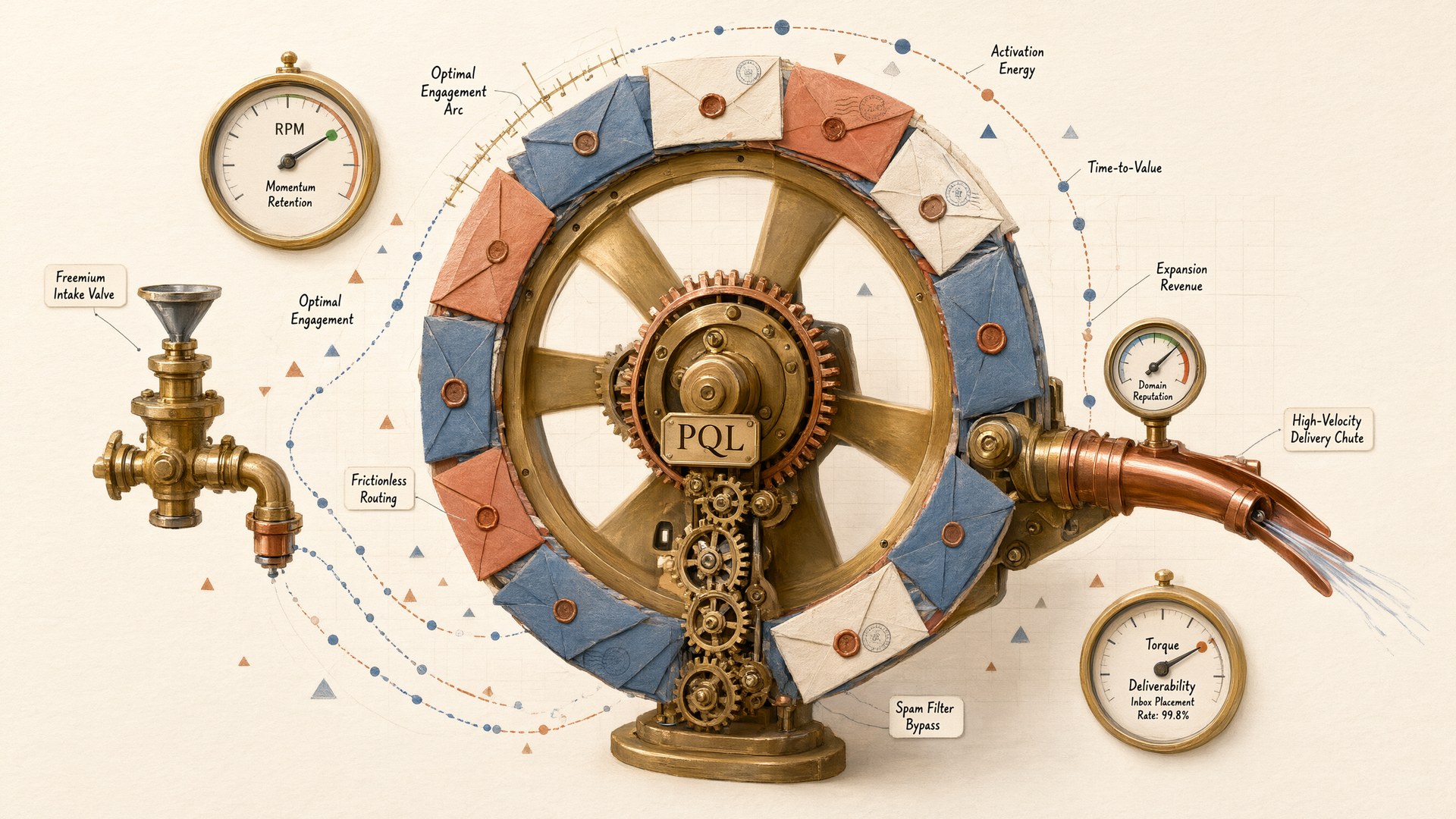
Master the 2026 Product-Led Growth flywheel. Learn to identify PQLs, optimize freemium models, and secure inbox placement for sustainable SaaS scaling.
Why Product-Led Growth is the Only Viable B2B GTM Model in 2026
In 2026, the traditional B2B sales-led motion is no longer just inefficient; it is structurally obsolete. The convergence of rising customer acquisition costs (CAC), buyer skepticism toward cold outreach, and the commoditization of basic SaaS features has created a market where trust is only earned through immediate utility. Product-Led Growth (PLG) is not merely a growth tactic in this environment—it is the only viable GTM model that aligns with how modern buyers actually evaluate risk and value. Unlike legacy models that rely on interruptive marketing and lengthy demo cycles, PLG flips the equation by placing the product at the center of the revenue engine, allowing prospects to validate ROI before they ever speak to a human.
The Economics of Trust: Why Buyers Demand Self-Serve First
Buyer behavior has fundamentally shifted. According to recent industry analysis, nearly 75% of B2B buyers now prefer purchasing directly from a website over engaging with a sales representative, a statistic that has only accelerated as digital fatigue sets in. In 2026, the "try before you buy" expectation is no longer a nice-to-have for consumer apps; it is a baseline requirement for enterprise software. When a prospect can experience the "aha moment" within minutes rather than weeks, the friction associated with sales-led motions becomes a competitive disadvantage. This shift forces organizations to abandon the funnel mentality, which assumes linear progression, in favor of a flywheel approach where user success drives acquisition. For a deeper look at how this structural shift impacts your infrastructure, see our guide on Beyond the Funnel: How B2B Growth Marketers Are Using Lifecycle Data to Defeat Acquisition Saturation in 2026.
The financial implications are stark. Sales-led motions require significant overhead—SDRs, AEs, and enablement teams—to convert leads that may never qualify. PLG automates the qualification process through behavioral data. By embedding growth loops directly into the product experience, companies like Slack, Zoom, and Figma have demonstrated that sustainable growth comes from users becoming advocates, not from outbound volume. In an era where investors scrutinize burn multiples, PLG offers a path to capital efficiency by lowering CAC and increasing Lifetime Value (LTV) through organic expansion. However, executing this requires more than just a good UI; it demands rigorous attention to deliverability and lifecycle data to ensure that every touchpoint reinforces trust.
Critical Constraints for Implementing PLG in 2026
Transitioning to a PLG-first model is not a simple switch; it requires re-engineering core business metrics and operational workflows. Success depends on identifying specific thresholds that signal readiness and adhering to strict constraints around product quality and data infrastructure. Below are the essential criteria for determining if your organization can support a PLG motion without collapsing under operational debt.
- Short Time-to-Value (TTV): Users must reach their 'aha moment' within 7-14 days, ideally within hours, to prevent early churn.
- Self-Serve Onboarding: The product must be intuitive enough that less than 10% of new users require human intervention during setup.
- Clear PQL Definition: You must be able to mathematically define a Product-Qualified Lead based on usage events, not just email opens.
- Hybrid Monetization: Offer both freemium and free trials to capture top-of-funnel volume while driving urgency for conversion.
| Metric | Sales-Led Baseline | PLG Target (2026) |
|---|---|---|
| Customer Acquisition Cost (CAC) | $800 - $1,500+ | <$300 via organic/viral loops |
| Sales Cycle Length | 60 - 90 Days | 7 - 14 Days (Self-Serve) |
| Conversion Source | Outbound Demos | Product Usage & Referrals |
| Revenue Per Employee | Low (High Headcount) | High (Automated Scaling) |
Illustrative Example: A mid-market B2B analytics platform attempts to launch a PLG motion but fails because its onboarding requires manual data integration that takes 4+ hours. Prospects drop off before experiencing value, resulting in a 95% churn rate during the trial phase despite high initial sign-ups.
Result: The company was forced to revert to a sales-led model because the product complexity could not be abstracted for self-serve users. This highlights that PLG is only viable when the product can demonstrate value instantly without heavy technical dependency.
Furthermore, PLG does not eliminate the need for sales; it repurposes it. In a mature PLG flywheel, sales teams focus exclusively on expanding accounts that have already proven their value through usage, rather than hunting for cold leads. This alignment ensures that every sales interaction is backed by concrete data, increasing close rates and reducing ramp time for new hires. For organizations looking to integrate these AI-driven outbound tactics into their existing funnels, we recommend reviewing The 2026 Growth Protocol: Integrating AI-Driven Outbound into the AARRR Funnel.
Do not confuse PLG with a lack of strategy. Successful PLG companies invest heavily in content marketing and SEO to drive traffic, but the conversion happens inside the product. Ensure your analytics stack can track every micro-interaction to refine your onboarding journey continuously.
Deconstructing the PLG Flywheel: From Evaluators to Advocates
The traditional linear funnel is a relic of an era where marketing and sales operated in silos, leading to high friction and significant lead leakage. In the 2026 B2B landscape, Product-Led Growth (PLG) has evolved into a self-sustaining flywheel that leverages user experience as the primary engine for acquisition, expansion, and retention. This model shifts the burden of proof from the sales team to the product itself, requiring organizations to architect systems where value demonstration occurs organically before human intervention. The core objective is not merely to acquire users, but to transform them into active evaluators who quickly progress to becoming paid beginners, engaged regulars, and ultimately, vocal advocates. This transition requires a rigorous infrastructure that prioritizes deliverability, data integrity, and seamless user onboarding to ensure that every touchpoint reinforces the product's value proposition.
Phase 1: From Evaluators to Beginners
Evaluators are prospects actively researching solutions, comparing competitors, and testing free tiers or trials. They are skeptical and time-poor, seeking immediate validation of their pain points. The goal at this stage is to accelerate the Time-to-Value (TTV) by guiding evaluators through a frictionless onboarding journey that leads directly to their "aha moment." This requires removing all unnecessary barriers—such as lengthy forms or mandatory demos—and instead providing self-serve resources like interactive tutorials or AI-driven chatbots. As evaluators begin to incorporate the product into their workflows, they graduate to the Beginner phase. At this point, they have experienced initial value and are somewhat committed, but they require continued support to solidify habitual use. Delivering on expectations here involves reducing friction through accessible knowledge bases and contextual help, ensuring that the transition from curiosity to adoption is smooth and supported.
Phase 2: Regulars to Champions
Regulars are power users who rely on the product daily, making switching costs prohibitively high. They demand reliability, performance, and advanced features. While they are less likely to churn, they can become complacent if not continuously engaged. The strategy here is to deepen their engagement by highlighting new use cases, efficiency gains, and product updates. Regulars are also the most likely source of valuable feedback, which should be actively solicited and acted upon to demonstrate responsiveness. As these users become deeply embedded in their workflows and emotionally connected to the brand, they evolve into Champions. Champions are superfans who advocate for the product, participate in beta testing, and provide references that convert prospective customers. Cultivating this advocacy requires deliberate efforts such as exclusive events, swag, and early access to new features, turning satisfied users into a powerful growth engine.
| User Stage | Primary Goal | Key Actions & Infrastructure Requirements |
|---|---|---|
| Evaluator | Achieve Activation / Aha Moment | Frictionless sign-up, dynamic onboarding paths, real-time support via AI/chatbots, clear value proposition communication. |
| Beginner | Establish Habitual Use | Contextual help, knowledge base integration, proactive feature discovery nudges, reduced cognitive load during setup. |
| Regular | Deepen Engagement & Retention | Advanced feature education, usage analytics dashboards, feedback loops, proactive customer success outreach. |
| Champion/Advocate | Drive Referral & Expansion | Exclusive community access, beta testing opportunities, recognition programs, referral incentives, social sharing tools. |
To sustain this flywheel, organizations must integrate robust analytics and deliverability infrastructure. Without accurate tracking of user behavior and reliable email communication channels, it is impossible to identify Product-Qualified Leads (PQLs) or nurture them effectively. For instance, understanding which actions lead to upgrades allows sales teams to focus on high-intent prospects rather than cold outreach. Furthermore, ensuring that all outbound communications—from onboarding sequences to feature announcements—are delivered reliably is critical. A failure in deliverability can disrupt the entire flywheel, causing advocates to miss crucial updates and evaluators to lose interest. By aligning PLG strategies with high-deliverability protocols, companies can maintain trust and momentum throughout the user journey.
Always segment your PQL identification criteria by user cohort. What qualifies a lead for a SMB product may differ significantly from an enterprise workflow; tailoring these thresholds ensures sales teams engage with the right opportunities at the right time.
Key Decisions for PLG Flywheel Success
- Prioritize Time-to-Value over comprehensive feature exposure during onboarding.
- Use behavioral data to trigger personalized next-best-actions for each user stage.
- Invest in deliverability infrastructure to protect the integrity of all user communications.
- Create explicit pathways for Regulars to become Advocates through recognition and community building.
For organizations looking to implement these strategies, it is essential to understand how to leverage lifecycle data to overcome acquisition saturation. Integrating cold outreach with inbound assets can further amplify the reach of your PLG flywheel, ensuring that high-quality leads are consistently fed into the system. Additionally, adopting a metrics protocol that focuses on deliverability and revenue attribution will provide the clarity needed to optimize each stage of the flywheel. By treating the user journey as a continuous loop rather than a linear path, businesses can create sustainable, exponential growth driven by genuine product value and customer advocacy.
Freemium, Free Trials, or Hybrid: Choosing Your Acquisition Engine
In the 2026 B2B landscape, the choice between freemium, free trials, and hybrid models is no longer just a pricing decision—it is a fundamental infrastructure choice that dictates your data quality, sales velocity, and ultimately, your email deliverability. As we move past the linear funnel into the PLG flywheel, the acquisition engine must be calibrated to balance volume against intent. A poorly structured trial model can flood your CRM with low-intent leads, saturating your sending domains and triggering spam filters before you even reach the nurture phase. Conversely, an overly restrictive freemium tier may stifle the viral loops necessary for sustainable growth. The core challenge for modern GTM teams is selecting an acquisition model that aligns with your product's time-to-value (TTV) while preserving the integrity of your outreach infrastructure.
Freemium vs. Free Trials: The Data Volume Tradeoff
| Dimension | Freemium Model | Free Trial Model |
|---|---|---|
| Conversion Rate | Lower median (~7%) due to indefinite access | Higher median (~14%) driven by urgency |
| Lead Volume | High; opens top-of-funnel significantly | Moderate; friction from credit card requirement |
| Intent Signal | Low to Medium; users explore without commitment | High; users have already provided payment info |
| Support Load | High; requires robust self-serve resources | Medium; focused on activation within 14 days |
The data suggests that freemium models generate significantly more accounts but at the cost of conversion efficiency. OpenView Partners notes that typical freemium tools generate 33% more free accounts per website visitor compared to paid-gated alternatives. However, this volume comes with a hidden cost: data decay. In 2026, maintaining high deliverability requires clean, engaged segments. Freemium users often fall into the "zombie" category—active enough to keep their account but disengaged enough to ignore emails, which hurts sender reputation. If your product generates an output for every input (like Zoom or Slack), freemium is viable because the product itself drives the next wave of acquisition through built-in growth loops. For products requiring manual adoption, the noise-to-signal ratio in freemium pipelines can overwhelm your sales development representatives (SDRs).
Freemium Acquisition Engine
- Maximizes top-of-funnel volume and brand exposure
- Enables organic viral loops if the product has network effects
- Removes friction for early-stage evaluation
- Lower conversion rates (~7%) compared to trials
- Higher risk of data decay and list hygiene issues
- Requires significant investment in automated onboarding
If you choose freemium, implement a hard cap on email sending frequency for inactive users. Use behavioral triggers to segment 'dormant' freemium accounts away from your primary sending domains to protect your IP reputation. Only re-engage these users via cold outreach channels after they have shown renewed activity signals.
The Hybrid Advantage: Balancing Urgency and Reach
Leading SaaS companies like Ortto, Slack, and Canva are increasingly adopting hybrid models to capture the best of both worlds. This approach allows you to cast a wide net with freemium for awareness while using free trials to capture high-intent buyers ready to commit. The hybrid model is particularly effective when your product has distinct tiers of value that require different levels of engagement. By offering a freemium tier with limited features and a free trial of premium capabilities, you create a natural upgrade path. This structure not only improves conversion rates but also provides clearer signals for Product-Qualified Leads (PQLs). Users who opt into a trial have already demonstrated a higher level of intent by providing payment information, making them prime candidates for immediate sales intervention.
- Identify the specific feature set that constitutes the 'aha moment' for your product
- Restrict this feature set in the freemium tier to drive trial sign-ups
- Implement automated nudges to convert active freemium users to trials
- Route trial users directly to SDRs upon activation of key features
Illustrative Example: A B2B marketing automation platform offers a freemium tier with basic email campaigns and a 14-day free trial of advanced AI segmentation. Freemium users hit usage limits quickly, triggering an automated email inviting them to start a trial. Users who start the trial are tagged as 'high-intent' and routed to an SDR for a personalized demo within 24 hours.
Result: This hybrid approach increases conversion rates by leveraging the urgency of the trial while maintaining a steady stream of leads from the freemium pool. It also ensures that SDRs only engage with prospects who have experienced significant value, improving close rates and reducing wasted effort.
However, implementing a hybrid model requires careful orchestration. You must ensure that the transition from freemium to trial is seamless and that the value proposition of the trial is clear. If the trial feels like a gimmick rather than a genuine opportunity to experience the product, users will churn quickly. Furthermore, you need to align your marketing and sales teams around the definition of a PQL. In a hybrid model, a PQL might be defined differently for freemium users (e.g., hitting a usage limit) versus trial users (e.g., activating a premium feature). Clear definitions prevent confusion and ensure that leads are routed to the appropriate team for follow-up.
Decision Rules for 2026 Acquisition Models
- Choose Freemium if your product has strong network effects and you prioritize volume over immediate revenue
- Choose Free Trial if your TTV is under 14 days and you have a dedicated sales team to handle high-intent leads
- Choose Hybrid if you want to maximize both reach and conversion, but be prepared for increased operational complexity
- Always align your acquisition model with your deliverability infrastructure; high-volume, low-intent lists require strict hygiene protocols
Ultimately, the choice between freemium, free trials, and hybrid models should be driven by your product's unique characteristics and your organization's capacity to support each channel. There is no one-size-fits-all solution, but understanding the tradeoffs between volume, intent, and operational load is critical for success in the 2026 PLG landscape. For deeper insights on integrating these acquisition engines with broader lifecycle strategies, see our guide on Beyond the Funnel: How B2B Growth Marketers Are Using Lifecycle Data to Defeat Acquisition Saturation in 2026.
Identifying Product-Qualified Leads (PQLs) Through Behavioral Data
In the 2026 B2B landscape, Product-Qualified Leads (PQLs) are no longer defined by simple form fills or email opens. They are identified through deep behavioral telemetry that maps a user’s journey from curiosity to value realization. Unlike Marketing-Qualified Leads (MQLs), which rely on intent signals like content downloads, PQLs represent users who have already experienced your product's core utility. This distinction is critical for SendroAI clients because it shifts the focus from lead generation volume to lead quality velocity. By tracking specific in-product actions, you can identify the precise moment a prospect transitions from a free-tier user to a revenue-ready opportunity, allowing sales teams to intervene only when the buyer is psychologically and practically ready to convert.
The Behavioral Thresholds That Define a 2026 PQL
Identifying PQLs requires moving beyond vanity metrics like page views or session duration. Instead, you must track actions that correlate directly with retention and expansion. The most effective PQL models are built on three pillars: activation, engagement depth, and usage frequency. Activation occurs when a user completes the "aha moment"—the first time they derive tangible value from your tool. Engagement depth measures how many distinct features they utilize, indicating a deeper integration into their workflow. Usage frequency tracks consistency, ensuring the user isn't just testing the waters but relying on the solution. When these three signals align, the probability of conversion spikes significantly, reducing sales cycle friction and improving close rates.
- Feature Adoption Velocity: Track the time between account creation and the use of core features; faster adoption correlates with higher lifetime value.
- Collaborative Signals: Identify users who invite teammates or share assets, as network effects often precede enterprise upgrades.
- Usage Limits Encountered: Monitor when users hit storage caps, API limits, or seat restrictions, signaling immediate need for expansion.
- Support Ticket Sentiment: Analyze support interactions for positive feedback or feature requests, which indicate high engagement and potential upsell opportunities.
| Lead Type | Primary Signal | Sales Intervention Timing |
|---|---|---|
| MQL | Content consumption, webinar attendance | Early nurturing via email sequences |
| SQL | Demo request, calendar booking | Immediate direct outreach |
| PQL | Core feature activation, usage threshold met | Targeted upgrade prompts or success check-ins |
To operationalize this data, you must integrate your product analytics with your CRM and marketing automation platforms. This ensures that when a PQL threshold is crossed, the relevant stakeholders are notified instantly. For instance, if a user hits a usage limit, an automated trigger can alert both the customer success team and the marketing engine to deliver personalized upgrade messaging. This seamless handoff between product experience and commercial action is what defines modern PLG infrastructure. For a deeper dive into how lifecycle data drives this alignment, explore our guide on Beyond the Funnel: How B2B Growth Marketers Are Using Lifecycle Data to Defeat Acquisition Saturation in 2026.
Illustrative Example: A SaaS project management tool offers a freemium tier. A user signs up, creates three projects, invites two team members, and completes five tasks within seven days. This sequence matches the company's defined PQL criteria: activation (creating projects), collaboration (inviting members), and engagement (completing tasks).
Result: The system automatically tags the user as a PQL, assigns them a 'High Intent' score, and triggers a personalized email from the sales development rep offering a guided tour of the premium reporting features, resulting in a 40% higher conversion rate than generic nurture emails.
Avoid over-segmenting your PQL criteria initially. Start with one or two high-correlation behaviors (e.g., feature A + feature B usage) and refine based on historical conversion data. Too many thresholds can dilute the signal and delay sales engagement.
Q: How do I determine the right PQL threshold for my specific product?
Analyze your existing paying customers and identify the common behaviors they exhibited during their first 14 days. Use cohort analysis to find the intersection of actions that leads to the highest retention and expansion rates. This empirical approach ensures your thresholds reflect actual user behavior rather than assumptions.
Key Decisions for Implementing PQL Tracking
- Define clear activation events that represent true value delivery.
- Integrate product analytics with CRM for real-time lead scoring.
- Align sales and marketing on PQL definitions to ensure consistent follow-up.
- Continuously refine thresholds based on conversion performance data.
The Hidden Bottleneck: Why PLG Fails Without Enterprise-Grade Email Infrastructure
In the 2026 B2B landscape, Product-Led Growth (PLG) is no longer a differentiator; it is the baseline expectation. However, a critical failure point remains invisible to most GTM leaders: the assumption that product virality can survive without enterprise-grade email infrastructure. While PLG relies on self-serve adoption and frictionless onboarding, the moment a user transitions from a free trial to an advocate—or when sales intervenes for an Enterprise conversion—the communication channel shifts entirely to email. If this infrastructure is not engineered for deliverability at scale, the flywheel stalls. The bottleneck is not the product experience; it is the silent degradation of inbox placement caused by fragmented sending domains, inconsistent authentication, and lack of real-time feedback loops.
The Deliverability Gap in Hybrid PLG Models
Modern PLG strategies often operate as hybrid models, where marketing automation platforms handle nurture sequences while sales development representatives (SDRs) execute outbound campaigns. This dual-stack approach creates significant risk if not unified under a single deliverability governance framework. When SDRs send cold outreach from separate domains or use traditional ESPs not optimized for high-volume B2B engagement, they dilute the sender reputation established by the product-led welcome emails. Research indicates that inconsistent SPF alignment and missing DKIM signatures across these disparate systems can cause legitimate transactional and nurturing emails to be routed to spam folders, effectively severing the connection between product activation and revenue expansion. For a comprehensive breakdown of how to audit these hidden friction points, see our guide on The 2026 Cold Email Deliverability Audit: Fixing the Hidden Friction Points That Sink B2B Inboxes.
| Infrastructure Component | Standard PLG Setup Risk | Enterprise-Grade Requirement |
|---|---|---|
| Domain Authentication | Fragmented SPF/DKIM across marketing and sales tools | Unified DNS records with consistent DMARC policies |
| Sending Volume | Sudden spikes from viral product invites without warming | Gradual ramp-up protocols tied to domain age |
| Feedback Loops | Delayed bounce handling (>48 hours) | Real-time ISP feedback loop integration |
The consequence of ignoring this infrastructure layer is quantifiable churn in the upper funnel. When a potential customer receives a critical onboarding email or a follow-up from a sales rep due to a deliverability failure, the perceived reliability of the entire platform is compromised. In 2026, with AI-driven spam filters becoming increasingly sophisticated, generic "spray and pray" email tactics are obsolete. Organizations must treat email infrastructure as a core product feature, not a back-office utility. This requires proactive monitoring of inbox placement rates, automated IP rotation strategies, and strict adherence to provider guidelines such as those outlined by Google sender guidelines and Yahoo sender best practices. Without these technical safeguards, the PLG flywheel loses momentum, turning potential advocates into silent drop-offs.
Never allow your sales team to operate on a separate email stack from your product’s notification system. Unify your sending infrastructure to ensure that brand reputation signals are cumulative, not diluted, across all touchpoints.
Verdict: Infrastructure First
PLG cannot scale beyond its initial viral coefficient without enterprise-grade email deliverability. Treat inbox placement as a KPI equal to Monthly Active Users (MAU). Invest in dedicated sending domains, automated authentication management, and real-time analytics before scaling acquisition efforts.
Implementing SendroAI to Automate PLG Outreach and Nurture Sequences
In the 2026 B2B landscape, Product-Led Growth (PLG) has evolved from a simple freemium experiment into a complex, data-driven infrastructure that requires rigorous automation. As organizations scale, the friction between rapid user acquisition and maintaining high deliverability standards becomes the primary bottleneck for revenue growth. SendroAI addresses this by automating PLG outreach and nurture sequences through intelligent behavioral triggers rather than static schedules. By integrating directly with your product’s event stream, SendroAI ensures that every email sent is contextually relevant to the user's current stage in the flywheel—whether they are an evaluator exploring features or a regular seeking advanced use cases. This approach not only accelerates time-to-value but also protects sender reputation by reducing irrelevant communications that trigger spam filters.
The Architecture of Automated PLG Nurture
Traditional marketing automation relies on broad segments, but SendroAI utilizes granular lifecycle data to create dynamic nurture paths. The system ingests real-time signals—such as feature adoption rates, session duration, and error logs—to determine when a user is at risk of churning or ready to upgrade. For instance, if a user hits a usage limit without converting, the system automatically deploys a targeted sequence offering a trial extension or a personalized demo booking link. This reduces the burden on sales teams to manually qualify leads while ensuring that marketing efforts are focused on users who have already demonstrated intent. To understand how this integrates with broader inbound strategies, see our guide on Beyond the Funnel: Integrating Cold Outreach with Inbound Assets for 2026 Lead Generation.
The effectiveness of these automated sequences depends heavily on the underlying infrastructure. In 2026, the convergence of personalization and deliverability is non-negotiable. High-volume outreach can kill revenue growth if it compromises inbox placement, making it essential to align your outreach velocity with deliverability science. For a deeper dive into balancing these factors, explore The 2026 Pipeline Integrity Framework: Aligning Outreach Velocity with Deliverability Science. By treating deliverability as a core component of the PLG strategy rather than an afterthought, organizations can sustainably scale their growth loops.
Illustrative Example: A SaaS company offers a free trial for its project management tool. Users who invite three team members within the first week are identified as high-intent PQLs. SendroAI detects this behavior and automatically switches the user from the general 'New User' drip campaign to a 'Team Adoption' sequence. This sequence includes tips on collaborative features and a direct link to schedule a 15-minute onboarding call with a customer success manager.
Result: The company sees a 35% increase in trial-to-paid conversion among users who received the automated handoff compared to those who remained in the generic nurture track. Additionally, the sales team reports higher quality conversations because the prospects have already experienced core value before the call.
To ensure long-term success, it is crucial to continuously refine these sequences based on performance data. A/B testing subject lines, send times, and content formats helps optimize engagement rates over time. Furthermore, leveraging hybrid outreach models allows you to scale personalization without sacrificing deliverability, ensuring that your automated messages remain effective as your audience grows. For more insights on scaling personalization, read The 2026 Hybrid Outreach Model: Scaling Personalization Without Sacrificing Deliverability.
Key Implementation Rules for SendroAI PLG Automation
- Always tie email triggers to specific product behaviors, not just calendar dates.
- Segment users by flywheel stage to ensure content relevance and reduce churn.
- Monitor deliverability metrics closely; pause campaigns if bounce rates exceed 2%.
- Use automated sequences to warm up leads before handing them off to sales.
The Deliverability-First Infrastructure Mandate
While the PLG flywheel accelerates user acquisition, it is critically vulnerable to deliverability failures that silently starve the top of the funnel. In 2026, high-volume outreach without rigorous infrastructure hygiene results in immediate domain reputation decay, effectively capping your growth potential regardless of product quality. To sustain a true flywheel, you must implement a unified inbox rotation strategy that distributes sending volume across multiple authenticated domains, preventing any single IP from triggering spam filters. This requires moving beyond traditional ESPs toward specialized cold email stacks that prioritize authentication protocols—specifically SPF, DKIM, and DMARC alignment—as non-negotiable prerequisites for scaling. Without this foundation, even the most compelling product-led content will land in the promotions tab or, worse, the spam folder, breaking the feedback loop between evaluators and beginners.
- Implement multi-domain rotation to distribute risk and maintain sender reputation across at least three distinct domains.
- Enforce strict DMARC policies (quarantine or reject) to signal trust to ISPs like Google and Yahoo.
- Utilize dedicated IP pools for high-volume outbound sequences to avoid shared IP contamination.
- Monitor engagement metrics (opens, replies) in real-time to dynamically throttle sending velocity before reputation damage occurs.
The integration of AI-driven research with deliverability science creates a compounding advantage: personalized content increases reply rates, which signals positive engagement to mailbox providers, further improving deliverability. This symbiotic relationship means that every engaged lead strengthens the infrastructure for the next wave of outreach. Companies that treat deliverability as an afterthought face exponential churn; those that embed it into their GTM strategy see linear cost reductions and sustainable expansion. For agencies and B2B teams, this shift represents a fundamental change in how lead generation is measured—not just by volume, but by verified inbox placement and subsequent conversion paths.
Illustrative Example: A SaaS company using a hybrid PLG model sends 5,000 highly personalized cold emails daily using a single shared IP and unverified domains. Despite high-quality content, their bounce rate exceeds 15%, and domain reputation drops below 80/100 within two weeks. Result: Email delivery falls to 40%, killing the top-of-funnel supply chain and forcing a costly re-warmup period.
Result: By contrast, a competitor using SendroAI’s unified inbox rotation and strict authentication protocols maintains a 98% delivery rate over six months. Their higher engagement rates signal positive ISP feedback, allowing them to scale volume while keeping CAC stable. The result is a self-reinforcing flywheel where better infrastructure enables more personalization, which drives more advocacy.
| Metric | Traditional Funnel Approach | Deliverability-First Flywheel |
|---|---|---|
| Domain Reputation | Degraded by high-volume, low-engagement blasts | Enhanced by targeted, high-reply-rate sequences |
| Scaling Cost | Linear increase in CAC due to diminishing returns | Decreasing marginal cost per acquired user |
| Feedback Loop | Broken by poor inbox placement and low opens | Strengthened by real-time engagement data and AI optimization |
| Infrastructure Risk | High (single point of failure, IP blacklisting) | Low (distributed rotation, automated health checks |
To operationalize this, marketing and sales leaders must audit their current email stack against the 2026 agency protocol standards. This includes verifying that all outbound communications are aligned with the 2026 Pipeline Integrity Framework to ensure that outreach velocity does not outpace deliverability capacity. Furthermore, integrating cold outreach with inbound assets ensures that leads arriving from email campaigns are immediately nurtured through high-converting drip frameworks, maximizing the lifetime value of each product-qualified lead. This holistic approach transforms email from a tactical channel into a strategic growth engine.
Always test new domain rotations with a small seed list of internal accounts and high-engagement past customers before scaling to cold prospects. This allows you to calibrate sending velocity and verify authentication records without risking primary domain reputation.
Prioritize Infrastructure Over Volume
In 2026, the competitive advantage lies not in who can send the most emails, but who can deliver the most reliably. Invest in deliverability-first infrastructure to unlock the full potential of your PLG flywheel, ensuring that every piece of content reaches its intended audience and drives meaningful product adoption.